Independent comparisons. We may earn from shop links. Our editors compare products independently. Some links go to shops, and we may earn a commission. More info
Top pick: Aicevoos A1 Best value: Aicevoos A1 – About £7.99, 4.6 from 1,726 reviews, dual AC windows, a buzzer, and a torch. Features per pound among pens with a usable review sample, not the second-highest score. Updated October 2026.
A non-contact voltage tester, often called a volt stick, senses the electric field around an alternating-current conductor. It shows that field with a lamp, LEDs, or a buzzer. In the UK you buy one to see whether a flex, a socket face, or a switch still looks live. It does not measure 230 V, and it does not prove a circuit dead.
HSE guidance GS38 says these detectors should only identify live equipment. Proving dead needs a device that contacts the conductor, tested before and after you use it. On a listing, you judge a pen by its stated AC window, whether you can hear or see the alert in daylight, whether you can lower the sensitivity, and whether a measurement category is printed with a voltage beside it. UK mains are nominally 230 V AC at 50 Hz, with BS 1363 plugs. A figure of 12 V on that window is an alternating-current claim.
Silence is not a result until the pen has just alarmed on a known live socket. Flat cells and a lamp you cannot see in daylight are usual reasons a check misleads. The order of those checks is in the [non-contact voltage tester buying guide](/hub/measuring-equipment/non-contact-voltage-tester/sub/non-contact-voltage-tester-buying-guide). If you will touch copper or disconnect a fitting, isolate first and use a contact tester.
A non-contact voltage tester, often called a volt stick, senses the electric field around an alternating-current conductor. It shows that field with a lamp, LEDs, or a buzzer.
A non-contact voltage tester, often called a volt stick, senses the electric field around an alternating-current conductor. It shows that field with a lamp, LEDs, or a buzzer. In the UK you buy one to see whether a flex, a socket face, or a switch still looks live. It does not measure 230 V, and it does not prove a circuit dead.
HSE guidance GS38 says these detectors should only identify live equipment. Proving dead needs a device that contacts the conductor, tested before and after you use it. On a listing, you judge a pen by its stated AC window, whether you can hear or see the alert in daylight, whether you can lower the sensitivity, and whether a measurement category is printed with a voltage beside it. UK mains are nominally 230 V AC at 50 Hz, with BS 1363 plugs. A figure of 12 V on that window is an alternating-current claim.
Silence is not a result until the pen has just alarmed on a known live socket. Flat cells and a lamp you cannot see in daylight are usual reasons a check misleads. The order of those checks is in the [non-contact voltage tester buying guide](/hub/measuring-equipment/non-contact-voltage-tester/sub/non-contact-voltage-tester-buying-guide). If you will touch copper or disconnect a fitting, isolate first and use a contact tester.
A non-contact voltage tester, often called a volt stick, senses the electric field around an alternating-current conductor. It shows that field with a lamp, LEDs, or a buzzer. In the UK you buy one to see whether a flex, a socket face, or a switch still looks live. It does not measure 230 V, and it does not prove a circuit dead. HSE guidance GS38 says these detectors should only identify live equipment. Proving dead needs a device that contacts the conductor, tested before and after you use it.
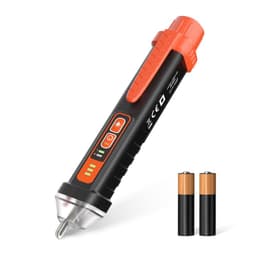
The Aicevoos A1 is £7.99, the lowest-priced dual-range pen in this set, with 4.6 from 1,726 amazon.co.uk reviews. It states 12–1000 V AC and 48–1000 V AC, a red or yellow lamp, a buzzer, a torch, auto-off at five minutes, and a class 2 laser under 1 mW. The listing says CE and double insulated, and it does not print CAT III or CAT IV. UK reviews use it on switches, sockets, and ceiling lights, and several say they would not spend more. One unit arrived with corroded AAA cells and worked after replacement. Another could not have its sensitivity reduced and alarmed on a phone from about 130–140 mm. A stabiliser review is filed on the ASIN and is not about the pen. In this set it is the best value when you want a loud dual-range pen and you can live without a printed measurement category, and the laser is a pointer, not a safer voltage test.
Pros
£7.99 with 4.6 from 1,726 reviews
Dual AC windows and an H/L key
Red or yellow lamp, a buzzer, and a torch
Auto-off stated at five minutes
Ranked 1 in Voltage Testers on this listing
Cons
No CAT III or CAT IV line, only CE
Corroded cells in one box
One unit stayed over-sensitive and alarmed on a phone
A stabiliser review is filed on this ASIN
Best for: You want a loud dual-range pen at the low end of this set for household sockets and flexes.
Less suitable: You need a printed CAT rating, or a pen that stays quiet beside a phone.
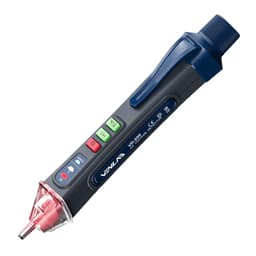
The YOWEXA YW-322 is £9.99 with 4.6 from 312 amazon.co.uk reviews. It states 12–1000 V and 48–1000 V, one to three LEDs, a variable buzzer, a torch in the tip, two AAA cells, a manual, and CE with CAT III 1000 V and CAT IV 600 V. UK reviews use the low setting to cut spurious alarms on 230 V sockets and switches. The same file says 12 V work is unreliable, that it is AC only and no use on a car, and that one test failed at 12–14 V while 240 V worked. One review calls mains detection inconsistent, with tracing up to about 470 mm off the cable. A tyre-inflator review sits on the ASIN and does not describe the pen. It suits a compact dual-range pen with cells already fitted. It is a weaker choice if the job is a vehicle loom.
Pros
4.6 from 312 reviews
Two modes, three LEDs, and a variable buzzer
Two AAA cells and a manual listed in the box
CAT III 1000 V and CAT IV 600 V claimed
Low sensitivity used in reviews to cut false alarms
Cons
12 V detection failed in a saved test while 240 V worked
Reviews say it is AC only and no use on a car
One review reports inconsistent 240 V tracing
A tyre-inflator review is filed on this ASIN
Best for: You want a compact dual-range pen for 230 V sockets and you will use the lower sensitivity.
Less suitable: You are buying it for a car, a camper DC loom, or cables buried in a wall.
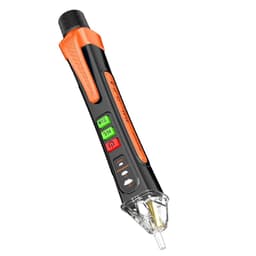
The Kaiweets listing at £10.99 is the largest review sample in this set, 4.5 from 16,240 amazon.co.uk ratings. The title says HT100 and the model field says HT101, part KW5023240. It states two AC windows, 12–1000 V and 48–1000 V, a buzzer, a torch, two AAA cells, and a screen that turns red above 90 V, with IEC CAT III 1000 V and CAT IV 600 V printed as a claim. UK reviews praise the beep on sockets and ceiling wiring, and the two sensitivity levels against pens that alarm on everything. The same file includes a unit that missed a live wire after working, a whole wall that read live, detection from about 150 mm, and harder readings on 12 V vehicle circuits than on 240 V mains. One review found no detection through armoured cable. In this set it is the top pick when you want a loud dual-range pen with a large review count. It does not prove a circuit dead.
Pros
4.5 from 16,240 ratings, the largest count in this set
Dual AC windows, 12–1000 V and 48–1000 V, with an S button
Buzzer, bar graph, and a screen that turns red above 90 V
Two AAA cells and a manual listed in the box
CAT III 1000 V and CAT IV 600 V claimed
Cons
Title says HT100 and the model number is HT101
UK reviews include hit-and-miss detection and a whole wall reading live
12 V vehicle readings were harder than 240 V mains in the saved reviews
No detection through armoured cable, in one review
Best for: You want a loud dual-range pen with the largest review count in this set for sockets, flexes, and ceiling wiring.
Less suitable: You need one model name on the box, a pen that stays quiet on a solid wall, or a tool that proves a circuit dead.
The VENLAB VD200 is £9.99 with 4.5 from 5,221 amazon.co.uk reviews, the second-largest count here. The listing states 12–1000 V AC and 48–1000 V AC, a red or orange lamp, a buzzer, a torch, two AAA cells, and IEC 61010-1 with CAT III 1000 V and CAT IV 600 V. UK reviews use it on old black wiring, light switches, and loft wires, and they like the loud beep. One first-time user did not learn from the instructions that red, not orange, is the live indication, and another unit arrived with flat cells. A review reports beeps where there was no socket and no red light. In this set it is a close alternative when you want the same class of dual-range claim at £9.99. It is still only a presence check.
Pros
4.5 from 5,221 reviews
Dual AC windows and an H/L button
Red or orange lamp, a buzzer, and a torch
Two AAA cells and a manual in the box
CAT III 1000 V and CAT IV 600 V claimed
Cons
One unit arrived with flat cells
Instructions did not explain red versus orange for a new user
Beeps with no red light, in one review
Buttons described as fiddly
Best for: You want a widely reviewed dual-range pen with batteries in the box and a colour plus beep alert.
Less suitable: You need the largest review sample, or you will treat an orange lamp as proof the wire is dead.
The Kioylmo pen is £7.99 with 4.5 from 15 amazon.co.uk ratings, and the file has four UK review blocks. It states 90–1000 V AC, dual sensitivity inside that window, red and blue LEDs, a buzzer, a torch, and a self-test claim. The bullets say 1000 V safety standards and do not name CAT III or CAT IV. One reviewer says there was no manual and they used a video. The other short comments call it accurate and good value, without a test method. Fifteen ratings and four texts are too thin to treat 4.5 as a settled record. There is no window below 90 V. It is a single-range option only if you accept that the evidence is a handful of reviews.
Pros
90–1000 V AC with a buzzer and two LED colours
Torch and a self-test claim
Listed at £7.99 and 20 g
Short UK comments call it easy
Cons
4.5 from only 15 ratings, with four UK texts
No CAT III or CAT IV identifier
No manual in one box
No range below 90 V
Best for: You want a light single-range pen with a beep and you can live with a thin review file.
Less suitable: You need a large sample, a printed CAT line, or a 12 V AC window.
The MUFASHA T-02a is £8.99 with 4.4 from 31 amazon.co.uk reviews, and the saved listing holds 13 UK review blocks. It states 12–1000 V AC and 48–1000 V AC, an H/L button, a red or orange lamp, a buzzer, a torch, a class 2 laser under 1 mW, and IEC 61010-1 with CAT III 1000 V and CAT IV 600 V. Reviews say batteries, including two AAA cells, were supplied, though the spec block does not list the cell type. Owners like the two ranges and a compact hook. The same small file calls the body flimsy for site use, questions the laser, and reports lights on wood, metal, and fabric during a 12 V camper try. Thirty-one ratings are not the sample behind the top pick. It is a dual-range option if you want a printed category line near £9 and you accept thin evidence.
Pros
Dual AC windows with an H/L button
CAT III 1000 V and CAT IV 600 V claimed
Torch, buzzer, and a pocket clip
Reviews say batteries were supplied
Cons
4.4 from only 31 reviews, with 13 UK blocks in the file
Feels flimsy for site use in those reviews
False alarms on wood, metal, and fabric in a camper test
Class 2 laser questioned as a safety extra
Best for: You want a dual-range pen with a CAT line printed and you can accept a small review count.
Less suitable: You need a large UK sample, or a pen for a camper DC circuit.
The BSIDE AVD06 is the dearest pen here at £13.99, with 4.3 from 213 amazon.co.uk reviews. It states 12–1000 V, eight LEDs in green, yellow, and red, auto or manual mode, and a torch. The spec block says CE and RoHS, does not print a CAT figure, and lists only the detector, while reviews say a 9 V cell is required and was not in the box. UK users like graduated lights for a ceiling and a simple check on sockets. The same file says it is too sensitive to separate several wires, that it could not tell live from neutral at a UK 3-pin socket, and that one unit found nothing on a 12 V car reversing-light circuit. It is the adjustable pen if you want a dial and you will buy the cell. It is a poor default if you expected batteries and a CAT line at the top of this price band.
Pros
Adjustable sensitivity plus auto and manual mode
Eight LEDs and a buzzer
4.3 from 213 reviews
Used in reviews for sockets, switches, and a cable break
Cons
Dearest listing here at £13.99, and the 9 V cell is not included
No CAT line, only CE and RoHS
Could not separate live and neutral at a UK 3-pin socket, in one review
No detection on a 12 V car circuit in one review
Best for: You want a sensitivity dial on a 12–1000 V pen and you will add a 9 V cell.
Less suitable: You want batteries in the box, a CAT mark, or a quiet pen among several cables.
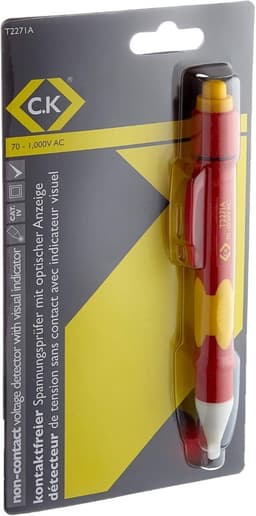
The C.K T2271A is £8.84 with 4.2 from 422 amazon.co.uk reviews, from Carl Kammerling. The spec line says 70–1000 V, a bright red LED, CAT IV 1000 V, CE, and double insulation. The bullets do not claim a buzzer, and UK reviews confirm there is no sound and that the lamp is hard to see in daylight. Reviews say it takes two AAA cells, which are not in the included-components line. Owners like the familiar name for a quick look at which side of twin and earth is line. The same UK blocks include broken tips and battery caps, buttons that failed, and units that stopped within days or a month. One review says it indicated on any object until it was switched off. It fits if you already know the C.K stick and you can see the lamp, and it is the wrong pen if you need a beep in a bright room.
Pros
Familiar C.K name, 4.2 from 422 reviews
70–1000 V and a CAT IV 1000 V claim
Pocket clip and a listed weight of 18.1 g
Used to see which side of twin and earth is line
Cons
No buzzer, and the lamp is hard to see in daylight
Tips, caps, and buttons break in the saved reviews
Two AAA cells are not listed in the box
Spec colour says black and the title says red
Best for: You want the known C.K stick for a visual check and you work where you can see a red LED.
Less suitable: You need a beep, a dual range, or a pen you will trust in daylight.
The Astraveo pen is £8.85 with 3.4 from five amazon.co.uk reviews, and the saved listing has three UK blocks, one of them Vine. It states 90–1000 V AC, an LED, a buzzer, adjustable sensitivity, and CE with CAT IV 1000 V. One reviewer says it matched a pen they had used for years. Another could not switch it on with several new batteries and binned it. A third reports too many false-negative readings, and the instructions were covered by a label. Five reviews, including a unit that would not start, are not a buying sample. The title says LED flashlight while the bullets describe indicator LEDs. Skip it if you need evidence the pen arrives working.
Pros
90–1000 V AC with an LED and a buzzer
CAT IV 1000 V and CE printed as a claim
Adjustable sensitivity in the bullets
One reviewer liked it against an older pen
Cons
3.4 from five reviews, the lowest scored line in this set
One unit would not turn on with new batteries
False-negative readings in the same small file
Instructions hidden by a label
Best for: You already accept a five-review listing and you only need a single 90–1000 V AC window.
Less suitable: You want a working unit on arrival, or any review sample above a handful.
The Yukesaky dyy816 is £5.99 and the listing has no Customer Reviews line, so the star rating is n/a. The bullets claim 90–1000 V AC, an LED, a buzzer, and a torch. The spec block has no CAT mark, no cell type, no dimensions, and no auto-off. Weight is 17 g and the rank shown is 129 in Voltage Testers. A question on the page about DC is unanswered. There is no UK review text to say whether the beep is loud, the cell arrives fitted, or the pen switches on. At this price it is a listing of claims. It is the pen to leave if you need any review evidence before you pay.
Pros
Lowest shelf price in this set at £5.99
Bullets claim 90–1000 V AC
LED, buzzer, and a torch are claimed
Listed weight 17 g
Cons
No Customer Reviews line and no UK review text
No CAT mark in the spec block
Cell type, dimensions, and auto-off are not stated
A DC question on the page is unanswered
Best for: You are comparing the cheapest single-range claim in this folder and you will not rely on reviews.
Less suitable: You want stars, a printed safety category, or any owner report that the pen works.
The question is on the page and is not answered. The bullets say 90 V to 1000 V AC.
What is the star rating?
There is no Customer Reviews line in the saved listing, so the rating is n/a.
Is a safety category printed?
No. The spec block has no CE or CAT line.
How we compared
Ten non-contact voltage tester listings on amazon.co.uk were scored from the listing text and the UK review notes already saved with each row. This is not a lab test, and a score does not mean a pen can prove a circuit dead. The working method is three blocks: Amazon stars at (stars ÷ 5) × 35, with no Customer Reviews line scoring 0; review count at log10 of the count × 6, capped at 25; and a presence-check kit capped at 25. The shelf price is not in the score. It decides the best value award only. Deductions apply for a thin review file, a unit that would not switch on or repeated false negatives in a sample of five, broken caps or buttons in a large UK file, a required cell missing from the box, a title that disagrees with the model number, a review of a different product on the ASIN, and flat or corroded cells. The three weights below are those blocks scaled from 35, 25 and 25 to 41, 29 and 30 so the figures on this page total 100.
1
Amazon stars
41%
In the method this block is (stars ÷ 5) × 35. A listing with no Customer Reviews line scores 0. The weight 41 is that 35-point block scaled so the three weights on this page total 100.
2
Review count
29%
In the method this block is log10 of the review count × 6, rounded half up and capped at 25. No reviews score 0. Fewer than 20 reviews deducts 8, and fewer than 6 deducts a further 6. The weight 29 is that 25-point cap scaled so the three weights total 100.
3
Presence-check kit
30%
In the method this block is capped at 25: 10 for a buzzer and a lamp, or 4 for a lamp only; 8 for a dual 12–1000 V and 48–1000 V AC window or an adjustable 12–1000 V window, or 4 for a single window from about 70–90 V; 5 for a CAT mark with a voltage beside it, 1 for an unnamed 1000 V safety line, or 0 for CE only or a blank; and 2 when the cells are named in the spec or the included-components line. The weight 30 is that 25-point cap scaled so the three weights total 100. Shelf price is not in the score.
Independent review
Last updated: October 2026
8 sources checked
Non-contact voltage tester buying guide
Start with the job the pen must not do, then the AC window, the alert, the sensitivity, the category line, and the cells. The notes below follow that order for these ten listings. None of the scores is a laboratory test.
What is a non-contact voltage tester?
A non-contact voltage tester, often called a volt stick, senses the electric field around an alternating-current conductor and shows it with a lamp, LEDs, or a buzzer. In the UK you buy one to see whether a flex, a socket face, or a switch still looks live, not to measure 230 V and not to prove a circuit dead. HSE guidance GS38 says these detectors should only identify live equipment. Proving dead needs a device that contacts the conductor, tested before and after.
Best for
A loud first look at a flex, a socket face, or a switch, when you will not treat silence as safe
A dual-range pen with a buzzer, used beside a two-pole tester that proves the circuit dead
A household 230 V AC check where you can lower the sensitivity among several cables
Not ideal for
Proving a circuit dead, or any job where you will touch copper
12 V DC in a car, a camper loom, or a circuit that is not AC
Anyone who reads a CAT line, a class 2 laser, or a star rating as a lab result
Mistakes to avoid
1
Treating silence as safe
GS38 says a voltage stick identifies live equipment and does not prove it dead. Silence is not a result until the pen has just alarmed on a known live socket. A flat cell is a common reason for a quiet pen.
2
Expecting DC from an AC window
A stated 12–1000 V AC range is an alternating-current claim. It is not evidence the pen will trace 12 V DC in a car or a camper. UK reviews in this set call that job unreliable.
3
Missing a lamp in daylight
A buzzer plus a lamp is easier to notice than a lamp alone. UK reviews of the C.K T2271A say there is no sound and that the red LED is hard to see in daylight.
What to weigh up
Job, window and alert
High
If you will touch copper or disconnect a fitting, isolate and use a two-pole tester or a GS38-style test lamp. The pen only supports treating the conductor as live. Dual-range listings here say 12–1000 V AC and 48–1000 V AC. Single-range listings say about 70–90 V to 1000 V AC. The 12 V figure is an AC claim, not a vehicle-loom tracer. A buzzer plus a lamp beats a lamp-only design. UK reviews of the C.K T2271A call that lamp faint in daylight.
Category, cells and reviews
Medium
Read the category and the voltage together. CAT III 1000 V and CAT IV 600 V is printed as a claim on YOWEXA, MUFASHA, Kaiweets, and VENLAB. An unnamed 1000 V safety line, or CE with no CAT figure, is a weaker statement. CAT II is socket outlets, CAT III is fixed distribution, and CAT IV is the meter and the service fuse. The mark was not verified here. Cells named in the spec or the included-components line matter because flat and corroded cells show up in UK reviews.
Which option suits you?
Three typical situations, each with a recommendation from this comparison.
🏠
A loud check on a flex or socket
You want a beep you can hear on a household flex, a socket face, or a switch, and you are not proving the circuit dead. The Aicevoos A1 is about £7.99, with 4.6 from 1,726 reviews, dual AC windows, a lamp, and a buzzer. The listing does not print a CAT line.
You already keep a contact tester for proving dead, and you want the pen only as a first look at sockets, flexes, and ceiling wiring. The Kaiweets listing is about £10.99, 4.5 from 16,240 ratings, with two AAA cells named in the box and a CAT line claimed. The title says HT100 and the model field says HT101.
You hoped to trace 12 V in a car, a camper, or a doorbell. These pens sense an alternating-current field. The YOWEXA YW-322 states a 12–1000 V AC window and UK reviews say it is AC only and no use on a car. Read that limit before you buy. It does not detect 12 V DC.
Common questions about non-contact voltage testers
What is a non-contact voltage tester?
A non-contact voltage tester, often called a volt stick, senses the electric field around an alternating-current conductor and shows it with a lamp, LEDs, or a buzzer. In the UK you use one to see whether a flex, a socket face, or a switch still looks live. It does not measure 230 V. UK mains are nominally 230 V AC at 50 Hz, with BS 1363 plugs. HSE guidance GS38 says these detectors should only identify live equipment.
Can a non-contact voltage tester prove a circuit is dead?
No. GS38 says voltage sticks identify live equipment and do not prove it dead. After isolation, HSG85 says you prove dead with a two-pole detector, a test lamp, or a fused voltmeter, and you prove that instrument before and after. Electrical Safety First does not advise a non-contact indicator for that job. Silence is not a result until the pen has just alarmed on a known live socket. How the two tools differ is in non-contact testers and two-pole testers.
What voltage window should you look for?
Dual-range listings in this comparison state 12–1000 V AC and 48–1000 V AC. Single-range listings state about 70–90 V to 1000 V AC. The 12 V figure is an alternating-current claim, not a 12 V DC tracer for a car or a camper. A control you can turn down matters when several cables would otherwise read as one live mass. A buzzer plus a lamp is easier to notice in daylight than a lamp on its own.
Which non-contact voltage tester is the top pick in this set?
The top pick is the Kaiweets pen at about £10.99. The title says HT100 and the model field says HT101. It states two AC windows, a buzzer, a torch, two AAA cells, and a screen that turns red above 90 V, with CAT III 1000 V and CAT IV 600 V claimed. The star line is 4.5 from 16,240 amazon.co.uk ratings, the largest count in this set. UK reviews also include missed live wires. The score is not a lab test, and the pen does not prove a circuit dead.
Which non-contact voltage tester is the best value?
The best value is the Aicevoos A1 at about £7.99, with 4.6 from 1,726 amazon.co.uk reviews. It states 12–1000 V AC and 48–1000 V AC, a lamp, a buzzer, and a torch. The page says CE and does not print CAT III or CAT IV. The award is features per pound among pens with a usable review sample. VENLAB and YOWEXA score higher because they print a category and name the cells. A cheaper pen with no review line does not take this award.
Will a 12–1000 V AC pen work on a car?
No. These pens sense an alternating-current field. A 12–1000 V AC window is not a 12 V DC tracer for a vehicle loom. UK reviews saved with these listings call 12 V work unreliable, including a note that one pen is AC only and no use on a car, and a camper try that alarmed on wood, metal, and fabric. A class 2 laser under 1 mW on some pens is a pointer, not part of the voltage test. Use a known-live 230 V socket for the check these listings describe.
What does a CAT mark mean on these pens?
CAT II, CAT III, and CAT IV are measurement categories in the BS EN 61010-1 family, and each needs a voltage beside it. CAT II is socket outlets, CAT III is fixed distribution, and CAT IV is the meter and the service fuse. On these listings the line is a claim, not a lab check, and UKCA is not established here. Some pages only say CE. A printed category does not mean the pen can prove a circuit dead.
When should you call a competent person?
Call a competent person for a consumer unit, a new circuit, or notifiable bathroom or shower work where you live, if you cannot find the isolation point, if the pen still alarms with the breaker off, or before you cut a cable you cannot see both ends of. Part P and competent-person schemes are England and Wales, not Scotland or Northern Ireland, and owning a pen does not authorise that work. A wiring check at a socket is a different job from a presence beep. See the socket tester comparison for that.
Our verdict
In this set of ten amazon.co.uk listings, the top pick is the Kaiweets pen at about £10.99, titled HT100 with model number HT101. It has 4.5 from 16,240 ratings, two AAA cells in the box, dual AC windows, and a claimed CAT III 1000 V and CAT IV 600 V line. The best value is the Aicevoos A1 at about £7.99, 4.6 from 1,726 reviews, with dual AC windows, a buzzer, and a torch, and no CAT line. VENLAB and YOWEXA score higher than the Aicevoos because they print a category and name the cells. The Yukesaky pen at about £5.99 is cheaper and has no review line, so it does not take the best value award. None of these scores is a lab test, and none of these pens proves a circuit dead.
About £7.99, 4.6 from 1,726 reviews, dual AC windows, a buzzer, and a torch. Features per pound among pens with a usable review sample, not the second-highest score.
Non-contact voltage testersDIY electrical checksamazon.co.uk listings
Peter F. is the editor for DIY & tools at productscompared.co.uk. Comparisons in this category are checked against amazon.co.uk listings, review evidence and public UK sources.
Updated: October 2026
8 sources checked
Guides to non-contact voltage testers
Guides on what to look for, how to use a product, and common mistakes.
Public UK sources from the research digest, last checked on 21 October 2026. Shelf prices and star lines are the amazon.co.uk figures captured with these ten listings. The price bands are this set, not a market average.
This page contains affiliate links to amazon.co.uk. If you buy through them, we may earn a commission at no extra cost to you. Prices, stars and review counts are from the UK listings checked for this comparison. We did not lab-test these non-contact voltage testers.