
Independent comparisons. We may earn from shop links. More info

Measurement microphone comparison 2026

The best measurement microphones, compared.

Top pick: Behringer ECM8000 Best value: Behringer ECM8000 – Lowest price that still scores at least 75 with at least 200 reviews: about £16.90, phantom stated, generic file only. Updated October 2026.

Peter F.
Peter F.Editor

A measurement microphone is a small omnidirectional electret or pre-polarised condenser, often about 6 mm, sold to report a sound field for room correction, a real-time analyser, or a processor that expects a measurement input. It is a poor substitute for a Class 2 sound level meter when the job is a noise-at-work assessment. You choose by the host you already own: a laptop with no interface, an interface that can supply phantom power, or a phone that still has a headset jack. You tell a suitable one by the connector, the power the listing states, and whether the calibration path is an individual file or only a generic curve. A printed frequency range is not a flatness claim. A file lists frequency offsets, sometimes plus a sensitivity figure, and it is not an acoustic calibrator. Those checks are in the [measurement microphone buying guide](/hub/measuring-equipment/measurement-microphone/sub/measurement-microphone-buying-guide). Point the capsule at the speaker with a 0-degree file, or at the ceiling at ear height with a 90-degree file. A windscreen only stops air across the capsule.

A measurement microphone is a small omnidirectional electret or pre-polarised condenser, often about 6 mm, sold to report a sound field for room correction, a real-time analyser, or a processor that expects a measurement input.

Behringer ECM8000

Best overall

Behringer ECM8000
8.2/10∼ £17

32 products checked · 58 hrs invested · +22,400 readers

9 of 9: Best measurement microphones compared

Swipe for more

1-2 of 9
Best overall
Behringer ECM8000
miniDSP UMIK-1
dbx RTA-M
Dayton Audio iMM-6
Dayton Audio EMM-6
PreSonus PRM1
Superlux ECM999U
beyerdynamic MM 1
Audix TM1
8.2/10
9.1/10
6.5/10
8.5/10
7.6/10
5.4/10
4.9/10
5.5/10
4.2/10
∼ £17
∼ £120
∼ £106
∼ £42
∼ £85
∼ £55
∼ £76
∼ £219
∼ £249
4.6(1,700)
4.6(1,334)
4.6(298)
4.5(1,142)
4.5(358)
4.4(80)
4.2(32)
4.2(12)
4.1(17)
View offer
View offer
View offer
View offer
View offer
View offer
View offer
View offer
View offer

Personal buying guide

Question 1 of 2

What will you plug the microphone into?

The best measurement microphones in detail

Behringer ECM8000

Rank 1

Behringer ECM8000

∼£17

Our view

The Behringer ECM8000 is an XLR condenser at £16.90, and the amazon.co.uk line is 4.6 from 1,700 reviews, with 32 United Kingdom texts in the sample. UK buyers use it for room frequency checks, studio treatment, speaker testing, and a church-hall PA on a Behringer DEQ2496, and one buyer compared two units and reported agreement within about 0.5 dB up to 10 kHz. That 0.5 dB note is one comparison, not a certificate, and the listing's 20 Hz to 20 kHz line is a stated range rather than a flatness claim. A UK review marks the microphone down because only a generic calibration file is available for Windows apps, and another buyer kept it for time alignment rather than trusting a room response. The listing states phantom power from +15 V to +48 V and does not name a battery, so a laptop headphone socket is not the host the bullets describe. Delivery notes disagree: one UK buyer received a case, a clip, and an adapter, and another said the clip was missing. It is the low shelf price in this set when you already have phantom power and will accept a generic curve.

Pros

  • £16.90 with 4.6 from 1,700 amazon.co.uk reviews
  • Listing states phantom power from +15 V to +48 V
  • UK reviews cover room checks, speaker tests, and a DEQ2496
  • Two units agreed within about 0.5 dB up to 10 kHz in one UK comparison

Cons

  • No individual calibration file; a UK review found only a generic file
  • Needs an interface or mixer that can supply phantom power
  • One UK buyer reported a missing clip
  • The listing does not make the computer-interface requirement obvious

Best for: Someone who already owns phantom power and wants a cheap omnidirectional capsule for a rough room or PA check.

Less suitable: A laptop with no interface, or any job where the individual curve has to be in the file.

Specifications

Model
Behringer ECM8000
Brand
Behringer
Price
∼£17
Customer rating
4.6/5(1,700)
Connector
XLR
Phantom
+15 V to +48 V
Calibration
Generic file
Frequency
20 Hz–20 kHz
Host
Interface
UK texts
32 of 50

Common questions

Does the ECM8000 need a battery?

The listing asks and the bullets do not name a battery. They state phantom power from +15 V to +48 V.

Is there an individual calibration file?

Not in the bullets. A UK review says only a generic calibration file is available for Windows apps.

What pattern do the bullets state?

Omnidirectional. The listing form-factor line says boundary and gooseneck, which does not match that pattern description.

miniDSP UMIK-1

Rank 2

miniDSP UMIK-1

∼£120

Our view

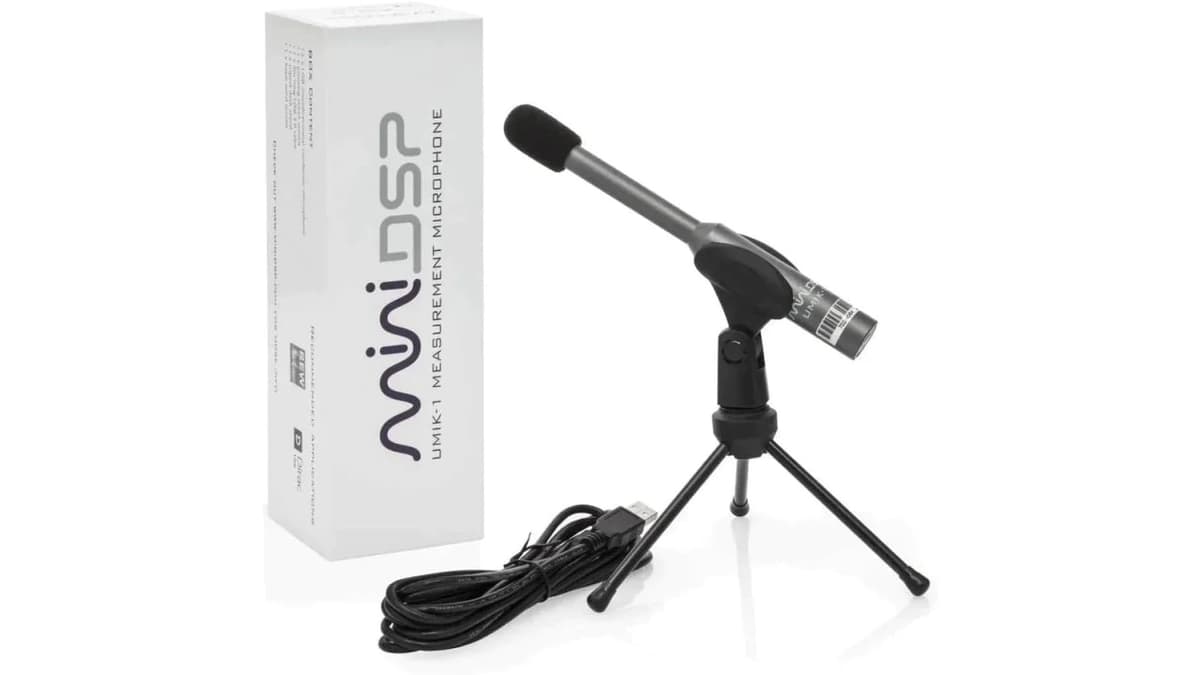
The miniDSP UMIK-1 is a USB measurement microphone at £120, and the amazon.co.uk line is 4.6 from 1,334 reviews, with 29 United Kingdom texts in the raw sample. UK buyers use it for room correction in REW, Dirac Live, and DSP or Wiim setups, and one 2026 review describes an RTA and SPL check as straightforward once the serial file is loaded. The bullets name a unique calibration file with a sensitivity figure, plus a mini tripod, a windscreen, and a padded case, and they describe the microphone as driverless USB rather than phantom-powered. One UK buyer swapped the supplied lead for a 2 m USB-C cable because the one in the box is short, and another returned the unit because the computer setup felt too involved next to the microphone that came with the receiver. The listing frequency is 20 Hz to 20 kHz, while a UK review says the box prints 8 Hz to 20 kHz. The attribute table also says one lithium-ion battery is required, which the bullets never describe. It is the strongest laptop path in this set when you want the file and the USB plug together, and a poor fit if you need a second electrical channel on the same converter.

Pros

  • Unique calibration file by serial number, with a sensitivity figure in the bullets
  • USB plug and play in the bullets, so no phantom supply is named
  • 4.6 from 1,334 amazon.co.uk reviews, 29 of them United Kingdom texts in the sample
  • Mini tripod, windscreen, and padded case in the box
  • Bullets name Dirac Live, REW, and Smaart

Cons

  • Supplied USB cable is short, in UK reviews
  • One UK buyer returned it because the software path was too involved
  • Listing says 20 Hz to 20 kHz; a UK review says the box prints 8 Hz to 20 kHz
  • Attribute table says a lithium-ion battery is required; the bullets do not

Best for: A laptop or Mac used for one listening seat in REW or Dirac, when you do not already own an audio interface.

Less suitable: Two-channel transfer-function work, a dbx DriveRack, or a phone that has no computer.

Specifications

Model
miniDSP UMIK-1
Brand
miniDSP
Price
∼£120
Customer rating
4.6/5(1,334)
Connector
USB
Phantom
Not required
Calibration
Serial file
Frequency
20 Hz–20 kHz
Host
REW, Dirac
Case
Padded case
Stand
Mini tripod
Weight
120 g
UK texts
29 of 50

Common questions

Does the UMIK-1 need phantom power?

The bullets describe USB plug and play and do not name phantom power. The same attribute table says one lithium-ion battery is required, which the bullets do not explain.

Which software do the bullets name?

Dirac Live, REW, Smaart, and other acoustic software. A UK review also used it with an Arcam AVR running Dirac.

Is a case in the box?

The listing includes a mini tripod, a USB cable, and a windscreen in a padded transport case. UK reviews say the supplied cable is short.

dbx RTA-M

Rank 3

dbx RTA-M

∼£106

Our view

The dbx RTA-M is sold as the omnidirectional microphone for the DriveRack series at £105.75, and the amazon.co.uk line is 4.6 from 298 reviews. Three United Kingdom texts sit in the raw sample, and one of them is an off-topic prompt rather than a product comment. The UK lines that do address the microphone say it works with a DriveRack PA2. The listing states DC 9 V to 52 V, an XLR connector, and no cable in the box, with a clip and a case. A reviewer used one with an iPad RTA app and a Focusrite interface when no DriveRack was in the system, after a comparison against a Brüel & Kjær omnidirectional microphone. Other texts describe crackling or popping after a minute or two, a unit that failed after a week, and a microphone that arrived noisy on cables that were quiet with other capsules. No individual calibration file is stated. It is the row for a DriveRack, and a weak default if you wanted a calibrated USB microphone for a laptop.

Pros

  • Listing names the DriveRack series and states DC 9 V to 52 V
  • 4.6 from 298 amazon.co.uk reviews
  • UK reviews that discuss the product say it works with a DriveRack PA2
  • Clip and case in the box contents

Cons

  • No cable in the box
  • No individual calibration file is stated
  • Crackling, popping, and noisy arrivals in the review sample
  • Only three United Kingdom texts, and one of those is off-topic

Best for: A dbx DriveRack owner who wants the microphone the listing names for that processor.

Less suitable: A laptop measurement with no DriveRack, or anyone who needs an individual calibration file in the box.

Specifications

Model
dbx RTA-M
Brand
dbx
Price
∼£106
Customer rating
4.6/5(298)
Connector
XLR
Phantom
9 V to 52 V
Calibration
Not stated
Frequency
20 Hz–20 kHz
Host
DriveRack
Case
Case, no cable
Stand
Clip
UK texts
3 of 50

Common questions

Is a cable included?

No. The listing says the cable is not included. Box contents name a clip and a case.

Which processor do the bullets name?

The DriveRack series. UK reviews mention a DriveRack PA2. Recording use is asked in the FAQ and not answered in the bullets.

What voltage does the listing state?

Operating voltage DC 9 V to 52 V. That is the phantom range printed on this amazon.co.uk page.

Dayton Audio iMM-6

Rank 4

Dayton Audio iMM-6

∼£42

Our view

The Dayton Audio iMM-6 is a small omnidirectional capsule on a 3.5 mm TRRS plug at £42.12, and the amazon.co.uk line is 4.5 from 1,142 reviews, with 21 United Kingdom texts in the sample. UK buyers use it for room-correction measurements and car-audio EQ on an iPad with AudioTools, or on an Android phone once the Dayton file is loaded. The title says calibrated, but the bullets do not describe that file, so the download step comes from the reviews rather than the specification table. A 2026 UK review used an older handset because the current phone is USB-C and has no analogue jack. The listing asks whether a laptop will work and the bullets do not answer yes. One unit arrived damaged and was returned before it could be tested. The frequency-response attribute stops at 18 kHz and the bullets do not state a low-frequency limit. It belongs with a phone or tablet that still has a headset jack, and it does not replace a USB microphone on a jack-less laptop.

Pros

  • 3.5 mm TRRS plug, powered from the headset jack, with a headphone pass-through
  • 4.5 from 1,142 amazon.co.uk reviews, 21 of them United Kingdom texts in the sample
  • UK reviews describe a unique Dayton calibration file loaded into the app
  • Kickstand that elevates and angles the phone and the capsule

Cons

  • Needs a 3.5 mm headset jack; a USB-C phone was the reason one UK buyer used an old handset
  • The bullets do not describe the calibration file the title implies
  • Laptop use is asked on the listing and not answered in the bullets
  • One unit arrived damaged and was returned untested

Best for: A phone or tablet that still has a 3.5 mm TRRS headset jack, for room or car measurements in an app.

Less suitable: A current USB-C phone with no analogue jack, or a laptop you expected to plug this into.

Specifications

Model
Dayton Audio iMM-6
Brand
Dayton Audio
Price
∼£42
Customer rating
4.5/5(1,142)
Connector
3.5 mm TRRS
Phantom
Headset jack
Calibration
In reviews
Frequency
Up to 18 kHz
Host
TRRS phone
Stand
Kickstand
Weight
100 g
UK texts
21 of 50

Common questions

Will the iMM-6 work on Android?

The listing says yes for Android devices that still have a TRRS headset jack. A 2026 UK review used an older phone because the current handset is USB-C.

Can I use it with a laptop?

The listing asks that question and the bullets do not say yes. Treat a laptop as unanswered on this page.

Is there a kickstand?

Yes. The box description includes a kickstand that elevates and angles the device and the capsule, plus a headphone or line-out pass-through.

Dayton Audio EMM-6

Rank 5

Dayton Audio EMM-6

∼£85

Our view

The Dayton Audio EMM-6 is an XLR electret at £84.68, with 4.5 from 358 reviews and two United Kingdom texts in the sample. A UK review describes a boxed individual calibration graph and a serial-number download, and says the microphone compared well with others nearly five times the price. Another UK buyer returned it because the file showed deviations of 2 to 3 dB where a flat line was expected. The printed curve is the correction, and other reviewers were surprised it was not flat. The amazon.co.uk bullets do not state a phantom voltage, so you cannot read +15 V to +48 V off this listing. Self-noise is called very high in one review and able to disturb a control-room measurement. A dented XLR opening stopped the plug connecting, and that buyer would not trust the calibration afterwards. The case, the clip, and the calibration paper are the concrete extras in the box. It is the XLR row to open when you already have phantom power and you want the graph the ECM8000 does not include.

Pros

  • Individual calibration response graph in the box, plus a serial download in a UK review
  • Stand mount, foam windscreen, and transport case
  • 4.5 from 358 amazon.co.uk reviews
  • A UK review compared it with microphones nearly five times the price

Cons

  • Phantom voltage is not stated on the amazon.co.uk bullets
  • One UK buyer returned it because the calibration curve was not a flat line
  • Self-noise called high enough to disturb a control-room measurement
  • A dented XLR opening stopped the plug connecting

Best for: An interface that already supplies phantom power, when you want Dayton's individual graph rather than a generic curve.

Less suitable: A buyer who expects the printed response to be a flat line, or a laptop with no XLR interface.

Specifications

Model
Dayton Audio EMM-6
Brand
Dayton Audio
Price
∼£85
Customer rating
4.5/5(358)
Connector
XLR
Calibration
Individual graph
Frequency
Up to 20 kHz
Host
Interface
Case
Transport case
Stand
Stand mount
Weight
454 g
UK texts
2 of 50

Common questions

Is the calibration file individual?

The bullets include a unique calibration response graph. A UK review also describes online access by serial number.

Does the listing state phantom voltage?

No. The amazon.co.uk bullets leave phantom voltage unstated. A maker sheet is a separate claim.

What is in the case?

A stand mount, a foam windscreen, a transport case, and the calibration graph. The box-contents attribute also names a warranty card.

PreSonus PRM1

Rank 6

PreSonus PRM1

∼£55

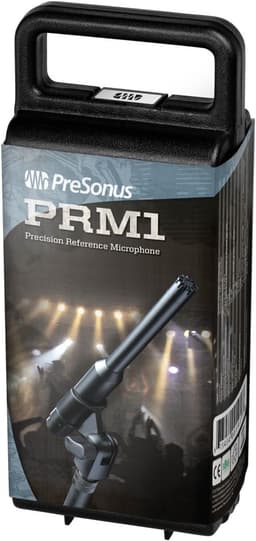
Our view

The PreSonus PRM1 is a 1/4-inch XLR electret at £55, and the amazon.co.uk line is 4.4 from 80 reviews, with one United Kingdom text in a sample of 13. That UK line says it works well with a PA2. The box includes a clip, a foam windscreen, and a hard case, and the listing calls the response linear from 20 Hz to 20 kHz and names room correction, speaker calibration, and PreSonus StudioLive mixers with Smaart. A review states that a calibration file is not included, and treats that absence as the reason for the price. Phantom voltage is not stated in the bullets. The weight attribute prints 0.45 g, which is not a believable microphone mass, so treat that cell as a bad listing figure. One buyer disliked the quality and was disputing a refund. It sits between the ECM8000 and the EMM-6 on price, with a case and without an individual file.

Pros

  • Clip, foam windscreen, and hard case in the box
  • Listing says linear from 20 Hz to 20 kHz and names REW and StudioLive with Smaart
  • The only UK review says it works well with a PA2
  • 2 year manufacturer warranty on the listing

Cons

  • A review says no calibration file is included
  • Phantom voltage is not stated in the bullets
  • Listing weight of 0.45 g is not a usable mass
  • One United Kingdom text, plus a refund dispute in the wider sample

Best for: A PreSonus StudioLive or a PA measurement where a hard case matters more than an individual file.

Less suitable: A buyer who needs the calibration curve in the box, or who is choosing from the UK review count alone.

Specifications

Model
PreSonus PRM1
Brand
PreSonus
Price
∼£55
Customer rating
4.4/5(80)
Connector
XLR
Calibration
No file
Frequency
20 Hz–20 kHz
Host
StudioLive
Case
Hard case
Stand
Clip
UK texts
1 of 13

Common questions

Does the PRM1 include a calibration file?

Not in the bullets. A review says the microphone does not include a calibration file, and gives that as the reason for the price.

What comes in the box?

A clip, a foam windscreen, and a hard case.

Which mixers do the bullets recommend?

PreSonus StudioLive mixers and VSL with Smaart. The only UK review mentions a PA2.

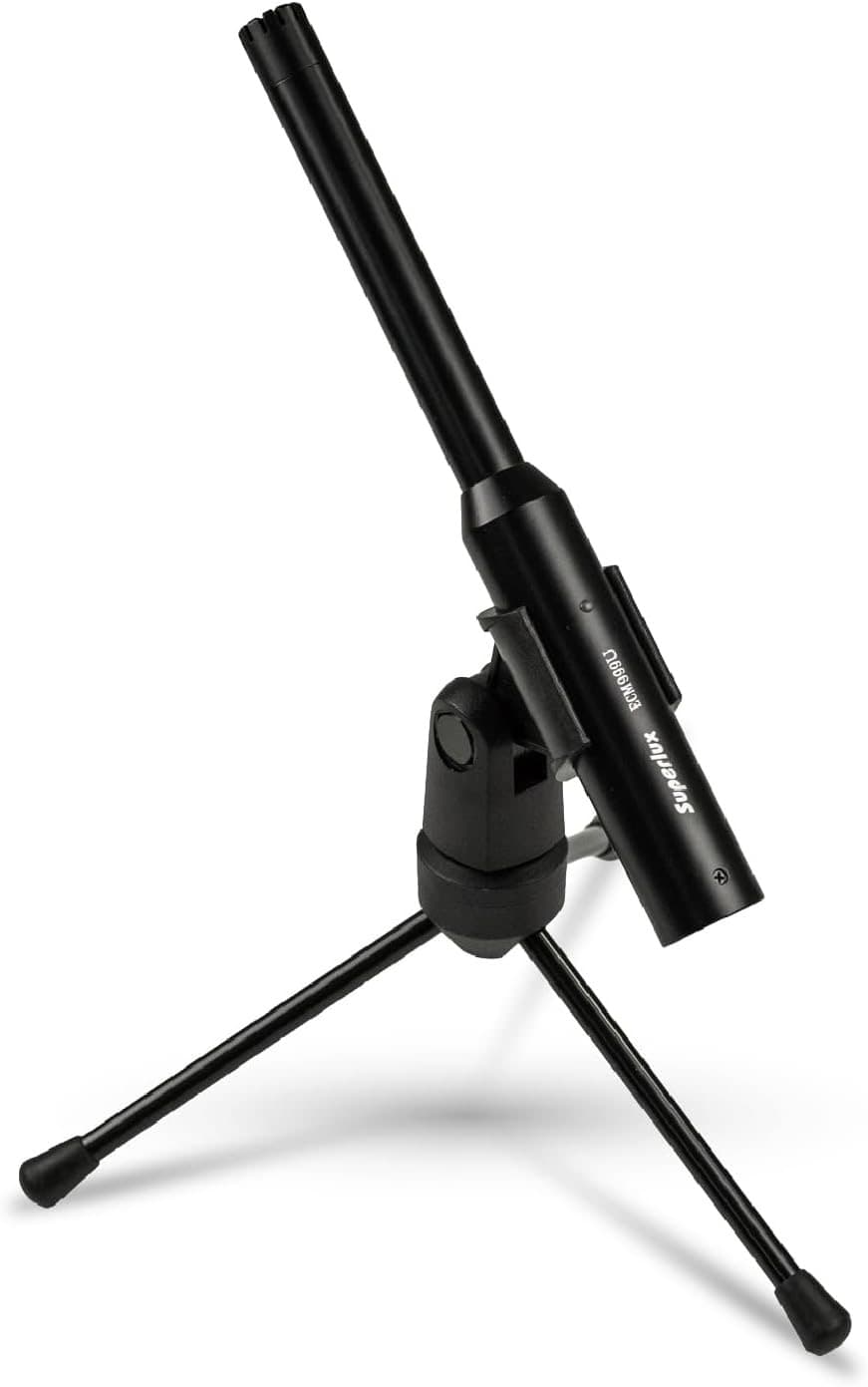
Superlux ECM999U

Rank 7

Superlux ECM999U

∼£76

Our view

The Superlux ECM999U is a USB-C measurement microphone at £76, and the amazon.co.uk line is 4.2 from 32 reviews. None of the 28 review texts in the saved listing are from the United Kingdom, so the comments that follow are United States texts rather than a UK sample. The bullets state 10 Hz to 20 kHz, 24-bit/48 kHz, a 133 dB maximum SPL, a 1/4-inch capsule, and a 2 m USB cable, and they say phantom power and an external interface are not required. Reviewers used it with REW and for a desktop monitor tune, and one called a side-by-side with a dearer reference very close. The same file includes a return because the calibration QR or link did not work and Amazon support did not produce the file. A taller stand than the included table stand is wanted in one review. Superlux calls the capsule free-field, which stays a maker claim on a thin, non-UK review set. It is a USB-C alternative only when the calibration slip on the outer packaging actually yields a file.

Pros

  • USB-C, 24-bit/48 kHz, with phantom and an interface both described as unnecessary
  • Bullets state 10 Hz to 20 kHz and 133 dB maximum SPL
  • 2 m USB cable, HM10S clip, DS01 table stand, windscreen, and a soft case
  • US reviews mention REW and a desktop monitor tune

Cons

  • No United Kingdom review text in the saved listing
  • A US review returned the unit because the calibration link did not work
  • 4.2 from 32 reviews
  • The included table stand is too short for some placements, in one review

Best for: A Windows 10, Windows 11, or Mac laptop when you specifically need USB-C and the calibration slip works.

Less suitable: Anyone judging it from UK reviews, because this saved listing has none, or a two-channel measurement.

Specifications

Model
Superlux ECM999U
Brand
Superlux
Price
∼£76
Customer rating
4.2/5(32)
Connector
USB-C
Phantom
Not required
Calibration
File claimed
Frequency
10 Hz–20 kHz
Host
Windows, Mac
Case
Soft case
Stand
Table stand
Weight
499 g
UK texts
0 of 28

Common questions

Does the ECM999U need an audio interface?

The bullets say it removes the need for phantom power and for an external audio interface. Systems named are Windows 10, Windows 11, and Mac.

Where is the calibration file?

The listing says details are on a slip on the outer packaging, and to contact the seller if it is missing. A US review says the promised link did not work.

Are there UK reviews in this file?

No. The raw sample has 28 texts and none are marked United Kingdom. The 4.2 from 32 is the listing line, not a UK write-up.

beyerdynamic MM 1

Rank 8

beyerdynamic MM 1

∼£219

Our view

The beyerdynamic MM 1 is an omnidirectional condenser at £219, and the amazon.co.uk line is 4.2 from 12 reviews, with one United Kingdom text among three in the saved listing. The listing says it is linear at 90 degrees and diffuse-field calibrated, with a tolerance of ± 1.5 dB between 50 Hz and 16 kHz, and the box includes a clamp, a hard case, and an individual measuring note. The UK review used it for room calibration and monitor alignment, and says further calibration files arrived by email after a request rather than as a download in the carton. Phantom voltage is not stated on the amazon.co.uk bullets. The frequency-response attribute stops at 16 kHz, a narrower printed band than the 20 kHz lines on cheaper rows. Two of the three texts are short praise from outside the UK, so the complaint list is thin. It is a stated-tolerance XLR microphone when you will wait for the emailed files, and it is not a large-sample UK pick.

Pros

  • Listing states ± 1.5 dB from 50 Hz to 16 kHz, linear at 90 degrees
  • Individual measuring note, MA-CL 21 clamp, and a hard case
  • UK review: calibration files were emailed after a request
  • 2 year warranty on the listing

Cons

  • Further calibration files are not a download in the box; the UK review waited for email
  • Phantom voltage is not stated on the amazon.co.uk bullets
  • 4.2 from only 12 reviews, with one United Kingdom text
  • Printed band on the attribute line stops at 16 kHz

Best for: A home studio that wants the stated 90-degree tolerance and will request the files.

Less suitable: Anyone who wants a large UK review sample, or a file they can download before the first sweep.

Specifications

Model
beyerdynamic MM 1
Brand
beyerdynamic
Price
∼£219
Customer rating
4.2/5(12)
Connector
XLR
Calibration
Measuring note
Frequency
50 Hz–16 kHz
Host
Interface
Case
Hard case
Stand
Clamp
UK texts
1 of 3

Common questions

Where is the calibration file?

The box includes an individual measuring note. A UK review says the 0-degree and 90-degree files have to be requested and are emailed.

What tolerance does the listing print?

± 1.5 dB between 50 Hz and 16 kHz, described as linear at 90 degrees and diffuse-field calibrated.

What clamp is in the box?

The MA-CL 21 clamp, with a 3/8 inch internal thread and a 21 mm inner diameter, plus a hard case.

Audix TM1

Rank 9

Audix TM1

∼£249

Our view

The Audix TM1 is a 6 mm omnidirectional condenser at £249, and the amazon.co.uk line is 4.1 from 17 reviews. None of the four review texts in the saved listing are from the United Kingdom. A 2025 US review praises the build and the accuracy, and another says a later TM1 had less low-end roll-off than an earlier Audix reference microphone. One unit arrived defective and was replaced by Audix, with a windshield sent as a gift. The bullets describe a linear 20 Hz to 20 kHz response and do not name a calibration file or a case. Phantom voltage is not stated on the listing. The item-type attribute says dynamic microphone while the bullets say condenser, and the country-of-origin attribute says China while the bullets say the microphone is machined and tested in the United States. At the highest price in this set, both the file and the UK sample are missing.

Pros

  • Bullets describe a 6 mm omnidirectional condenser for room analysis, RTA, and SPL work
  • A US review says a defective unit was replaced by Audix
  • Listed weight 231 g, nickel finish, brass in the material line

Cons

  • No calibration file is named, at £249
  • No United Kingdom review text in the saved listing
  • Phantom voltage is not stated on the listing
  • Item type says dynamic, and origin says China, against the condenser and US-build bullets

Best for: An engineer who already knows the TM1 and is replacing a unit, with the maker's own phantom figure checked off this listing.

Less suitable: A first measurement microphone chosen because it is the dearest row, or a buyer who needs UK reviews and a file in the box.

Specifications

Model
Audix TM1
Brand
Audix
Price
∼£249
Customer rating
4.1/5(17)
Connector
XLR
Calibration
Not stated
Frequency
20 Hz–20 kHz
Host
Room analysis
Weight
231 g
UK texts
0 of 4

Common questions

Is the TM1 omnidirectional?

The bullets say omnidirectional. The item-type attribute says dynamic microphone, which contradicts the condenser description.

Does it come with a case?

The listing FAQ asks and the bullets do not answer. A US review of a replacement mentions a windshield sent as a gift, not a case in the box.

Is a calibration file named?

No. The title and bullets say accurate measurement and SPL, and they do not name a file.

How we compared

Nine measurement-microphone listings on amazon.co.uk were scored on 21 October 2026 from the listing and the review notes. This is not a laboratory test, and a capsule is not scored as a Class 1 or Class 2 sound level meter. Listing cells that describe the wrong object stay in the notes and do not add points. Amazon evidence, calibration and host, the United Kingdom review pattern, and value are weighted 40, 30, 20 and 10. The top pick is the highest score. If two scores tie, the higher amazon.co.uk review count takes that place. Best value is the lowest price among microphones that score at least 75, have at least 200 reviews, and are not the top pick.

1

Amazon evidence

40%

Up to 40 points from the amazon.co.uk star average and how many reviews sit behind it. A count of at least 1,000 scores higher than a count under 15. The block is capped at 40. Stars are not a calibration.

2

Calibration and host

30%

Up to 30 points for the connector and the calibration path the listing actually prints. A unique file on USB scores higher than an individual graph, a file that appears only in reviews, a measuring note, a stated phantom range with no individual file, a USB-C file claim, a review that says no file, or no file and no United Kingdom text.

3

Review pattern

20%

Up to 20 points from how many United Kingdom review texts are in the raw sample. At least 20 UK texts scores higher than two, one, or none. A large non-UK sample does not fill that gap.

4

Value

10%

Up to 10 points for the shelf price against review volume. The lowest price with at least 1,000 reviews scores highest on this block. A dearer microphone with an individual file and a large count can still score. The block does not treat a generic curve as the same thing as an individual file.

Independent review
Last updated: October 2026
8 sources checked

Measurement microphone buying guide

Start with the connector, then the power the listing states, then whether the file is individual or generic. The notes below follow that order for these nine listings. None of the scores is a laboratory test.

What is a measurement microphone?

A measurement microphone in this comparison is a small omnidirectional electret or pre-polarised condenser, usually about 6 mm, sold to report a sound field. UK buyers use that reading for room correction, a real-time analyser, a processor that expects a measurement input, or a phone app. It is a poor substitute for a Class 2 sound level meter when the job is a noise-at-work assessment.

Best for

  • One listening seat on a laptop, when you do not already own an audio interface
  • An interface that already supplies phantom, when a generic curve is acceptable
  • A phone or tablet that still has a 3.5 mm TRRS headset jack

Not ideal for

  • A noise-at-work exposure, a planning condition, or a neighbour complaint
  • A two-channel transfer-function measurement on a USB capsule
  • A USB-C phone with no analogue headset jack

Mistakes to avoid

  1. 1

    Plugging an XLR capsule into a headphone socket

    The ECM8000 listing states phantom power from +15 V to +48 V and does not name a battery. A laptop headphone socket is not that supply. USB and USB-C rows are the ones that carry the converter.

  2. 2

    Loading the wrong aim file

    Use a 0-degree file with the capsule pointed at the speaker, and a 90-degree file with the capsule pointed at the ceiling, at ear height. The two files are not interchangeable.

  3. 3

    Treating a wiggly graph as a fault

    An individual response graph is the correction. One UK buyer returned an EMM-6 because the file was not a flat line. A flat line is not what that graph is for.

What to weigh up

Connection and power

High

The first split is the host you already own. USB and USB-C measurement microphones carry the preamp and the converter. The bullets that describe them do not ask for phantom power, and they cannot be one channel of a two-channel transfer-function measurement, because the converter is inside the capsule. A 3.5 mm TRRS plug is neither of those. It takes power from a headset jack and usually offers a headphone pass-through. It belongs on a phone or tablet that still has that jack.

Calibration file and what you will not measure

Medium

A calibration file is a list of frequency offsets, sometimes plus a sensitivity number. It is not an acoustic calibrator, and it does not make the capsule an integrating sound level meter. The UMIK-1 listing ties a unique file, including sensitivity, to the serial number. The EMM-6 listing includes an individual response graph, and a UK review also describes a serial download. The MM 1 box includes an individual measuring note.

Which option suits you?

Three typical situations, each with a recommendation from this comparison.

One seat on a laptop

You want one listening seat in room-correction software and you do not already own an audio interface. The miniDSP UMIK-1 is about £120, with 4.6 from 1,334 amazon.co.uk reviews. The bullets name a unique calibration file, including sensitivity, on USB. It is a poor fit for a second channel on the same converter.

Our recommendation

View offer

Phantom power already owned

You already have an interface or mixer and a generic curve is acceptable. The Behringer ECM8000 is about £16.90, with 4.6 from 1,700 reviews. The listing states phantom power from +15 V to +48 V and does not include an individual file. A laptop headphone socket is not the host.

Our recommendation

View offer

A phone that still has a jack

You measure a room or a car from a phone or tablet that still has a 3.5 mm TRRS headset jack. The Dayton Audio iMM-6 is about £42.12, with 4.5 from 1,142 reviews. A 2026 UK review used an older handset because the current phone is USB-C. It does not replace a USB microphone on a jack-less laptop.

Common questions about measurement microphones

Which measurement microphone is the top pick in this set?
The top pick is the miniDSP UMIK-1 at about £120. The amazon.co.uk line is 4.6 from 1,334 reviews, and the bullets name a unique calibration file, including a sensitivity figure, on USB. The bullets do not call for phantom power. UK buyers use it for one listening seat in room-correction software. UK reviews say the supplied USB cable is short, and the attribute table mentions a lithium-ion battery the bullets never describe. The score uses the listing from 21 October 2026. It is not a lab test.
Which measurement microphone is the best value?
Best value is the Behringer ECM8000 at about £16.90, with 4.6 from 1,700 amazon.co.uk reviews. It is the lowest price among the microphones here that score at least 75 and have at least 200 reviews. The listing states phantom power from +15 V to +48 V. It does not include an individual calibration file, and a UK review found only a generic file. A laptop headphone socket is not the host the bullets describe. The stated 20 Hz to 20 kHz line is a range, not a flatness claim.
How much does a measurement microphone cost on amazon.co.uk in this comparison?
These nine shelves run from about £16.90 to about £249, captured on 21 October 2026. That range is this comparison, not a market average. Under £50 sit the ECM8000 at about £16.90 and the iMM-6 at about £42.12. About £50 to £90 covers the PRM1, the ECM999U and the EMM-6. About £100 to £120 covers the RTA-M and the UMIK-1. Above £200 sit the MM 1 at about £219 and the TM1 at about £249. Earthworks and laboratory kits are not in this set.
What should you check before you buy a measurement microphone?
Check the connector first, then power, then the file. USB and USB-C carry the converter in the capsule and do not need phantom power. An XLR condenser needs an interface or mixer, and several listings leave the phantom voltage unstated. A 3.5 mm TRRS plug needs a phone or tablet that still has a headset jack. Then ask whether the file is individual, generic, or absent. A printed 20 Hz to 20 kHz line is a range, not a flatness claim. A file is not an acoustic calibrator.
Does a measurement microphone replace a sound level meter?
No. A measurement microphone is not a Class 2 sound level meter under BS EN 61672, and it is not a calibrator under BS EN 60942. HSE action values sit at 80 dB(A) and 85 dB(A), with peaks at 135 dB(C) and 137 dB(C), and limits at 87 dB(A) and 140 dB(C). A room-correction sweep is not LAeq or LCPeak. When an employer needs an exposure figure, start from a sound level meter, not a bare capsule.
Should you buy USB, XLR, or a phone plug?
Choose the chain you already own. A laptop with no interface points to USB or USB-C. That capsule cannot be one channel of a two-channel measurement, because the converter is inside the microphone. An XLR capsule needs phantom from a mixer or interface. One listing states +15 V to +48 V, and another states 9 V to 52 V. Several other XLR bullets leave the voltage unstated. A phone that still has a 3.5 mm TRRS jack is a third path. A USB-C-only phone is not.
What is a calibration file, and what is it not?
A calibration file is a list of frequency offsets, sometimes plus a sensitivity number. The UMIK-1 listing ties a unique file to the serial number. The EMM-6 listing includes an individual response graph. The ECM8000 listing does not, and a UK review found only a generic file. The MM 1 box includes a measuring note, and a UK review says further files arrived by email. A wiggly graph is the correction, not a fault. A file is not a Class 2 calibrator.
When should you leave this table?
Leave it when an employer needs a daily exposure figure against 80 dB and 85 dB, or a peak against 135 dB and 137 dB. A planning condition, a licence, or a neighbour complaint needs an environmental method, not a room-correction sweep. Hearing protection for a workforce that needs HML or octave bands is the same kind of job. Suspected hearing damage is an occupational-health question. Do not plug or unplug an XLR condenser into a live PA with the channel open. The pop can damage loudspeakers.

Our verdict

The top pick is the miniDSP UMIK-1 at about £120. The amazon.co.uk line is 4.6 from 1,334 reviews, and the bullets name a unique calibration file, including sensitivity, on a USB plug that does not call for phantom power. Best value is the Behringer ECM8000 at about £16.90, with 4.6 from 1,700 reviews. It is the lowest price among the microphones that score at least 75 and have at least 200 reviews. The listing states phantom power from +15 V to +48 V and does not include an individual file. A 4.6 from 1,700 reviews does not outrank a serial file on USB. None of these scores is a lab test, and none of these capsules is a Class 2 sound level meter.

Best overall
Behringer ECM8000

Behringer ECM8000

View offer
Best value
Behringer ECM8000

Behringer ECM8000

Lowest price that still scores at least 75 with at least 200 reviews: about £16.90, phantom stated, generic file only.

View offer

Editorial

Peter F. - Editor
Editor
Measurement microphonesAcoustic listingsamazon.co.uk listings

Peter F. is the editor for DIY & tools at productscompared.co.uk. Comparisons in this category are checked against amazon.co.uk listings, review evidence and public UK sources.

Updated: October 2026
8 sources checked

Guides to measurement microphones

Guides on what to look for, how to use a product, and common mistakes.

Related comparisons

Sources

Public UK sources from the research digest, last checked on 21 October 2026. Shelf prices and star lines are the amazon.co.uk figures captured with these nine listings. The price bands are this set, not a market average.

  1. HSE L108: Controlling noise at work (retrieved 21 October 2026)
  2. HSE INDG362: Noise at work (retrieved 21 October 2026)
  3. Cirrus Research: which class of sound level meter (retrieved 21 October 2026)
  4. NoiseMeters: which meter for noise at work (retrieved 21 October 2026)
  5. Institute of Acoustics: a guide to sound level meters (retrieved 21 October 2026)
  6. miniDSP UMIK-1 (retrieved 21 October 2026)
  7. Room EQ Wizard getting started (retrieved 21 October 2026)
  8. Tantrum Audio: measurement microphones (retrieved 21 October 2026)

This page contains affiliate links to amazon.co.uk. If you buy through them, we may earn a commission at no extra cost to you. Prices, stars and review counts are from the UK listings checked on 21 October 2026. We did not lab-test these measurement microphones.