Independent comparisons. We may earn from shop links. Our editors compare products independently. Some links go to shops, and we may earn a commission. More info
Top pick: Hantek DSO5102P 100 MHz – Own 7-inch screen, a title that prints 100 MHz and 1 GSa/s, and 4.5 from 317 reviews, the largest bench sample in the set. You still check the mains lead. Best value: Hantek DSO2C10 100 MHz – 100 MHz bench screen at about £174.63, with 1 GSa/s and 8 M in the bullets and 4.4 from 156 reviews. The generator lines contradict each other. Updated October 2026.
A Hantek oscilloscope is a low-cost digital storage instrument for a home bench, a student, or a small workshop. It is not a CAT III installation tester, and it is not how you prove a circuit dead.
You tell a suitable one by form: a bench screen, a USB device that needs a computer, a battery handheld, or a vehicle USB tool for slow car sensors. Bandwidth is the sine-wave frequency where amplitude is about 3 dB down. A rule of thumb from the Institution of Electronics is about five times the square-wave fundamental for the fifth harmonic. 20 MHz suits slower work. 100 or 150 MHz is the step for faster edges. Also check the sample rate with both channels on, whether the software installs, and whether the probe shows a CAT rating. Those checks are in the [oscilloscope buying guide](/hub/measuring-equipment/hantek-oscilloscope/sub/hantek-oscilloscope-buying-guide).
UK mains are 230 V RMS. Plugs should be BS 1363 and fused. The ground clip on a mains bench scope is protective earth. A CAT II limit is not clearance for a consumer unit.
A Hantek oscilloscope is a low-cost digital storage instrument for a home bench, a student, or a small workshop. It is not a CAT III installation tester, and it is not how you prove a circuit dead.
A Hantek oscilloscope is a low-cost digital storage instrument for a home bench, a student, or a small workshop. It is not a CAT III installation tester, and it is not how you prove a circuit dead.
You tell a suitable one by form: a bench screen, a USB device that needs a computer, a battery handheld, or a vehicle USB tool for slow car sensors. Bandwidth is the sine-wave frequency where amplitude is about 3 dB down. A rule of thumb from the Institution of Electronics is about five times the square-wave fundamental for the fifth harmonic. 20 MHz suits slower work. 100 or 150 MHz is the step for faster edges. Also check the sample rate with both channels on, whether the software installs, and whether the probe shows a CAT rating. Those checks are in the [oscilloscope buying guide](/hub/measuring-equipment/hantek-oscilloscope/sub/hantek-oscilloscope-buying-guide).
UK mains are 230 V RMS. Plugs should be BS 1363 and fused. The ground clip on a mains bench scope is protective earth. A CAT II limit is not clearance for a consumer unit.
A Hantek oscilloscope is a low-cost digital storage instrument for a home bench, a student, or a small workshop. It is not a CAT III installation tester, and it is not how you prove a circuit dead. You tell a suitable one by form: a bench screen, a USB device that needs a computer, a battery handheld, or a vehicle USB tool for slow car sensors. Bandwidth is the sine-wave frequency where amplitude is about 3 dB down. A rule of thumb from the Institution of Electronics is about five times the square-wave fundamental for the fifth harmonic. 20 MHz suits slower work.
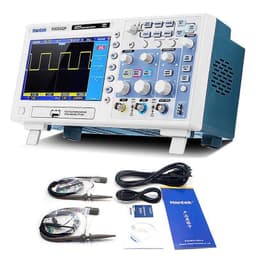
The DSO5102P is a mains-powered bench scope with its own 7-inch 800×480 screen, two channels, and a title that prints 100 MHz and 1 GSa/s. Across 317 amazon.co.uk reviews it sits at 4.5, the largest review sample among the bench units kept here, at a captured price of £262.99. Hantek's own page lists a record length up to 40K, which the amazon saved listing leaves blank, so that memory figure is the manufacturer's and not a listing bullet. UK reviews disagree on the mains lead: one describes a European plug with an unfused 13 A adaptor, another a UK lead, and the box line is not stable enough to promise two probe sets plus a compensation tool. USB on this title is storage and PC remote control, not a screen-less dongle, though one UK review could not get the PC link working. The ground clip on a mains scope is protective earth, and Hantek states 300 V RMS on a 10× probe for CAT I and CAT II, which is not clearance to probe a consumer unit. You get a trace with the laptop shut, at the highest price in this set, and you still have to check the plug before it meets a UK socket.
Pros
Own 7-inch screen, so a trace does not need a laptop
Title prints 100 MHz and 1 GSa/s, with 4.5 from 317 reviews
USB is specified for storage and PC remote control
Manufacturer page states 300 V RMS on a 10× probe for CAT I and CAT II
Cons
Dearest kept listing, at a captured £262.99
UK reviews disagree on a BS 1363 lead versus a European plug and an unfused adaptor
Memory depth is blank in the amazon saved listing; Hantek lists up to 40K
One UK review could not get the PC link working
Best for: You want knobs and a 7-inch screen for work around a 100 MHz title, and you will check the mains lead before it goes into a UK socket.
Less suitable: You need a waveform generator named in the title, a USB-only budget near £66, or eight vehicle channels.
Yes. The bullet states a 7-inch 64K colour TFT at 800 x 480. USB in the title is the storage and PC link, not a screen-less dongle.
What bandwidth and sample rate does the listing print?
100 MHz and 1 GSa/s, both in the title. Memory depth is not in the raw bullets. Hantek's own page lists a record length up to 40K.
Is the mains lead a UK plug?
UK reviews disagree. One describes a European plug plus an unfused 13 A adaptor. Another says a UK mains lead was supplied. Do not treat the lead as settled.
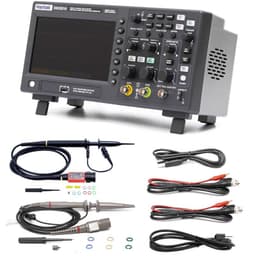
The DSO2D10 listing is a 100 MHz, two-channel bench scope at £219.99 with a 1-channel 25 MHz generator and a 4K arbitrary length in the bullets, rated 4.5 from 64 reviews. That star line matches the DSO5102P on a much smaller sample. One bullet prints 1 GSa/s and a later bullet prints 200 MSa/s, and the same file prints both 8 bit and 12 bits, so neither the faster rate nor 12 bits is a settled fact. The part-number field prints DSO2C10 while the title and the generator bullets describe the DSO2D10. Reviews say the manual and the PC software live on the Hantek website rather than in a complete paper pack. Hantek's series page puts the generator on the D models, which agrees with the title, while the part-number clash does not. You pay about £45 more than the DSO2C10 for a generator the title does name, and you should match that title to the part number on the carton. Under the Consumer Rights Act 2015 the goods should match the description you bought.
Pros
Title and bullets include a 1-channel 25 MHz generator
100 MHz and 8 M memory at £219.99, rated 4.5 from 64 reviews
Bullets add a 3-digit voltmeter and a 6-digit frequency display
SCPI remote control is stated on the listing
Cons
Sample rate is printed as both 1 GSa/s and 200 MSa/s
Vertical resolution is printed as both 8 bit and 12 bits
Part-number field prints DSO2C10
Review sample is 64, far smaller than the DSO5102P's 317
Best for: You want the 100 MHz bench form and a generator the title actually names, and you will check the part number when the carton arrives.
Less suitable: You need one sample-rate figure, or you do not need a generator and would rather pay the DSO2C10 price.
Yes. The style is 100 MHz, 2 channels plus a 1-channel waveform generator, and the bullet states 25 MHz with a 4K arbitrary length. Match the title to the part number on the carton.
Why do two sample rates appear?
One bullet prints 1 GSa/s. A later bullet prints 200 MSa/s. Both stay. The same file prints 8 bit and 12 bits. Neither the faster rate nor 12 bits is a settled fact.
Does the part number match the title?
No. The part-number field prints DSO2C10. The title and the generator bullets describe DSO2D10. Under the Consumer Rights Act 2015 the goods should match the description you bought.
The DSO2C10 is the 100 MHz bench listing at £174.63, with two channels, 1 GSa/s and 8 M memory in the bullets, and 4.4 from 156 reviews. That is about £88 less than the DSO5102P while it remains a scope with its own screen. The same bullet list says this model has no 1-channel 25 MHz generator and also that it supports arbitrary waveform output, so the generator is not something you can treat as included. The item-model field prints TXD-a219 against the DSO2C10 title. Hantek's DSO2000 series page says 500 MSa/s and 4 M when both channels run. That line is not in every amazon saved listing, so the title's 1 GSa/s stays the listing claim and the half-rate stays the manufacturer's two-channel note. A bullet mentions vehicles among hobby uses, which does not make this the 1008C vehicle program. Vertical resolution is stated as 8 bit. If you want a 100 MHz screen and you will not rely on a generator, this is the lower bench price in the set, on a listing that contradicts itself about waveform output.
Pros
100 MHz bench scope at £174.63, rated 4.4 from 156 reviews
Bullets state 1 GSa/s, 8 M memory and 8-bit resolution
Bullets list 14 trigger modes and five serial-protocol triggers
Own screen, so the first trace does not depend on a Windows driver
Cons
The bullet says there is no 25 MHz generator and also says arbitrary waveform output
Item model number prints TXD-a219
Two-channel 500 MSa/s is on the series page, not in every saved listing
A vehicle mention in the bullets is not the 1008C test program
Best for: You want a 100 MHz bench screen and you do not need the 25 MHz generator the D-model titles advertise.
Less suitable: You need a generator the listing states cleanly, or you only want a £66 USB scope and will accept the driver reports.
The bullet says the DSO2C10 models do not include a 1-channel 25 MHz waveform generator. The same bullet list also says it supports arbitrary waveform output. Both lines stay. Do not treat a generator as included.
What sample rate and memory does the listing state?
1 GSa/s and 8 M memory depth, and 8-bit vertical resolution. Hantek's series page says 500 MSa/s and 4 M when both channels run. That line is not in every amazon saved listing.
Is this the automotive 1008C?
No. A bullet mentions vehicles among home and hobby uses. It is not the 1008C vehicle-test program, and it is not an eight-channel USB tool.
The 2D42 is the handheld in this set: 40 MHz, two channels, a multimeter and a generator, at £149.99, with 4.4 from 106 reviews and no UK review text in the saved listing. The comparison fields give 250 MSa/s on one channel and 125 MSa/s with both channels on. Power is a replaceable 18650 charged from USB-C, and a bullet claims about two hours to charge and then a full day of use, which this comparison has not measured. The generator is stated, and its frequency is not printed in the saved listing. Hantek's series table states 150 V RMS on the oscilloscope input and a separate, higher limit on the meter jacks, so those sockets are not the same rating. The listing says CE and RoHS. Six items are counted in the box and not named. Stars without UK review text do not tell you how the battery, the screen or the probes behave on a British bench. It is a 454 g instrument you can carry when 40 MHz is enough, and you should not treat the meter sockets as the scope input.
Pros
Handheld at 454 g, with USB-C charging from a replaceable 18650
40 MHz and two channels, plus a multimeter in the same case
250 MSa/s on one channel and 125 MSa/s with both channels on
£149.99, with a star line of 4.4 from 106 reviews
Cons
The saved listing has no UK review text, so complaints are not documented here
Generator frequency is not printed
The manufacturer table gives the scope input and the meter jacks different voltage limits
The box count is six pieces, and those pieces are not named
Best for: You want a battery handheld around 40 MHz and you accept that UK review comments are missing from this file.
Less suitable: You need 100 MHz, a written UK review sample, or a mains bench with a 7-inch screen.
The bullet says oscilloscope, multimeter and waveform generator. Bandwidth is 40 MHz on 2 channels. The generator frequency is not printed in this saved listing. The meter jacks are not the same rating as the scope input.
How is it powered?
A replaceable 18650 lithium battery. Charge from 5 V / 2 A or a computer USB port, and the bullet says you can use it while charging. A full-day claim after about two hours of charge was not measured here.
What do UK reviews say?
The amazon.co.uk line is 4.4 from 106. This saved listing has no Reviewed in the United Kingdom blocks, so praise and complaints are not documented here. Stars alone do not describe the battery, the screen or the probes.
The DSO2D15 is the 150 MHz title in this set, at a captured £215.99, with two channels, 1 GSa/s on the title and a single 25 MHz generator, rated 4.4 from 92 reviews. The model and part-number fields print DSO2000, and the title also says handheld, which clashes with the bench form used for the other DSO2000 rows. Probe count is not fixed: the title ends with a P4100 probe, and UK reviews report one lead and two. Hantek's series page mentions 500 MSa/s when both channels run. That note does not delete the 1 GSa/s on the title. The listing's maximum operating voltage field is 300 V. At £215.99 this capture is slightly cheaper than the 100 MHz DSO2D10, which is a shelf quirk rather than proof of a better instrument. Later public snippets have already moved the price and the star line, so £215.99 and 4.4 from 92 stay the figures frozen here. If you want the highest bandwidth printed on a kept title, and you can live with the DSO2000 part-number field, this is that row, provided the probe count in your box matches what you expected.
Pros
Highest bandwidth on a kept title, at 150 MHz
Bullet states a single 25 MHz generator
Captured at £215.99, rated 4.4 from 92 reviews
Bullets include a dual-channel voltmeter and a frequency counter
Cons
Part number and item model print DSO2000, and the title also says handheld
UK reviews disagree on one probe versus two
Two-channel sample rate is not a single figure across the title and the series page
A later shelf snippet did not match this captured £215.99
Best for: You want 150 MHz on the title plus a generator, and you will read the part-number field as DSO2000 rather than as a second model.
Less suitable: You need a settled probe count, or a 7-inch screen the DSO5102P bullets actually describe.
150 MHz, with 1 GSa/s and 2 channels. The bullet adds a single 25 MHz generator. The series page mentions 500 MSa/s when both channels run. That note does not delete the 1 GSa/s on the title.
How many probes are in the box?
The listing does not fix a number. The title ends with a P4100 probe. One UK review reports one test lead. Another reports two. Count what is in your box.
Which model number is on the listing?
The title prints DSO2D15. The model-number and part-number fields print DSO2000. The title also says handheld, which clashes with the bench form of the other DSO2000 rows.
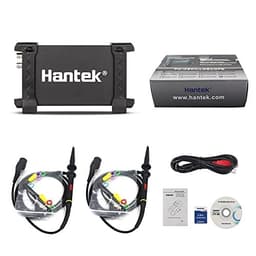
The 1008C+ is an eight-channel USB instrument for vehicle tests at £107.00, rated 4.3 from 322 reviews, with no screen of its own and no bandwidth printed in the amazon saved listing. It takes power from USB 2.0. The bullets name ignition, sensor, bus, starter and charging tests, plus camshaft and crankshaft simulation, which is not a general lab waveform generator. The listed box is the scope, an instruction CD, an auto probe, four alligator-clip leads and four coaxial connectors. Hantek's manual states 2.4 MSa/s and 4K on a single channel, and a bandwidth cell of 100 kHz single channel. Those figures belong to the manual, not to the amazon bullets, and they are why this is not a 100 MHz bench scope. UK reviews describe Windows 10 64-bit driver trouble, software that stayed in Chinese until the scope was plugged in, and a secondary ignition pickup called unstable. One box that did not match a manual's probe list is a single report, not a rate. If you want several slow car signals on a laptop, this is the listing that says so. Secondary ignition still belongs with someone whose trade is vehicle electrics when that is not your work.
Pros
Eight channels aimed at vehicle menus, at £107.00
4.3 from 322 reviews, a large sample for this set
USB powered, with an auto probe and four clip leads listed in the box
Camshaft and crankshaft simulation is named on the bullet
Cons
No screen, and no bandwidth or sample rate in the amazon saved listing
The manual's 2.4 MSa/s sits far below the 100 MHz bench titles
UK reviews report Windows 10 driver trouble and a Chinese interface until the device is plugged in
Reviews describe the secondary ignition pickup as unstable
Best for: You want several slow vehicle sensors on one USB device and you already have a laptop for the software.
Less suitable: You want a 100 MHz bench trace, a scope with its own screen, or a secondary-ignition capture you can treat as guaranteed.
No. It is a PC USB instrument. The bullet says USB 2.0, plug and play, with no extra power supply. The trace lives on the computer.
What bandwidth does this saved listing print?
None. Bandwidth and sample rate are not in this amazon saved listing. The manual states 2.4 MSa/s and 4K on a single channel, and a bandwidth cell of 100 kHz. Those figures are the manual's, not a listing bullet.
What do UK reviews say about the software?
An instruction CD is in the box. Reviews describe Windows 10 64-bit driver trouble, and software that stayed in Chinese until the scope was plugged in. A secondary ignition pickup is described as unstable.
The 6022BE is the cheapest two-channel scope kept here, at £65.99, with 20 MHz and 48 MSa/s real-time, 4.0 from 240 reviews, and no screen of its own. It is powered from USB 2.0. The listing names Windows 10, 8, 7, NT, XP and Vista. UK reviews still describe an unsigned driver, so Windows 10 has meant turning signature checks off, and one UK review said Windows 11 failed after calibration. That Windows 11 report is one review, not a failure rate, and this comparison does not claim Windows 11 support. A UK review describes visible 8-bit steps, and another describes noise at 20 mV/div with the probes shorted, which can be the instrument rather than the circuit you hoped to blame. Review text mentions two 1×/10× probes, and there is no included-components field to confirm the box. The ground is the PC's ground, so a clip on the wrong node can put the USB port at risk. You get a 20 MHz trace only while a computer is attached, at a price the bench screens in this set do not match.
Pros
Lowest captured price in the set, at £65.99 for two channels
20 MHz and 48 MSa/s are stated, with 4.0 from 240 reviews
USB powered, with no extra supply in the bullets
The listing names Windows 10 among older Windows versions
Cons
No screen; the trace lives on the PC
UK reviews describe an unsigned driver
One review reports Windows 11 failing after calibration
Noise at 20 mV/div with the inputs shorted is reported, and the ground is the PC ground
Best for: You already work on a PC, you will accept driver friction, and 20 MHz covers the edges you actually measure.
Less suitable: You want a trace with the computer off, a 100 MHz front end, or a driver that installs like ordinary signed Windows software.
No. It is a PC-based USB oscilloscope with no screen of its own, powered from the USB port. The trace exists only while a computer is attached. The ground is the PC's ground.
Which Windows versions does the listing name?
Windows 10, 8, 7, NT, XP and Vista. UK reviews say the driver is unsigned, so Windows 10 needs signature checks off. One UK review says Windows 11 failed after calibration. That is one review, not a claim of Windows 11 support.
What bandwidth and sample rate are stated?
20 MHz and 48 MSa/s real-time, on 2 channels. A UK review describes noise at 20 mV/div with the probes shorted. That can be the instrument rather than the circuit.
The 6022BL is the same 20 MHz, 48 MSa/s USB idea as the 6022BE, at £71.71, with 16 logic channels added and a lower star line of 3.9 from 175 reviews. It has no screen and no external supply. The case is listed as anodised aluminium at 299 g. UK reviews describe 1×/10× probes and, in one review, about 20 clips for DIL packages. One UK review says the stock hardware has no AC coupling, which the bullets neither confirm nor deny. Windows reports split: some say Windows 10 works after a Hantek or Device Manager install, one says not to buy it for Windows 10 or 11, and one says a driver install left a Windows 10 laptop unable to boot. That boot report is one review, not a measured failure rate, and it is still a reason to install on a machine you can recover. The product notes describe the logic software as limited. You pay about £6 more than the 6022BE for those logic channels, and you still need the PC, the driver, and a signal inside 20 MHz.
Pros
16 logic channels beside two 20 MHz analogue channels
£71.71, only a little above the 6022BE
USB powered, in an anodised aluminium case listed at 299 g
Review text describes probes and a set of logic clips
Cons
Lowest star line in the set, at 3.9 from 175 reviews
One UK review reports a driver install that left Windows 10 unable to boot
One review says there is no AC coupling, and the bullets are silent on coupling
No screen, and nothing in the file supports a Windows 11 claim
Best for: You want a cheap look at logic levels next to two analogue channels, and you can recover the PC if a driver misbehaves.
Less suitable: You want the 6022BE's higher star line without logic channels, or a bench screen that does not depend on Windows.
Both are 20 MHz USB scopes at 48 MSa/s, with no screen of their own. The 6022BL title adds 16 logic channels. The captured price is £71.71, about £6 above the 6022BE, and the star line is lower, at 3.9 from 175.
Does it need a laptop?
Yes. It has no screen of its own and the bullet says USB 2.0 with no external power. The case is listed as anodised aluminium at 299 g.
What do UK reviews say about Windows?
Some say Windows 10 works after a Hantek driver or a Device Manager install. One says not to buy it for Windows 10 or 11. One says a driver install left a Windows 10 laptop unable to boot. That boot report is one review, not a measured failure rate.
How we compared
Eight Hantek oscilloscope listings on amazon.co.uk were read from the captured pages, the UK review notes on those pages, and the public sources below. The 0–100 figure on each card is the amazon.co.uk star rating times 20. It is not a laboratory bandwidth test and not a safety test. Where two rows share a star line, the written comparison uses the weights below: form and bandwidth, sample rate and memory, whether a generator or extra channel is actually stated, whether the listing agrees with itself, and the shelf price against what the title describes. A part-number clash, two sample rates, two bit depths, a disputed mains lead, or stars with no UK review text all count against that reading.
1
Amazon stars and review volume
30%
Up to 30 points from the amazon.co.uk star average and how many reviews sit behind it. The card score itself is that star average times 20. A 4.5 from 317 is not the same evidence as a 4.5 from 64. Stars with no UK review text in the saved listing are thinner still. The number is not a calibration.
2
Form and bandwidth
25%
Up to 25 points for whether the instrument has its own screen, needs a PC, or is a handheld, and for the bandwidth the title actually prints. A vehicle USB tool with no bandwidth in the amazon file does not score as a 100 MHz bench scope. 20 MHz and 150 MHz are different jobs.
3
Sample rate and memory
20%
Up to 20 points for a sample rate and a memory depth the listing states, including whether the rate still holds with both channels on. A series-page note of 500 MSa/s on two channels is the manufacturer's line when it is missing from the amazon bullets. Two rates in one file are not one settled figure.
4
Generator, software and the box
15%
Up to 15 points when a generator, logic channels, or vehicle menus are named and you would use them. A bullet that both denies and offers a generator does not score as included. Unsigned Windows drivers and a probe count that reviews do not agree on sit in this block.
5
Price against the title
10%
Up to 10 points for the captured shelf price against what the title describes: a 7-inch bench screen, a 100 MHz bench without a settled generator, a named 25 MHz generator, or a 20 MHz USB scope. The lowest price is not this block's winner when the trace lives only on a PC and the driver is unsigned.
Independent review
Last updated: October 2026
8 sources checked
Hantek oscilloscope buying guide
Start with form, then bandwidth against the edge you care about, then sample rate and memory, then a generator only if you will use it, then software and what is actually in the box. The notes below follow that order for these eight listings. None of the scores is a laboratory test.
What is a Hantek oscilloscope?
A Hantek oscilloscope in this comparison is a low-cost digital storage instrument on amazon.co.uk for a home bench, a student, or a small workshop. It draws voltage against time. It is not a CAT III installation tester, and it is not the instrument you use to prove a circuit dead. Eight listings were kept. The card score is the amazon.co.uk star rating times 20. Nothing here is a laboratory bandwidth test.
Start with form.
Best for
A home bench that wants knobs and a screen around a 100 MHz title
A PC user who will accept an unsigned driver for a 20 MHz trace
Several slow vehicle sensors on one USB device, with the right probe
Not ideal for
Proving a circuit dead, or probing a consumer unit
Anyone who needs Windows 11 support stated as a fact
A secondary-ignition capture treated as guaranteed
Mistakes to avoid
1
Buying megahertz and ignoring the two-channel rate
A title can print 1 GSa/s while a series page says 500 MSa/s with both channels on. The DSO2D10 prints 1 GSa/s and 200 MSa/s in the same file. The faster figure is not settled.
2
Expecting a signed Windows install
UK reviews of the 6022BE and 6022BL describe unsigned drivers. One review reports Windows 11 failing after calibration. This comparison does not claim Windows 11 support.
3
Using the 1008C as a 100 MHz bench scope
The amazon saved listing prints no bandwidth. The manual states 2.4 MSa/s and 4K. It is an eight-channel USB tool for slow vehicle signals, and it has no screen of its own.
What to weigh up
Form, bandwidth, sample rate and memory
High
Form decides whether you need a laptop. A bench scope and the 2D42 handheld show a trace on their own screen. The 6022BE, 6022BL and 1008C+ do not. Bandwidth is the sine-wave frequency where amplitude is about 3 dB down. The Institution of Electronics gives a rule of thumb of about five times the square-wave fundamental if you want the fifth harmonic. 20 MHz is the USB pair. 40 MHz is the handheld. 100 MHz is the DSO5102P, DSO2C10 and DSO2D10. 150 MHz is the DSO2D15 title.
Generator, software, plug and box
Medium
Pay for a generator only when the title names it and the bullets do not take it back. The DSO2D10 and DSO2D15 state a 25 MHz generator. The DSO2C10 says the model has none and also says arbitrary waveform output. The 6022BL's extra is 16 logic channels, not a generator, at about £6 above the 6022BE, with a lower star line. The 1008C simulates cam and crank for vehicle menus.
Which option suits you?
Three typical situations, each with a recommendation from this comparison.
🔧
Knobs and a screen
You want a trace with the laptop shut, around a 100 MHz title. The DSO5102P is about £262.99, with a 7-inch screen in the bullets and 4.5 from 317 reviews. Check the mains lead before it meets a UK socket. UK reviews disagree on a BS 1363 lead versus a European plug and an unfused adaptor.
You already work on a computer and 20 MHz covers the edges you measure. The 6022BE is about £65.99, with 4.0 from 240 reviews and no screen of its own. UK reviews describe an unsigned driver. This comparison does not claim Windows 11 support.
You want vehicle menus on one USB device and you already have a laptop. The 1008C+ is about £107, eight channels, 4.3 from 322 reviews, and no screen. The amazon file prints no bandwidth. The manual's 2.4 MSa/s is why this is not a 100 MHz bench scope. Secondary ignition still belongs with someone whose trade is vehicle electrics when that is not your work.
Which Hantek oscilloscope is the top pick in this set?
The top pick is the Hantek DSO5102P at about £262.99. It is a mains bench scope with its own 7-inch screen, two channels, and a title that prints 100 MHz and 1 GSa/s. The amazon.co.uk line is 4.5 from 317 reviews, the largest bench sample kept here. Memory depth is blank on the listing; the manufacturer page lists up to 40K. UK reviews disagree on a UK plug versus a European plug and an unfused adaptor. The card score is the star rating times 20, not a lab test.
How much does a Hantek oscilloscope cost on amazon.co.uk in this comparison?
Captured shelf prices in this set run from about £65.99 to about £262.99. The two 20 MHz USB scopes are about £65.99 and about £71.71. The eight-channel vehicle USB tool is about £107, and the 40 MHz handheld is about £149.99. The 100 MHz bench scope without a settled generator is about £174.63. Generator benches and the 7-inch 100 MHz sit from about £215.99 to about £262.99. These are this comparison's captured prices, not a market average. A later shelf snippet has already moved at least one of them.
How should you judge bandwidth on a Hantek oscilloscope?
Bandwidth is the sine-wave frequency where amplitude is about 3 dB down. The Institution of Electronics gives a rule of thumb of about five times the square-wave fundamental if you want the fifth harmonic. 20 MHz is the USB pair, 40 MHz the handheld, 100 MHz the common bench step, and 150 MHz the highest title kept. Also check the sample rate with both channels on. A series page says 500 MSa/s on two channels, and that line is not in every amazon file.
Should you buy a USB Hantek oscilloscope or a bench screen?
Buy a bench screen, or the handheld, if you need a trace with the laptop shut. Buy a USB scope if you already work on a PC and you will accept driver friction. UK reviews of the 20 MHz USB pair describe unsigned drivers. One review said Windows 11 failed after calibration. That is one review, not a failure rate, and this page does not claim Windows 11 support. The eight-channel USB tool is for slow vehicle sensors. It has no screen, and its amazon file prints no bandwidth.
Can these probes be used on a UK socket or a consumer unit?
No. UK mains are 230 V RMS, and a plug should be BS 1363 and fused. HSE GS38 expects probes to meet BS EN 61010-031 and to show a CAT rating: CAT II on appliances, CAT III on socket outlets, CAT IV at the origin. The ground clip on a typical mains bench scope is protective earth. The DSO5102P page states 300 V RMS on a 10× probe for CAT I and CAT II. That is not clearance to probe a consumer unit.
What should you do when a Hantek listing contradicts itself?
Trust the title and record the clash. The DSO2D10 prints 1 GSa/s and 200 MSa/s, and both 8 bit and 12 bits, and its part-number field prints DSO2C10. The DSO2C10 bullet denies a 25 MHz generator and also says arbitrary waveform output. The DSO2D15 title prints 150 MHz while the part-number field prints DSO2000. Do not treat 12 bits as fact while the same listing says 8-bit. Under the Consumer Rights Act 2015 the goods should match the description you bought.
When should you leave this Hantek oscilloscope table?
Leave it for a consumer unit, any plan to lift the scope earth, and secondary ignition if vehicle electrics are not your trade. Do not use the eight-channel USB tool as a 100 MHz bench scope: the manual states 2.4 MSa/s, and the amazon file prints no bandwidth. Do not read noise at 20 mV/div with the inputs shorted as a fault in the circuit. Other makers sit in the oscilloscope comparison. Stars are not a certificate, and none of these rows is a laboratory test.
Our verdict
In this set of eight amazon.co.uk listings, the top pick is the Hantek DSO5102P at about £262.99. It is a mains bench scope with its own 7-inch 800×480 screen, two channels, and a title that prints 100 MHz and 1 GSa/s, with 4.5 from 317 reviews, the largest review sample among the bench units kept here. UK reviews disagree on a BS 1363 lead versus a European plug and an unfused adaptor. The best value is the Hantek DSO2C10 at about £174.63, with 100 MHz, 1 GSa/s and 8 M memory in the bullets, and 4.4 from 156 reviews. The same bullet list says this model has no 25 MHz generator and also that it supports arbitrary waveform output. The 0–100 card score is the star rating times 20. None of these rows is a lab test.
Best overall
Hantek DSO5102P 100 MHz
Own 7-inch screen, a title that prints 100 MHz and 1 GSa/s, and 4.5 from 317 reviews, the largest bench sample in the set. You still check the mains lead.
Hantek oscilloscopesElectrical test gearamazon.co.uk listings
Peter F. is the editor for DIY & tools at productscompared.co.uk. Comparisons in this category are checked against amazon.co.uk listings, review evidence and public UK sources.
Updated: October 2026
8 sources checked
Guides to Hantek oscilloscopes
Guides on what to look for, how to use a product, and common mistakes.
Public sources from the research digest. Shelf prices and star lines are the amazon.co.uk figures captured with these eight listings. The price bands are this set, not a market average. The card score is the star rating times 20, not a laboratory result.
This page contains affiliate links to amazon.co.uk. If you buy through them, we may earn a commission at no extra cost to you. Prices, stars and review counts are the captured UK listing figures. We did not lab-test these oscilloscopes.