Independent comparisons. We may earn from shop links. More info

Volt stick vs two-pole tester

Updated: 22 October 2026

Volt stick vs two-pole tester is the fork when a pen has beeped and the next job is to disconnect a fitting. The pen asks whether something nearby still looks live. The two-pole tester, proved before and after, is what HSE guidance points at when the conductors must be dead. Peter F., editor for DIY & tools, wrote this on 22 October 2026 from GS38 and HSG85. The pens, from £5.99 to £13.99, are on the [non-contact voltage tester comparison](/hub/measuring-equipment/non-contact-voltage-tester). A qualifying purchase through our links can earn a commission at no extra cost to you. If you will touch copper, the pen is the wrong instrument.

Volt stick vs two-pole tester is the fork when a pen has beeped and the next job is to disconnect a fitting. The pen asks whether something nearby still looks live.

Our top picks

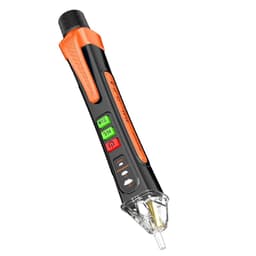
Aicevoos Aicevoos A1

Best overall

Aicevoos Aicevoos A1
6.5/10about £7.99
Kaiweets Kaiweets HT100

Rank 2

Kaiweets Kaiweets HT100
8.0/10about £10.99
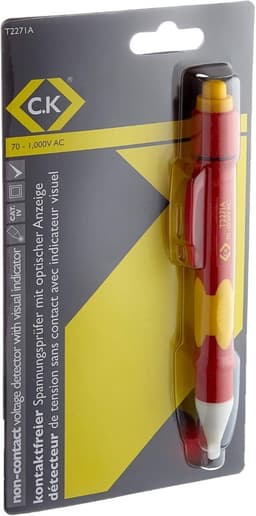
C.K C.K T2271A

Alternative

C.K C.K T2271A
5.4/10about £8.84
On this page

Two different questions

One question is whether a live field is near this flex, socket face, or switch. The pens in this comparison sense that field. They do not clip to the copper. A beep means treat it as live. It does not mean 230 V RMS. The other question is whether the conductors are dead, so you may disconnect them. That needs a probe on each point after isolation. A pen at the sheath cannot see a broken neutral or a terminal that is still live. A Martindale VT12 at £33.48 on a best-seller snapshot is a different product. Paying £10.99 for the Kaiweets does not buy that second question. The known-live check is on how to use a non-contact voltage tester.

What GS38 and HSG85 actually say

GS38 says a voltage stick identifies live equipment and must not prove it dead. A beep on a known live socket does not make a later silence a dead conductor. HSG85 says that after isolation you prove dead with a two-pole detector, a test lamp, or a fused voltmeter, proved before and after, preferably on a proving unit. A multimeter on the wrong function can show a comforting zero. If the second proof fails, the dead reading is void. Electrical Safety First does not advise a non-contact indicator for that detection. Gas Safe Technical Bulletin 118a allows a look at casings, then requires a two-pole indicator. It does not register you. BS EN 61243-3:2014 is the two-pole contact detector, up to 1000 V AC, not these pens. A CAT line does not convert one.
Aicevoos Aicevoos A1

Testsieger

Aicevoos Aicevoos A1
6.5/10about £7.99

When the pen is still the one you pick up

Use the pen before isolation, when you only need to notice a live field on a flex, a socket face, or one cable in a loft. The beep tells you to find the breaker. It is not proof of dead, which is how C.K and Kaiweets reviews use these sticks. Electricians still carry both tools. Fluke’s 1AC II and a Volt Stick 230Y are not rows here, and GS38 does not exempt a £40 pen. The buying points are on the buying guide. If the pen alarms with the breaker already off, stop and call a competent person.

What you use when you will disconnect

When you will lift a fitting or cut a cable, isolate first, then prove dead with a two-pole indicator or a GS38-style test lamp, on a proving unit before and after. A pen beep is not that before proof. Do not swap in a multimeter left on the wrong function. Call a competent person for a consumer unit, a new circuit, or notifiable bathroom or shower work where you live, if you cannot find the breaker, or before you cut a cable you cannot see both ends of. Part P is England and Wales only. If you are only looking, the pen can say treat the flex as live.

Common questions

Can the pen prove a circuit dead if you tested it on a live socket first?
No. The known-live check shows that the pen can see a field then. GS38 still says a voltage stick must not be used to prove equipment dead. A later silence can be a flat cell, the wrong side of a flex, armour, or a pen that has auto-off. Silence is a reason to check the pen again. It is not a reason to touch the conductor.
What does a two-pole tester do that the pen cannot?
It contacts two points and shows whether a voltage is present between them. That is how you test the conductors you are about to disconnect, after isolation. The pen never touches the copper and can couple to a neighbouring field or miss a field inside armour. BS EN 61243-3 is the standard scope for that two-pole contact detector. It is not the standard that describes these pens.
Is a multimeter the right substitute?
HSG85 does not recommend a multimeter as the proving tool, because it can be on the wrong function and then show no voltage. A two-pole detector or a test lamp is the preferred contact instrument, proved before and after. A multimeter can still be the right meter when you are measuring a voltage you already know how to range, on a circuit you are not treating as proved dead. It is the wrong swap for the pen when the job is safe isolation.
What is a proving unit?
A proving unit is a known live source used to test the voltage indicator, not to test the house. HSG85 says you prove the instrument before and after the dead check, preferably on one. You prove, you test the conductors, you prove again. If the indicator fails the second proof, you discard the dead reading. The unit does not make a non-contact pen into a contact tester.
Who should do the isolation if you cannot find the breaker?
A competent person. If you cannot find the isolation point, if the pen still alarms with the breaker you chose turned off, or if the work is a consumer unit, a new circuit, or notifiable bathroom or shower work where you live, stop and get that person. Do not keep sweeping the pen until a silence appears and then disconnect. Part P is England and Wales only. It is not a qualification the pen confers in Scotland or Northern Ireland either.

Related pages

Sources

Public UK sources from the research digest, last checked on 21 October 2026. Shelf prices and star lines are the amazon.co.uk figures captured with these ten listings. The price bands are this set, not a market average.

  1. HSE GS38: electrical test equipment for use on low voltage electrical systems (retrieved 21 October 2026)
  2. HSE HSG85: electricity at work — safe working practices (retrieved 21 October 2026)
  3. Electrical Safety First: Best Practice Guide 2, issue 4.3 (retrieved 21 October 2026)
  4. Megger: measurement categories (retrieved 21 October 2026)
  5. Martindale: installation categories (retrieved 21 October 2026)
  6. GOV.UK: use a competent person scheme (retrieved 21 October 2026)
  7. Volt Stick 230Y (retrieved 21 October 2026)
  8. amazon.co.uk Best Sellers: Voltage Testers (retrieved 21 October 2026)