Independent comparisons. We may earn from shop links. More info

How to use a non-contact voltage tester

Updated: 22 October 2026

How to use a non-contact voltage tester is a known-live check, then a slow pass of the tip, then a stop if the next step is touching copper. Peter F., editor for DIY & tools, wrote this on 22 October 2026 from GS38, HSG85, and the amazon.co.uk reviews in this comparison. It is not a full safe-isolation procedure. The pens are on the [non-contact voltage tester comparison](/hub/measuring-equipment/non-contact-voltage-tester). A qualifying purchase through our links can earn a commission at no extra cost to you. A beep means treat it as live. Silence means check the pen again.

How to use a non-contact voltage tester is a known-live check, then a slow pass of the tip, then a stop if the next step is touching copper.

Our top picks

Kaiweets Kaiweets HT100

Best overall

Kaiweets Kaiweets HT100
8.0/10about £10.99
VENLAB VENLAB VD200

Alternative

VENLAB VENLAB VD200
7.7/10about £9.99
C.K C.K T2271A

Alternative

C.K C.K T2271A
5.4/10about £8.84
On this page

Check the pen on a live socket first

Fit the cells first. VENLAB, YOWEXA, and Kaiweets list two AAA cells, and reviews include flat and corroded ones. C.K cells are not in the included list. BSIDE reviews say a 9 V cell was missing. A power-on lamp is not a mains test. Alarm the pen on a socket you know is live, at nominally 230 V AC, and again if you drop it or it auto-offs. MUFASHA, VENLAB, and Kaiweets state three minutes. Aicevoos states five. If that socket stays silent, do not call the suspect flex dead. The C.K lamp is hard to see in daylight. Which pens beep is the buying guide.

What a beep and a colour mean

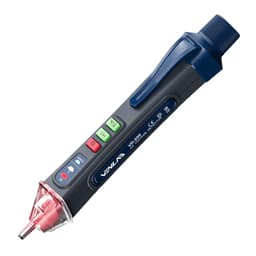
A beep or a colour change means a field the pen will call live, not a measured 230 V. Kaiweets turns red above 90 V. VENLAB uses red nearer live and orange further away or nearer neutral. Learn that colour on the known socket first. Go round the whole flex, because one side of a round cable can stay quiet. Use the 48–1000 V AC window among a bundle of mains cables. High sensitivity also finds a phone, about 130–140 mm in one Aicevoos review.
Kaiweets Kaiweets HT100

Testsieger

Kaiweets Kaiweets HT100
8.0/10about £10.99

When the pen lies by excess or by silence

A noisy wall is coupling, not a map. Kaiweets reviews include a wall that read live and a pick-up from about 150 mm. YOWEXA reviews include tracing about 470 mm off the cable. Silence fits a flat cell, one side of a round flex, steel-wire armour, or DC. One Kaiweets review found no detection through armour and did through plastic conduit. That is one review, not a depth. Repeat the known-live check. Do not cut the cable. Cars and doorbells are the 12 V page.

Where this method stops

Stop when you will disconnect, open a consumer unit, or cut a cable. GS38 does not let the pen prove equipment dead. After isolation, HSG85 wants a two-pole tester or a test lamp, proved before and after. That comparison is the volt stick vs two-pole tester page. Call a competent person if you cannot find the breaker, if the pen still alarms with it off, or for notifiable bathroom or shower work where you live. Part P is England and Wales, not Scotland or Northern Ireland.

Common questions

What do you do if it stays silent?
You do not call the cable dead. You return to the known-live socket, check the cells, and try the other side of a round flex. Silence also fits a flat cell, steel-wire armour, a voltage below the window, or DC. Only after the pen alarms again on the known socket, and you have been round the whole flex, have you learned that this pen saw no field. That is still not proof you may touch the copper.
Why does it beep across a whole wall or near a phone?
Because the sensitive window couples to nearby fields, not only to the cable you intended. Kaiweets reviews include a whole wall reading live. An Aicevoos review includes a phone at about 130–140 mm. Lower the sensitivity, or switch to the 48–1000 V AC window on a dual-range pen, and separate the cables if you can. A noisy wall is a reason to stop tracing, not a map of the wire.
Do you need to run the tip around the whole flex?
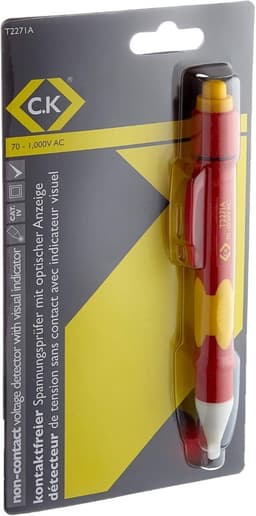
Yes. A multi-core flex can show a field on one side and stay quiet on the other. Maker guidance treats that full circumference as the usual miss. C.K reviews say the stick lights on one side of a cable only, and that it can still help you see which side of twin and earth is line. One pass along the top of the flex is not the check.
Can you use it on steel-wire armoured cable?
Do not expect a field outside the armour. One Kaiweets review reported no detection through armoured cable and detection through plastic conduit. That is a single review, not a tested depth. If the cable is armoured, a silent pen is the expected miss. It is not evidence the cores are dead. Use a contact method at a point where the conductors are accessible to the right instrument.
What does a faster beep or a colour change mean?
It means stronger or closer, on the terms that listing prints, not a measured voltage. YOWEXA uses more LEDs and a faster buzzer. Kaiweets turns the screen red above a stated 90 V. VENLAB uses red for nearer live and orange for further away or nearer neutral, and a new user can mix those colours up. Learn the colour on a known-live socket first. Do not convert it into a number the pen does not show.
When do you stop and use a contact tester or call someone?
Stop when you will disconnect, cut, or open a consumer unit. Use a two-pole tester or a GS38-style test lamp, proved before and after, for the dead check. Call a competent person if you cannot find the breaker, if the pen still alarms with that breaker off, for notifiable bathroom or shower work where you live, or before you cut a cable you cannot see both ends of. The pen’s job ended at treat this as live.

Related pages

Sources

Public UK sources from the research digest, last checked on 21 October 2026. Shelf prices and star lines are the amazon.co.uk figures captured with these ten listings. The price bands are this set, not a market average.

  1. HSE GS38: electrical test equipment for use on low voltage electrical systems (retrieved 21 October 2026)
  2. HSE HSG85: electricity at work — safe working practices (retrieved 21 October 2026)
  3. Electrical Safety First: Best Practice Guide 2, issue 4.3 (retrieved 21 October 2026)
  4. Megger: measurement categories (retrieved 21 October 2026)
  5. Martindale: installation categories (retrieved 21 October 2026)
  6. GOV.UK: use a competent person scheme (retrieved 21 October 2026)
  7. Volt Stick 230Y (retrieved 21 October 2026)
  8. amazon.co.uk Best Sellers: Voltage Testers (retrieved 21 October 2026)