





Cut a roll for filler and plaster
You cut mesh for a block, a pole or a strip, at one medium grit. The ProDec Advance roll is the top pick: 5 m × 115 mm, 120 grit, £4.99, with 4.6 from 1,372 reviews. It is not a hook-and-loop disc.
The best sanding meshes, compared.
Top pick: QZATACAEN 240 grit mesh roll Best value: NuoDunco 125 mm mesh discs – Lowest shelf price for a stated 125 mm fifty-disc mix, at £10.99. No review line, so the score stays below the evidence-rich rows. Updated October 2026.

Sanding mesh is a coated abrasive on an open weave. UK listings call it mesh discs, net sandpaper or sanding screen. You buy it when punched paper clogs, and when you want dust to pass through the face into a random orbital sander instead of lining up six or eight holes. A 125 mm disc belongs on a 125 mm hook-and-loop pad. HSE still expects on-tool extraction, and UK pages say protection still applies. The order of checks is on the [sanding mesh buying guide](/hub/sanders/sanding-mesh/sub/sanding-mesh-buying-guide).
Sanding mesh is a coated abrasive on an open weave. UK listings call it mesh discs, net sandpaper or sanding screen.

38 products checked · 61 hrs invested · +22,800 readers
Swipe for more
1-2 of 11


Personal buying guide
Question 1 of 2
What are you fitting the mesh to?
QZATACAEN sells a 6 m by 10.6 cm silicon carbide mesh roll at 240 grit for £13.99, with a 5.0 average from 5 amazon.co.uk reviews in the capture. The bullets describe double-sided use and warn that a few grains may fall off before first use, which is honest listing copy rather than a test result. Only three short UK notes sit in the stored file and none raise a fault, so the perfect star line is almost unworn evidence. The brand field is empty even though the manufacturer name prints elsewhere. Treat this as a cut-to-length fine roll for hand work, not as a substitute for fifty hook-and-loop discs.
Pros
Cons
Best for: Hand sanding and small patches where you cut 240 grit mesh from a roll.
Less suitable: Buyers who want hundreds of UK reviews before trusting mesh on a powered sander.
Specifications
Common questions
Is this a disc pack?
No. It is a 6 m × 10.6 cm roll at 240 grit. There is no stated pad diameter. You cut it for hand work.
Why is 5.0 from five reviews a thin line?
Five reviews, with three short UK notes and no fault raised, is a small sample. It is not the same evidence as 4.6 from 1,372.
What does the listing say about loose grain?
The bullets warn that a few grains may fall off before first use. That is listing copy, not a measured shed rate.
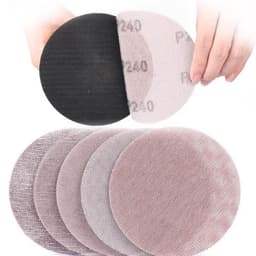
Ruidawin offers sixty 125 mm hook-and-loop mesh discs for £15.88, with ten each of 80, 120, 180, 240, 320 and 400 grit, and 5.0 from 3 amazon.co.uk reviews in the capture. Those three UK notes praise dust control against paper, grip on an orbital sander and value versus branded mesh, and none name a defect, which is encouraging but a tiny sample. The structured L × W field prints 125 × 125 centimetres while the diameter field says 125 mm, so trust the title and diameter, not the centimetre line. Bullets name aluminium oxide and ceramic together. Reasonable try if you accept three reviews as the whole story.
Pros
Cons
Best for: A 125 mm orbital owner who wants a full grit mix and accepts a three-review file.
Less suitable: Risk-averse buyers who rely on hundreds of UK notes, or worn pads without a pad saver.
Specifications
Common questions
Is the disc 125 mm or 125 cm?
The diameter field and the title say 125 mm. The L × W field prints 125 × 125 centimetres. Trust the millimetre diameter, not the centimetre line.
What do the three reviews say?
Three UK notes praise dust control against paper, grip on an orbital sander and value versus branded mesh. None name a defect. There is no long-term wear report.
Which grits are in the box?
Ten each of 80, 120, 180, 240, 320 and 400, sixty discs. The bullets name aluminium oxide and ceramic together.
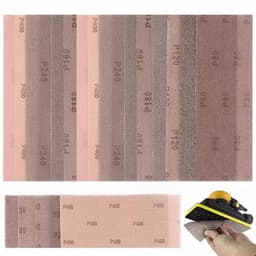
Yurifaz lists fifty hook-and-loop mesh sheets at 80 × 230 mm for £15.09, with ten each of P80, P120, P180, P240 and P400, and a 5.0 line from 1 amazon.co.uk review. That lone UK note says the sheets had not been tried yet, so the star figure does not describe sanding performance in the file. The bullets name filler and drywall among uses while the compatible-material field lists metal, plastic and wood only. The format suits rectangular orbital heads and hand blocks that take an 80 × 230 mm sheet, not a round 125 mm pad. Without further reviews this is a specification-led buy.
Pros
Cons
Best for: You own an 80 × 230 mm hook-and-loop sheet tool and want a grit ladder in mesh rather than paper.
Less suitable: Round orbital pads, or anyone who waits for a meaningful review count.
Specifications
Common questions
Has anyone in the file used these sheets?
The one UK review says the sheets had not been tried yet. The 5.0 line does not describe sanding performance in this capture.
What size are they?
80 × 230 mm hook-and-loop sheets, fifty in the pack. They suit a rectangular head of that size, not a round 125 mm pad.
Which materials are named?
The bullets name filler and drywall. The compatible-material field lists metal, plastic and wood only. Those two lines do not match.
Gerlon’s COPR1F pack is three 70 × 125 mm aluminium oxide mesh refills at 180 grit for £4.82, with 4.7 from 143 amazon.co.uk reviews on the listing line. The bullets state they are for dustless sanding with the appropriate shim, not for a round hook-and-loop pad, which limits them to Gerlon’s holder or an equivalent block. Fine 180 grit sits between the coarser 80 and 120 SKUs the maker sells separately. Written reviews in the stored file are not marked United Kingdom, so treat praise themes as thin even when the star count looks strong. At about £1.61 a sheet you pay for a small refill, not a fifty-disc orbital bundle. The word dustless is the listing’s. Mesh is still not a substitute for extraction.
Pros
Cons
Best for: You already use Gerlon’s dustless shim and need 180 grit mesh refills.
Less suitable: 125 mm or 150 mm hook-and-loop orbitals, or universal sheet sizes.
Specifications
Common questions
Will these fit a 125 mm orbital pad?
No. They are 70 × 125 mm meshes for Gerlon’s shim or a matching holder. They are not round hook-and-loop discs.
Are the reviews a UK panel?
The listing line is 4.7 from 143. The written reviews in the stored file are not marked United Kingdom, so the themes are not treated as a UK panel.
Does the listing’s dustless claim replace extraction?
The bullets say dustless sanding with the shim. HSE still expects on-tool extraction for wood dust, and mesh is an air path, not the extractor.
SI FANG lists fifty 125 mm mesh discs at £15.99 with 4.7 from 32 amazon.co.uk reviews, and the bullets name 80 grit with aluminium oxide and ceramic in the grain line. UK buyers describe a secure fit on a Makita LXT sander, less dust than paper, and one person who replaced a worn pad after discs slipped. The stored file keeps a UK review title that quotes a mixed 80-to-400 pack, which clashes with the single-grit bullets, so check the label when the box arrives. A bullet mentions stability up to 12,000 rpm without a UKCA or EN mark in the capture. This is the highest-scoring 125 mm disc row on stars, but thirty-two reviews is a thin file next to ProDec’s roll or S&R’s sheets.
Pros
Cons
Best for: You run a 125 mm hook-and-loop orbital and want mesh with strong recent UK feedback on grip and dust.
Less suitable: You need a documented grit ladder in the box, or a pad that is already losing hooks.
Specifications
Common questions
Are these discs a grit mix?
The bullets say 80 grit only, with aluminium oxide and ceramic. One UK review title describes a mixed 80-to-400 pack. Check the label on arrival.
What do the UK notes say about the pad?
UK buyers describe a secure fit on a Makita LXT sander. One person replaced a worn pad after discs slipped, and one note mentions too little loop material.
Is 12,000 rpm a certified limit?
A bullet claims stability up to 12,000 rpm. The capture does not print UKCA or EN 13743. Treat the figure as a seller claim.
ProDec Advance is a 5 m by 115 mm sanding mesh roll at 120 grit for £4.99, rated 4.6 from 1,372 amazon.co.uk reviews, with glass fibre and aluminium oxide on both sides. UK buyers cut lengths for hand blocks, pole sanders and machines that take a strip, and they use it on plaster, plasterboard, filler, timber and light metal. Several note that a torn piece can still last because both faces carry abrasive, while others ask for separate finer rolls that are not in this SKU. The detail table prints two different weights and this roll is not a hook-and-loop disc, so it will not mount on a 125 mm orbital pad without adaptation. It is the top pick in this comparison because no other row combines this review depth with a sub-£5 shelf price for mesh.
Pros
Cons
Best for: Decorating and repair jobs where you cut mesh to a block, pole tool or sheet clamp at medium 120 grit.
Less suitable: A 125 mm or 150 mm hook-and-loop disc sander without cutting your own pads.
Specifications
Common questions
Will this roll fit a 125 mm orbital sander?
No. It is a 5 m × 115 mm roll you cut for a block, a pole or a strip. It is not a hook-and-loop disc.
What grit is on the roll?
120 grit only, glass fibre and aluminium oxide, described as double-sided. Finer grades are separate products. UK buyers asked for those finer rolls.
Why do the weights disagree?
The detail table prints both 0.24 g and 238 grams. Treat that as a listing clash, not as a weighed result from this page.
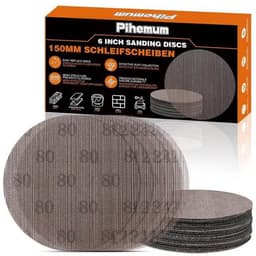
Pihemum’s 150 mm pack lists sixty hook-and-loop mesh discs at £24.99, with 4.4 from 65 amazon.co.uk reviews. UK buyers use them on wood, plaster and paint where punched paper used to clog, and several say dust passes through the weave better than on solid discs. The title and material line name grits from 80 to 400, while the grit-number field stores 80 only, so you should treat the split as unstated until you open the box. The same UK notes that praise cutting power also report torn edges on corners and discs that left a worn pad mid-pass. At about £0.42 a disc this is the set’s only 150 mm mixed mesh row, so the price only makes sense if your sander already runs a 150 mm hook-and-loop pad.
Pros
Cons
Best for: You already own a 150 mm random orbital with hook-and-loop and you want mesh instead of punched discs on filler, wood or paint.
Less suitable: A 125 mm sander, edges and nails where open mesh tears quickly, or a pad with short or worn hooks.
Specifications
Common questions
Will a 150 mm disc fit a 125 mm pad?
No. This pack is 150 mm only. A 125 mm sander needs a 125 mm disc. The two diameters do not interchange.
Is the grit mix confirmed?
The title lists 80 through 400. The grit-number field stores 80 only. Treat the split as unstated until you open the box.
Why do discs leave the pad?
UK reviews mention torn rims and discs that left a worn hook face mid-pass. Short or worn hooks are a known reason. A pad saver takes that wear.
KQCXIK’s pack is fifty 125 mm ceramic mesh discs at £21.99, with 4.4 from 65 amazon.co.uk reviews and a highlight line listing grits from 60 to 240. The open weave is meant to drop dust through a 6- or 8-hole pad without lining up holes, which the bullets state explicitly. Ceramic is sold as a sharper, longer-lasting grain than ordinary aluminium oxide, but this listing does not reproduce Norton’s laboratory three-times claim. The grit-number field stores 240 while the highlight lists five grades, and none of the review texts in the stored file are marked United Kingdom, so the star line is wider than the quoted comments. Pay more here only if you want ceramic on mesh rather than the cheapest oxide mix.
Pros
Cons
Best for: A 125 mm hook-and-loop orbital where you want ceramic mesh and a stated spread down to 60 grit.
Less suitable: Budget-first shopping on aluminium oxide alone, or jobs where you need UK review detail on pad grip.
Specifications
Common questions
Does ceramic mesh last three times as long?
Not on the evidence here. Norton’s “up to three times” line is Norton’s test. This listing does not reproduce that claim, and no review in the file is marked United Kingdom.
Which grits are listed?
The highlight lists 60, 80, 120, 180 and 240. The grit-number field stores 240 only. The count per grit is not in the file.
Do I still line up the holes?
The bullets say the weave suits 6-hole and 8-hole pads without hole alignment. Dust still needs the extractor running. Mesh is the air path, not the extractor.
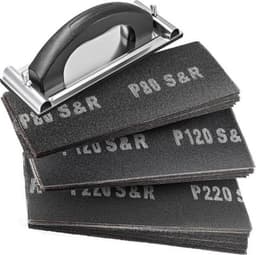
S&R ships thirty silicon carbide mesh sheets at 280 × 93 mm plus a hand block, with grits from P80 to P400, for £18.95 and 4.2 from 735 amazon.co.uk reviews. The bullets target drywall joints, filler, plaster, render and wood on a pole sander or hand block, which matches decorating more than disc sanding. The included-components line lists sheets at 93 × 280 mm and a block at 80 × 230 mm, so the two sizes do not match without trimming, and one UK buyer said the block was missing on arrival. Silicon carbide is the sharper grain Norton points at lighter pressure on fillers and non-ferrous work. Choose this when you already work with rectangular mesh sheets, not when you only own a round orbital.
Pros
Cons
Best for: Decorating with rectangular mesh sheets on filler, plaster or drywall joints, where you can trim to the block.
Less suitable: A round 125 mm or 150 mm orbital, or a job that needs the sheet and the block to be the same rectangle.
Specifications
Common questions
Are the sheets the same size as the block?
No. The sheets are 280 × 93 mm. The block is listed at 80 × 230 mm. They do not match without trimming. One UK review reported a missing block.
What grain is named?
Silicon carbide, which Norton points at lighter pressure on fillers and non-ferrous work. The bullets target drywall joints, filler, plaster, render and wood.
Will these fit a 125 mm disc pad?
No. They are rectangular sheets with a hand block, not hook-and-loop discs for a round orbital pad.
Sruhrak sells fifty 125 mm mesh discs for £15.29, rated 4.2 from 161 amazon.co.uk reviews, with grits stated from 80 to 400 and aluminium oxide in the bullets. UK buyers praise dust collection on orbital sanders compared with ordinary paper, though one reviewer using a Mirka extractor and a fresh bag still saw dust on the workpiece. The structured backing field says non-woven fabric while UK comments talk about Velcro grip, so treat attachment as hook-and-loop in practice but read the page carefully before you assume a PSA pad. The grain field also lists mixed abrasives against the oxide bullet line. At roughly £0.31 a disc it sits in the mid band for mixed 125 mm mesh, with a larger review file than several cheaper titles but a lower average than the 4.7 rows.
Pros
Cons
Best for: A 125 mm hook-and-loop orbital where you want a mixed grit box without paying for a trade net brand.
Less suitable: You rely on a PSA pad, or you expect Mirka-grade dust-through without checking extraction first.
Specifications
Common questions
Is the backing hook-and-loop?
UK comments talk about Velcro grip. The structured backing field says non-woven fabric and does not print hook and loop. Do not assume a PSA pad.
Did dust pass through on a Mirka setup?
One UK reviewer using a Mirka extractor and a fresh bag still saw dust on the workpiece. Other UK notes praise dust collection compared with paper.
Which grain is named?
The bullets say aluminium oxide and grits from 80 to 400. The grain field lists mixed abrasives, so the two lines do not agree.
NuoDunco lists fifty 125 mm hook-and-loop mesh discs for £10.99, with ten each of 80, 120, 180 and 240 grit and five each of 320 and 400, all described as aluminium oxide. The raw capture has no customer-review line and no review text, so grip, dust-through and edge tear are unknown from amazon.co.uk buyers in this file. Dimension fields at 12.7 cm match a 5 inch pad. At about £0.22 a disc it is the cheapest mixed 125 mm mesh pack in the set on shelf price alone, which is why it carries the best value badge, not because it beat ProDec on reviews. Treat it as a budget ladder when you can return a box that will not stick.
Pros
Cons
Best for: You want the cheapest stated mixed 125 mm mesh box and you can inspect loop grip on the first disc.
Less suitable: Shoppers who will not buy without amazon.co.uk review history, or worn pads that already throw paper.
Specifications
Common questions
Will these discs fit a 125 mm sander?
The title names hook-and-loop discs at 125 mm, and the dimension field is 12.7 cm, which matches a 5 inch pad. They will not fit a 150 mm pad.
What grits are in the box?
The listing states ten each of 80, 120, 180 and 240, and five each of 320 and 400. There is no review line to confirm what arrived.
Why is there no star rating?
This capture has no customer-review line and no review text. Grip, dust-through and edge tear are not described by amazon.co.uk buyers in the file.
Eleven amazon.co.uk listings were scored for this page. Weights sum to 100. A star row is the amazon.co.uk listing line. When the stored notes say the written reviews are not marked United Kingdom, those themes are not treated as a UK panel. There was no lab test. Shelf prices are from the 19 October 2026 capture, from £4.82 to £24.99. The missing review line on the NuoDunco pack stays in the score and in the text.
Amazon evidence
30%Star rating and review count on the UK listing. A 5.0 from 1, 3 or 5 reviews scores far below a 4.6 from 1,000-plus. A missing star line scores zero on this block.
Listing agreement
30%A size you can match to a pad, roll or block, a grit line that agrees with itself, a named grain, and a backing the field actually prints. Clashing grit fields, a centimetre line against a millimetre diameter, or a sheet and a block of different rectangles lose points.
Review outcome
25%Clogging, dust through the mesh, grip and life, taken from the stored review notes. Edge tear, discs leaving the pad, a missing block, and a review that says the sheets were unused are deductions. No review text scores zero.
Value
15%Shelf price in GBP against a pack you can still describe. The lowest price does not win the whole score when the review line is missing. It can still win the value award when the grit split and the diameter are stated.
The checks run in this order: pad or block, format, grit, grain, then price. The table is the eleven listings from the 19 October 2026 amazon.co.uk capture. None of these packs was measured in a lab. Mesh is not dust-free, and no kept listing prints UKCA or EN 13743.
Sanding mesh is a coated abrasive on an open weave. Shops also call it net sandpaper or sanding screen. You choose it when punched paper clogs, and when you want dust to pass through the face into the sander instead of lining up six or eight holes. The pad comes first. A 125 mm disc belongs on a 125 mm hook-and-loop pad. A 150 mm disc belongs on a 150 mm pad. Hook-and-loop does not stick to a PSA pad.

A 150 mm disc does not belong on a 125 mm pad. A roll does not mount as a disc. Gerlon’s 70 × 125 mm mesh needs that maker’s shim.
Pihemum’s field says 80 while the title lists 80–400. KQCXIK’s field says 240 while the highlight lists five grades. Read both lines.
Mesh lets air through. HSE still expects an M or H class extractor for wood dust, and RPE of at least APF 20 for much indoor wood sanding. A domestic vacuum is not that unit.
Diameter and attachment come first. In this set the 125 mm hook-and-loop rows are NuoDunco, SI FANG, KQCXIK, Sruhrak and Ruidawin. Pihemum is 150 mm only. Yurifaz is an 80 × 230 mm sheet. S&R prints sheets at 280 × 93 mm and a block at 80 × 230 mm, so those two rectangles are not the same part. Gerlon is a 70 × 125 mm refill. ProDec and QZATACAEN are rolls you cut. The machine under a round disc is a separate buy, covered in the [orbital sander comparison](/hub/sanders/orbital-sander).
Aluminium oxide is the ordinary grain on ProDec, NuoDunco, Gerlon and Yurifaz, and it is what the Sruhrak bullets name. Silicon carbide is on S&R and on the QZATACAEN roll. Ceramic is the KQCXIK title, and SI FANG and Ruidawin name oxide and ceramic together. None of those unbranded titles inherits Norton’s three-times laboratory line. Dust through the mesh still needs the hose. One UK Sruhrak note, on a Mirka extractor with a fresh bag, still saw dust on the work.
Three typical situations, each with a recommendation from this comparison.
You cut mesh for a block, a pole or a strip, at one medium grit. The ProDec Advance roll is the top pick: 5 m × 115 mm, 120 grit, £4.99, with 4.6 from 1,372 reviews. It is not a hook-and-loop disc.
You own a 125 mm hook-and-loop pad and you want the lowest shelf price for a stated fifty-disc mix. NuoDunco is £10.99. This capture has no star line, so grip and life are unknown from reviews.
Your orbital is 150 mm, not 125 mm. Pihemum is the only 150 mm mixed mesh row here, sixty discs at £24.99, with 4.4 from 65 reviews. UK notes mention torn rims and discs leaving a worn pad.
The top pick is the ProDec Advance 120 grit mesh roll, at £4.99, with 4.6 from 1,372 reviews. UK notes cover plaster, filler and timber cut to length. It is not a round disc. The best value is the NuoDunco 125 mm mix at £10.99, with a stated grit split and no review line in this capture. A missing star line does not become the top pick because the box is cheaper than the other 125 mm packs. A 150 mm disc does not belong on a 125 mm pad.

NuoDunco 125 mm mesh discs
Lowest shelf price for a stated 125 mm fifty-disc mix, at £10.99. No review line, so the score stays below the evidence-rich rows.
Editorial

Peter F. is the editor for DIY & tools at productscompared.co.uk. Comparisons in this category are checked against amazon.co.uk listings, review evidence and public UK sources.
Guides on what to look for, how to use a product, and common mistakes.
Sources taken from the research digest. Listings are from the amazon.co.uk capture of 19 October 2026.
This article contains affiliate links. If you buy through these links we may earn a small commission, at no extra cost to you. Prices, stars and review counts come from stored amazon.co.uk listings. We did not run a lab test.