Independent comparisons. We may earn from shop links. Our editors compare products independently. Some links go to shops, and we may earn a commission. More info
Top pick: Funnytek 75 × 533 mm zirconia belts Best value: Aucenix 75 × 533 mm sanding belts – Lowest 75 × 533 mm price in the set, at £8.49 for 14 belts. Reviews describe a proud seam that thumps, and the grain field is blank. Updated October 2026.
A sanding belt is a closed loop of abrasive cloth or paper, and the loop has to match the sander before grit matters. UK handheld machines commonly take 75 × 533 mm or 100 × 610 mm, while file sanders and some bench machines use other sizes, including 10 × 330 mm, 13 × 457 mm and 100 × 560 mm. Read the manual or the label on the worn belt. Do not order from the model name alone. Aluminium oxide is the usual grain for wood and softer metal when the listing names those materials. Zirconia suits harder steel only when the page says zirconia. HSE expects extraction where practicable and respiratory protection with an assigned protection factor of at least 20 for much handheld sanding. Match the loop on the [sanding belt size guide](/hub/sanders/sanding-belt/sub/sanding-belt-size-guide), then use the table for these twelve listings.
On a replacement buy, width and length come before grit.
A sanding belt is a closed loop of abrasive cloth or paper, and the loop has to match the sander before grit matters.
A sanding belt is a closed loop of abrasive cloth or paper, and the loop has to match the sander before grit matters. UK handheld machines commonly take 75 × 533 mm or 100 × 610 mm, while file sanders and some bench machines use other sizes, including 10 × 330 mm, 13 × 457 mm and 100 × 560 mm. Read the manual or the label on the worn belt. Do not order from the model name alone. Aluminium oxide is the usual grain for wood and softer metal when the listing names those materials. Zirconia suits harder steel only when the page says zirconia. HSE expects extraction where practicable and respiratory protection with an assigned protection factor of at least 20 for much handheld sanding. Match the loop on the [sanding belt size guide](/hub/sanders/sanding-belt/sub/sanding-belt-size-guide), then use the table for these twelve listings.
On a replacement buy, width and length come before grit.
A sanding belt is a closed loop of abrasive cloth or paper, and the loop has to match the sander before grit matters. UK handheld machines commonly take 75 × 533 mm or 100 × 610 mm, while file sanders and some bench machines use other sizes, including 10 × 330 mm, 13 × 457 mm and 100 × 560 mm. Read the manual or the label on the worn belt. Do not order from the model name alone. Aluminium oxide is the usual grain for wood and softer metal when the listing names those materials. Zirconia suits harder steel only when the page says zirconia.
Funnytek is a 12-belt, 75 × 533 mm zirconia pack at £21.99, the highest price in this set. The title lists grits 40, 60, 80, 120, 240 and 400, but the structured grit field is blank and the feature block is empty, while the materials line names metal, plastic, stone and wood. Weight is 735 g and country of origin is China. The star line is 5.0 from 1 review, which is why the stored score is 100, and rank is 26 in Abrasive Belts under Business, Industry & Science. The single stored text is about metalworking with two power files, which take narrow belts rather than a 75 mm handheld loop, so it does not show that this size fitted. There is no second review, no joint note and no life comment you can separate from that power-file sentence. It is the only 75 × 533 mm zirconia row here if your listing photos confirm the grain and the grit split, and it is not the top pick, because one mismatched review cannot carry a 75 mm belt against packs with thousands of ratings.
Pros
75 × 533 mm zirconia, the only zirconia row at that size
Title lists 40, 60, 80, 120, 240 and 400 grit
Materials line names metal, plastic, stone and wood
735 g, heavier than the aluminium oxide 75 mm packs
Cons
£21.99, the highest price, with 5.0 from one review
That review describes power files, not a 75 mm belt sander
Structured grit field and features are blank
Best for: You specifically want zirconia on a confirmed 75 × 533 mm sander and you will judge the belts yourself rather than from the single review.
Less suitable: You want a proven aluminium oxide mix with a large review file, or a narrow belt for a power file.
The listing targets 75 × 533 mm loops. The single review describes power files, which take narrow belts, so it does not show that this width fitted a handheld belt sander.
Can they be used on metal?
The materials line names metal, plastic, stone and wood. The one stored review is about metalworking with power files, not about this 75 mm loop on a belt sander.
What grits are in the pack?
The title lists 40, 60, 80, 120, 240 and 400 across 12 belts. The structured grit field and the feature block are blank.
STEBRUAM’s 100 × 560 mm pack is 10 belts at £15.99, rated 4.8 from 13 reviews, with rank 16 in Sander Belts. The feature line says two each of 60, 80, 100, 120 and 240 grit, while the structured grit field stores only 240. Backing is stored as cloth-backed, open-coat aluminium oxide, the materials line names wood, aluminium, non-ferrous metal, plastic and fibreglass, and a bullet claims a two-way tape joint plus an anti-clog coating. Weight is 650 g and the dimension line is 56 × 10 × 0.1 centimetres, which matches a 560 mm by 100 mm loop laid flat, with country of origin China. No praise or criticism text is stored, so the 4.8 sits on a count of 13 rather than a described joint or a described life. It is the mixed-grit option in this set for a sander whose manual says 100 × 560 mm. It will not tension on a 100 × 610 mm machine, where the NUTKIT row is the other length, so treat the high stars as a thin sample until you have used a belt.
Pros
100 × 560 mm, 10 belts at £15.99
Feature line lists two each of 60, 80, 100, 120 and 240
Cloth-backed, open-coat aluminium oxide
4.8 from 13 reviews
Cons
Structured grit field stores only 240
No review sentences are stored
13 reviews is a small file beside the 75 mm packs
Best for: Your manual says 100 × 560 mm and you want one cloth-backed aluminium oxide mix from 60 to 240 grit.
Less suitable: Your sander takes 100 × 610 mm, or you want written reviews about tracking and joint thump.
GEOGIEEW lists 15 belts at 75 × 533 mm for £15.99, with 4.7 from 120 reviews and rank 117 in Sander Belts. The stored review sample has no praise or criticism text, so the star line is a count without a written theme you can check. The title says mixed grits 80, 120, 150, 240 and 400, while a feature bullet says three each of 80, 120, 150, 240 and 320, and the structured grit field stores only 80. That is three different grit stories on one page. The bullets describe aluminium oxide on a fabric carrier, reinforced flat joints, and electrostatic coating so grain stays put, and they name grinding, sharpening, rust removal, metal and wood. Item weight is 550 g and the dimension line is 32 × 21 × 12 cm, which is a large carton figure for a belt loop. The score in this file is 96, level with the 100 × 560 mm pack, but the missing review sentences and the grit clash are the reason it is not the top pick. Choose it only after the live gallery shows which grit list you will actually receive.
Pros
75 × 533 mm, 15 belts at £15.99
4.7 from 120 amazon.co.uk reviews
Bullets name aluminium oxide on a fabric carrier
Title lists a spread from 80 through 400 grit
Cons
Title says 400 grit; a bullet says 320; the spec stores 80
No review sentences are stored
Rank 117 in Sander Belts, behind the high-count 75 mm packs
Best for: You want another 75 × 533 mm assortment at a similar price to the STEBRUAM 15-pack and you can verify the grit list on the live page.
Less suitable: You need the grit grades in writing without a title-versus-bullet clash, or written reviews about joint thump and life.
The STEBRUAM listing sold under the TX 33 brand line is a 75 × 533 mm, 15-belt pack at £16.99. The star line reads 4.6 from 9,614 reviews and rank 2 in Sander Belts, which is the same star line and rank as the 13 × 457 mm STEBRUAM row, and the stored review texts match that other size. A feature bullet says three each of 80, 120, 150, 240 and 400 grit in open-coat aluminium oxide, while the structured grit field only stores 400. The same bullet names wood, aluminium, non-ferrous metal, plastic and fibreglass, and a two-way tape joint that the listing says stays flat. Stored comments include a smooth joint, frayed edges that did not last as long as OEM belts, and abrasive that does not last, including belts that snap. Other stored lines name a Ryobi sander, a DeWalt kit and a power file, which is a poor match for a 75 mm handheld loop, so you should not treat every comment as proof about this width. At 520 g it is close in weight to the Ur-Excellent 12-pack, and it adds the finer 240 and 400 grades the 12-pack title does not list. Buy it when you want that wider grit spread on a 75 × 533 mm machine and you can live with a review file that is not unique to this ASIN.
Pros
£16.99 for 15 belts at 75 × 533 mm
Bullet lists three each of 80, 120, 150, 240 and 400
Open-coat aluminium oxide and a tape joint claimed
Star line 4.6 from 9,614 on this capture
Cons
Spec field stores only 400, not the five grades
Stored reviews match the 13 × 457 mm STEBRUAM listing
Comments include fraying, short life and belts that snap
Best for: You need a 75 × 533 mm assortment that states 80 through 400 grit and you will check the live grit photos before you rely on the blanker spec field.
Less suitable: You want a review file that clearly belongs to this width alone, or a single coarse grit for a long production run.
The listing targets belt sanders that take 75 × 533 mm loops. Stored reviews also name other machines, including a power file, so do not treat every comment as proof about this width.
Can they be used on metal?
The bullet names wood, aluminium, non-ferrous metal, plastic and fibreglass. That is a listing claim. The stored reviews are shared with the 13 × 457 mm row.
What grits are in the pack?
A feature bullet says three each of 80, 120, 150, 240 and 400 grit. The structured grit field stores only 400.
This STEBRUAM row is the 13 × 457 mm pack at £14.64, with a structured pack count of 15 belts and a listed weight of 400 g. The title and the included line say 15 sanding belts, while one feature bullet says 60 pieces with three each of 80, 120, 150, 240 and 400 grit, and the structured grit field is blank. A bullet says the belts are for Black & Decker Powerfile sanders and names wood, aluminium, non-ferrous metal, plastic and fibreglass, with open-coat aluminium oxide and a two-way tape joint. The star line is 4.6 from 9,614 and rank 2 in Sander Belts, identical to the 75 × 533 mm STEBRUAM row, and the stored review texts are the same, including comments about a Ryobi sander and a DeWalt kit. Those machines are not what the compatibility bullet names. Colour is stored as red/brown and the parcel size as 16 × 15 × 7 cm. It is the listing to open when your file sander manual says 13 × 457 mm and you can confirm the live pack count against the 15-versus-60 clash, and a poor default if you needed reviews written about this narrow belt.
Pros
13 × 457 mm, tied in a bullet to Black & Decker Powerfile sanders
£14.64, with open-coat aluminium oxide claimed
Feature bullet lists 80, 120, 150, 240 and 400 grit
400 g, lighter than the 75 mm assortments
Cons
Title says 15 belts; a bullet says 60 pieces
Structured grit field is blank
Star line and reviews match the 75 × 533 mm STEBRUAM listing
Best for: Your power file takes 13 × 457 mm and you will check the live image for whether the box is 15 belts or the 60-piece line in the bullet.
Less suitable: You need a review file that is clearly about this 13 mm belt, or a 75 × 533 mm handheld sander.
A bullet names Black & Decker Powerfile sanders and the size 13 × 457 mm. The stored reviews match the 75 × 533 mm STEBRUAM listing, including other machines.
Can they be used on metal?
The bullet names wood, aluminium, non-ferrous metal, plastic and fibreglass. That is a listing claim, and the review texts are shared with another size.
What grits are in the pack?
One bullet says three each of 80, 120, 150, 240 and 400, inside a 60-piece line. The title says 15 belts. The structured grit field is blank.
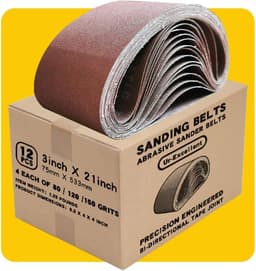
The Ur-Excellent listing is a 75 × 533 mm loop, and the part field also prints 3x21in, at £14.99 for 12 belts. On amazon.co.uk this capture shows 4.6 from 7,679 reviews and rank 3 in Sander Belts. The title and the feature lines say four belts each of 80, 120 and 150 grit in aluminium oxide, although the structured grit field is blank. Reviewers describe them smoothing wood, and one notes that the required direction of travel is marked on the inside of the belt. A buyer who compared them with original-manufacturer belts marked durability down, and another says the belts clog even while they stay sturdy enough to take some abuse. The feature list claims an antistatic, washable resin additive to resist loading, plus a diagonal lap splice, and names wood, aluminium, non-ferrous metal, glass, plastic and stone. At 530 g it is a mid-weight 75 mm assortment here, and the large review file is why it is the top pick when your sander takes this exact loop. It is a weaker box if you needed 240 grit and finer in the same pack, because those grades are not in the stated 80/120/150 split.
Pros
£14.99 with 4.6 from 7,679 amazon.co.uk reviews
Title states four each of 80, 120 and 150 grit
75 × 533 mm, also printed as 3x21in
A reviewer notes the direction mark inside the belt
Cons
Structured grit field is blank
Reviewers report clogging, and one rates durability below original belts
No 240 grit or finer in the stated assortment
Best for: You already know the sander takes 75 × 533 mm and you want 80, 120 and 150 grit for wood with a large review file.
Less suitable: You need 240 grit and finer in the same box, or a belt the reviews say outlasts an original-manufacturer loop.
The listing targets belt sanders that take 75 × 533 mm loops, also printed as 3x21in. Check your manual or the worn belt label before ordering.
Can they be used on metal?
The feature list names aluminium, non-ferrous metal, glass, plastic and stone, as well as wood. That is a listing claim, not a test on stainless steel.
What grits are in the pack?
The title and the feature lines say four belts each of 80, 120 and 150 grit. The structured grit field is blank. There is no 240 grit or finer in that stated split.
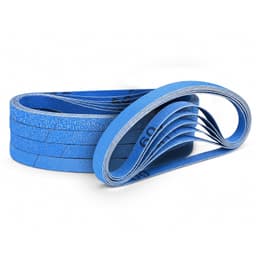
Sruhrak lists 30 belts at 10 × 330 mm for £11.99, with six each of 60, 80, 120, 240 and 400 grit in zirconia. The star line is 4.5 from 78 reviews, and rank is 2 in Abrasive Belts under Business, Industry & Science rather than the DIY Sander Belts rank used by most rows here, at a listed weight of 100 g. The bullets claim blue zirconia that outlasts aluminium oxide, a two-way seam, and a fit on 10 × 330 mm belt and file sanders. Stored criticism is specific: the first two belts snapped almost at once, and another buyer says they snap long before they wear out, while a separate note says zirconia belts outlasted a pack of aluminium oxide over three months. One stored review describes 533 × 9 mm belts and a count of 40, which is not this listing’s size or pack count, so that text should not be read as a fit report for 10 × 330 mm. It is the mixed zirconia file-sander pack when your machine is that size and you can afford belts that fail at the joint. It is the wrong buy for a 13 × 457 mm power file.
Pros
30 belts, six each of 60, 80, 120, 240 and 400, at £11.99
10 × 330 mm zirconia, with a two-way seam claimed
4.5 from 78 reviews
One reviewer reports a longer life than aluminium oxide over three months
Cons
Reviews say belts snapped before the grit was worn out
One stored review describes 533 × 9 mm and a pack of 40
Rank sits in Business abrasive belts, not DIY Sander Belts
Best for: You have a 10 × 330 mm file sander and you want zirconia across 60 to 400 grit rather than a single grade.
Less suitable: You need a 13 × 457 mm loop, or you cannot tolerate belts that reviews say snap at the joint.
The bullets claim a fit on 10 × 330 mm belt and file sanders. One stored review describes 533 × 9 mm and a count of 40, which is not this pack.
Can they be used on metal?
The stored materials line does not name a metal. The bullets claim blue zirconia that outlasts aluminium oxide, which is a life claim, not a materials list.
What grits are in the pack?
The listing says six each of 60, 80, 120, 240 and 400 grit, 30 belts in total. The spec field stores 400.
Kozelo is a 20-belt pack of 13 × 457 mm loops at £7.49, with four each of 60, 80, 120, 180 and 240 grit, and the bullet also prints the inch size 1/2 × 18 inch. Grain is aluminium oxide, the materials line lists glass, metal and wood, and this capture shows 4.4 from 17 reviews, rank 38 in Sander Belts, country of origin China, and a weight of 130 g. The dimension field reads 106.7 × 5 × 5 centimetres, which is a long carton figure beside a 457 mm belt. One UK review says the belts work with a Black & Decker power file, while a review filed from the United States says they are not a great fit on a Black & Decker Powerfile and slip off quite a lot. The bullets claim a smooth seam in both directions, electrostatic coating, and hard cloth that is moisture-proof. With only three review texts stored, that slip comment is a large share of the written evidence. It is a low shelf price for a stated five-grit file-sander mix, and a gamble if your power file is already fussy about tracking.
Pros
£7.49 for 20 belts, four each of 60, 80, 120, 180 and 240
13 × 457 mm, also written as 1/2 × 18 inch
Aluminium oxide, with glass, metal and wood named
One UK note of a fit on a Black & Decker power file
Cons
Only 17 reviews, with three texts stored
A US review says the belts slip off a Black & Decker Powerfile
Dimension field prints 106.7 cm beside a 457 mm loop
Best for: You run a 13 × 457 mm power file, you want coarse through 240 grit, and you can return a pack that will not track.
Less suitable: You need a large review file, or a 10 × 330 mm belt, which is a different loop.
The size is 13 × 457 mm, also written as 1/2 × 18 inch. One UK review reports a fit on a Black & Decker power file. A US review says the belts slip off a Powerfile.
Can they be used on metal?
The materials line lists glass, metal and wood. That is a listing claim. Only three review texts are stored, and they discuss fit rather than metal.
What grits are in the pack?
Four belts each of 60, 80, 120, 180 and 240 grit, 20 belts in total. The spec field stores that same sequence.
Shineboc sells 30 belts at 10 × 330 mm, all 240 grit, for £14.99. The bullets call the grain blue zirconium corundum, which this file stores as zirconia, and they pair the size with 3/8 × 13 inch air-file sanders. The star line is 4.3 from 544 reviews and rank 6 in Sander Belts, at a listed weight of 90 g. Several stored reviews describe other jobs or sizes, including a Parkside 9 × 533 mm sander, a mixed grit range and a Makita, so those lines are a weak guide to this single-grit 10 mm pack. Comments that do read like a narrow belt mention snapping, failure at the joint before the grit is worn out, and abrasive that sheds faster than a branded belt, alongside notes that some lasted longer than ordinary aluminium oxide. The listing claims a bi-directional diagonal join meant to avoid a splice bump, and it aims the grain at harder metal and blade sharpening as well as wood, with no second grit in the title or the bullets. It suits a 10 × 330 mm file sander when you specifically want 240 grit zirconia in bulk, and it is the wrong loop for a 75 mm or 100 mm handheld.
Pros
30 belts of 240 grit at 10 × 330 mm for £14.99
Zirconia, described as blue zirconium corundum
4.3 from 544 reviews and rank 6 in Sander Belts
Bullet claims a bi-directional diagonal join
Cons
Single grit only, so there is no coarse belt in the box
Stored reviews include other sizes and mixed-grit comments
Matching comments mention snapping at the joint and shedding
Best for: Your file sander takes 10 × 330 mm and you want a large stock of 240 grit zirconia rather than a grit mix.
Less suitable: You need coarse grits in the same pack, or a 75 × 533 mm or 100 mm handheld belt.
The bullets pair 10 × 330 mm with 3/8 × 13 inch air-file sanders. Several stored reviews name other sizes, so those lines are a weak guide to this pack.
Can they be used on metal?
The listing aims the zirconia grain at harder metal and blade sharpening as well as wood. That is a claim. Some stored reviews are about other machines.
What grits are in the pack?
All 30 belts are 240 grit. There is no coarse belt in the title or the bullets.
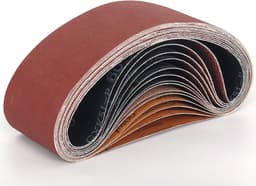
Aucenix is the £8.49 pack of 14 belts at 75 × 533 mm, rated 4.3 from 83 reviews, with rank 7 in Sander Belts. The title lists grits 60, 80, 120, 180, 240, 400 and 600, but the feature block, grain, backing and structured grit field are all blank, so that sequence lives in the title only. Reviewers who like it mention a snug fit, plenty of grades and a useful price. The repeated complaint is the joint: overlapped seams that thump or bounce the sander each revolution, a seam that kept catching, and a buyer who then bought different belts from Screwfix. Another note says a couple of belts broke after a small block of wood, described as 6 × 4 × 4 inches. Weight is 520 g, in line with the other 75 mm packs. It is the best value when you already own a 75 × 533 mm sander and you will reject any belt whose seam stands proud before you sand a show face. It is a false economy if a smooth joint matters more than the £8.49 shelf price.
Pros
£8.49 for 14 belts at 75 × 533 mm
4.3 from 83 reviews and rank 7 in Sander Belts
Title lists 60 through 600 grit
Several reviewers report a useful range of grades
Cons
Grain, backing and the grit field are blank
Reviews describe a high joint that thumps or bounces the sander
One buyer reports belts breaking on a small wooden block
Best for: You want the lowest 75 × 533 mm price in this set and you will check each seam before you sand a visible surface.
Less suitable: You need a flat joint for furniture, or a spec line that names the grain rather than a title-only grit list.
NUTKIT is a single-grit pack: 12 belts, 100 × 610 mm, 80 grit aluminium oxide, at £12.99. The star line is 4.1 from 13 reviews, with rank 209 in Sander Belts, and the materials line names metal, plastic and wood. Weight is 890 g, the heaviest row in this set, country of origin is China, the manufacturer field says HFX-online while the brand line says NUTKIT, and the unit-count field stores 1.0 gram, which is not a usable pack count beside the title’s 12 belts. Features and joint notes are blank. The three stored reviews are mild: decent quality, reasonable for a belt sander, and useful while restoring wooden windows, with no criticism text stored. There is no 120 or 240 belt in the title, so a furniture job still needs a finer pack afterwards. It is the only 100 × 610 mm row here, which matters if that is the length on your worn belt, and a thin file if you wanted mixed grits or a crowd of reviews.
Pros
100 × 610 mm, 80 grit aluminium oxide, 12 belts at £12.99
The only 610 mm length in this comparison
Materials line names metal, plastic and wood
Review notes mention wooden-window restoration
Cons
4.1 from 13 reviews and rank 209 in Sander Belts
80 grit only, so there is no finer belt in the pack
Manufacturer field says HFX-online, and joint notes are blank
Best for: Your manual or old belt says 100 × 610 mm and you want 80 grit aluminium oxide for stock removal on wood.
Less suitable: You need 100 × 560 mm, a grit finer than 80, or a large review file.
YUANLTDQIN lists a 60-pack of 13 × 457 mm aluminium oxide belts at £13.25. The title says 10 each of 40, 60, 80, 120, 180 and 240 grit and names metal, rust, paint and welding grinding, while the structured grit field, the feature block and the materials field are blank. This capture has no star rating and no review text, and the score stored on the row is 75. Weight is 378 g and rank is 133 in Sander Belts. There is no joint description and no compatibility line beyond sanders that take 13 × 457 mm. At £13.25 for 60 belts it is the largest pack count here, but the missing rating means you cannot see whether those belts track or snap. It is a speculative bulk buy for a 13 × 457 mm file sander if you accept an unrated listing, and it is not a substitute for the Kozelo pack if you wanted even a small set of written reviews.
Pros
60 belts at 13 × 457 mm for £13.25
Title lists 10 each of 40, 60, 80, 120, 180 and 240
Aluminium oxide is the stored grain
378 g for the stated count
Cons
No amazon.co.uk star rating and no review text in this capture
Structured grit field and features are blank
No joint or backing description
Best for: You need a large stock of 13 × 457 mm belts and you can inspect the live page because this file has no reviews.
Less suitable: You want a rated pack, a written fit note for a Black & Decker power file, or any size other than 13 × 457 mm.
The title is for sanders that take 13 × 457 mm loops. There is no further compatibility line and no review that confirms a fit.
Can they be used on metal?
The title names metal, rust, paint and welding grinding. The materials field is blank, and this capture has no review text.
What grits are in the pack?
The title says 10 each of 40, 60, 80, 120, 180 and 240 grit. The structured grit field and the feature block are blank. There is no star line in this capture.
How we compared
Twelve amazon.co.uk listings were scored for this page. Weights sum to 100. A grit list that appears only in the title, a shared review file across two sizes, and a star line with no written reviews are not treated as a lab result. There was no lab test. Shelf prices are the stored listing prices, from £7.49 to £21.99.
1
Size match
30%
Width and length have to match the manual or the worn belt. A 100 × 560 mm loop does not tension on a 100 × 610 mm machine, and a 10 × 330 mm file belt does not run on a 13 × 457 mm power file.
2
Amazon evidence
25%
Star rating and review count on amazon.co.uk, with a deduction when the count is thin, when the raw file has no star line, or when the stored reviews belong to a different belt size.
3
Grit and grain
25%
A grit sequence that the title and the bullets agree on, and a grain the listing actually names. A blank spec field, or 400 in one place and 320 in another, deducts. Zirconia scores only when the page says zirconia.
4
Joint and value
20%
A stated joint, and review notes about thump, snap or clogging, set against the shelf price in GBP and the number of belts. The lowest price does not erase a seam that reviewers say bounces the sander.
Independent review
Last updated: October 2026
8 sources checked
Sanding belt buying guide
The checks run in this order: loop size, grit, grain, joint, then price. The table is the twelve listings. None of these belts was measured in a lab for this page. A review count is hobby-weight use on amazon.co.uk, not a proof of industrial life. A sanding belt does not control wood dust by itself.
What is a sanding belt?
A sanding belt is a closed loop of abrasive cloth or paper. The loop has to match one belt sander or one bench machine. On a replacement buy, width and length come before grit. A wrong length will not tension. A wrong width will not track. UK handheld machines commonly use 75 × 533 mm or 100 × 610 mm. Some models use 75 × 457 mm or 100 × 560 mm. File sanders and pipe tools use narrow loops such as 10 × 330 mm and 13 × 457 mm.
Best for
A 75 × 533 mm handheld sander used on wood, with a mixed grit pack
A file sander whose manual prints 10 × 330 mm or 13 × 457 mm
Not ideal for
Anyone ordering from the sander’s model name without measuring the old belt
Regular indoor woodwork with no extraction and no suitable mask
Mistakes to avoid
1
Ordering from the model name
A wrong length will not tension and a wrong width will not track. 100 × 560 mm and 100 × 610 mm are not interchangeable. Neither are 10 × 330 mm and 13 × 457 mm.
2
Skipping grit steps
Coarse scratches from about P40 to P80 remain if you jump to a fine belt. A mixed pack only helps if you actually use the grades in order.
3
Ignoring the dust
HSE treats wood dust as a serious hazard. Extraction where practicable, and RPE with an assigned protection factor of at least 20 for much handheld sanding, are the expectation. Do not sand lead paint without an assessment.
What to weigh up
Size and grit
High
Size is the first cut. The loop on the worn belt, or the size in the manual, has to match the listing. In this set the handheld width is 75 × 533 mm on the Ur-Excellent, STEBRUAM, GEOGIEEW, Aucenix and Funnytek rows. The 100 mm rows split by length. STEBRUAM is 100 × 560 mm and NUTKIT is 100 × 610 mm. Those two lengths do not interchange. Narrow loops are Shineboc and Sruhrak at 10 × 330 mm, and STEBRUAM, Kozelo and YUANLTDQIN at 13 × 457 mm.
Grain, joint and dust
High
Aluminium oxide covers general wood and softer metal when the listing names those materials. Zirconia is the grain on Shineboc, Sruhrak and Funnytek. Ceramic is not named on these rows. Zirconia is not a better wood belt by default. It can cost more, as the Funnytek pack does at £21.99, without helping on softwood. Open coat, claimed on the STEBRUAM rows, is the coating that resists clogging on softwood and paint.
Which option suits you?
Three typical situations, each with a recommendation from this comparison.
🪵
75 mm sander, wood, mixed grit
You already know the machine takes 75 × 533 mm and you want 80, 120 and 150 grit with a long review file. The Ur-Excellent pack is the top pick at £14.99, with 4.6 from 7,679 reviews. Reviewers also report clogging, and there is no 240 grit in the stated split.
You want the cheapest 75 × 533 mm pack in this set and you will check each seam before you sand a visible face. The Aucenix 14-pack is £8.49. Reviews describe a high joint that thumps, and the grain field is blank.
Your tool takes 10 × 330 mm or 13 × 457 mm, not a 75 mm handheld belt. Shineboc is 30 belts of 240 grit zirconia at 10 × 330 mm. Kozelo is the £7.49 mix at 13 × 457 mm, with a review that says the belts slip on a Black & Decker Powerfile.
The top pick is the Ur-Excellent 75 × 533 mm pack, twelve belts at about £14.99. amazon.co.uk shows 4.6 from 7,679 reviews, and the title states four each of 80, 120 and 150 grit in aluminium oxide. Reviewers describe wood sanding and a direction mark inside the belt. They also report clogging. There is no 240 grit in the stated split. It is the top pick only when your sander takes that exact loop.
How much does a sanding belt pack cost on amazon.co.uk?
In this set the shelf prices run from about £7.49 for the Kozelo 20-belt pack at 13 × 457 mm, and £8.49 for the Aucenix 14-belt pack at 75 × 533 mm, up to £21.99 for the Funnytek zirconia 12-pack. Most mixed 75 mm packs sit between £14.64 and £16.99. The NUTKIT 80-grit box at 100 × 610 mm is £12.99. These are stored amazon.co.uk prices for these twelve ASINs, not a market average.
What should I check before I buy sanding belts?
Check width and length first, against the manual or the old belt. Then check the grit list on the title, the bullets and the spec field, because several rows here disagree with themselves. Then check the grain. Aluminium oxide is the general choice for wood. Zirconia counts only when the listing names it. Read the joint notes and the reviews for thump, snap and clogging. Price comes last. A blank spec field is not a confirmed mix.
Which sanding belt size do I need?
You need the size printed for your machine. In this comparison, 75 × 533 mm is the common handheld loop. 100 × 560 mm and 100 × 610 mm are different lengths and do not swap. 10 × 330 mm and 13 × 457 mm are file-sander loops and do not swap either. A bullet that names a Black & Decker Powerfile is about 13 × 457 mm, not about a 75 mm belt sander. If the old belt is missing, match the loop before you order.
Is aluminium oxide or zirconia the better grain?
Aluminium oxide is the general grain for wood and softer metal when the listing includes those materials. Zirconia is tougher and is the grain to consider for harder steel and heavy removal. It is not automatically better for softwood, and it can cost more without a benefit. In this set the zirconia rows are Shineboc and Sruhrak at 10 × 330 mm, and Funnytek at 75 × 533 mm. Funnytek has one review, and that review describes power files.
Do I need dust extraction when belt sanding?
Yes for regular indoor woodwork. HSE guidance on hand-held powered sanders expects on-tool extraction where practicable, and respiratory protective equipment with an assigned protection factor of at least 20, such as FFP3, for much handheld sanding, plus a face fit for a tight mask. Wear eye protection as well. Do not sand lead paint or an unknown old coating without a proper assessment. A resin additive on a belt is not a dust control.
Why do some sanding belts thump or snap?
The joint passes the platen every revolution. A lap or diagonal splice should run flat. Aucenix reviews describe an overlapped seam that thumps or bounces the sander, and one buyer then bought different belts. Sruhrak and Shineboc comments include belts that snap at the joint before the grit is worn out. A smooth-joint claim on a listing is not a measurement. Check a new belt by hand before you sand a visible face.
Should I buy a mixed-grit pack or one grit?
Buy a mixed pack when one job moves from coarse removal to a finer grade and you already know the loop size. Buy a single grit when you will stay on one grade, as with the Shineboc 240-grit box of 30, or the NUTKIT 80-grit box of 12 at 100 × 610 mm. A title that lists seven grits while the spec field is blank, as on the Aucenix pack, is a weaker promise than a title and a bullet that name the same grades.
Our verdict
The top pick is the Ur-Excellent 75 × 533 mm pack, at £14.99, with 4.6 from 7,679 reviews and a stated split of 80, 120 and 150 grit. Reviewers report clogging, and one rates durability below original-manufacturer belts. The best value is the Aucenix 14-pack at £8.49, with 4.3 from 83 reviews. The repeated complaint is an overlapped joint that thumps. A 4.3 from 83 reviews does not become the top pick because it is the cheapest. A 10 × 330 mm belt will not run on a 75 mm sander.
Peter F. is the editor for DIY & tools at productscompared.co.uk. Comparisons in this category are checked against amazon.co.uk listings, review evidence and public UK sources.
Updated: October 2026
8 sources checked
Guides to sanding belts
Guides on what to look for, how to use a product, and common mistakes.
This article contains affiliate links. If you buy through these links we may earn a small commission, at no extra cost to you. Prices, stars and review counts come from stored amazon.co.uk listings. We did not run a lab test.