Independent comparisons. We may earn from shop links. More info

How to change a sanding belt

Updated: 21 October 2026

The new loop is in the wrong direction, the sander thumps once a revolution, and the belt is already walking off the roller. Changing a sanding belt is a short job if the machine is unplugged and the size is the one printed on the old cloth. The Products Compared editorial team wrote this from the review notes in our [sanding belt comparison](/hub/sanders/sanding-belt) and from HSE guidance on hand-held sanding, not from a single brand’s service manual. Lever names differ. Your manual wins where it disagrees with a generic step. A qualifying purchase through our links can earn a commission at no extra cost to you.

The new loop is in the wrong direction, the sander thumps once a revolution, and the belt is already walking off the roller.

Our top picks

On this page

Before you start

Unplug a corded sander, or remove the battery, before your fingers go near the rollers. Wear eye protection. For wood, HSE guidance expects on-tool extraction where you can connect it, and a mask of at least APF 20, such as a face-fit tested FFP3, for much of this work. Do not sand lead paint or a coating you cannot identify. Read the size and the arrow while the belt is in your hand. If they do not match the manual, stop. Forcing a 560 mm belt onto a 610 mm sander tears the joint. The pairs in this comparison are on the sanding belt size guide.

Taking the old belt off

Release the tension before you pull. On most handheld sanders a side lever cams the front roller back. On a file sander it may be a knob or a spring arm. If the loop will not slide off sideways, the tension is still on. Do not cut a belt off unless the lever is broken and the tool is isolated. A shiny face has stopped cutting. A frayed edge has been tracking into the housing. Aucenix reviewers describe seams that stand proud and thump. Check the new belt for that step, pencil the arrow if you might refit the old one, and dust the rollers while the tool is unplugged.

Direction and the joint

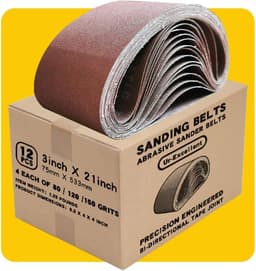
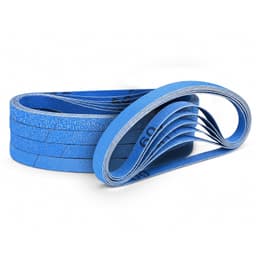
The arrow inside the belt must agree with the arrow on the sander. One Ur-Excellent reviewer points out that the direction is printed inside the loop. Run the lap backwards and the trailing edge picks, thumps and can tear. STEBRUAM claims a two-way tape joint, and Shineboc a diagonal connection. Aucenix buyers report a seam that bounces the sander, and one stopped using the pack. Sruhrak and Shineboc notes include belts that snap before the grit is worn out. Pinch the seam. A step will mark a show face.

Tension and tracking

Close the lever to the firm cam the manual describes. Too loose and the belt walks off on the work. Too tight and the joint snaps, which is the failure in the narrow-belt reviews. If the lever will not close, the belt is short or the release is not fully open. Do not add washers and do not cut the belt. Track with the belt moving and your hands clear. Turn the knob a little, let it settle, then turn again. If it still walks, unplug and check width, a glazed roller and a lumpy seam. A fresh coarse belt digs a hollow if you pivot on the front roller. Connect extraction before that cut.

When to throw a belt away

Retire a belt when it no longer cuts, when the joint is split or proud enough to thump, or when the edge is frayed into the housing. Ur-Excellent reviewers report clogging, and life below original-manufacturer belts, even where an anti-loading additive is claimed. Washing is a listing claim, not a method we tested. Shineboc’s pack is 240-grit zirconia only, which will not strip failed varnish in a sensible time. Do not tape a snapped Sruhrak belt back onto a show face. The next grade is the sanding belt grit guide.

Common questions

Which way round does a sanding belt go?
The arrow inside the belt points the same way as the rotation arrow on the sander. That keeps the lap joint from catching. If the print has rubbed off, mark a pencil arrow before you remove a belt you might refit. A listing that says the joint runs both ways still does not beat a printed arrow when you can see one.
How tight should the belt be?
Tight enough that the tension lever closes as the manual intends, and tight enough that the belt does not creep when it touches the work. If you are forcing the lever, the belt is short or the release is incomplete. If the belt flaps, it is loose or too long. The tracking knob cannot replace tension.
How do I stop the belt walking off?
Unplug, check the width and the seam, then track with the belt running and your hands clear. Turn the knob a little at a time until the belt sits in the middle of the roller. A narrow belt on a power file, which is the Kozelo slip comment, may still walk. A proud joint, the Aucenix complaint, will thump and can walk even when the length is right.
The belt keeps slipping off. What else causes it?
Wrong length, wrong width, a loose tension lever, dust built up on the roller, or a joint that stands proud. Confirm the millimetres against the size guide before you blame the tracking screw. A 100 × 560 mm belt will not behave on a 100 × 610 mm sander. Neither will a 10 × 330 mm belt on a 13 × 457 mm file.
When should I discard a belt?
When it no longer cuts, when the edge is frayed, when the joint is split or proud enough to thump, or when it has snapped. Clogged aluminium oxide that only polishes is finished, whatever the grit number still says. Do not tape a broken narrow belt and put it back on a show-face job. Order the next one to the size in the manual.

Related pages

Sources

Sources taken from the research digest. Listings were checked from the stored amazon.co.uk capture.

  1. BenchRefill — sanding belt grits (retrieved 21.10.2026)
  2. BenchRefill — handheld belt sizes (retrieved 21.10.2026)
  3. Mirka UK — belt sanding (retrieved 21.10.2026)
  4. Abrasive Finishing Systems — handheld belt selection (retrieved 21.10.2026)
  5. Faithfull Tools — belt sander belts (retrieved 21.10.2026)
  6. HSE WD7 — hand-held powered sanders (retrieved 21.10.2026)
  7. HSE — wood dust (retrieved 21.10.2026)
  8. SAIC UK — belt size finder (retrieved 21.10.2026)