Independent comparisons. We may earn from shop links. More info

Sanding belt grit chart for wood and metal

Updated: 21 October 2026

You have fitted a fresh belt and the door still shows the last scratch, only shinier. A sanding belt grit chart is there to tell you which grade does the cutting and which grade you should leave for a block or a random orbit. The Products Compared editorial team used the grit lines in our [sanding belt comparison](/hub/sanders/sanding-belt) and the public UK notes on FEPA grades and wood dust. We did not measure stock removal in a lab. A qualifying purchase through our links can earn a commission at no extra cost to you.

You have fitted a fresh belt and the door still shows the last scratch, only shinier.

Our top picks

On this page

Reading grit numbers

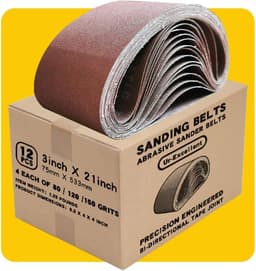
The P in front of a grit is the FEPA scale used on most belts sold for UK sanders. A bigger number is a smaller grain. About P40 to P80 is coarse removal, P80 to P120 is the smoothing band, and P120 to P180 is as fine as a belt usually needs to go before you change tool. P240 and P400 on these packs are for a light pass or for metal, not for flattening a twisted stile. If you jump from 60 to 180, the fine belt polishes the high spots and leaves the grooves. Step one or two grades at a time. Ur-Excellent’s stated set is 80, 120 and 150. Aucenix’s title adds 60, 180, 240, 400 and 600, with the spec field blank, so you only have that ladder if the belts in the box are printed that way.

Grit stages for wood

Failed varnish and saw-mill glaze usually want something around 60 or 80. A 40-grit belt, which YUANLTDQIN’s title includes and most of the 75 mm packs here do not, digs in if you lean on the front roller. Eighty grit is the workhorse: it is in the Ur-Excellent mix, and it is the whole of the NUTKIT 100 × 610 mm pack. Move to 120 once the shape is right, and stop around 150, the finest grade Ur-Excellent states, for furniture you will finish by hand. Pushing a belt through 240 on softwood often burnishes a loaded belt. Belt to about 120 or 150, then a block or a random orbit for 180 and above before the first coat.

Grit stages for metal

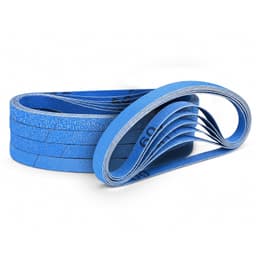
Metal wants less pressure than timber. Leaning on the belt heats the joint and blues the surface. For rust and mill scale, start around 60 or 80 if the pack contains it. NUTKIT’s materials line includes metal, and the only grit in that box is 80, so it is a removal belt rather than a polish. Step 80, 120, 180 if you have them, and stop when the scratch is even. Harder steel is where the listing should say zirconia or ceramic. Ceramic is not named on any pack here. Zirconia is named on Sruhrak and Shineboc, both 10 × 330 mm, and on Funnytek at 75 × 533 mm. Sruhrak’s mix runs 60, 80, 120, 240 and 400, six of each. Aluminium and brass are a better match for aluminium oxide than for a grain aimed at steel.

Abrasive grains

Aluminium oxide is the general grain for wood, paint and mild steel. It wears by rounding, so a dull belt starts to polish and heat. Change it. Do not press harder. Zirconia fractures and exposes fresh edges, which is why listings aim it at harder metal. It can be wasted money on softwood. Funnytek’s zirconia 12-pack is £21.99, against aluminium oxide 75 mm packs from £8.49 to £16.99. Do not relabel a blue zirconia belt as ceramic. Silicon carbide, often used on glass, stone and between coats, is not the stored grain on these rows. Ur-Excellent’s feature list still names glass and stone. Take the grain from the spec field when it is filled in. How that sits next to price is the sanding belt buying guide.

Open coat and clogging

Open coat means the grains are spaced so dust has somewhere to sit. Prefer it for softwood, old varnish and filler. Closed coat cuts harder on dry material, then loads on resin. STEBRUAM’s bullets on the 75 mm and 13 mm rows say “special anti-clog coating”, and the 100 × 560 mm backing field says open coat. One Ur-Excellent review still says the belts clog, while calling them sturdy. A shiny band and a sudden loss of cut mean the belt is loaded. HSE guidance treats wood dust as a health hazard: on-tool extraction where you can connect it, and a mask of at least APF 20, such as FFP3, for much handheld sanding. When the cut dies, change grade or change belt.

Common questions

What grit sanding belt should I use on wood?
As a rule of thumb, 60 or 80 to clear finish and shape the timber, 120 to replace those scratches, and about 150 as the last belt grade before hand sanding. Ur-Excellent states 80, 120 and 150. Going to 240 on a belt sander often burnishes softwood. Stop and switch tool once the scratch looks even.
What grit removes paint?
Coarse, around 40 to 80, ideally on an open-coat belt so the paint has somewhere to go. NUTKIT is 80 grit only. Packs whose title starts at 80 will work, more slowly than a 40. Do not sand lead paint or a coating you cannot name. Extraction and a proper mask matter more on old paint than the brand of belt.
Is P80 or P120 the right next belt?
P80 while you are still removing material or old finish. P120 once the surface is flat and you are only chasing the 80-grit scratch. If you fit 120 too early you will spend a long time and load the belt. If you stay on 80 too long you cut hollows, especially near the front roller.
Can I jump from 60 to 180?
You can fit the belt, and you will still see the 60-grit grooves. The fine belt polishes the ridges and leaves the valleys. Step 60, then 80 or 100, then 120, then 150 or 180. Aucenix’s title includes those steps. Whether every belt in the delivered box is labelled that way is something the blank spec field does not prove.
Which grain is for steel, and which for aluminium?
Zirconia, where the listing says so, is the grain aimed at harder steel. Sruhrak and Shineboc say it, on 10 × 330 mm belts. Aluminium and other non-ferrous metals are a better match for aluminium oxide in this set, because silicon carbide is not the stored grain. Light pressure either way. Ceramic is not in these listings.
What is the finest grit to use on a belt sander before finish?
For furniture, stop around 120 or 150 and move to a block or a random orbit. Belts of 240, 400 and 600 appear in some titles here, and they are optional light passes, not the usual last step before varnish. A belt sander is for removal and for making the scratch one size, not for the final polish.

Related pages

Sources

Sources taken from the research digest. Listings were checked from the stored amazon.co.uk capture.

  1. BenchRefill — sanding belt grits (retrieved 21.10.2026)
  2. BenchRefill — handheld belt sizes (retrieved 21.10.2026)
  3. Mirka UK — belt sanding (retrieved 21.10.2026)
  4. Abrasive Finishing Systems — handheld belt selection (retrieved 21.10.2026)
  5. Faithfull Tools — belt sander belts (retrieved 21.10.2026)
  6. HSE WD7 — hand-held powered sanders (retrieved 21.10.2026)
  7. HSE — wood dust (retrieved 21.10.2026)
  8. SAIC UK — belt size finder (retrieved 21.10.2026)