Independent comparisons. We may earn from shop links. More info

Linisher comparison 2026

The best linishers, compared.

Top pick: Bucktool MM491GV variable-speed belt and disc sander Best value: Not assigned – The cheapest machine has a 25 mm belt, and the cheapest 100 mm belt has repeated UK arrival faults. Updated October 2026.

Peter F.
Peter F.Editor

You want a bench machine that trues an edge or a small part, and the listings shout about watts. A linisher is a stationary abrasive-belt machine, usually sold on amazon.co.uk as a belt-and-disc bench sander. UK woodworkers buy one for edges, end grain and small parts. Knife makers and fabricators often need a different machine. Judge one by belt width, a table that stays put, a hose port and belt speed, not by the wattage in the title. The common full-size belt here is about 100 × 914 mm, with a 150 mm disc and roughly 370–380 W. This set also includes a 25 mm belt, a grinding wheel with a 50 mm belt, and a 700 W variable-frequency combo. Scores start from the published star line, so one review cannot outrank hundreds. Belt width and who should skip each type are set out in the [linisher buying guide](/hub/sanders/linisher/sub/linisher-buying-guide). Guided knife sharpeners, handheld belt files, disc-only sanders and battery rotary kits are not linishers.

You want a bench machine that trues an edge or a small part, and the listings shout about watts. A linisher is a stationary abrasive-belt machine, usually sold on amazon.co.uk as a belt-and-disc bench sander.

22 products checked · 58 hrs invested · +21,400 readers

6 of 6: Best linishers compared

Swipe for more

1-2 of 6
Best overall
Bucktool MM491GV variable-speed belt and disc sander
Bucktool BD4802IV 700 W belt and disc sander
Clarke CS4-6E belt and disc sander
Best value
Bucktool MM493C 25 mm belt and disc sander
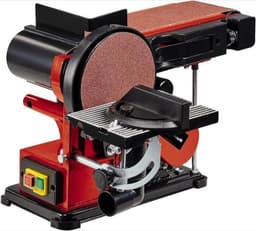
Einhell TC-US 380 belt and disc sander
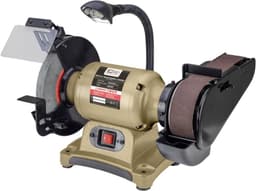
SIP-01459 bench grinder and linisher
7.9/10
7.5/10
8.9/10
8.7/10
8.0/10
–/10
∼ £160
∼ £300
∼ £136
∼ £86
∼ £121
∼ £156
5.0(1)
5.0(1)
4.5(149)
4.5(46)
4.2(448)
–
View offer
View offer
View offer
View offer
View offer
View offer

The best linishers in detail

Bucktool MM491GV variable-speed belt and disc sander

Rank 1

Bucktool MM491GV variable-speed belt and disc sander

∼£160

Our view

The Bucktool MM491GV is the only 100 mm machine here with stated variable speed: 300–600 m/min on the 100 × 915 mm belt and 2,000–4,000 rpm on the 150 mm disc, from a 370 W motor. It also lists a 60 mm dust port, a tension lever for belt changes and hook-and-loop disc paper, which addresses the disc complaint on the smaller Bucktool. The listing shows 5.0 from a single amazon.co.uk review, and that one UK owner calls the speed control really useful, the belt a good size and the disc support very accurate. One review is not a durability record, and nothing in the file says how the table, switch or tracking hold up over months. The listing does not state which abrasives come in the box, and a buyer's question about metal use has no answer. At about £159.99 and 13 kg it is worth a look if slower belt speeds matter for heat-sensitive work, as long as you buy knowing the owner record is almost empty.

Pros

  • Stated belt and disc speed ranges
  • 60 mm dust port and hook-and-loop disc
  • The one UK review praises speed control and the disc support

Cons

  • Only one stored review
  • Abrasives in the box are not listed
  • Metal use is asked in the listing and not answered

Best for: A 100 mm bench sander where you want a stated speed range

Less suitable: Anyone who needs more than a single review before buying

Specifications

Model
Bucktool MM491GV variable-speed belt and disc sander
Brand
Bucktool
Price
∼£160
Customer rating
5.0/5(1)
Power
370 W
Belt size
100×915 mm
Belt speed
300–600 m/min
Disc or wheel
150 mm disc
Speed control
Variable
Dust port
60 mm
Belt position
Horizontal or vertical
Weight
13 kg
Voltage
230 V

Common questions

Is the speed adjustable?

The listing states disc speed from 2,000 to 4,000 rpm and belt speed from 300 to 600 m/min.

What belt does it take?

The listing states a 100 × 915 mm belt and a 150 mm disc, with a tension lever and hook-and-loop disc paper.

Is there a dust port?

Yes. The listing states a 60 mm dust port for extraction.

Bucktool BD4802IV 700 W belt and disc sander

Rank 2

Bucktool BD4802IV 700 W belt and disc sander

∼£300

Our view

The Bucktool BD4802IV is the most powerful machine in this set on paper: a 700 W variable-frequency motor driving a 100 × 914 mm belt and a 200 mm disc across 900–3,600 rpm. The listing adds a speed memory button that holds the setting while the plug stays connected, a 0–60 degree steel mitre gauge, a disc table that tilts to 45 degrees, a metal dust port that doubles as a work stop, and a sharpening attachment for knife bevels. It quotes belt speed as 2.9–11.7 m/s, not m/min, so it does not line up neatly with the other Bucktool. The amazon.co.uk listing shows 5.0 from one rating with no review text stored, so there is no owner account of tracking, noise or the motor controller. The voltage attribute reads 220 V, and neither the port diameter nor the warranty is stated. At about £299.99 and 20 kg it is a specification bet for metalwork and bevel grinding, and the right buyer is someone comfortable judging a machine without reviews and using the returns window if it disappoints.

Pros

  • Highest stated power in this set
  • Speed range with a memory button if power stays on
  • 200 mm disc and a sharpening attachment are described

Cons

  • One star rating and no stored review text
  • Belt speed is given in m/s, not m/min
  • Voltage attribute says 220 V

Best for: A metalworking belt-and-disc spec if you accept almost no owner record

Less suitable: Anyone buying on reviews rather than the specification sheet

Specifications

Model
Bucktool BD4802IV 700 W belt and disc sander
Brand
Bucktool
Price
∼£300
Customer rating
5.0/5(1)
Power
700 W
Belt size
100×914 mm
Belt speed
2.9–11.7 m/s
Disc or wheel
200 mm disc
Speed control
Variable
Belt position
Horizontal or vertical
Weight
20 kg
Voltage
220 V

Common questions

Does the 700 W Bucktool change speed?

The listing states 900 to 3,600 rpm, a speed knob, and a memory button that holds the setting if power is not disconnected.

How big is the disc?

The bullets state a 200 mm disc and a 100 × 914 mm belt, both described as 120 grit.

What do owners say?

The listing shows 5.0 from 1 review. No review text is stored in the raw file, so owner comments are not available here.

Clarke CS4-6E belt and disc sander

Rank 3

Clarke CS4-6E belt and disc sander

∼£136

Our view

The Clarke CS4-6E runs a 100 × 914 mm belt at 450 m/min and a 150 mm disc at 2,850 rpm, with a belt that tilts and locks anywhere from flat to vertical. It holds 4.5 from 149 amazon.co.uk reviews, and all 46 stored texts come from UK buyers, which makes it the best-documented machine in this set. Owners describe a heavy cast build that stays put once screwed or blocked down, enough power for DIY joinery, scroll-saw parts and light metal clean-up, and a stated 60 mm hose port that is easy to fit. The most repeated complaint is the disc table, which is fiddly to square and slips unless the clamp is really tight, and the mitre gauge is called inaccurate. Owners also say the built-in fan moves little dust, so plan on a separate extractor, and the belt guard slows frequent grit changes. Isolated reports include electrics that failed after about three months and a seized tension bar. At 18.4 kg and about £136.48 it is the sensible bench linisher for edges and end grain if you are willing to check the table for square before each job.

Pros

  • UK reviews praise the heavy cast build
  • Belt tilts from horizontal to vertical
  • 60 mm dust port is stated

Cons

  • Disc table slips unless the clamp is tight
  • Mitre gauge called inaccurate
  • Built-in fan is described as weak

Best for: DIY edges and end grain on a bench you can bolt or block

Less suitable: Fine disc-table work if you need the table to stay square without a fight

Specifications

Model
Clarke CS4-6E belt and disc sander
Brand
Clarke
Price
∼£136
Customer rating
4.5/5(149)
Power
370 W
Belt size
100×914 mm
Belt speed
450 m/min
Disc or wheel
150 mm disc
Speed control
Single speed
Dust port
60 mm
Belt position
Tilts 0–90°
Weight
18.4 kg
Voltage
230 V

Common questions

What belt size does the Clarke CS4-6E use?

The listing states a 4 × 36 in belt, given as 100 × 914 mm, running at 450 m/min.

Does it have a dust port?

Yes. The listing states a 60 mm dust extraction port. UK reviews say the built-in fan is weak and a separate extractor helps.

Will the disc table stay square?

UK reviews say the table is fiddly to set and slips unless the clamp is tight. The listing includes a removable 225 × 160 mm table.

Bucktool MM493C 25 mm belt and disc sander

Rank 4

Bucktool MM493C 25 mm belt and disc sander

∼£86

Our view

The Bucktool MM493C runs a 25.4 × 762 mm belt and a disc of about 125 mm from a 250 W motor at a stated 2,980 rpm, so it shapes pens, jewellery, model parts and small offcuts rather than a full-width timber edge. It sits at 4.5 from 46 amazon.co.uk reviews, and 27 of the 28 stored texts are from UK buyers. Those owners describe it as quiet for a bench machine, with little vibration, a belt change that takes moments thanks to the quick-release cover, and assembly measured in minutes. Several also use it on aluminium, PCB edges and small blades, although the listing sells it as a wood sander. The recurring complaint is the disc: it takes adhesive paper, not hook-and-loop, so swapping grits is slower and one owner converted it. One UK unit only hummed and never turned the belt, which is a returns case rather than a pattern in this file. At about 9 kg and about £85.99 it suits a shed shelf, but anyone expecting a wide edge or a 2 × 72 grinder will find the belt too narrow.

Pros

  • UK reviews call it quiet, with little vibration
  • Belt change is described as easy
  • Small enough for pens, models, and light metal

Cons

  • Belt is only about 25 mm wide
  • Disc is adhesive, not hook-and-loop
  • One UK unit hummed and did not turn

Best for: Small parts, pens, jewellery, and light metal in a short workshop

Less suitable: Wide timber edges, or anyone treating one dead-on-arrival report as impossible

Specifications

Model
Bucktool MM493C 25 mm belt and disc sander
Brand
Bucktool
Price
∼£86
Customer rating
4.5/5(46)
Power
250 W
Belt size
25.4×762 mm
Disc or wheel
125 mm disc
Speed control
Single speed
Belt position
Table 0–45°
Weight
9.04 kg
Voltage
230 V

Common questions

How wide is the Bucktool belt?

The listing states a 25.4 × 762 mm belt and a disc of about 125 mm (the dimension line says 127 mm).

Does the disc use hook-and-loop paper?

The listing does not say hook-and-loop. UK reviews describe an adhesive disc, and one owner converted the machine.

Is the belt change tool-free?

The listing describes a quick-release belt cover and storage for the spanner. It does not say the whole machine assembles without tools.

Einhell TC-US 380 belt and disc sander

Rank 5

Einhell TC-US 380 belt and disc sander

∼£121

Our view

The Einhell TC-US 380 pairs a 100 × 914 mm belt at up to 292 m/min with a 150 mm hook-and-loop disc, and the belt pivots between horizontal and vertical. It is the most-reviewed machine here at 4.2 from 448 amazon.co.uk ratings, but only 12 of the first 50 stored texts are from the UK. Those UK owners say it sands easily, one praises the dust extractor, and the K80 belt and disc in the box mean you can start straight away. The same UK slice repeats arrival faults: loose or missing screws, a knocking rear bearing, a broken disc carrier, a belt that would not track, and a unit that tripped the garage supply. Several also say it vibrates hard unless you screw it to the bench. The listing gives 220 V as the voltage attribute and no dust-port diameter, so check the plug and your hose before the return window closes. At about £121 it is the cheapest 100 mm belt in this set, provided you inspect it on arrival and bolt it down.

Pros

  • UK review praises easy sanding and the dust extractor
  • Hook-and-loop disc and tool-free belt centring
  • K80 belt and K80 disc are in the box

Cons

  • UK reviews say it vibrates unless screwed down
  • UK reports of loose screws, a knocking bearing, and a belt that would not track
  • Dust port diameter is not stated

Best for: General bench sanding if you bolt it down and can return a faulty unit

Less suitable: Anyone who needs a long UK review record of quiet, square running

Specifications

Model
Einhell TC-US 380 belt and disc sander
Brand
Einhell
Price
∼£121
Customer rating
4.2/5(448)
Power
380 W
Belt size
100×914 mm
Belt speed
Up to 292 m/min
Disc or wheel
150 mm disc
Speed control
Single speed
Belt position
Horizontal or vertical
Weight
13.2 kg
Voltage
220 V

Common questions

What belt does the Einhell take?

The item highlight states a 100 × 914 mm belt. The box includes one K80 belt and one K80 disc.

Can the belt stand vertical?

Yes. The listing says the belt can be pivoted to horizontal or vertical.

Does it include dust extraction?

The listing says it has a dust extractor and tool-free belt centring. The port diameter is not stated. UK reviews both praise the extractor and say the machine vibrates unless screwed down.

SIP-01459 bench grinder and linisher

Rank 6

SIP-01459 bench grinder and linisher

∼£156

Our view

The SIP-01459 puts a 200 mm grinding wheel and a 50 × 710 mm linisher belt on one cast-iron base, both turning at a stated 2,980 rpm, with the belt tilting to 45 degrees. That makes it a metalworking station for deburring, tool grinding and edge clean-up on mild steel, tool steel, copper and brass, not a woodworking edge sander: there is no sanding disc and the belt is half the width of the 100 mm machines. The listing describes an eye shield, a spark arrestor, a stone guard, a quick-release belt cover, an LED lamp and a 2-year manufacturer warranty. The motor is given as S2 550 W and S1 370 W continuous, while the amperage attribute says 13 A, and the listing does not reconcile those figures. There is no customer-review line and no review text for this ASIN on amazon.co.uk, so nothing here confirms how it runs, tracks or lasts. The score is missing, not a zero-star result. At about £155.99 and 16.8 kg it suits a fabricator who already knows the grinder-linisher format, rather than a first-time buyer who wants owner reports.

Pros

  • 200 mm grinding wheel and a 50 mm belt on one base
  • Eye shield, spark arrestor, and stone guard are listed
  • 2-year manufacturer warranty is stated

Cons

  • No sanding disc
  • No review text in the listing file
  • Listed 13 A is not reconciled with 550 W

Best for: Metal deburring and tool grinding where a short 50 mm belt is enough

Less suitable: Wood edges that need a 100 mm belt and a sanding disc

Specifications

Model
SIP-01459 bench grinder and linisher
Brand
SIP
Price
∼£156
Power
S2 550 W
Belt size
50×710 mm
Disc or wheel
200 mm wheel
Speed control
Single speed
Belt position
Tilts 45°
Weight
16.8 kg
Voltage
230 V

Common questions

Is the SIP a disc sander?

No. The listing describes a 200 mm grinding wheel and a 710 × 50 mm linisher belt, not a sanding disc.

What speed does it run at?

The listing says 2,980 rpm on both the grinder and the linisher. It does not state a variable speed or a belt speed in metres per minute.

What guards are listed?

The bullets list an eye shield, a spark arrestor, a stone guard, and a quick-release belt cover.

How we compared

Six amazon.co.uk linisher listings were scored from the published star line. A prior of 3.8 stars, counted as 20 reviews, stops a single five-star rating from outranking a machine with 149 or 448 reviews. Repeated UK reports of loose or missing parts, bearing noise or a broken carrier deduct 4 points. A voltage attribute of 220 V deducts 2. A star line with no stored owner text deducts 2. No review line means no score. No laboratory sanding, noise or endurance test was run.

1

Belt size

30%

Width and length decide the job. A 100 mm belt sands an edge. A 25 mm or 50 mm belt is a different class, and a replacement belt has to match both dimensions.

2

Disc and table

25%

A disc is useful only if the table clamps square and sits on the side where rotation pushes the work down. A slipping table or a grinding wheel instead of a disc changes the job.

3

Belt speed

20%

Listed belt speed, in metres per minute where the listing gives it, shows whether the machine is a fixed high speed or a stated range. A fixed high speed is a poor match for a thin hardened edge.

4

Dust port and weight

15%

A stated port is a hose size, not clean air. At about 13–20 kg these machines walk unless they are bolted or blocked down.

5

Review evidence

10%

Stars and review counts are amazon.co.uk listing figures. A single rating is not treated as a durability record, and a missing review line scores nothing.

Independent review
Last updated: October 2026
8 sources checked

Linisher buying guide

Choose the belt width first, then the table and the speed. Watts in the title will not tell you whether the belt is 25 mm or 100 mm.

What is a linisher?

A linisher is a stationary abrasive-belt machine. UK woodworkers buy one to true edges, end grain and small parts. On amazon.co.uk the usual listing is a belt-and-disc bench sander: one motor, about a 100 mm belt, a 150 mm disc, and on the Clarke a belt that tilts from 0 to 90 degrees. Knife makers and fabricators often need a different machine. Guided knife sharpeners, handheld belt files, disc-only sanders and battery rotary kits are not linishers.

Best for

  • Shed woodworkers truing edges and end grain
  • Small-parts makers working pens and jewellery
  • Fabricators who only need light edge clean-up

Not ideal for

  • Knife makers who need a 2 × 72 or 50 × 2,000 mm grinder
  • Anyone expecting a dust port to hold hardwood dust under the workplace exposure limit

Mistakes to avoid

  1. 1

    Buying on watts

    The title wattage will not tell you the belt width. The 250 W Bucktool is a 25.4 mm belt. The 370 W Clarke is a 100 mm belt. Match width and length before you order a spare.

  2. 2

    Sanding on the rising side

    HSE guidance says the table should sit close to the disc, on the side where rotation pushes the work down into the table. The rising side can throw the piece. Track the belt by hand before you start.

  3. 3

    Reading one five-star review as a test

    The variable-speed 370 W Bucktool and the 700 W Bucktool each show one rating. The SIP file has no review line. One rating does not prove reliability, and this page did not run a laboratory test.

What to weigh up

Belt size

High

Belt width decides the job. A 100 mm belt sands an edge. In this set the Clarke CS4-6E and the Einhell TC-US 380 use 100 × 914 mm, the Bucktool MM491GV uses 100 × 915 mm, and the Bucktool BD4802IV uses 100 × 914 mm. That is the common full-size belt, paired on the Clarke, Einhell and MM491GV with a disc of about 150 mm and, on the Clarke and Einhell, roughly 370–380 W. The Bucktool MM493C is a different class.

Disc and table

High

A 150 mm disc helps only if the table clamps square and stays there. Clarke reviews say the disc table is fiddly to set and slips unless the clamp is really tight, and they call the mitre gauge inaccurate. The listing includes a removable 225 × 160 mm table. HSE guidance on sanders says the table should sit close to the disc, on the side where rotation pushes the work down into the table. Sanding on the rising side can throw the piece. Disc fixing differs.

Which option suits you?

Three typical situations, each with a recommendation from this comparison.

Shed woodworker

You want a bolted-down 100 mm machine for edges and end grain. Judge the Clarke CS4-6E against the Einhell TC-US 380 on the table clamp and the UK review record, not on a 10 W gap. The Clarke has the longer UK review file in this set.

Small-parts maker

Pens, jewellery and small offcuts suit the 25.4 mm Bucktool MM493C. Do not expect it to true a wide timber edge. The belt is a different class from the 100 mm machines.

Fabricator

Treat this set as edge clean-up. The SIP-01459 is the only grinding wheel here. Makers name a 2 × 72 or 50 × 2,000 mm grinder for bevels in hard steel, and that class is not an ASIN in this comparison.

Common questions about linishers

What is a linisher?
A linisher is a stationary abrasive-belt machine. On amazon.co.uk it is a belt-and-disc bench sander for edges, end grain and small parts. The common full-size belt in this set is about 100 × 914 mm, with a 150 mm disc and roughly 370–380 W. A 25 mm belt, a grinder-and-belt combo and a 2 × 72 knife grinder are different jobs. Judge belt width and belt speed before the wattage in the title.
How much does a linisher cost on amazon.co.uk?
Captured listing prices in this set, not a live scrape, run from about £85.99 for the Bucktool MM493C with a 25 mm belt, through about £121 for the Einhell TC-US 380 and about £136.48 for the Clarke CS4-6E, to about £155.99 for the SIP and about £159.99 for the variable-speed Bucktool MM491GV. The Bucktool BD4802IV is about £299.99. No 2 × 72 price is taken from this comparison.
What belt size should you buy?
A 100 mm belt sands an edge. The Bucktool MM493C belt is 25.4 × 762 mm, for pens, jewellery and small offcuts. The SIP belt is 50 × 710 mm beside a grinding wheel. Order a replacement belt only when width and length both match. Buying on watts and receiving a 25 mm belt is the common mistake. A 4 × 36 woodworking linisher does not replace a 2 × 72 or 50 × 2,000 mm knife grinder.
Does the disc table matter?
A 150 mm disc is useful only if the table clamps square. Clarke reviews say the disc table slips unless the clamp is really tight, and the mitre gauge is called inaccurate. HSE guidance says the table should sit close to the disc, on the side where rotation pushes the work down into the table. Sanding on the rising side can throw the work. Check the table for square before each job.
Does a dust port keep wood dust safe?
A stated 60 mm port, as on the Clarke and the Bucktool MM491GV, is a hose size, not clean air. HSE gives a hardwood dust limit of 3 mg/m³ and softwood 5 mg/m³ as 8-hour averages. Mixed dust uses 3 mg/m³ for all of it. A port is not evidence you are under that limit. See wood dust when sanding.
What plug and voltage should you check?
UK mains are nominally 230 V, and a domestic plug should be a correctly fitted BS 1363 plug. The Einhell listing and the Bucktool BD4802IV give 220 V as the voltage attribute. That is a listing figure, not a measurement here. Machinery on the GB market must meet the Supply of Machinery (Safety) Regulations 2008. If the motor only hums, smells or trips the circuit, or the plug is not a sound BS 1363 plug, use the returns path.
Which linisher has the strongest review record?
The Clarke CS4-6E is 4.5 from 149 amazon.co.uk reviews, with stored texts from UK buyers. The Einhell TC-US 380 is 4.2 from 448 ratings, with repeated UK arrival faults. The two variable-speed Bucktools each show one rating, and the SIP file has no review line. One five-star review is not a durability test, and no top pick is awarded across these different classes.
Can these machines grind knives or steel?
Use this set for edge clean-up. The SIP-01459 is the only grinding wheel here. Makers name a 2 × 72 or 50 × 2,000 mm grinder for bevels in hard steel. A fixed high belt speed is a poor match for a thin hardened edge. Do not grind steel into a hood still full of wood dust. A handheld belt sander is a different tool for flat timber, not a bench linisher.

Our verdict

No top pick or best value is awarded. The Clarke CS4-6E has the highest score, from 4.5 stars and 149 reviews, but it leads a 25 mm machine by only two points and the machines are different classes. The cheapest listing is the 25 mm Bucktool at about £85.99. The cheapest 100 mm belt is the Einhell at about £121, and UK reviews repeat arrival faults, so that price is not treated as best value.

Best overall
Bucktool MM491GV variable-speed belt and disc sander

Bucktool MM491GV variable-speed belt and disc sander

View offer
Best value
Not assigned

Not assigned

The cheapest machine has a 25 mm belt, and the cheapest 100 mm belt has repeated UK arrival faults.

View offer

Editorial

Peter F. - DIY & tools editor
DIY & tools editor
SandersBench linishersDIY & tools

Peter F. is the editor for DIY & tools at productscompared.co.uk. Comparisons in this category are checked against amazon.co.uk listings, review evidence and public UK sources.

Updated: October 2026
8 sources checked

Guides to linishers

Guides on what to look for, how to use a product, and common mistakes.

Related comparisons

Sources

Public UK sources and manufacturer pages used for this comparison, last checked on 16 October 2026.

  1. HSE: Wood dust (retrieved 16 October 2026)
  2. HSE: WD12 dust extraction (retrieved 16 October 2026)
  3. HSE: Sanders (retrieved 16 October 2026)
  4. HSE: PUWER overview (retrieved 16 October 2026)
  5. Control of Noise at Work Regulations 2005, regulation 4 (retrieved 16 October 2026)
  6. Supply of Machinery (Safety) Regulations 2008 (retrieved 16 October 2026)
  7. Clarke CS4-6E manual (retrieved 16 October 2026)
  8. GOV.UK product safety report 2408-0132 (retrieved 16 October 2026)

This article contains affiliate links. If you buy through them, we may earn a commission at no extra cost to you. Prices, stars and review counts come from amazon.co.uk listings. We did not run a laboratory sanding, noise or endurance test.