Independent comparisons. We may earn from shop links. Our editors compare products independently. Some links go to shops, and we may earn a commission. More info
Top pick: SHALL 1010 W 76×533 Best value: KATSU 900 W 76×533 – Lowest handheld price here at about £44.99, with a thin fault record that includes a failed lock. Updated October 2026.
A belt sander on amazon.co.uk is not one tool. This shelf mixes corded wide-belt handhelds, usually 76 × 533 mm, a benchtop belt-and-disc machine, a 13 mm power file, a mini bench sharpener, and a narrow cordless belt sold without a battery. Split the choice by the job, not by wattage: paint, a door, boards, or an edge. A usable machine keeps the belt on the rollers, moves dust somewhere that does not clog at once, and arrives with a BS 1363 plug. Several 5.0 scores rest on one to seven reviews. The [belt sander buying guide](/hub/sanders/belt-sander/sub/belt-sander-buying-guide) covers form, belt size, the plug, dust and review depth.
A belt sander moves a continuous abrasive loop over rollers. Corded handhelds are about 3–4.5 kg and 720–1010 W: and at 1010 W, at 1010 W, at 950 W, at 900 W, the BS 8038 at 800 W, anDA88-GB at 720 W. They suit doors, tables and a short run of boards. C-clamps that pin one upside down are not a guarded bench sander.
A belt sander on amazon.co.uk is not one tool.
A belt sander on amazon.co.uk is not one tool. This shelf mixes corded wide-belt handhelds, usually 76 × 533 mm, a benchtop belt-and-disc machine, a 13 mm power file, a mini bench sharpener, and a narrow cordless belt sold without a battery. Split the choice by the job, not by wattage: paint, a door, boards, or an edge. A usable machine keeps the belt on the rollers, moves dust somewhere that does not clog at once, and arrives with a BS 1363 plug. Several 5.0 scores rest on one to seven reviews. The [belt sander buying guide](/hub/sanders/belt-sander/sub/belt-sander-buying-guide) covers form, belt size, the plug, dust and review depth.
A belt sander moves a continuous abrasive loop over rollers. Corded handhelds are about 3–4.5 kg and 720–1010 W: and at 1010 W, at 1010 W, at 950 W, at 900 W, the BS 8038 at 800 W, anDA88-GB at 720 W. They suit doors, tables and a short run of boards. C-clamps that pin one upside down are not a guarded bench sander.
A belt sander on amazon.co.uk is not one tool. This shelf mixes corded wide-belt handhelds, usually 76 × 533 mm, a benchtop belt-and-disc machine, a 13 mm power file, a mini bench sharpener, and a narrow cordless belt sold without a battery. Split the choice by the job, not by wattage: paint, a door, boards, or an edge. A usable machine keeps the belt on the rollers, moves dust somewhere that does not clog at once, and arrives with a BS 1363 plug. Several 5.0 scores rest on one to seven reviews.
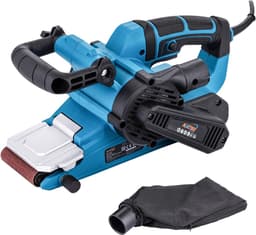
The SHALL is a 1010 W handheld with a 76×533 mm belt, six speeds and two metal C-clips that let you fix it upside down as a desktop sander. It shows 5.0 stars from only seven amazon.co.uk reviews, and at least two of those are Amazon Vine first looks. Reviewers say it feels substantial and handles planks and furniture, and several bought it for the bench clamps. One reviewer says the dust bag collects well, and the bullets list 12 belts, though not their grits. The listing does not print a speed range or a voltage. Several reviewers had not yet started a long job, so the score says little about durability. The listing claims a two-year replacement for quality faults, at £63.99. Clamps that pin a handheld upside down are not a guarded bench sander.
Pros
Power and six speeds praised on planks and furniture
Bench clamps are a repeated reason to buy
One reviewer says the dust bag collects well
Cons
Almost no long-job evidence in the seven texts
Speed numbers are not in the listing
Best for: A hobbyist who wants a 76×533 mm sander that can also be clamped.
Less suitable: Anyone treating a 5.0 from seven reviews as a durability test.
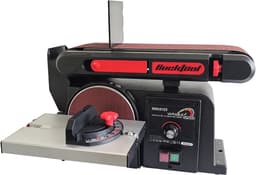
The Bucktool is a 13 kg benchtop machine, not a handheld: a 100×915 mm belt runs at 300–600 m/min beside a 150 mm disc at 2,000–4,000 rpm. You bring the work to it, which suits squaring ends, shaping edges and finishing small parts in a garage or shed. The belt station works horizontally or vertically, and dust leaves through a 60 mm port, so you need an extractor or shop vacuum rather than a bag. It shows 5.0 stars from a single amazon.co.uk review, which praises the speed control and the belt size. One review is not a durability record. The listing does not say whether belts or discs come in the box, and the machine cannot sand a floor or a hung door. At £159.99 it is the priciest machine here, with a two-year limited warranty in the bullets.
Pros
The single review praises speed control
Belt size and disc support are praised
Cons
Only one stored review
Not a machine you carry onto a floor
Best for: Bench work where you hold the wood, including ends on the disc.
Less suitable: Floorboards, stairs, or any job that needs a handheld.
The Sbestily is a 2.3 kg mini bench belt grinder for sharpening knives and garden tools, not a sander for doors or floors. Its 775 motor is set through a seven-step slider on the power adapter, with a claimed 4,000 to 9,000 rpm. The listing describes an angled belt for blades, side wheels for grinding and polishing, an alloy body and removable rubber feet so you can fix it to a bench. It shows 5.0 stars from a single amazon.co.uk review, and no review text is stored, so there is no owner feedback to weigh. The attribute table says 220 V and does not describe the UK plug. No dust collection is stated, and the belt size is not given in millimetres. At £55.99 it only makes sense as a small sharpening tool.
Pros
Listing describes an angled belt for blades and side wheels
Cons
No stored review text
220 V on the attribute, plug not described
No dust collection stated
Best for: Knife and tool sharpening on a bench.
Less suitable: Doors, floorboards, or anyone who needs owner feedback.
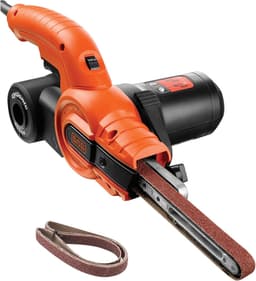
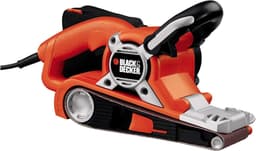
The BLACK+DECKER KA900E is a 350 W power file with a 13 mm belt, built for stair treads, corners, spindles, rusty patches and weld tidy-up where a 76 mm belt will not reach. It has 4.5 stars from 95 amazon.co.uk reviews at £47.94, and several buyers were replacing an older file they had worn out. Reviewers say it removes paint and wood quickly as long as you do not lean on it, and they find the belt change easy. It is loud enough that ear defenders come up in reviews. There is no tracking adjustment, so for some users the band flies off, and the side-mounted motor twists the tool in one owner's hand. Dust goes to a vacuum port rather than a bag, and one review says about half still escapes. A UK reviewer gives the belt as 13×451 mm, a size that is awkward to buy.
Pros
Reaches places a 76 mm belt cannot
Repeat buyers replacing an older file
Useful on paint, rust and welds in reviews
Cons
Loud
Belt can fly off if it cannot be tracked
Side-mounted motor twists the tool for one reviewer
Best for: Detail sanding in gaps, on stairs and on small metal.
Less suitable: Doors, floors, or any wide flat face.
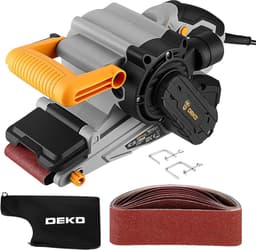
The DEKO pairs a 1010 W motor with a 76×533 mm belt that runs at 120–400 m/min across six speeds, and the box includes ten belts from 40 to 180 grit plus two metal C clamps. Across 18 amazon.co.uk reviews it holds 4.4 stars, and the stored texts call it powerful and solid for £59.99. Reviewers praise the speed dial on pine doors, and one likes clamping it upside down as a small bench sander. Tracking is the recurring complaint: the belt can still walk left with the adjuster at its limit. The dust bag misses a share of the dust, so plan on a mask or a vacuum. One owner reports the motor died after about 30 hours on rough-cut beams, and another unit smoked within five minutes. The listing gives 220 V and does not describe the plug. Those clamps are not a guarded bench sander.
Pros
Reviewers call it powerful for the price
Variable speed is praised
One review likes the clamp-down bench mode
Cons
Belt still walks off at the limit of the adjuster
Dust bag does not catch everything
One motor died after heavy use of about 30 hours
Best for: Flat DIY sanding on wood, with spare grits and a clamp mode in the box.
Less suitable: All-day work on large rough beams, if you need a tool with a long review record.
The Einhell TC-BS 8038 is an 800 W, 230 V handheld that reviewers use to strip paint and varnish from doors, banisters, oak and scaffold boards. It carries 4.3 stars from 2,509 amazon.co.uk reviews, by far the largest record in this comparison, at £48.94. It runs at a single speed and pulls hard enough that reviewers keep both hands on it, and some report hours on boards without the motor stopping. The repeated fault is tracking: the belt walks, catches the front roller and, in several reports, cuts into the plastic surround until it jams. The dust bag misses a lot, so many owners rig a vacuum adaptor. Only one P80 belt comes in the box, and coarse belts wear in minutes. The listing does not state the belt length; one UK reviewer says 75×533 mm fits.
Pros
Strong paint removal for the price across a large review set
Usable for long board sessions in some reviews
Tracking works once the adjuster is understood
Cons
Belt walks off and can cut the plastic housing
Dust bag misses a lot
Only one belt in the box
Best for: Occasional to medium DIY stock removal, if you can buy extra 75×533 mm belts.
Less suitable: A guarded bench sander, or a quiet precision finish.
At £44.99 the KATSU is the cheapest handheld here: 900 W, a 76×533 mm belt, and 200–400 m/min over six settings according to the bullets. It shows 4.3 stars from 40 amazon.co.uk reviews, but only nine texts are stored. Most are short notes saying it does the job for DIY, is easy to use and is good value. Two of those nine report serious faults. In one, the belt flew off, the bearing seat broke and plastic melted in about ten minutes; in another, the locking mechanism failed on first use and the reviewer called it unsafe. The box has one P80 belt and a dust bag, so budget for spare grits. Treat it as a light, occasional tool until a larger review record appears.
Pros
Short reviews call it powerful enough for DIY
Price is the lowest handheld in this set
Cons
Belt lock failed and plastic melted in one review
Only nine review texts are stored out of 40
Best for: Light, occasional flat sanding if you accept a thin fault record.
Less suitable: A first serious job where a broken lock would stop the work.
The BLACK+DECKER KA88-GB is a 720 W, 230 V handheld with an angled nose and a front bump stop, and reviewers use it to sand floorboards closer to the skirting than a square-nosed sander allows. It holds 4.2 stars from 357 amazon.co.uk reviews at £59.49, and some owners report years of use on an older KA88. The handle sets in three positions, which helps on fences, panels and awkward corners. Tracking is the frequent complaint, because the knob loosens with vibration and the belt wanders. The cyclonic canister collects little unless a strong vacuum is attached, and the adaptor does not fit every household vacuum. There is no variable speed, and separate reports mention a broken handle lever and a damaged plug. The table does not state the belt size; one UK reviewer buys 75×533 mm. The listing weight of 998 g is not used here, because reviewers call the tool big and heavy.
Pros
Gets closer to skirting than a square nose, in reviews
Enough for DIY floors and fences
Some owners report years on an older example
Cons
Tracking wanders and the knob loosens
Dust canister is a common complaint
No variable speed
Best for: Floorboard edges and general DIY where a 75×533 mm belt is acceptable.
Less suitable: Anyone who needs variable speed or a reliable onboard dust box.
The Enventor is a 950 W handheld with a 76×533 mm belt and 12 belts in the box: three each of P24, P80, P120 and P180. It holds 4.2 stars from 33 amazon.co.uk reviews at £59.99, and owners use it to strip paint and varnish from doors, frames and tables. Reviewers say the weight does some of the work, the front grip is comfortable and the belt change is straightforward. One finds the tracking wheel too sensitive, and another unit broke within five minutes. Several of the stored texts read as first-use notes, so long-term evidence is thin. The listing prints speed as 120–380 rpm and gives no voltage. Its claims of a motor 70% cooler and 25% quieter are not backed by any measurement.
Pros
Paint and varnish removal on doors and tables
Included grit range
Belt change described as easy
Cons
Tracking wheel too sensitive in one review
Broke within five minutes in one review
Speed is printed as rpm, not m/min
Best for: Flat DIY sanding where a set of grits in the box matters.
Less suitable: A buyer who needs a stated UK voltage or included bench clamps.
The JOJOCY is a cordless narrow belt sander that takes a Dewalt 20 V Max pack, with a 330×10 mm belt and 20 belts from 40 to 180 grit in the box. The battery and charger are not included, so the £58.99 price only works if you already own a listed pack such as a DCB200 or DCB205. It has 4.2 stars from 12 amazon.co.uk reviews, and the stored UK texts call it fine for small areas and occasional use. The battery is tight to fit and remove, and the instructions are poor enough that the first belt fit is trial and error. One reviewer likes a reverse function that the bullets do not mention. The listing contradicts itself on power, quoting 0–13,000 rpm on a 20 V pack in the bullets and 220 V at 5,000 rpm in the attributes. It is a detail tool, not a sander for floors or doors.
Pros
Fine for small areas in the six UK reviews
Twenty belts included
One reviewer likes a reverse function
Cons
Battery is tight to fit
Instructions are poor
Not a floor or door sander
Best for: Occasional detail work if you already own a listed Dewalt 20 V pack.
Less suitable: Anyone without that battery, or anyone sanding wide flat surfaces.
The GALAX PRO is a 1010 W handheld with a 76×533 mm belt, and the box includes five P80 belts, enough for a first strip on boards or a door. It holds 4.1 stars from 156 amazon.co.uk reviews, and owners call it powerful for £50.99 on floorboards, pallet wood and garage doors. Speed and tracking get praise once they are set, and some buyers say the weight helps press the belt down. Dust handling is the main complaint: the bag tears, the zip fails, or the barred port clogs, and no round extractor adaptor is supplied. Separate reviews report units that stopped after about 20 minutes, after a few hours, or after four uses, and one tension lever snapped after five belt changes. The listing prints its speed as 120–380 rpm, which is not a belt speed you can compare with metres per minute.
Pros
Powerful on floors and boards for the price, in many reviews
Five starter belts
Speed and tracking praised when they are set
Cons
Dust bag and port are a common complaint
Some units stopped after short use
Tension lever snapped in one review
Best for: A budget corded 76×533 mm sander for wood, with extra belts planned.
Less suitable: Stone, or a job that depends on the cloth bag alone.
One sander, five 76×533 mm P80 belts, and a user manual. The cable in the bullets is 2 m.
Does the dust bag work?
A bag is included. Reviews report torn fabric, a failed zip, and a port that clogs.
What speed unit does the listing use?
The highlight says 120–380 rpm. The bullets say six speeds. Do not read rpm as metres per minute.
How we compared
The figure beside each model is the amazon.co.uk star average scaled to 100. It is not a laboratory test, and a 5.0 from one to seven reviews is not treated as a durability result. The top pick is the corded handheld with the deepest review record for doors and boards. The best value is the lowest-priced 76 × 533 mm handheld, with its fault notes kept in view. The weights below are the buying checks on this page. They sum to 100. Eight public UK sources sit under the page.
1
Form and job
25%
A wide handheld suits doors and boards. A belt-and-disc suits work you bring to the bench. A file or a mini belt suits corners, welds and knives. Wattage does not rank those forms against each other.
2
Belt size
20%
76 × 533 mm, also sold as 75 × 533 mm, is the DIY handheld size here. A 76 × 457 mm belt will not fit. The file, the Bucktool and the cordless belt use different sizes.
3
Dust and UK plug
20%
A cloth bag is not an M-class extractor. Prefer a bag or a port you can see, and a BS 1363 plug. A listing that only says 220 V still needs a UK 3-pin plug.
4
Speed and belt change
15%
A dial helps on veneer and paint. Keep m/min and rpm as printed, and do not convert them. A tension release you can work without tools matters because belts clog and tear.
5
Review evidence
20%
Read the count beside the stars. Einhell is 4.3 from 2,509 and the KA88 is 4.2 from 357. SHALL is 5.0 from 7. Bucktool and Sbestily are 5.0 from 1.
Independent review
Last updated: October 2026
8 sources checked
Belt sander buying guide
Start with the job. A door or a run of boards needs a corded wide handheld. Ends and edges on a bench need a belt-and-disc. Corners, welds and knives need a file or a mini belt. Then check the belt length, the plug and the review count. Prices in this set run from about £44.99 to £159.99 on amazon.co.uk.
What is a belt sander?
A belt sander moves a continuous abrasive loop over rollers. On amazon.co.uk that name covers several tools. Corded handhelds in this set are about 3–4.5 kg and 720–1010 W: DEKO and SHALL at 1010 W, GALAX PRO at 1010 W, Enventor at 950 W, KATSU at 900 W, the Einhell TC-BS 8038 at 800 W, and the BLACK+DECKER KA88-GB at 720 W. They suit doors, tables and a short run of boards. C-clamps that pin one upside down are not a guarded bench sander.
Best for
DIYers stripping a door, a table or a short run of boards with a corded 76 × 533 mm handheld and spare belts
Bench woodworkers who want a disc as well as a belt, and who can bring the wood to the machine
People tidying spindles, welds or knives, who need a file or a mini belt rather than a floor handheld
Not ideal for
A whole room of floorboards you need flat, which is a hired floor drum rather than a cloth-bag handheld
Anyone who reads a 5.0 from one to seven reviews as a durability test
A job that needs a travel adaptor instead of a BS 1363 plug, or a 457 mm belt on a 533 mm sander
Mistakes to avoid
1
Using a file or a 10 mm belt on a door
The KA900E is a 13 mm power file. The JOJOCY is a 330 × 10 mm cordless belt, and its battery is not in the box. Neither one levels a door or a run of boards. A wide corded handheld is the tool for that face.
2
Fitting a 457 mm belt, or ignoring tracking
76 × 457 mm and 76 × 533 mm are different lengths. A short belt will not fit this handheld size. If you leave tracking until the belt has cut the housing, the plastic surround is already damaged. Einhell and the KA88 both collect that complaint.
3
Trusting a thin 5.0, or a cloth bag on a floor
SHALL is 5.0 from seven reviews. Bucktool and Sbestily are 5.0 from one. That is not a durability result. A floor you need flat is a hired drum, not a handheld with a cloth bag. A bag is not M-class extraction, and you should empty it before metal.
What to weigh up
Form and belt size
High
Form comes first because these listings are not one product. A wide corded handheld is for doors, tables and boards. In this set that group runs about 3–4.5 kg and 720–1010 W. A benchtop belt-and-disc is for work you hold. The Bucktool is 370 W, about 13 kg, with a 100 × 915 mm belt and a 150 mm disc. A power file is for gaps: the KA900E is 350 W and 13 mm wide. The Sbestily is a 2.3 kg mini bench belt for knives. A 10 mm cordless belt is a detail tool, and the battery is not included.
Dust, plug, speed and evidence
High
Prefer a bag plus a round vacuum port if the listing shows one. The Bucktool has a 60 mm port and no bag. The KA900E has a vacuum port, not a cloth bag. Several handheld bags miss dust, tear, or clog. A cloth bag is not an M-class or H-class extractor. HSE treats belt sanding as high dust. Hardwood dust is limited to 3 mg/m³ and softwood to 5 mg/m³ as eight-hour averages, and mixed dust uses 3 mg/m³ for all of it. At work, sheet WD7 wants class M or H extraction.
Which option suits you?
Three typical situations, each with a recommendation from this comparison.
🚪
Doors, tables and boards
You are stripping paint or levelling a door, a table or a short run of boards. You want a corded 76 × 533 mm handheld and spare belts. The Einhell TC-BS 8038 is about £48.94, 800 W at 230 V, with 4.3 from 2,509 reviews. The belt can walk off, and only one P80 belt is in the box.
You want the wood to move, and you want a disc for ends as well as a belt. The Bucktool is a 13 kg benchtop machine at about £159.99, with a 100 × 915 mm belt and a 150 mm disc. It will not sand a floor or a hung door, and it has one stored review.
A 76 mm belt will not reach a spindle, a weld or a stair detail. The BLACK+DECKER KA900E is a 350 W, 13 mm power file at about £47.94, with 4.5 from 95 reviews. It is loud, and it is the wrong tool for a door or a floor.
Which belt sander is the top pick for doors and boards?
For flat stock removal, the top pick is the Einhell TC-BS 8038 at about £48.94. It is an 800 W, 230 V handheld with 4.3 from 2,509 amazon.co.uk reviews, the deepest record in this set. The belt can walk off and cut the plastic housing, the dust bag misses a lot, and only one P80 belt is in the box. A 5.0 from one to seven reviews does not outrank that record.
How much does a belt sander cost on amazon.co.uk?
Stored prices on 16 October 2026 run about £44.99 to £63.99 for the corded handhelds, the file and the mini bench belt, and £159.99 for the Bucktool belt-and-disc. The KATSU is the lowest handheld at about £44.99. The Einhell is about £48.94. A rule of thumb from this shelf is that DIY corded handhelds here sit under £65. These are the kept listings, not a survey of every UK shop, and prices move.
What belt size fits a DIY handheld?
The usual DIY handheld belt here is 76 × 533 mm, also sold as 75 × 533 mm. A 76 × 457 mm belt will not fit a 533 mm machine. The Einhell table does not state the length; one UK reviewer says 75 × 533 mm fits. The KA88 table also omits the size, and one UK reviewer buys 75 × 533 mm. The file, the Bucktool and the cordless belt use other sizes.
Is the dust bag enough?
No. HSE treats belt sanding as high dust, and a cloth bag is not an M-class or H-class extractor. Hardwood dust has a workplace limit of 3 mg/m³ and softwood 5 mg/m³, as eight-hour averages. Mixed dust uses 3 mg/m³ for all of it. At work, HSE sheet WD7 wants on-tool extraction of class M or H. Empty the bag before you sand metal, because sparks and wood dust are a fire risk.
Should you buy a handheld or a benchtop belt sander?
Use a wide handheld when the tool moves over a door, a table or boards. Use the Bucktool belt-and-disc when the wood moves and you also want a 150 mm disc for ends. It will not sand a floor or a hung door. C-clamps that pin a handheld upside down are not a guarded bench sander. A power file or a 10 mm cordless belt is for corners, not for a door.
Does a 5.0 star score mean a better belt sander?
Not in this set. SHALL is 5.0 from seven reviews, including Vine first looks. Bucktool and Sbestily are 5.0 from one review. Those scores do not prove durability. Einhell is 4.3 from 2,509 and the KA88 is 4.2 from 357, and both still have tracking and dust complaints. Read the count beside the stars before you treat a perfect score as a long-term result. More watts also does not rank a file against a handheld.
Do you need a UK plug, and when should you hire a floor sander?
UK mains are 230 V and a domestic plug is BS 1363. A listing that says 220 V still needs a UK 3-pin plug, not a travel adaptor. Hire a floor drum for a whole room you need flat. A handheld and a cloth bag will dish boards and leave dust. After a belt has levelled a door, an orbital sander is the usual next tool for a finer finish. Stop if it smokes or the plug is damaged.
Our verdict
The top pick is BLACK+DECKER KA900E, with the highest score in this comparison (8.9 out of 10, from 95 amazon.co.uk reviews). The best value is the KATSU 900 W handheld at about £44.99, the lowest handheld price in this set. Two of its nine stored review texts describe a belt that flew off or a lock that failed on first use, so treat it as a light, occasional tool.
DIY & toolsSanders and abrasivesUK plugs and wood dust
Peter F. is the editor for DIY & tools at productscompared.co.uk. Comparisons in this category are checked against amazon.co.uk listings, review evidence and public UK sources.
Updated: October 2026
8 sources checked
Guides to belt sanders
Guides on what to look for, how to use a product, and common mistakes.
Public UK sources on wood dust, hand-held sanders, machinery supply and noise and vibration limits. Listing prices and star counts are from the amazon.co.uk extracts kept for this comparison on 16 October 2026. Prices move.
This page contains affiliate links to amazon.co.uk. If you buy through them, we may earn a commission at no extra cost to you. Scores use the 11 listings kept on 16 October 2026. They are not a laboratory test.