Independent comparisons. We may earn from shop links. More info

Belt sander buying guide

Updated: October 2026

The amazon.co.uk Belt Sanders shelf puts a handheld near £45 next to a 13 kg bench machine and a knife grinder. This belt sander buying guide sorts that shelf before you compare brands. Choose the form, then the belt length you will buy again, then the plug, the dust handling and how many reviews sit behind the stars. Prices and the full table stay on the [belt sander comparison](/hub/sanders/belt-sander). Listings were checked on 16 October 2026. This is not a lab test. A qualifying purchase through our links can earn a commission at no extra cost to you.

The amazon.co.uk Belt Sanders shelf puts a handheld near £45 next to a 13 kg bench machine and a knife grinder. This belt sander buying guide sorts that shelf before you compare brands.

Our top picks

Einhell Einhell TC-BS 8038

Rank 2

Einhell Einhell TC-BS 8038
8.6/10about £48.94
KATSU KATSU 900 W 76×533

Best value

KATSU KATSU 900 W 76×533
8.6/10about £44.99
On this page

Four machines share one Amazon shelf

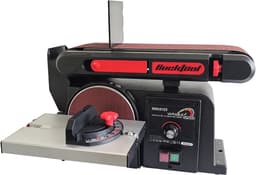
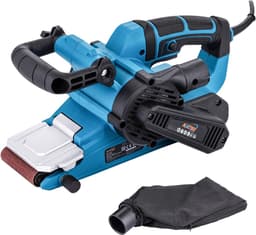
The category mixes tools that cannot do each other's work. The usual one is a corded handheld with a 76 mm belt, which you carry to a door, a worktop or a floorboard. The Bucktool is a benchtop belt-and-disc sander: a 100×915 mm belt and a 150 mm disc on a 13 kg machine. You hold the wood against it, so it will never sand a hung door. The BLACK+DECKER KA900E is a power file with a 13 mm belt for stair treads, corners and rusty patches. If the question is whether the tool or the wood should move, the handheld versus benchtop comparison settles that.

Match the belt before you match the brand

Belts only fit one size. Most handhelds here take 76×533 mm. Toolstation stocks 75×533 mm and 75×457 mm side by side, and those lengths do not interchange. A 457 mm belt will not stretch round a 533 mm machine. The Einhell TC-BS 8038 states a 76 mm width and no length. A UK reviewer reports that 75×533 mm belts fit. The KA88-GB has the same gap. A reviewer gives the KA900E as 13×451 mm and says that size is awkward to find. The bench machine needs 100×915 mm. The Einhell and the KATSU ship with one P80 belt. A coarse belt can wear out within minutes on old paint, so a one-belt kit is a starter.

Plug, dust and speed

A sander sold in Britain should arrive with a UK 3-pin plug to BS 1363. Electrical Safety First advises against a travel adaptor. Some listings print 220 V, including the DEKO and the Sbestily. The plug in the box is the check. If the listing is silent, ask the seller. Reviews of the Einhell and the KA88 say the bag or canister misses a large share of the dust. The HSE treats belt sanding as a very high-dust task, with workplace limits of 3 mg/m³ for hardwood dust and 5 mg/m³ for softwood. A home job sits outside those rules. The dust is the same, so indoors plan a mask and a vacuum or an M-class extractor. Speed units do not compare across listings: the DEKO quotes 120–400 m/min, while the KA88 attribute says 12,000 rpm and the tool has no speed control.

What the star rating is allowed to prove

The Einhell shows 4.3 from 2,509 amazon.co.uk reviews, so the paint-stripping praise and the tracking faults are both visible. The SHALL shows 5.0 from seven reviews, at least two of them Vine first looks. The Bucktool and the Sbestily each show 5.0 from one review. None of these was a laboratory test. Pick the form, the belt length and the plug, then the listing whose reviews match your job. Named picks are on the best belt sander for each job. A whole room is the belt sander for floorboards guide.

Common questions

What belt size should a DIY handheld belt sander use?
Most handheld belt sanders sold on amazon.co.uk take a 76×533 mm belt, often written as 75×533 mm. UK shops also sell 75×457 mm belts, and the two lengths do not interchange. Before you buy spares, check the belt length on the listing. If the listing only gives the width, look for a manual or ask the seller, because a reviewer's note is not a specification.
Is 220 V on a belt sander listing a problem in the UK?
UK mains is nominally 230 V, so a 220–240 V tool is normal. The real check is the plug. A sander used in Britain should come with a UK 3-pin plug to BS 1363, and Electrical Safety First advises against running one through a travel adaptor. If the listing shows 220 V and does not mention the plug, confirm it with the seller before you order.
Do I need variable speed on a belt sander?
Variable speed helps when you switch from stripping thick paint to a lighter pass on thin veneer or softwood, because a slower belt removes less material. It is not essential for flattening boards or doors. Several single-speed sanders strip paint well in reviews. Good belt tracking and a belt that stays on the rollers matter more day to day than the number of speed settings.
Is a dust bag on a belt sander enough?
Usually not. Reviews of several popular amazon.co.uk belt sanders say the bag or canister misses a large share of the dust, and the HSE describes belt sanding as a very high-dust task. For short outdoor jobs a bag may be tolerable. Indoors, connect a vacuum or an M-class extractor where the tool allows it, and wear a suitable dust mask.
Is a power file a belt sander I can use on a door?
A power file such as the BLACK+DECKER KA900E is listed among belt sanders, but it runs a 13 mm belt on a narrow arm. It reaches stair treads, corners and small metal parts. On a flat door or a floorboard it would take far too long and leave an uneven surface. For wide faces, choose a 76 mm handheld.
Why is a 5.0 score not automatically better than 4.3?
A 5.0 from one or seven reviews shows that a few buyers were happy, often soon after delivery. A 4.3 from thousands of reviews includes long-term owners and the faults they found. On amazon.co.uk, always read the review count next to the stars, and read the critical reviews for the job you plan to do.

Related pages

Sources

Public UK sources on wood dust, hand-held sanders, machinery supply and noise and vibration limits. Listing prices and star counts are from the amazon.co.uk extracts kept for this comparison on 16 October 2026. Prices move.

  1. HSE, Wood dust (retrieved 16 October 2026)
  2. HSE, WD7 Hand-held sanders (retrieved 16 October 2026)
  3. HSE, Cutting and sanding wood (retrieved 16 October 2026)
  4. BSI, BS EN 62841-2-4:2014 (retrieved 16 October 2026)
  5. GOV.UK, Supply of Machinery (Safety) Regulations 2008 (retrieved 16 October 2026)
  6. Electrical Safety First, Sanders (retrieved 16 October 2026)
  7. Control of Vibration at Work Regulations 2005, regulation 4 (retrieved 16 October 2026)
  8. Control of Noise at Work Regulations 2005, regulation 4 (retrieved 16 October 2026)