Independent comparisons. We may earn from shop links. More info

Handheld belt sander vs bench sander

Updated: October 2026

Handheld belt sander vs bench sander comes down to one question: does the tool move to the work, or does the work move to the tool? Carry the sander to a door or a board and you want a handheld. Bring small parts and ends to a fixed machine and a belt-and-disc sander does that better. Clamping a handheld upside down is a third, limited option. Prices and the full table are on the [belt sander comparison](/hub/sanders/belt-sander). Listings were checked on 16 October 2026. This is not a lab test. A qualifying purchase through our links can earn a commission at no extra cost to you.

Handheld belt sander vs bench sander comes down to one question: does the tool move to the work, or does the work move to the tool? Carry the sander to a door or a board and you want a handheld.

Our top picks

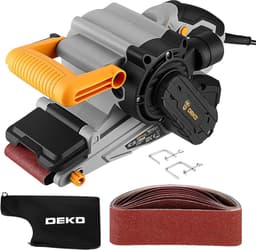
DEKO DEKO 1010 W 76×533

Rank 2

DEKO DEKO 1010 W 76×533
8.8/10about £59.99
Einhell Einhell TC-BS 8038

Rank 3

Einhell Einhell TC-BS 8038
8.6/10about £48.94
On this page

The tool moves, or the wood moves

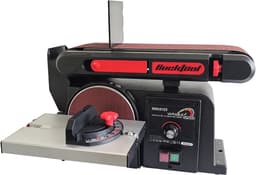
A handheld travels across the work: a door on trestles, a worktop, decking or floorboards. Most in this set run a 76×533 mm belt, cost about £44.99 to £63.99, and weigh about 3 to 4.6 kg. Your hands set the angle and the path. A benchtop sander stays put. The Bucktool is the only true bench machine here: a 100×915 mm belt and a 150 mm disc on a 13 kg base. It suits ends, edges and repeated small parts. It will not sand a hung door, a floor or a long board. Squaring six shelf ends is a bench job. Flattening a stripped door is a handheld job. Floors are a separate question in the belt sander for floorboards guide.

What two C-clamps are

The DEKO includes two metal C clamps, and one reviewer uses that table mode. The SHALL includes two C-clips and a lock, and several reviewers bought it for desktop use. The Einhell does not list clamps, and a reviewer says it will not clamp upside down in a Workmate. A clamped handheld can take an occasional edge. It does not give you a table, a fence or a disc. The belt stays exposed, and dust is still the cloth bag. The HSE treats a fixed belt sander as a separate risk, including a workpiece thrown off the belt, which is why a proper bench machine has guards and rests. If you clamp it every weekend, you need that machine.

What the bench machine is for

The Bucktool belt runs at 300–600 m/min, horizontally or vertically, beside a 150 mm disc at 2,000–4,000 rpm. Dust leaves through a 60 mm port, so you connect an extractor or a shop vacuum. Its 370 W is not a useful comparison with a 1010 W handheld: one motor drives a belt you push, the other drives a belt and disc you feed. It weighs 13 kg, measures 55 × 32 × 37 cm, and costs £159.99. One amazon.co.uk review praises the speed control. The listing does not say whether belts or discs are in the box. A kitchen table with nowhere to leave 13 kg is a handheld job. The best belt sander for each job names those picks. Doors and boards you cannot lift: a handheld. Ends and repeat small parts: the Bucktool, if one review is enough. Occasional edges and no space for a bench: a clamp-on handheld, with the belt exposed.

The mini belt is not this choice

The Sbestily appears in the same amazon.co.uk category, but it is neither of these tools. It is a 2.3 kg mini bench belt grinder sold for sharpening knives and garden tools, with a speed slider on the power adapter, side wheels and rubber feet. It will not flatten a board or square a shelf end the way the Bucktool does. Treat it as a sharpening tool. The belt sander buying guide sets out how the other forms on the shelf compare.

Common questions

When should I choose a bench sander over a handheld belt sander?
Choose a bench sander when you bring small pieces to the tool: squaring ends, shaping edges and curves, or repeating the same part. A belt-and-disc machine such as the Bucktool does that with a fixed belt and a disc. Choose a handheld when the work is too large or fixed to lift, such as a door, worktop or floorboards.
Are the C-clamps on a handheld belt sander a real bench sander?
No. Clamps let you fix some handhelds, such as the DEKO and the SHALL, upside down to sand small parts against the belt. You get no table, no fence, no disc and no proper dust port, and the belt is exposed. It works for the occasional edge. If you would use it every week, a bench belt-and-disc sander is the better tool.
Can I turn the Einhell TC-BS 8038 upside down on a bench?
The listing does not mention clamps or a bench mode, and a UK reviewer says it cannot be turned over and clamped in a Workmate. If you want a handheld that also works upside down, look for one sold with clamps, such as the DEKO or the SHALL, and check the listing for the clamp and lock details.
Is a 370 W bench sander weaker than a 1010 W handheld?
Not in a useful sense. The two do different jobs. A handheld's motor drives a belt you push across a surface, while a bench machine like the Bucktool's 370 W unit drives a 100×915 mm belt and a 150 mm disc that you feed the work into. Comparing watts across the two forms does not tell you which will sand better.
Do I need dust extraction on a bench belt sander?
Yes. The Bucktool has a 60 mm dust port, not a bag, so you need an extractor or shop vacuum connected. Belt sanding creates a lot of fine dust whichever form you use. If you use a fixed sander at work, the HSE expects suitable extraction and guarding. At home, a vacuum and a dust mask are the practical minimum.
Which belt sander should I buy if I only have a kitchen table?
A handheld. A bench belt-and-disc sander such as the Bucktool weighs 13 kg and needs a permanent bench. A handheld works on trestles or outside, then goes back in its box. If you want the occasional edge as well, choose one with clamps in the box, accepting that a clamped handheld is not a fenced bench machine.

Related pages

Sources

Public UK sources on wood dust, hand-held sanders, machinery supply and noise and vibration limits. Listing prices and star counts are from the amazon.co.uk extracts kept for this comparison on 16 October 2026. Prices move.

  1. HSE, Wood dust (retrieved 16 October 2026)
  2. HSE, WD7 Hand-held sanders (retrieved 16 October 2026)
  3. HSE, Cutting and sanding wood (retrieved 16 October 2026)
  4. BSI, BS EN 62841-2-4:2014 (retrieved 16 October 2026)
  5. GOV.UK, Supply of Machinery (Safety) Regulations 2008 (retrieved 16 October 2026)
  6. Electrical Safety First, Sanders (retrieved 16 October 2026)
  7. Control of Vibration at Work Regulations 2005, regulation 4 (retrieved 16 October 2026)
  8. Control of Noise at Work Regulations 2005, regulation 4 (retrieved 16 October 2026)