Independent comparisons. We may earn from shop links. More info

How to use a belt sander

Updated: October 2026

The first time you switch a belt sander on, it can snatch forward or the belt can creep off one side. How to use a belt sander, for a corded handheld, is mostly setup: unplug it, fit the belt with the arrow the right way, track it, let the weight do the work, and wait until the belt stops before you put it down. Which model to buy is on the [belt sander comparison](/hub/sanders/belt-sander). The review examples were checked on 16 October 2026. This is not a lab test. A qualifying purchase through our links can earn a commission at no extra cost to you.

The first time you switch a belt sander on, it can snatch forward or the belt can creep off one side.

Our top picks

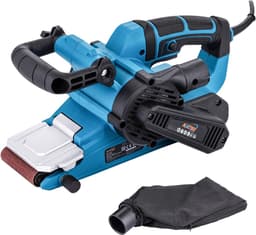
Einhell Einhell TC-BS 8038

Best overall

Einhell Einhell TC-BS 8038
8.6/10about £48.94
KATSU KATSU 900 W 76×533

Best value

KATSU KATSU 900 W 76×533
8.6/10about £44.99
On this page

Fit the belt before you care about speed

Unplug the sander before you touch the belt. Electrical Safety First and UK hire-shop sheets both make that the first rule. Release the tension lever, slide the old belt off, and fit the new one so the printed arrow matches the arrow on the housing. A belt fitted backwards can split at the joint. Seat it evenly, then close the lever. Reviews of the GALAX PRO describe a lever that snapped after five changes, and one Einhell owner had a lever that would not lock shut. If it will not hold the belt, do not run it. Most handhelds take 76×533 mm, often sold as 75×533 mm. A 457 mm belt will not tension on them. Length is covered in the belt sander buying guide.

Track it, then land it flat

Hold the sander clear of the work and of your body, run it briefly, and turn the tracking knob a little if the belt drifts. Hire-shop sheets ask you to do this for every new belt. Tracking is the common complaint on the Einhell, the KA88, the GALAX PRO and the KATSU. Once a wandering belt has cut the plastic, new belts catch the damaged edge. That is a return or repair. Start the motor before the belt touches the wood. Land the whole plate at once, both hands on the tool, and keep moving along the grain. Do not press. The weight is enough, and extra pressure digs. A nose that dips off the end of a door cuts a hollow in seconds.
Einhell Einhell TC-BS 8038

Testsieger

Einhell Einhell TC-BS 8038
8.6/10about £48.94

Grit, dust and switching off

Start at the coarsest grit the job needs, then work finer: P40 or P60 for thick paint or rough-sawn wood, often P80 then P120 then P180 for varnish or light marks. That is a method, not a rule for every timber. Several kits include only one P80 belt, and coarse belts wear out quickly on old paint. Belt sanding is one of the HSE's very high-dust tasks, and a cloth bag rarely catches it all. Empty the bag at about half full, connect a vacuum where there is a port, and wear a dust mask, eye protection and ear defenders. Never sand metal straight after wood without emptying the bag, because a spark can ignite fine wood dust. Lift off, release the trigger, and wait until the belt has stopped before you set the tool down. Unplug it before the next belt or before you empty the bag.

When this is the wrong tool

A handheld suits a door, a worktop, a few boards or a deck. It is slow on a whole room, and it is easy to leave dips. A hire drum and an edger are the comparison for a full floor, set out in the belt sander for floorboards guide. Shaping the ends of small parts belongs on a bench machine, as the handheld versus benchtop comparison explains. If the motor smokes, sparks or smells of burning, unplug it. Reviews in this set describe sanders that smoked within minutes. That is a fault to report, not a pass to finish.

Common questions

Which way does the arrow on a sanding belt point?
The arrow printed inside the belt must point the same way as the arrow on the sander's housing, which shows the direction of travel. Fitting the belt backwards can split it at the joint. Always unplug the sander before you change or turn a belt, and check the arrow every time, because a reversed belt fits and looks normal until it fails.
Do I adjust belt tracking with the sander running?
Yes, but only with the sander held clear of the work and of your body, usually upside down or on its side. Run it briefly, watch which way the belt drifts, and turn the tracking knob a small amount at a time. Never adjust tracking while the belt is touching wood, and keep your fingers away from the moving belt.
How hard should I press on a belt sander?
Do not press. The weight of the sander is enough pressure for the belt to cut. Pushing down makes the belt dig, slows the motor and wears the belt faster. Keep both hands on the tool to guide it, keep it flat and keep it moving along the grain so it does not cut a hollow in one spot.
What grit should I start with on a belt sander?
Start with the coarsest grit the job needs and work finer. Heavy paint or rough sawn wood may need P40 or P60. Varnish and light marks often start at P80, then P120 and P180. Skipping too many grades leaves deep scratches that take longer to remove. Many kits include only one P80 belt, so buy spare grits first.
How often should I empty a belt sander dust bag?
Empty it when it is about half full, as UK hire-shop safety sheets advise. A full bag stops collecting and pushes more dust into the air. Always empty it before you sand metal after wood, because sparks can ignite fine wood dust. A bag rarely catches everything, so wear a dust mask and connect a vacuum where you can.
What should I do if the belt has already cut the sander housing?
If a wandering belt has cut into the plastic housing, new belts will keep catching the damaged edge and tearing. Better technique will not fix that. Stop using the sander and contact the seller or manufacturer about a repair or return. Check the tracking on any replacement as soon as you fit the first belt.

Related pages

Sources

Public UK sources on wood dust, hand-held sanders, machinery supply and noise and vibration limits. Listing prices and star counts are from the amazon.co.uk extracts kept for this comparison on 16 October 2026. Prices move.

  1. HSE, Wood dust (retrieved 16 October 2026)
  2. HSE, WD7 Hand-held sanders (retrieved 16 October 2026)
  3. HSE, Cutting and sanding wood (retrieved 16 October 2026)
  4. BSI, BS EN 62841-2-4:2014 (retrieved 16 October 2026)
  5. GOV.UK, Supply of Machinery (Safety) Regulations 2008 (retrieved 16 October 2026)
  6. Electrical Safety First, Sanders (retrieved 16 October 2026)
  7. Control of Vibration at Work Regulations 2005, regulation 4 (retrieved 16 October 2026)
  8. Control of Noise at Work Regulations 2005, regulation 4 (retrieved 16 October 2026)