How to use a linisher
The box is open and the machine is on your bench. You flick the switch, and within seconds the belt creeps towards the edge of the drum while the whole thing shuffles sideways. This guide on how to use a linisher covers the first hour in order. Fix the machine down, fit and track the belt by hand, and use the disc on the side that pushes the work into the table. It applies to the belt-and-disc machines in the [linisher comparison](/hub/sanders/linisher). If you are still choosing, read the [belt and disc sander buying guide](/hub/sanders/linisher/sub/linisher-buying-guide) first. This is not a lab test. A qualifying purchase through our links can earn a commission at no extra cost to you.
The box is open and the machine is on your bench. You flick the switch, and within seconds the belt creeps towards the edge of the drum while the whole thing shuffles sideways.
The box is open and the machine is on your bench. You flick the switch, and within seconds the belt creeps towards the edge of the drum while the whole thing shuffles sideways. This guide on how to use a linisher covers the first hour in order. Fix the machine down, fit and track the belt by hand, and use the disc on the side that pushes the work into the table. It applies to the belt-and-disc machines in the linisher comparison. If you are still choosing, read the belt and disc sander buying guide first. This is not a lab test. A qualifying purchase through our links can earn a commission at no extra cost to you.
Our top picks
| Badge | Product | Fixing | Belt change | Disc | Note | Price | Offer |
|---|---|---|---|---|---|---|---|
| Best overall |  Clarke Clarke CS4-6E belt and disc sander | 18.4 kg, bolt or block | Guard slows grit changes | Table slips if clamp is loose | 9.0 | about £136.48 | View offer |
 Bucktool Bucktool MM493C 25 mm belt and disc sander | About 9 kg | Quick-release cover | Adhesive, not hook-and-loop | 8.8 | about £85.99 | View offer | |
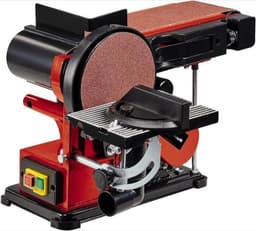
 Einhell Einhell TC-US 380 belt and disc sander | 13.2 kg, vibrates unless fixed | Tracking faults reported | Hook-and-loop | 8.0 | about £121 | View offer |


On this page
Before you switch on
Fit and track the belt
Use the disc without launching the work
Change the belt and the disc
Dust, noise and when to stop
Common questions
Do I have to bolt a linisher to the bench?
How do I stop the sanding belt walking off the drum?
Which side of the disc sander should I use?
Do I still need a mask if the extractor is connected?
When should I stop using the machine and send it back?
Related pages
Sources
Public UK sources and manufacturer pages used for this comparison, last checked on 16 October 2026.
- HSE: Wood dust (retrieved 16 October 2026)
- HSE: WD12 dust extraction (retrieved 16 October 2026)
- HSE: Sanders (retrieved 16 October 2026)
- HSE: PUWER overview (retrieved 16 October 2026)
- Control of Noise at Work Regulations 2005, regulation 4 (retrieved 16 October 2026)
- Supply of Machinery (Safety) Regulations 2008 (retrieved 16 October 2026)
- Clarke CS4-6E manual (retrieved 16 October 2026)
- GOV.UK product safety report 2408-0132 (retrieved 16 October 2026)