Independent comparisons. We may earn from shop links. More info

Linisher for metal

Updated: October 2026

A burr on a steel bracket, a blunt chisel and a rough aluminium edge are different jobs. Whether a linisher for metal makes sense depends on the metal and what the machine was built for. Sparks in wood dust are the risk to take seriously. This page goes through the six machines in the [linisher comparison](/hub/sanders/linisher): which listings name metal, and where each one runs out. Belt width, if you have not chosen it, is in the [belt and disc sander buying guide](/hub/sanders/linisher/sub/linisher-buying-guide). Prices are captured listing prices. This is not a lab test. A qualifying purchase through our links can earn a commission at no extra cost to you.

A burr on a steel bracket, a blunt chisel and a rough aluminium edge are different jobs. Whether a linisher for metal makes sense depends on the metal and what the machine was built for.

Our top picks

On this page

What the woodworking machines actually claim

Clarke describes the CS4-6E as suitable for woods, most plastics and non-ferrous metals: aluminium, brass and copper, not steel. The Einhell TC-US 380 listing does not name metal, and a buyer's question on that listing has no stored answer. The Bucktool MM491GV is sold for woodworking, and its metal question is also unanswered. Owners go further. One UK Clarke owner used it on stainless exhaust pipes, and others describe light metal clean-up. That is owner practice, not a new specification. UK owners of the Bucktool MM493C sand aluminium and small blades on its 25 mm belt. Soft aluminium tends to smear onto a wood belt, so keep a separate belt for it. That is workshop practice, not a tested rule.

Belt or grinding wheel

A flat belt over a platen leaves a flat edge, which suits a plate, a cut bar or a long burr. A round stone leaves a hollow, which suits a chisel, a drill bit or a mower blade. On the UK MIG Welding Forum, fabricators steered plate-squaring away from the wheel and towards a linisher, with several grits. One reply suggested zirconium belts. That was a forum suggestion, not a test, and the belt must match the machine. A fixed 450 m/min belt, as on the Clarke, heats a thin edge quickly. Dip the work and keep it moving, or the steel can lose its temper.

The grinder-linisher in this set

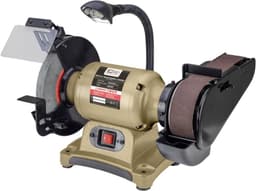
The SIP-01459, about £155.99, is the only machine here with a 200 mm grinding wheel and a 50 × 710 mm belt on one base, both at a stated 2,980 rpm. The listing names mild steel, tool steel, copper and brass, plus an eye shield, a spark arrestor and a stone guard. There is no sanding disc, no rating line and no review text. The motor is given as S2 550 W and S1 370 W, while the amperage attribute says 13 A. Those figures are not reconciled. The Bucktool BD4802IV, about £299.99, claims metal and knife bevels, with a variable-frequency motor and a sharpening attachment. It has one rating and no stored review text, so you are buying the specification.

Sparks and wood dust

Do not grind steel on a machine full of wood dust. HSE guidance on wood-waste collection (WIS32) warns that metal in sanding off-cuts can throw sparks that set sawdust smouldering, and it says to keep metal out of wood-dust systems. Wood dust can also burn. Empty the hood, the port and any bag before you touch steel, or disconnect the wood extractor. Brass and aluminium throw few sparks. Steel does. A separate machine, such as the SIP, is the cleaner split. Wear eye protection.

When this page is the wrong page

If you grind knife bevels in hardened steel regularly, none of the 4 × 36 inch woodworking linishers here is the right tool. Makers in that field use 2 × 72 inch or 50 × 2,000 mm belt grinders, with longer belts, faster cooling and platens built for bevel work. The linisher vs belt grinder page explains when that extra cost is justified. For tracking and disc direction on whichever machine you choose, see how to use a linisher.

Common questions

Can I use a belt-and-disc sander on steel?
For light deburring and clean-up, owners do, but the woodworking machines in this comparison are not sold for steel. Clarke lists woods, most plastics and non-ferrous metals for the CS4-6E. Clear out all wood dust before grinding steel, keep the work cool, and wear eye protection.
What does non-ferrous mean on the Clarke CS4-6E?
Non-ferrous means metals without iron: aluminium, brass, copper and similar. Clarke's description covers those alongside wood and most plastics. It does not mention steel, tool steel or hardened knife bevels. One UK owner sanded stainless pipes, but that is owner practice beyond the maker's line.
Is the SIP the metal machine in this comparison?
The SIP-01459 is the only machine here with both a 200 mm grinding wheel and a linisher belt, and its listing names mild steel, tool steel, copper and brass. It has no sanding disc and a 50 mm belt. There are no amazon.co.uk ratings or review texts to confirm how it performs.
Why use a belt rather than a grinding wheel on a plate edge?
A flat belt produces a flat, square edge, while a round grinding wheel leaves a curved, hollow surface. UK fabricators on the MIG Welding Forum steer plate-squaring work towards a linisher or belt grinder, used with several grits. A wheel suits shaping and sharpening tools instead.
Can I grind a knife bevel on a 370 W bench linisher?
You can touch up a small blade, and some small-machine owners do. For regular bevel work in hardened steel, a 4 × 36 inch woodworking linisher runs hot and is not built for it. Knife makers use 2 × 72 inch or 50 × 2,000 mm grinders, which are a different class of machine.
What happens if I grind steel into wood dust?
HSE guidance warns that friction sparks from metal can set sawdust smouldering inside collection systems, and wood dust can burn. Empty and brush out the hood, port and extractor bag before grinding steel, or keep a separate machine for metal. A smouldering fire can start after you leave the workshop.

Related pages

Sources

Public UK sources and manufacturer pages used for this comparison, last checked on 16 October 2026.

  1. HSE: Wood dust (retrieved 16 October 2026)
  2. HSE: WD12 dust extraction (retrieved 16 October 2026)
  3. HSE: Sanders (retrieved 16 October 2026)
  4. HSE: PUWER overview (retrieved 16 October 2026)
  5. Control of Noise at Work Regulations 2005, regulation 4 (retrieved 16 October 2026)
  6. Supply of Machinery (Safety) Regulations 2008 (retrieved 16 October 2026)
  7. Clarke CS4-6E manual (retrieved 16 October 2026)
  8. GOV.UK product safety report 2408-0132 (retrieved 16 October 2026)