Independent comparisons. We may earn from shop links. More info

Belt and disc sander buying guide

Updated: October 2026

You have cleared a corner of the shed and want a bench machine that squares a shelf end, rounds a box lid or cleans a bracket. Listings shout wattage, and that does not say whether the machine fits the job. This belt and disc sander buying guide puts belt size first, then the disc and table, then speed, dust, weight and the plug. The six machines, with captured prices, are in the [linisher comparison](/hub/sanders/linisher). Prices and review counts are from those amazon.co.uk listings. This is not a lab test. A qualifying purchase through our links can earn a commission at no extra cost to you.

You have cleared a corner of the shed and want a bench machine that squares a shelf end, rounds a box lid or cleans a bracket. Listings shout wattage, and that does not say whether the machine fits the job.

Our top picks

On this page

What you are buying

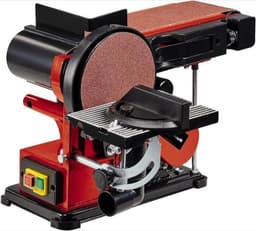
On amazon.co.uk a linisher is almost always a belt-and-disc bench sander. One motor drives an abrasive belt and, usually, a sanding disc. You bring the work to the machine, so it suits edges, end grain and small parts, not a tabletop. The SIP-01459 pairs a 200 mm grinding wheel with a narrow belt and has no disc. The 700 W Bucktool BD4802IV is sold for metalworking. A 2 × 72 inch knife grinder is a separate purchase. The linisher for metal guide marks that line.

Belt width and length

Three widths appear in this set, and the belt matters more than the motor rating. The Bucktool MM493C uses 25.4 × 762 mm for pens, jewellery and small offcuts. UK owners call it quiet. It will not sand a wide timber edge in one pass. The SIP belt is 50 × 710 mm beside a grinding wheel. A 100 mm belt, on the Einhell TC-US 380, the Clarke CS4-6E and both larger Bucktools, is the width for timber edges. Those machines list 914 mm or 915 mm, both sold as 4 × 36 inch. Order a replacement only when width and length match the machine.

Disc, table and speed

A 150 mm disc is the norm on the 100 mm machines. The 700 W Bucktool lists 200 mm and the small Bucktool about 125 mm. HSE guidance on sanders says to work on the side where rotation pushes the piece down onto the table, which needs a table that clamps close to the disc. Clarke owners say the disc table slips unless the clamp is tight, and several call the mitre gauge inaccurate. The small Bucktool takes adhesive discs. The Einhell and the MM491GV list hook-and-loop. The Clarke lists 450 m/min and the Einhell up to 292 m/min. The MM491GV states 300–600 m/min. The 700 W model quotes 2.9–11.7 m/s. Both variable-speed machines show only one amazon.co.uk rating.

Dust, weight and the plug

The Clarke and the Bucktool MM491GV state a 60 mm port. The Einhell listing mentions a dust extractor and gives no diameter. Clarke owners say the built-in fan moves little dust. A port is a hose size, not clean air. HSE sets a workplace exposure limit for hardwood dust at 3 mg/m³. These machines weigh about 9–20 kg, and UK reviews say the Einhell and the Clarke walk unless screwed down. UK mains are a nominal 230 V with a BS 1363 plug. The Einhell and the 700 W Bucktool show 220 V as a listing attribute, so check the plug inside the return window.

What to spend

Captured prices, not a live scrape: the Bucktool MM493C about £85.99, the Einhell about £121, the Clarke about £136.48, the SIP about £155.99, the MM491GV about £159.99, and the 700 W Bucktool about £299.99. The step to about £121 buys a belt four times wider. The step to about £159.99 buys variable speed with almost no owner record. Who should skip each machine is on the best linisher page. Setup is in how to use a linisher.

Common questions

Is a linisher the same as a belt-and-disc sander?
In UK listings the terms overlap heavily. A linisher is a stationary machine with an abrasive belt, and most amazon.co.uk listings pair that belt with a sanding disc on the same motor. Some machines, such as the SIP-01459, pair the belt with a grinding wheel instead. Check what sits on the second shaft before you assume there is a disc.
Should I buy a 25 mm belt or a 100 mm belt?
Buy a 25 mm belt if your work is pens, jewellery, models or small offcuts, and you want a light machine of about 9 kg. Buy a 100 mm belt if you sand timber edges, box parts or shelf ends. A narrow belt will not cover a wide edge in one pass, and it is the most common mismatch buyers report.
Do 914 mm and 915 mm belts interchange?
Both lengths are sold as 4 × 36 inch, and some owners use them interchangeably. Tracking and tension on your particular machine decide whether a 1 mm difference matters. Order replacement belts to the size printed on your machine's listing or manual, and test one belt before you buy a multipack.
Is 370 W enough for a bench linisher?
For DIY timber edges and light metal clean-up, UK owners of 370–380 W machines generally report enough power. Wattage on its own tells you little. Belt width, belt speed and a table that stays square affect results more than the 10 W gap between two similar machines.
What dust-port size should I look for?
Look for a stated diameter that matches your extractor hose, such as the 60 mm port listed on the Clarke CS4-6E and the Bucktool MM491GV. If a listing gives no diameter, ask the seller or check the manufacturer's UK page before you buy. A port connects a hose. It does not guarantee clean air.

Related pages

Sources

Public UK sources and manufacturer pages used for this comparison, last checked on 16 October 2026.

  1. HSE: Wood dust (retrieved 16 October 2026)
  2. HSE: WD12 dust extraction (retrieved 16 October 2026)
  3. HSE: Sanders (retrieved 16 October 2026)
  4. HSE: PUWER overview (retrieved 16 October 2026)
  5. Control of Noise at Work Regulations 2005, regulation 4 (retrieved 16 October 2026)
  6. Supply of Machinery (Safety) Regulations 2008 (retrieved 16 October 2026)
  7. Clarke CS4-6E manual (retrieved 16 October 2026)
  8. GOV.UK product safety report 2408-0132 (retrieved 16 October 2026)