Wood dust sanding: why the bag is not the control

The hardwood dust limit is 3 mg/m³ over eight hours at work. A cloth bag on a belt sander is not an M-class extractor, whether you are at home or on the job.
On this page

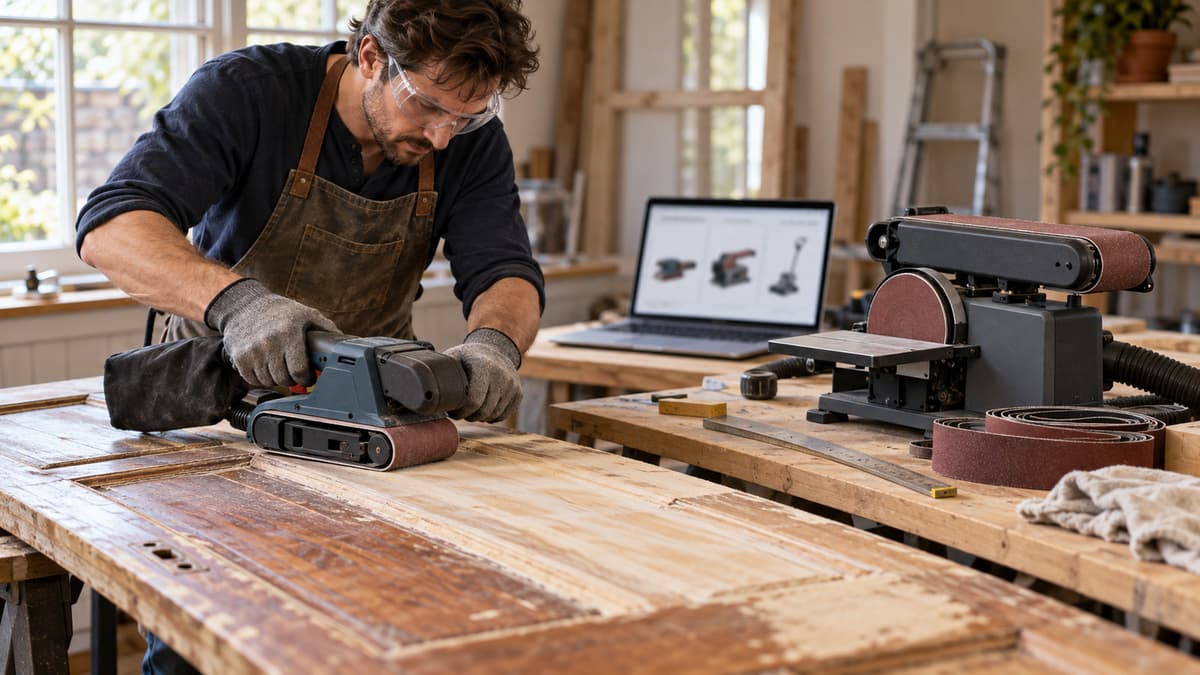
You have just taken the varnish off a pine door. The cloth bag on the belt sander is warm, and a fine film is already on the windowsill. Wood dust sanding at that rate fills a room faster than the bag fills. The sack catches a share of the chips you can see. HSE sheet WD7, written for hand-held sanders, names an M-class or H-class extractor, and none of the cloth bags in our belt sander comparison is that machine.
This page uses HSE's wood-dust exposure limits, that WD7 sheet, HSE's construction note on cutting and sanding wood, Electrical Safety First's advice on sanders, and the amazon.co.uk listings recorded for this comparison on 16 October 2026. We did not measure dust in the air and did not run a laboratory test. A qualifying purchase through our amazon.co.uk links can earn a commission at no extra cost to you.
In short
At work, HSE's hardwood dust limit is 3 mg/m³ and the softwood limit is 5 mg/m³, both as eight-hour averages, and a mixture that includes hardwood uses 3 mg/m³ for all of the wood dust. Those duties sit with an employer under COSHH. Sanding your own door leaves you outside that employer duty, while the dust stays the same material, and a cloth bag on a belt sander around £50 is outside the M-class or H-class extractor in HSE sheet WD7.
What wood dust sanding puts in the air
A belt keeps cutting for as long as you hold it on the wood. HSE's construction guidance treats a belt sander as a high-dust example when people cut or sand wood. The pile under the bench is the coarse fraction. The fraction the workplace limits care about is inhalable dust in the air, weighed in milligrams per cubic metre.
Hardwood, softwood and board all make that dust. Oak and pine both look pale once they are ground fine, so the colour of the cloud is a poor guide to the species. MDF is wood fibre bound with resin, so sanding it is still wood dust. A search for an MDF dust sander usually means a fine cloud. The bag does not sort resin from fibre.
Treat bag size as a rule of thumb, not as a timed test. On a coarse belt, a cloth bag can be tight while you are still on the first door. After that it stops taking dust, and more of the cloud stays in the room. We have no exposure figure, in milligrams, for any belt sander in this comparison.
The hardwood dust limit, and who it binds
At work, COSHH wood dust is an employer duty in Great Britain. HSE's workplace exposure limits, as eight-hour averages, are 3 mg/m³ for hardwood and 5 mg/m³ for softwood. If hardwood is mixed with other wood dust, the 3 mg/m³ hardwood dust limit applies to all of the wood dust in the mix. Three milligrams is three thousandths of a gram in a cubic metre of air, spread across an eight-hour day. A visible cloud in a box room can sit far above that for the minutes you are sanding. HSE still expects exposure as low as reasonably practicable at work, because of cancer and asthma. The numbers are ceilings, and this page has not measured the cloud on any of these tools.
Those limits bind the employer. If you pay people to sand in a workshop, dust control is that employer's duty. Sanding a door in your own house does not put you under COSHH as an employer. Northern Ireland regulates hazardous substances under its own COSHH rules, and the figures quoted here are the HSE limits.
The dust in a spare bedroom is the same material. A short DIY session is not an eight-hour shift, so the workplace average is not a personal allowance for twenty minutes in a closed hall. Get the dust out of the air you breathe.
A dust bag is not M-class extraction
HSE sheet WD7 asks for extraction of class M or class H on hand-held sanders. Class M and class H are ratings of the extractor, the machine the hose runs to. A cloth bag clipped over the outlet has no such class on any listing we checked. Belt sander dust extraction, in the sense WD7 uses, means that rated machine. The bag is a catch-pot the maker included in the box.
Some sanders add a round port so a hose has somewhere to push on. That port is only a connector. The class, if there is one, sits on the extractor you attach. A household vacuum can pull the cloud away from your face and blow the fine fraction back through a filter never rated class M or H. That sits outside the control the sheet names.
Electrical Safety First includes a mask in its precautions for sanders, along with unplugging the tool. Dust mask sanding is that backup layer. Wear a mask that seals if you sand, at home or at work. A mask does not repair a torn bag, and it is not a workplace face-fit programme. At home it is a sensible extra beside extraction.
If the only dust hardware in the box is a fabric sack, you do not have WD7's control, whatever the wattage. An employer closes that gap with an M-class or H-class machine. On your own door the same gap is a health gap. An open window helps a small room, and it is not a measurement.
What these bags do in the reviews
Review text is not a milligram reading. The amazon.co.uk comments on these listings still show what owners meet when they trust the bag. Prices below are the amazon.co.uk prices recorded on 16 October 2026.
The Einhell TC-BS 8038, 800 W, was £48.94, with 4.3 stars from 2,509 reviews, the deepest record in the set. Reviewers say the bag misses a lot, so many rig a vacuum adaptor. One P80 belt comes in the box, and one UK reviewer says a 75×533 mm belt fits.
The DEKO, 1010 W, was £59.99, with 4.4 stars from 18 reviews, and owners say the bag misses a share. The GALAX PRO, also 1010 W, was £50.99, with 4.1 stars from 156 reviews. Owners report a torn bag, a failed zip, or a barred port that clogs, and no round adaptor is supplied. The BLACK+DECKER KA88-GB was £59.49, with 4.2 stars from 357 reviews. Its cyclonic canister collects little unless a strong vacuum is attached, and the adaptor does not fit every household vacuum.
The Bucktool belt-and-disc, £159.99, sends dust through a 60 mm port on a 13 kg bench machine. One review gives it 5.0 stars, and the listing does not state class M or H.
The buying guide puts dust and the UK plug beside belt size. The floor page separates a handheld from a hired drum, which moves a different volume of dust. A 5.0 from a handful of reviews, as on the SHALL, is too thin to treat as a dust result.
Fire, metal sparks, and emptying
Wood dust burns. Electrical Safety First tells you to empty the bag before you sand metal, because sparks and wood dust are a fire risk. The mistake is a rusty hinge or a weld, started while the sack is still full from the door you just stripped. Unplug the sander, empty it away from the workpiece, and only then change to a belt for metal.
Once the sack is half full it stops collecting, and the cloud at the belt gets worse. Tip the dust into something you can close, with the tool unplugged. If the tool smokes, stop. One DEKO review describes a unit that smoked within five minutes, which is a fault report rather than a normal smell.
Emptying the bag removes fuel and gives the sack room to catch chips again. The fine dust that missed the bag is still in the room, and a broom puts that fraction back in the air. A vacuum of class M or H is the control WD7 names for lifting what has settled. Emptying does not give the cloth bag that class.
Tracking and pressure sit with that habit on the how to use page. Empty the bag before it is tight, and keep metal off a wood-filled sack. A handheld around £45 to £65 still has an unclassed bag.
Common questions
Is wood dust from sanding dangerous?
What is the hardwood dust limit in the UK?
Does softwood dust count?
Is MDF dust the same as wood dust?
Does the bag on a £50 sander meet HSE guidance?
Do I need a dust mask when I sand at home?
Can I sweep wood dust up?
Why should I empty the bag before sanding metal?

Peter F. is the editor for DIY & tools at productscompared.co.uk. Comparisons in this category are checked against amazon.co.uk listings, review evidence and public UK sources.
Related articles
Belt sander price UK: handheld, bench or a hire day
Handheld, bench and hire-day prices from this amazon.co.uk set, and what a shelf price still leaves out.

Empty belt sander dust bag: stop at half full
A half-full cloth bag stops collecting, and the wood dust inside can still burn.

Floor sander hire cost: one day, or buy a handheld
A handheld and a hired floor drum move different amounts of dust. Which job suits which.