Sanding mesh for plaster and filler
You have a proud line of filler along a plasterboard joint, or a skim patch that still shows under raking light. Open mesh helps because gypsum loads paper quickly, but mesh is not a dust extractor, and the wrong grit on cured skim can cut through in one pass. This page is only about walls and repairs. Pad sizes and the amazon.co.uk ranking start in the [sanding mesh comparison](/hub/sanders/sanding-mesh). Technique sits in [how to use sanding mesh](/hub/sanders/sanding-mesh/sub/sanding-mesh-how-to-use). Format is in the [buying guide](/hub/sanders/sanding-mesh/sub/sanding-mesh-buying-guide). Named orbital packs are in [best mesh sanding discs](/hub/sanders/sanding-mesh/sub/sanding-mesh-best). There was no lab test. A qualifying purchase can earn a commission at no extra cost to you.
You have a proud line of filler along a plasterboard joint, or a skim patch that still shows under raking light.
You have a proud line of filler along a plasterboard joint, or a skim patch that still shows under raking light. Open mesh helps because gypsum loads paper quickly, but mesh is not a dust extractor, and the wrong grit on cured skim can cut through in one pass. This page is only about walls and repairs. Pad sizes and the amazon.co.uk ranking start in the sanding mesh comparison. Technique sits in how to use sanding mesh. Format is in the buying guide. Named orbital packs are in best mesh sanding discs. There was no lab test. A qualifying purchase can earn a commission at no extra cost to you.
Our top picks
| Badge | Product | Format | Grit | Fits | Note | Price | Offer |
|---|---|---|---|---|---|---|---|
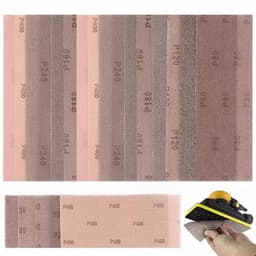
| Best overall |  Yurifaz Yurifaz 80 × 230 mm mesh sheets | 80 × 230 mm sheets | 10 each of P80 to P400 | Palm block | 6.2 | about £15.09 | View offer |
 ProDec ProDec Advance 120 grit mesh roll | 5 m × 115 mm roll | 120 only | Block or pole strip | 9.4 | about £4.99 | View offer | |
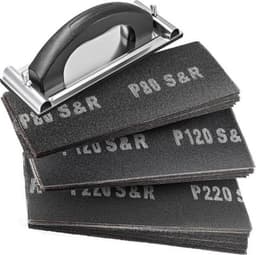
 S&R S&R mesh sheets with hand block | Sheets plus hand block | P80, P120, P220, P400 | Sheet 280 × 93 mm; block 80 × 230 mm | 8.2 | about £18.95 | View offer |

On this page
Sand only what has cured
Which grit on filler and which grit on skim
Sheets and rolls, not a random disc
Gypsum dust still needs a hose
Common questions
What grit mesh should I use on filler before painting?
Can I use P80 on new skim?
Should I buy sheets, a roll, or discs for plasterboard?
Do I need extraction when sanding plasterboard joints?
Is gypsum dust the same as wood dust?
Which pack in the comparison is actually flat sheets?
Will mesh clog on filler?
When should I call a plasterer instead?
Related pages
Sources
Sources taken from the research digest. Listings are from the amazon.co.uk capture of 19 October 2026.
- HSE — wood dust (retrieved 21.10.2026)
- HSE WD7 — hand-held powered sanders (retrieved 21.10.2026)
- HSE — cutting and sanding wood (retrieved 21.10.2026)
- HSE — sanding plasterboard joints (retrieved 21.10.2026)
- HSE CIS69 — extraction as one system (retrieved 21.10.2026)
- Mirka — Abranet (retrieved 21.10.2026)
- Mirka — dust-free sanding (retrieved 21.10.2026)
- Norton — choosing sandpaper (retrieved 21.10.2026)
- Homebuilding — mesh sandpaper or standard sandpaper (retrieved 21.10.2026)
- Protrade — Velcro sanding discs (retrieved 21.10.2026)