




Kitchen fitter
You want 60 or 80 teeth for doors and worktops, with diameter, bore and kerf written in the same file. The 80-tooth Saxton is the listing in this set that pairs that tooth count with the largest amazon.co.uk review sample.
The best 190x30 saw blades, compared.
Top pick: DeWalt DT10399-QZ Elite 3-pack Best value: Saxton TCT19040T 40-tooth blade – Lower shelf price than the 80-tooth Saxton, with plate and kerf both printed. Updated 22.10.2026.

A 190x30 saw blade is a circular saw blade about 190 mm across with a 30 mm centre hole. In the UK you fit that size to many handheld circular saws and to some mitre and table saws. The title and the specification should agree on diameter and bore. A 184 mm blade is for a different saw. A reducing ring is only for a 25 mm, 25.4 mm (1 inch), 20 mm or 16 mm arbor, and only if the flange covers it. The ring should sit slightly thinner than the plate. Where the saw has a riving knife, the knife must be thicker than the plate and thinner than the kerf, and it should sit close to the blade. Use the [riving knife clearance](/hub/saw-accessories/190x30-saw-blade/sub/190x30-saw-blade-riving-knife) before you fit a thin disc. About 24 teeth suit a fast rip, about 40 suit general wood, and 60 or 80 suit a face you will see. A thickness field of 30 mm is the bore, not the kerf.
A 190x30 saw blade is a circular saw blade about 190 mm across with a 30 mm centre hole. In the UK you fit that size to many handheld circular saws and to some mitre and table saws.

36 products checked · 64 hrs invested · +18,600 readers
Swipe for more
1-2 of 10


Personal buying guide
Question 1 of 2
What cut do you need?
The DeWalt DT10399-QZ Elite pack, listed at about £33.99, is titled as three 190 mm, 24-tooth nail-tough blades. The item type says 190/30 mm and 24 teeth, and the thickness field says 1.65 mm. On amazon.co.uk it carries 4.7 from 731 reviews, the highest star line in this set. The same file sets the style name to Single, the material to Shell, the dimensions to 190 by 19 centimetres, and the included components to 1. The bullets limit it to saws without a split wedge. Reviewers praise thin, fast timber cuts and also report a hole with no washers.
Pros
Cons
Best for: You want three 24-tooth DeWalt blades for a saw that has no riving knife, and you can ignore the contradictory fields.
Less suitable: Your saw has a riving knife, or you need a 16 mm or 20 mm ring in the pack.
Specifications
Common questions
How many blades are in the DeWalt Elite pack?
The title, the set name and the item count say three. The style name says Single and the included-components field says 1.
Does the Amazon file name a kerf?
No. The item-thickness field says 1.65 mm. The bullets do not use the word kerf. They do say the set is for circular saws without a split wedge.
Are reducing rings included?
No ring is listed. One review says the centre hole is too large for most saws and that filler washers are not in the pack.
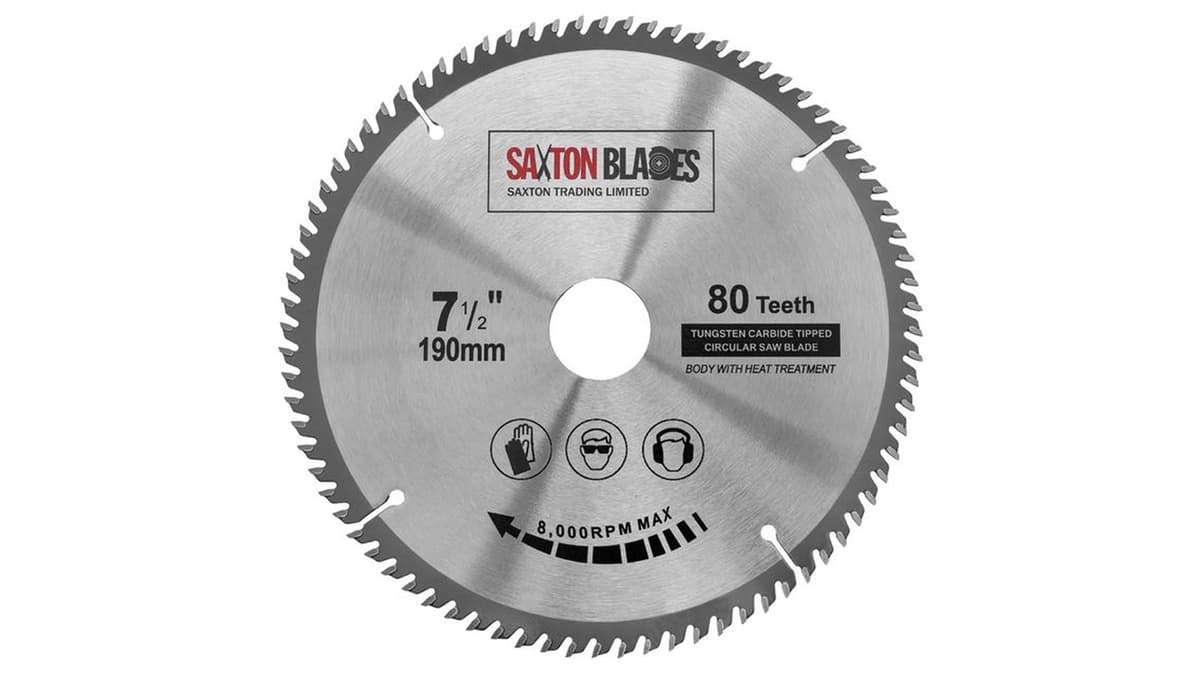
The Saxton TCT19080T, listed at about £14.49, is one 190 mm blade with 80 teeth, a 30 mm bore and a kerf the bullets state as 2.4 mm. On amazon.co.uk it carries 4.6 from 2,297 reviews, the largest count in this set, which is why it is the top pick. Rings for 16 mm, 20 mm and 25 mm are included, and the bullets say the flange still has to clamp the ring. Reviewers describe clean cuts on doors, MDF and worktops, and one review says the rings are thinner than the blade and slip out. The material field says Plastic, while the bullets describe wood. No maximum speed is printed.
Pros
Cons
Best for: You want a documented 80-tooth wood blade for doors, MDF or worktops, and your arbor is 30, 25, 20 or 16 mm.
Less suitable: You need a fast 24-tooth ripping blade, or a kerf the file never separates from the plate.
Specifications
Common questions
Are reducing rings included with this Saxton blade?
Yes. The bullets and the included-components line say 16 mm, 20 mm and 25 mm rings come with the 30 mm bore.
What kerf does the listing state?
The bullets say a 2.4 mm kerf. The item-thickness field also says 2.4 mm. A plate thickness is not given.
Why does the material field say plastic?
The specification field says Plastic. The bullets describe a wood blade for softwood, hardwood, plywood, MDF and laminated plastic. Those two lines are both in the file.
The Saxton TCT19040T, listed at about £12.49, is one 190 mm, 40-tooth ATB blade. The bullets state a 2.4 mm kerf and a 1.6 mm plate, with 16, 20 and 25 mm rings. On amazon.co.uk it carries 4.6 from 906 reviews. That is the best value because the price is below the 80-tooth Saxton and the file still prints plate and kerf. Reviewers praise door trimming and a Ryobi fit. One says the blade blunted after about four cuts in thick oak. The material field says Plastic. No maximum speed is printed.
Pros
Cons
Best for: You want one general wood blade with a printed plate and kerf, and about £12.49 is enough.
Less suitable: You want the finest face in this set, which is the 80-tooth Saxton, or a 24-tooth framing blade.
Specifications
Common questions
Does this 40-tooth Saxton include rings?
Yes. The bullets include 16 mm, 20 mm and 25 mm reduction rings for the 30 mm bore.
What is the plate thickness?
The bullets say the plate is 1.6 mm and the kerf is 2.4 mm. The item-thickness field says 2.4 mm.
Is 40 teeth a rip blade in this listing?
The bullets say it is for cuts along the grain and across it. One reviewer says it has too many teeth for ripping and still calls the crosscut clean.
The DeWalt DT10304-QZ, listed at about £15.50, is one Extreme framing blade, 190 mm by 30 mm with 24 teeth. The amazon.co.uk line is 4.6 from 799 reviews. The set name says elite. The thickness field says 30 mm. Reviewers who use it for fencing and carpentry praise the thin cut, and others say the kerf is too thin for a riving knife and that a Milwaukee flange will not tighten. One review reports a tooth lost on a 25 mm nail. No ring is listed.
Pros
Cons
Best for: You want one 24-tooth DeWalt framing blade for a DWE575K or DWE576K and you will check the knife and the flange.
Less suitable: You wanted the Elite three-pack, DT10399-QZ, or a blade with a printed kerf.
Specifications
Common questions
Is this the Elite series?
The title says Extreme Framing, model DT10304-QZ. The set name says elite. A UK review says the blade is Extreme and that the picture is wrong.
What thickness does the specification give?
The item-thickness field says 30 mm, which is the same figure as the bore. The bullets say thin kerf and do not give a number.
Which saws does the file name?
The compatible-devices field names DeWalt DWE575K and DWE576K. Reviews also mention Makita battery saws and a Milwaukee that would not clamp the thin plate.
The BAUBECK 24-tooth blade, listed at about £16.89, states 190 mm by 30 mm, a fast multi-material cut, and rings for 1 inch, 20 mm and 16 mm. The amazon.co.uk line is 4.6 from 35 reviews. The thickness field says 30 mm. The part number matches the 80-tooth BAUBECK. UK reviews mention plywood, skirting and pallet nails. One says it did not fit a Ryobi. One review title on the file names a 210 mm blade. It is ranked number 1 in Mitre Saw Blades on this capture.
Pros
Cons
Best for: You want a 24-tooth BAUBECK disc and you already have a 30 mm arbor.
Less suitable: You need a large review sample, a printed kerf, or a guaranteed fit on a 16 mm saw.
Specifications
Common questions
How many reviews are on the star line?
The amazon.co.uk line says 4.6 from 35 reviews. The raw file contains 14 UK-marked review texts.
Will it fit every circular saw?
The bullets say it fits standard saws if the arbor matches or you use a reducer. One UK review says it did not fit a Ryobi because the saw fittings did not grab the blade.
Is the kerf printed?
No. The item-thickness field says 30 mm. The title uses 30 mm as the bore.
The LSHUZIYU blade, listed at about £13.99, states 190 mm, 60 teeth, a 30 mm bore, ATB and a 2.4 mm kerf, with a maximum of 8,500 rpm in the bullets. The amazon.co.uk line is 4.5 from 285 reviews. UK reviews mention clean decking and cabinet cuts, a missing tooth on arrival, and burning within two hours. The title and the first bullet do not list the same washers. Many other reviews in the file are not marked United Kingdom and talk about other sizes. The manufacturer field says ANJUE.
Pros
Cons
Best for: You want a 60-tooth wood blade with a printed speed limit and you will check the washers in the packet.
Less suitable: You need one agreed ring list, or you will treat non-UK reviews as British owners.
Specifications
Common questions
Which reducing washers does the file list?
The title lists 25.4 mm, 22.23 mm, 20 mm and 15.88 mm. Bullet 1 lists 25.4 mm, 22.23 mm and 20 mm. The 15.88 mm washer is only in the title.
Is a maximum speed printed?
Yes. The bullets say 8,500 rpm. That is a listing figure, not a measured speed.
Are the reviews all from the UK?
The star line is 4.5 from 285 on the amazon.co.uk file. Many of the review texts are marked Italy, Germany, Ireland and elsewhere, and some describe other diameters.
The BAUBECK 80-tooth blade, listed at about £14.90, states 190 mm by 30 mm and rings for 1 inch, 20 mm and 16 mm. The amazon.co.uk line is 4.4 from 276 reviews. The thickness field says 30 mm and the dimensions say 19 by 3 cm. The part number BAU-CSB-PARENT-MULTI-PRO is the same as the 24-tooth BAUBECK. Reviewers praise clean wood cuts and aluminium trim. Several say the edge dies on laminate flooring. One ground a guard because the kerf was too narrow.
Pros
Cons
Best for: You want a cheap 80-tooth blade and you will judge the rings and the kerf yourself.
Less suitable: You need a printed kerf, or a blade whose part number is not shared with another tooth count.
Specifications
Common questions
What does the 30 mm thickness field mean?
The item-thickness field says 30 mm. The title uses 30 mm as the bore. No separate kerf is printed.
Does the listing claim metal?
The style name is Fine Finish - Multi Material, and the compatible-material field says metal, plastic and wood. The bullets list mild steel and aluminium as well as wood. Reviews that name a job mostly name wood, laminate or aluminium trim.
Is the 16 mm ring a tight fit?
One UK review says the 16 mm adapter worked but was a loose fit and could be lost when the blade was removed.
The BATIOPV pack, listed at about £24.99, is titled as three 190 mm by 30 mm wood blades at 24, 48 and 60 teeth, with a 2.2 mm thickness and 7,200 rpm in the bullets. The tooth field says 60 and the thickness field says 1.8 mm. The model number is HCS90T. The amazon.co.uk line is 4.3 from 207 reviews. UK comments call the cut decent. One UK review says they do not stay sharp. Many other reviews in the file are not marked United Kingdom.
Pros
Cons
Best for: You want a mixed 24, 48 and 60 tooth pack and you will check which disc is which when it arrives.
Less suitable: You need one agreed tooth count and one agreed thickness before you order.
Specifications
Common questions
How many tooth counts are in the pack?
The title and the bullets say three blades, 24, 48 and 60 teeth. The number-of-teeth field says 60. The model number is HCS90T.
Which rings are listed?
The bullets say reducer rings for 20 mm and 16 mm. The title mentions a 20 mm ring. A 25 mm ring is not listed.
What speed is printed?
The bullets say a maximum of 7,200 rpm. The item-thickness field says 1.8 mm and the bullets say 2.2 mm.
The SabreCut SCCSN30190_24, listed at about £9.99, is one 190 mm, 24-tooth blade with a 30 mm bore. The thickness field says 1 mm. The amazon.co.uk line is 4.1 from 76 reviews, the lowest in this set. Bullets claim a thin-kerf NiCo ATB blade for timber and sheet goods. The material field says high speed steel and the power-source field says hand powered. One framer reports months of stud work. Other reviews describe smoking on a Bosch GKS 190, a short life in OSB, and a Milwaukee flange that will not tighten.
Pros
Cons
Best for: You want the cheapest 24-tooth 30 mm blade in this set and you will test the clamp before a job.
Less suitable: You need a ring, a printed kerf, or a blade whose material field matches the bullets.
Specifications
Common questions
What is the blade made of, according to the file?
The specification says high speed steel. The bullets say NiCo alternate-top-bevel teeth and a hammer-shield coating. Both lines are in the raw file.
Does it include a reducing ring?
No. The bullets limit compatibility to a 190 mm blade with a 30 mm bore.
Why do Milwaukee reviews say it will not fit?
UK reviews say the blade is too thin for Milwaukee CCS66 and FCS66, so the flange does not clamp, and that the hole is too big.
The CRALY E19024FR, listed at about £14.99, states 190 mm, 24 ATB teeth, a 30 mm arbor, a 2.0 mm kerf and bushings for 16 mm, 20 mm and 25.4 mm. The bullets name plywood, MDF, OSB and laminated wood, plus a non-stick coating and expansion slots. The raw file has no customer-review line, so there is no star rating to quote. The item dimensions are 18.5 by 19 cm, which is a close match to 190 mm but not exact. No maximum speed is printed.
Pros
Cons
Best for: You want a fully specified 24-tooth wood blade and you can accept a listing with no reviews.
Less suitable: You buy from review volume, or you need a printed maximum speed.
Specifications
Common questions
What kerf does CRALY print?
The key specification says 2.0 mm. The item-thickness field says 2 mm. No separate plate thickness is given.
Which bushings are included?
The specification says 16 mm, 20 mm and 25.4 mm bushings for the 30 mm arbor.
Is there an Amazon rating?
No customer-review line is in the raw file. The rating is recorded as 0 for that reason.
Ten amazon.co.uk listings were read on 19 October 2026 and scored on review evidence, whether the file agrees with itself, and shelf price against a size that is actually written down. This is not a lab test. Maker pages are not copied into the scores.
Amazon evidence
40%Star rating, then review count. A line of 4.6 from 2,297 ranks above 4.7 from 731 when that file contradicts itself. No review line scores 0 on this criterion. Review text that is not marked United Kingdom does not add points. A parent listing that mixes other diameters costs points.
Listing clarity
35%An agreed 190 mm and 30 mm, one tooth count, a kerf number, a wood job, and a ring list or an honest none. A thickness field of 30 mm, a material field that fights the bullets, or a set name from another series costs points.
Value
25%Shelf price against a blade whose size is written down. The lowest price does not win while its material field says high speed steel and the bullets say NiCo.
Buy a 190x30 saw blade by checking the saw first, then the listing. Confirm 190 mm and 30 mm, then any ring, then kerf against the riving knife, then tooth count, and only then the price. The ten listings behind this page were read on amazon.co.uk on 19 October 2026. Scores follow review evidence, whether the file agrees with itself, and price against a size that is actually written down. Nothing here is a laboratory cut test.
A 190x30 saw blade is the round woodworking disc defined by two measurements: about 190 mm outside diameter and a 30 mm hole. Those two figures decide whether it will mount. Tooth count, kerf and rings decide whether the cut, and the saw guard, will accept it. In the UK, many handheld circular saws and some mitre and table saws use this bore. A saw specified at 184 mm is a different machine. Start with the listing, not the price.
On several files the thickness field copies the bore. That 30 mm is the hole, not the width of the cut. If no separate kerf is printed, you cannot check a riving knife from the listing.
A 24-tooth three-pack and a single 24-tooth framing blade can share a diameter and still be different parts. A parent part number shared by an 80-tooth file and a 24-tooth file is the same problem. Read the tooth count on the disc you receive.
A 16 mm ring that sits loose can fall out when you remove the blade. A multi-material line is not a mild-steel rating. Stop if a tooth is missing, the plate is cracked, or the guard has been ground away.
The first check is whether this blade is the size your saw was built for. A 190x30 saw blade needs about 190 mm outside diameter and a 30 mm hole, and those figures should appear in the title and in the specification. A nearby size, including a 184 mm handheld saw, is a different machine. Do not borrow a manual from another market and assume the bore matches. A reducing ring is the second check, and only if your arbor is 25 mm, 25.4 mm (1 inch), 20 mm or 16 mm.
Kerf is the width of the cut. The plate is the body of the disc. If your saw has a riving knife, Health and Safety Executive guidance is precise: the knife is thicker than the plate, thinner than the kerf, and within 8 mm of the blade on a bench saw. You can apply that rule only when the file prints a kerf. A thickness field of 30 mm is the bore copied into the wrong box. A bullet that says thin kerf without a number leaves the knife check undone.
Three typical situations, each with a recommendation from this comparison.
You want 60 or 80 teeth for doors and worktops, with diameter, bore and kerf written in the same file. The 80-tooth Saxton is the listing in this set that pairs that tooth count with the largest amazon.co.uk review sample.
You want one blade for cuts along the grain and across it, and you want a plate and a kerf both printed. The 40-tooth Saxton is the best value on that brief, with rings for 16, 20 and 25 mm.
You want a 24-tooth blade whose flanges actually clamp. Read the thin-kerf reviews before you buy a framing disc, and check the knife. The single DeWalt Extreme is the 24-tooth file that names the DWE575K and DWE576K.
The top pick is the Saxton TCT19080T. On amazon.co.uk it carries 4.6 from 2,297 reviews, the largest sample here, and the listing states 190 mm, 80 teeth, a 30 mm bore and a 2.4 mm kerf. The best value is the Saxton TCT19040T at about £12.49, with that same kerf and a 1.6 mm plate both printed. The DeWalt Elite three-pack has the highest star line, 4.7 from 731, and is not the top pick, because the same file conflicts on style name, material, dimensions and a split-wedge limit. None of these scores is a lab test.

Saxton TCT19040T 40-tooth blade
Lower shelf price than the 80-tooth Saxton, with plate and kerf both printed.
Editorial

Peter F. is the editor for DIY & tools at productscompared.co.uk. Comparisons in this category are checked against amazon.co.uk listings, review evidence and public UK sources.
Guides on what to look for, how to use a product, and common mistakes.
Public UK sources and maker pages from the research digest, last checked on 19 October 2026.
This page contains affiliate links to amazon.co.uk. If you buy through them, we may earn a commission at no extra cost to you. Listings were read on 19 October 2026. This is not a lab test, and a qualifying purchase does not change the scores.