Independent comparisons. We may earn from shop links. More info

How to change a circular saw blade on a 30 mm bore

Updated: 22 October 2026

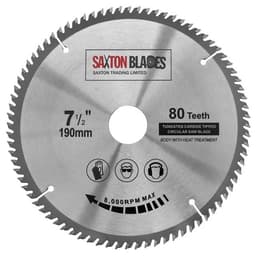
The new 190 mm disc is on the bench and the bolt looks simple until the blade spins the wrong way or the ring walks out. How to change a circular saw blade, on a 30 mm bore, is a short sequence: power off, match the arrow, seat a ring only if the flange covers it, then make a short test cut. The order follows Evolution’s blade leaflet, Trend’s instruction and a Mafell manual, plus failures on these amazon.co.uk files on 19 October 2026. It is not a ranking and not a lab test. A qualifying purchase can earn a commission at no extra cost to you. The listings are on the [190x30 saw blade comparison](/hub/saw-accessories/190x30-saw-blade).

The new 190 mm disc is on the bench and the bolt looks simple until the blade spins the wrong way or the ring walks out.

Our top picks

On this page

Power off and match the arrow

Take the battery off, or pull the plug, before your hand goes near the bolt. Press the spindle lock, if the saw has one, and only then put the spanner on the bolt. Mafell’s MKS 185 Ec manual, a 185 mm saw rather than one of these blades, tells you to match the arrow on the blade to the arrow on the machine. On that example the bolt is undone anti-clockwise. Your own manual decides the thread. Teeth on a handheld saw usually point up at the front of the shoe. A blade fitted backwards will burn and climb. Clean the old pitch off the flanges first.

Seat the ring or do not use it

If the arbor is already 30 mm, leave the reducing rings in the bag. On a 16 mm, 20 mm or 25 mm arbor, the ring should slide on without a hammer, sit flush, and sit slightly thinner than the plate so the flanges clamp metal to metal. Evolution’s leaflet and Trend’s instruction both say a loose bush is not used, and the flange must cover it. On the Saxton files, one owner says the rings slip out. A 25 mm ring and a 25.4 mm ring are not interchangeable.

Clamp, then a short cut

Tighten with the saw’s own spanner while the spindle lock is held. Do not slide a pipe over the spanner. Trend’s instruction refuses that. The blade should not rotate on the spindle once the lock is released. One Extreme review describes paint in the hole that let the blade spin on a Makita spindle. Scrape it out. If it still spins, stop. Reconnect power only for a short cut in scrap. A burn on the first 300 mm usually means a backwards blade, a blunt tooth, or a feed that is too slow. A missing carbide tip, as one UK review of the LSHUZIYU blade reported, means you do not run it.

Stop if the knife or the guard has to be ground

A thin plate can sit so low in the flanges that the nut will not pull up. SabreCut and Extreme reviews both describe a Milwaukee flange that will not tighten on the thin plate. That is a mismatch, not a cue to file the flange. If the riving knife sits proud of the kerf, take the blade off. Do not grind the knife or the guard. One BAUBECK review describes a guard ground to clear a narrow kerf. That is the case this page refuses. Changing the blade stops being a domestic fitting job when the knife, guard or flange has to be altered. A workplace saw sits under the employer’s PUWER checks. Fit a blade whose plate and kerf suit the knife, using the riving knife page.

Common questions

Which way does the arrow point?
The arrow on the blade points the same way as the arrow on the saw. On a typical handheld circular saw the teeth at the front of the shoe point upwards. There is no single bolt direction. Mafell’s example loosens anti-clockwise. Your manual decides the thread. A blade fitted against the arrow will burn the timber and try to climb out of the cut.
Do I unplug before I touch the bolt?
Yes. Pull the plug, or take the battery off, before you retract the guard or fit the spanner. The switch is not an isolation. Hold the spindle lock, then turn the bolt the way your manual shows. You reconnect only when the blade is tight, the guard returns, and you are ready for a short scrap cut.
Can I tap a loose ring in and hope?
No. Evolution’s leaflet and Trend’s instruction both say a loose bush is not used. The ring has to sit flush, slightly thinner than the plate, and the flange has to cover it. A hammer blow can crack the ring or bell the bore. If the 16 mm adapter rocks, as one BAUBECK owner described, leave it out.
Why does the blade spin on the spindle after I tighten it?
The bore is not driving on the spindle. Paint in the hole, which one Extreme review found, will let the disc rotate even when the bolt feels done up. Clean the bore and the flanges and try again with the spindle lock held. If it still spins, the arbor or the ring is wrong. Do not add a longer bar to the spanner.
What if the riving knife will not go into the cut?
The knife is thicker than the kerf, so this blade does not fit that saw. Stop the test cut. Do not remove the knife, and do not grind it down. Change to a blade whose kerf is wider than the knife and whose plate is thinner than the knife, or fit the knife the saw was supplied with.
What do I do if a tooth is missing?
Do not fit the blade. A UK review of the LSHUZIYU disc reported a missing tooth on arrival. One missing tip throws the disc out of balance. A cracked body is not repaired at home. Send it back under the description you paid for, and keep the packet so you can show the damage.

Related pages

Sources

Public UK sources and maker pages from the research digest, last checked on 19 October 2026.

  1. HSE: Circular saw benches (rip saw) (retrieved 19.10.2026)
  2. HSE Woodworking Information Sheet WIS16 (retrieved 19.10.2026)
  3. HSE: Woodworking machinery standards (retrieved 19.10.2026)
  4. HSE L114: Safe use of woodworking machinery (retrieved 19.10.2026)
  5. Consumer Rights Act 2015, section 11 (retrieved 19.10.2026)
  6. DeWalt DWE575K-GB 190 mm circular saw (retrieved 19.10.2026)
  7. DeWalt DT10399-QZ Elite circular saw blade 3-pack (retrieved 19.10.2026)
  8. Trend CSB/19060TC 190 mm x 30 mm blade (retrieved 19.10.2026)