Independent comparisons. We may earn from shop links. More info

Riving knife too thick for a 190 mm circular saw blade

Updated: 22 October 2026

You have lined the new 190 mm blade up with the saw, and the riving knife either will not enter the kerf or sits in the slot and still lets the timber pinch. A riving knife too thick for blade is a fit failure, even when the diameter and the 30 mm bore are right. The knife has to be thicker than the plate and thinner than the kerf. This page applies that geometry to the amazon.co.uk files read on 19 October 2026, using the Health and Safety Executive’s rip-saw guidance. A qualifying purchase can earn a commission at no extra cost to you. The listings are on the [190x30 saw blade comparison](/hub/saw-accessories/190x30-saw-blade).

You have lined the new 190 mm blade up with the saw, and the riving knife either will not enter the kerf or sits in the slot and still lets the timber pinch.

Our top picks

On this page

Plate, knife, kerf

The plate is the steel body. The kerf is the wider slot the teeth cut. The riving knife holds that slot open so the timber cannot close on the rising teeth. HSE’s rip-saw page says the knife should be thicker than the plate, thinner than the kerf, and within 8 mm of the blade on a bench saw. If the knife is thicker than the kerf, it will not enter. If it is thinner than the plate, the wood can still pinch. DeWalt’s UK manual for the DWE7492 gives that saw’s knife as 2.3 mm beside a 2.0 mm body on a 250 mm blade. Those numbers are not yours. Not every handheld saw has a knife.

What these listings print

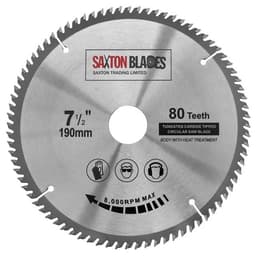
Only the Saxton TCT19040T prints both widths: a 1.6 mm plate and a 2.4 mm kerf. A 2.0 mm knife would sit between them. The TCT19080T states a 2.4 mm kerf and no plate on amazon.co.uk. CRALY states a 2.0 mm kerf and no plate. LSHUZIYU states 2.4 mm. SabreCut’s thickness field says 1 mm, with no kerf word. BAUBECK’s files and the Extreme file put 30 mm in the thickness field. That number is the bore, so it cannot be compared with a knife.

Elite, Extreme and a saw that has a knife

The Elite pack, DT10399-QZ, is three 190 mm, 24-tooth blades in the title. The Amazon bullets limit it to saws without a split wedge, and the file never uses the word kerf. The thickness field says 1.65 mm. DeWalt’s UK page calls the kerf 1.65 mm and the plate 1 mm, which Amazon does not label as a pair. If your saw has a knife, that bullet has already excluded the pack. The Extreme leaves thickness at 30 mm, so Amazon gives you no kerf. Reviews say the kerf is too thin for an older knife. Taking the knife off removes the part that stops the timber closing on the teeth.

Do not grind the knife or the guard

If the knife will not enter, change the blade or the knife. Do not grind either. One BAUBECK review describes a guard ground because the kerf was too narrow. A ground knife can end up thinner than the plate. Once a blade fits, the arrow, the flange and a scrap cut are on the how to change a circular saw blade page. On a workplace saw, PUWER sits on that geometry. This page is not a legal opinion. Use the buying guide if the thickness field was 30 mm and you still have no real kerf.

Common questions

Why will the riving knife not enter the cut?
The knife is thicker than the kerf. It has to be thinner than the slot the teeth open and thicker than the plate. HSE states that order for a rip saw, including a gap within 8 mm of the blade on a bench. A correct 190 mm diameter does not fix a knife that sits proud. You need both widths in millimetres, not the word “thin”.
Can I take the knife off?
Removing the knife lets the timber close on the rising blade. HSE’s guidance is to use a knife that matches the blade, and another knife if you change blades, not to run without one. A handheld saw built without a knife is a different machine. A saw the Elite bullets exclude with “without a split wedge” should keep a knife that fits.
What is a split wedge?
A split wedge is another name for the riving knife or splitter behind the blade. The Elite Amazon bullets limit that pack to saws without a split wedge. If your saw has one, leave the pack. It is not a suggestion to remove the wedge. The Extreme file never prints a kerf, and reviews already describe a knife that would not pass.
Is 1.65 mm the kerf of the Elite pack?
DeWalt’s UK page for DT10399-QZ states a 1.65 mm kerf and a 1 mm plate. The Amazon thickness field says 1.65 mm and does not call it the kerf. Keep those sources apart. Even if you use the UK page’s 1.65 mm, the bullets still point the pack at saws without a split wedge.
What if the listing only says thin kerf?
You do not yet know whether the knife will fit. Thin kerf, with no millimetres, might be a narrow slot, a thin plate, or a slogan. The Saxton 40-tooth file is the one that prints both, 1.6 mm plate and 2.4 mm kerf. A 30 mm thickness field is the bore, used by BAUBECK and by Extreme. Measure, or choose a listing that states both widths.
Does a handheld saw without a knife escape this rule?
Yes, in the narrow sense that there is no knife to clash with the kerf. Many handheld circular saws rely on the guard and the shoe. The Elite bullets are written for that case. The moment the saw has a knife, or you move the same blade to a table saw, the HSE order applies again. Diameter and bore can be right and the blade can still be the wrong width.

Related pages

Sources

Public UK sources and maker pages from the research digest, last checked on 19 October 2026.

  1. HSE: Circular saw benches (rip saw) (retrieved 19.10.2026)
  2. HSE Woodworking Information Sheet WIS16 (retrieved 19.10.2026)
  3. HSE: Woodworking machinery standards (retrieved 19.10.2026)
  4. HSE L114: Safe use of woodworking machinery (retrieved 19.10.2026)
  5. Consumer Rights Act 2015, section 11 (retrieved 19.10.2026)
  6. DeWalt DWE575K-GB 190 mm circular saw (retrieved 19.10.2026)
  7. DeWalt DT10399-QZ Elite circular saw blade 3-pack (retrieved 19.10.2026)
  8. Trend CSB/19060TC 190 mm x 30 mm blade (retrieved 19.10.2026)