Independent comparisons. We may earn from shop links. Our editors compare products independently. Some links go to shops, and we may earn a commission. More info
The best reciprocating saw blades for masonry, compared.
Top pick: CECOMBINE 10 inch masonry blades, value pack Best value: Fyeme 10 inch carbide-tooth blade – About £6.99 for one carbide-tooth blade, 4.2 from 109 ratings, for old brick and mortar. Pitch is not stated, and a UK review says it did not cut concrete blocks. Updated 22.10.2026.
A reciprocating saw blade for masonry is a sabre-saw blade with a tungsten-carbide tooth strip, or a carbide-grit edge, on a 1/2 inch (13 mm) universal shank. You buy one in the UK when the material would blunt a bi-metal wood or metal blade. Typical jobs are a short run of facing brick, aerated block, hollow brick, fibre cement or cement board.
Match the edge to the material. Carbide teeth suit aerated block, hollow brick, fibre cement and ordinary brick. Carbide grit suits tile and brittle sheet. A coarse pitch, about 2 teeth per inch, is the usual tooth for brick. Read any printed exclusion. Listings often say they are not for stone, hard rock, cement blocks or fine branches. Believe that line when a title says concrete. The shank stays outside the cut. A short blade will not cross a thick cavity wall. A blade around 380 to 450 mm needs a saw that can hold a straight stroke.
Those checks, in order, are in the [reciprocating saw blade masonry buying guide](/hub/saw-accessories/reciprocating-saw-blade-masonry/sub/reciprocating-saw-blade-masonry-buying-guide).
A reciprocating saw blade for masonry is a sabre-saw blade with a tungsten-carbide tooth strip, or a carbide-grit edge, on a 1/2 inch (13 mm) universal shank.
A reciprocating saw blade for masonry is a sabre-saw blade with a tungsten-carbide tooth strip, or a carbide-grit edge, on a 1/2 inch (13 mm) universal shank. You buy one in the UK when the material would blunt a bi-metal wood or metal blade. Typical jobs are a short run of facing brick, aerated block, hollow brick, fibre cement or cement board.
Match the edge to the material. Carbide teeth suit aerated block, hollow brick, fibre cement and ordinary brick. Carbide grit suits tile and brittle sheet. A coarse pitch, about 2 teeth per inch, is the usual tooth for brick. Read any printed exclusion. Listings often say they are not for stone, hard rock, cement blocks or fine branches. Believe that line when a title says concrete. The shank stays outside the cut. A short blade will not cross a thick cavity wall. A blade around 380 to 450 mm needs a saw that can hold a straight stroke.
Those checks, in order, are in the [reciprocating saw blade masonry buying guide](/hub/saw-accessories/reciprocating-saw-blade-masonry/sub/reciprocating-saw-blade-masonry-buying-guide).
A reciprocating saw blade for masonry is a sabre-saw blade with a tungsten-carbide tooth strip, or a carbide-grit edge, on a 1/2 inch (13 mm) universal shank. You buy one in the UK when the material would blunt a bi-metal wood or metal blade. Typical jobs are a short run of facing brick, aerated block, hollow brick, fibre cement or cement board. Match the edge to the material. Carbide teeth suit aerated block, hollow brick, fibre cement and ordinary brick. Carbide grit suits tile and brittle sheet. A coarse pitch, about 2 teeth per inch, is the usual tooth for brick.
The CECOMBINE value pack is titled as 10 inch carbide-tipped masonry blades at £19.99, and the set name says five pieces. The unit count is also 5, while the number-of-items field says 2, so the pack you receive is not settled on the listing. It shows 5.0 out of 5 from a single amazon.co.uk rating, and no review text is stored. Teeth per inch is not stated. The part number JJ24290-30A matches the two-piece CECOMBINE listing, which does have UK comments about skating on Fletton brick. Bullets name brick, aerated concrete, lime-sand brick and cement panels. Until the live page confirms the piece count, that five-star line is not evidence of how the blade cuts.
Pros
Set name offers a multi-blade 10 inch carbide-tooth pack at £19.99
Listing names brick, aerated concrete, lime-sand brick, and cement panels
Universal shank for reciprocating, sabre, and tiger saws
Cons
Pack count fields disagree: the set name says five pieces and the number of items says 2
Only one rating, and no review text is stored
Same part number as the two-piece listing, so the pages are easy to confuse
Best for: A buyer who has checked the live pack count on amazon.co.uk and still wants spare 10 inch carbide teeth.
Less suitable: Anyone who needs a confirmed piece count or UK review evidence of a cut. Neither is clear on the listing.
The set name says 10 inch times 5 pieces and the unit count is 5. The number-of-items field says 2. The count is not consistent on the listing, so check the live page before you rely on five blades.
Is there UK review text?
The listing shows 5.0 from 1 rating. No review text is stored with that rating, so the star line is not evidence of a cut.
Which shank does it use?
The listing says a universal shank for reciprocating, sabre and tiger saws. Teeth per inch is not stated. The part number matches the two-piece listing.
The Saxton R228BC is a single 2 TPI carbide-tipped blade, about 228 mm long and 1.5 mm thick, listed at £10.99 with a 1/2 inch shank. Across 1,766 amazon.co.uk ratings it sits at 4.5 out of 5, and the UK reviews describe a slow cut in facing brick and lightweight block for doorways, cat flaps, and chasing. Several of those reviews say the teeth were still usable after a small brick job, and that dust was lower than with a 9 inch grinder when a vacuum sat beside the blade. Clay brick is much slower than breeze block, and the saw can get hot. One review lost three teeth across 22 hard bricks when the feed was too heavy. Dense block and engineering brick are the materials those reviews say to leave alone. A diamond disc is still faster when both faces of a single-brick wall are open.
Pros
2 TPI carbide tooth, about 228 mm and 1.5 mm thick, on a 1/2 inch shank at £10.99
UK reviews describe slow cuts in facing brick, lightweight block, doorways, and cat flaps
Less airborne dust than a grinder in several UK reviews when a vacuum sits beside the blade
4.5 out of 5 from 1,766 amazon.co.uk ratings
Cons
Dense block and engineering brick are the wrong material in the UK reviews
Teeth can snap under pressure: one review lost three teeth across 22 hard bricks
Clay brick is much slower than breeze block, and the saw can get hot
Best for: A short cut in facing brick, lightweight block, porous concrete, or cement board, where a slow feed is acceptable.
Less suitable: Dense block, engineering brick, and a fast cut through a single-brick wall when both faces are open to a diamond disc.
The MUOZLOP pack is three 380 mm (15 inch) blades at £35.14, the highest price in this set, with 2 TPI brazed carbide teeth and a stated thickness of 1.5 mm. It scores 4.5 out of 5 from 16 amazon.co.uk ratings, and 12 UK reviews are stored. Reviewers describe a stiff blade with limited flex and a straight cut lengthways in blocks, and less mess than a disc on paving and brick. Progress is slow. On a DeWalt DCS367N-XJ 18 V saw the long blade vibrated heavily in mortar, and that user stopped. The listing says it cannot cut concrete that contains stones, while the bullets name porous concrete, light brick, soft masonry stone and fibre cement. One buyer had not tried masonry yet and used a blade on a tree root, so that rating is not a masonry result.
Pros
Three 380 mm blades at 2 TPI, with a stated thickness of 1.5 mm
UK reviews describe a stiff, straight cut in block and less mess than a disc
Listing names porous concrete, light brick, and fibre cement
Cons
Highest price in the set at £35.14, from only 16 ratings
A long blade vibrated heavily in an 18 V DeWalt saw in one UK review
Cannot cut concrete that contains stones, and progress is described as slow
Best for: Light brick, porous concrete, and fibre cement when a 380 mm blade fits a saw that can hold a straight stroke.
Less suitable: Concrete that contains stones, and a small 18 V saw that already vibrates with a long blade in mortar.
Three blades, 380 mm (15 inch), 2 TPI. The listing thickness is 1.5 mm. It is the highest price in this set, at about £35.14.
What does the listing say it cannot cut?
Concrete with stones. The bullets name porous concrete, light brick, soft masonry stone and fibre cement. Progress in the UK reviews is described as slow.
What did a UK review say about an 18 V saw?
On a DeWalt DCS367N-XJ the long blade vibrated heavily while cutting mortar, and the user stopped. A 380 mm blade needs a saw that can hold a straight stroke.
The EZARC 80271802 is a single 450 mm (18 inch) carbide-tooth blade at £23.37, sold for porous aerated concrete, hollow brick, fibre cement and drywall. It scores 4.2 out of 5 from 402 amazon.co.uk ratings. The listing says that length can cut an entire block in one stroke, and it excludes stones, hard rocks, cement blocks and fine branches. Only six UK reviews are stored against those 402 ratings. Those short comments say it cuts brick and aerated block, lasted for the job, and has been used as a mortar rake. Teeth per inch is not stated, and there is no millimetre thickness. A 450 mm blade needs a saw that can hold it straight. A non-UK line about carbide chipping on reinforcing bar is not counted as a UK fault.
Pros
Longest blade in the set at 450 mm, listed for a full block in one stroke
4.2 out of 5 from 402 amazon.co.uk ratings
UK comments mention aerated block, brick, and use as a mortar rake
Printed exclusion for stones, hard rocks, cement blocks, and fine branches
Cons
TPI is not stated, and only six UK reviews are stored against 402 ratings
Listing excludes cement blocks and stone
A 450 mm blade is hard to hold straight in a small cordless saw
Best for: A deep cut in aerated concrete or hollow brick when the saw can control 450 mm and the material is inside the listing.
Less suitable: Cement blocks, stone, reinforcing bar, and a small cordless saw that cannot keep a long blade on the line.
The Fyeme listing is one 10 inch (254 mm) alloy blade with tungsten carbide teeth at £6.99, the lowest price in this set. It scores 4.2 out of 5 from 109 amazon.co.uk ratings. UK reviews describe it cutting old brick and mortar, including cleaning bricks for reuse and a window opening where spare blades were left over. The set name lists 10, 12, 18 and 20 inch, but the unit count is 1, so the page is a single 10 inch blade. Teeth per inch is not stated; a number-of-teeth field says 15, which is not a pitch. A UK review says it did not cut concrete blocks even though the description suggested it would. The thickness attribute prints 24 mm, which does not read as a blade gauge.
Pros
Lowest price in this set at £6.99 for one carbide-tooth blade
UK reviews describe cuts in old brick and mortar, including cleaning bricks for reuse
TPI is not stated, and the set name lists several lengths while the unit count is 1
The 24 mm thickness attribute does not read as a blade gauge
Best for: A low-cost single blade for old brick, mortar, and the aerated or cement-board materials the listing names, when you do not need a stated TPI.
Less suitable: Concrete block, a multi-length set, and any job that depends on a printed tooth pitch.
The TOLESA T122201 is a single 300 mm, 2 TPI brazed carbide blade at £17.99, with a universal shank. It scores 4.1 out of 5 from 145 amazon.co.uk ratings. The listing names porous aerated concrete, hollow brick and red brick, and it says not to use it on stones, hard rocks, cement blocks or fine branches. UK reviews describe a straight cut and less airborne dust on small mortar jobs, and one reviewer cut a double-skin wall and finished that job on the same blade. The same reviews say the blade snags and snaps in professional use, and that it wobbles in the clamp. House brick was still difficult for one buyer, who pre-drilled the cut line. A listing dimension of 30.5 cm sits beside the 300 mm title, so the title length is the figure to use when you check reach.
Pros
300 mm, 2 TPI carbide tooth, with a printed exclusion for cement blocks and stone
UK reviews mention less dust on small mortar jobs and a straight cut
One UK review cut a double-skin wall and finished that job on the same blade
4.1 out of 5 from 145 amazon.co.uk ratings
Cons
UK reviews describe snapping when the blade snags, and wobble in the clamp
One UK review needed pre-drilled holes in house brick
The title says 300 mm and a dimension line says 30.5 cm
Best for: Porous aerated concrete, hollow brick, and red brick, on a saw that holds the blade without wobble in the clamp.
Less suitable: Cement blocks, stone, hard rock, and a professional cut where the blade is likely to snag.
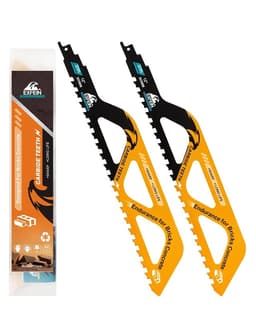
The EXFEIN pack is two 305 mm carbide blades at £23.99, with 2 TPI, a 1/2 inch shank, and a stated working length of 253 mm. It scores 4.1 out of 5 from 128 amazon.co.uk ratings. UK reviews include a brick cut on a Worx cordless saw, bricks from about 1900, and 3 inch breeze blocks plus thermal blocks for two door openings, with one blade still holding its teeth. Another review says the edge blunted after about 10 bricks and treats the blade as a DIY-only edge. The cut is described as slow. The listing excludes stones, hard rocks, cement blocks and fine branches, and names porous aerated concrete, hollow brick, fibre cement and drywall. A thickness attribute of 13 mm matches the shank width rather than a blade gauge.
Pros
Working length is stated: 305 mm total, 253 mm in the cut, 2 TPI
Two blades in the pack at £23.99
A UK review cut breeze block and thermal block for two door openings
4.1 out of 5 from 128 amazon.co.uk ratings
Cons
UK reviews report the edge blunting after about 10 bricks
Described as a slow cut, not a fast one
Listing excludes cement blocks and stone
Best for: Porous block, hollow brick, and fibre cement, when you want a spare blade and a stated working length near 253 mm.
Less suitable: Cement blocks, stone, and a job that needs the edge to stay sharp past a handful of bricks.
The listing states 305 mm total and 253 mm working length, at 2 TPI. The shank is 1/2 inch. The 13 mm thickness attribute matches that shank width, not a blade gauge.
What does the listing say not to cut?
Stones, hard rocks, cement blocks and fine branches. It names porous aerated concrete, hollow brick, fibre cement and drywall.
How many blades are included?
Two, at about £23.99. UK reviews describe a slow cut, and one review says the edge blunted after about 10 bricks.
The PAYA PYRCB9G is a three-piece pack of 228 mm carbide-grit blades at £21.50, with a 40–50 grit edge and a stated 2.4 mm cutting width, not a 2 TPI tooth. It scores 3.6 out of 5 from 10 amazon.co.uk ratings, and no UK review text is stored. The listing names tile, plasterboard, fibreboard, lightweight brick, quartz and sintered stone. Non-UK text in the stored notes includes immediate dulling and a broken blade, which is not UK evidence and is not a British failure rate. A doorway in clay brick wants a carbide tooth, which this grit edge is not. At £21.50 for three blades it is the only grit option in the set, and the sample is too small to rank it beside a blade with 1,766 ratings.
Pros
40–50 grit edge for tile and cementitious sheet, which a 2 TPI tooth is not
Three 228 mm blades, with a stated 2.4 mm cutting width
Listing names tile, fibreboard, lightweight brick, and sintered stone
Cons
No UK review text is stored, and only 10 ratings at 3.6 out of 5
Non-UK text includes immediate dulling and a broken blade, which is not UK evidence
The wrong edge for a doorway in clay brick
Best for: Tile, fibre cement sheet, plasterboard, and lightweight brick named on the listing, when you want grit rather than teeth.
Less suitable: A doorway in clay brick or aerated block, which wants a carbide tooth rather than a grit edge.
The CECOMBINE standard set is two 10 inch carbide-tipped blades at £10.59, with a universal shank and no stated teeth per inch. It scores 3.5 out of 5 from only 14 amazon.co.uk ratings, and six UK reviews are stored. Those reviews say it cuts Thermalite that has been plastered with bonding, and that it is usable on soft mortar and toothing brickwork. Harder cement joints are slow, and one review says the blade slides on Fletton brick. A doorway in blockwork wandered off the line and was finished with a hand masonry saw. One tooth came off on clinker block. The part number JJ24290-30A is the same as the value-pack listing, so the two pages are easy to mix up.
Pros
Two 10 inch carbide-tooth blades at £10.59
UK reviews report cuts in plastered Thermalite, soft mortar, and toothing brickwork
Universal shank for reciprocating and sabre saws
Cons
UK reviews report skating on Fletton brick and a wandering cut in blockwork
Only 3.5 out of 5 from 14 ratings, and TPI is not stated
One tooth lost on clinker block in a UK review
Best for: A spare pair for aerated block and soft mortar, if you have already checked that the brick is not a hard Fletton.
Less suitable: Harder cement joints, Fletton brick, and a doorway that has to stay on a marked line.
The standard set is two 10 inch blades. The number of items is 2. The part number matches the value-pack page, so check the piece count before you order.
Which materials does the listing name?
Brick, cement, aerated concrete, lime-sand brick and cement panels. UK reviews describe plastered Thermalite, soft mortar and toothing brickwork, and skating on Fletton brick.
Does the listing state teeth per inch?
No. TPI is not on the listing. The score on amazon.co.uk is 3.5 out of 5 from 14 ratings.
How we compared
Shelf prices, stars and review counts are the amazon.co.uk figures stored on 20 October 2026. This is not a laboratory cut. Each stored score is out of 100 and is shown here divided by 10. A stated length, tooth pitch, pack count or thickness counts only when that listing prints it, or when a UK review describes it. A 5.0 from one rating does not outrank a 4.5 from 1,766. The highest score is the top pick. Best value is a different listing: one carbide-tooth blade at the lowest price in the set, with a review sample large enough to read.
1
Amazon evidence
30%
The star line and the review count on amazon.co.uk. A large sample at 4.5 outranks a perfect score from a single rating. Stars are listing averages, not an error band and not a lab ranking.
2
Listing fit
25%
A stated 2 TPI, a stated working length and a printed exclusion score up. A title that says concrete while the bullets exclude cement blocks comes off. A set name that lists several lengths while the unit count is 1, and a pack count that disagrees with itself, come off. A thickness figure that repeats the shank width is not a blade gauge.
3
UK review outcome
25%
UK review text only. A slow cut in facing brick or aerated block scores up. Teeth snapping under pressure, skating on hard brick, a wandering doorway, failure on concrete block, and heavy vibration from a long blade in a small cordless saw come off. Reviews from outside the UK are not used as UK evidence.
4
Value
20%
Shelf price in GBP against a job the listing and the UK reviews support. The lowest price for one carbide-tooth blade with a readable review sample is the value line. A higher price with one rating and an unconfirmed pack count is not treated as a bargain.
Independent review
Last updated: 22.10.2026
8 sources checked
Reciprocating saw blade masonry buying guide
Match the material, then the printed exclusion, then the length and the pitch. A reciprocating saw blade for masonry is a carbide-tooth or carbide-grit sabre blade on a 1/2 inch shank. A bi-metal blade, a grit edge and a 450 mm tooth are not substitutes for one another. Believe an exclusion that rules out cement blocks and stone.
What is a reciprocating saw blade for masonry?
A reciprocating saw blade for masonry is a sabre-saw blade with a tungsten-carbide tooth strip, or a carbide-grit edge, on a 1/2 inch (13 mm) universal shank. A bi-metal blade at a fine pitch is for wood or metal. Mineral materials blunt it. In UK houses the usual jobs are a short run of facing brick, aerated block, hollow brick, fibre cement or cement board. Tile and brittle sheet are the grit job, not the toothed job.
Match the edge before the brand.
Best for
A short cut in facing brick, lightweight block or cement board, with a slow feed
Aerated block or hollow brick, on a saw that can hold the blade straight
Not ideal for
Dense concrete, engineering brick, stone or reinforced concrete
A load-bearing opening, a lintel, or indoor silica dust you cannot control
Mistakes to avoid
1
Buying a metal blade
A bi-metal blade at about 8–14 TPI is for wood or metal. Mineral material blunts it. Masonry wants a carbide tooth, or carbide grit when the job is tile or brittle sheet.
2
Leaning until a tooth snaps
A plunge start in the middle of a brick, or a heavy feed, snaps carbide teeth. UK reviews in this set include three teeth lost across 22 hard bricks, and a tooth lost on clinker block. Let the tooth cut.
3
A long blade in a small saw
A 380–450 mm blade needs a saw that can hold a straight stroke. One UK review stopped because a 380 mm blade vibrated heavily in mortar on an 18 V saw. Call a professional if the wall may be load-bearing or the opening needs a lintel.
What to weigh up
Material and the printed exclusion
High
Carbide teeth are for aerated block, hollow brick, fibre cement and ordinary brick. Carbide grit, about 40–50 grit, is for tile, plasterboard, fibreboard and lightweight brick. A bi-metal blade at 8–14 TPI is a different category. Read the exclusion before the title. Listings in this set say they are not for stones, hard rocks, cement blocks or fine branches, or that they cannot cut concrete that contains stones. Believe that line when the title says concrete.
Length, pitch and the saw
High
The shank stays outside the cut, so the working length is shorter than the title length. A short blade will not cross a thick cavity wall. Published references outside this set make the same point: Bosch’s S 1141 HM is 225 mm for a 175 mm cut at 3 TPI, and Rawlplug’s aerated blades are sold at 305 mm and 455 mm. Hilti’s UK brick blades and Eclipse’s brick blade are 2 TPI. A higher TPI is for metal. In this set, stated pitches are 2 TPI or 40–50 grit.
Which option suits you?
Three typical situations, each with a recommendation from this comparison.
🏠
A short cut in facing brick
You want a cat flap, a short doorway or a few facing bricks, and you can accept a slow feed. The Saxton R228BC is the top pick at about £10.99: about 228 mm, 2 TPI, 4.5 from 1,766 ratings. UK reviews describe facing brick and lightweight block. Dense block and engineering brick are the materials those reviews say to leave alone.
You are sizing aircrete or hollow brick and the saw can control a long stroke. The EZARC 450 mm blade is about £23.37, 4.2 from 402 ratings, and the listing says that length can take a full block in one stroke. It excludes cement blocks and stone. Teeth per inch is not stated.
You want one carbide-tooth blade for old brick or mortar and you do not need a printed pitch. The Fyeme 10 inch blade is best value at about £6.99, 4.2 from 109 ratings. Treat the page as one blade: the set name lists several lengths and the unit count is 1. A UK review says it did not cut concrete blocks.
Common questions about reciprocating saw blades for masonry
Which reciprocating saw blade for masonry is the top pick in 2026?
The top pick is the Saxton R228BC at about £10.99. It scores 9.4, the highest in this set. The listing is one carbide-tooth blade, about 228 mm, 2 TPI, on a 1/2 inch shank, with 4.5 from 1,766 amazon.co.uk ratings. UK reviews describe a slow cut in facing brick, lightweight block, doorways and cat flaps. Dense block and engineering brick are the materials those reviews say to leave alone. One review lost three teeth across 22 hard bricks when the feed was too heavy. This is not a laboratory cut.
Which masonry reciprocating saw blade is best value?
Best value is the Fyeme 10 inch carbide-tooth blade at about £6.99. It scores 8.6. The listing is one blade, 4.2 from 109 amazon.co.uk ratings, and it names brick, porous concrete, aerated concrete, sand-lime brick and cement board. UK reviews describe cuts in old brick and mortar. Teeth per inch is not stated. The set name lists several lengths while the unit count is 1, so treat it as one 10 inch blade. A UK review says it did not cut concrete blocks.
What should you check before you buy a masonry blade?
Match the material, then the exclusion, then the length. Carbide teeth are for aerated block, hollow brick and fibre cement. Carbide grit is for tile and brittle sheet. If the listing excludes stone, hard rock or cement blocks, believe that line when the title says concrete. The shank stays outside the cut. A short blade will not cross a thick cavity wall, and a 380–450 mm blade needs a saw that can hold a straight stroke. Check the pack count when the title and the item count disagree.
Will these blades cut concrete or engineering brick?
No. Do not treat these blades as a way through dense concrete, engineering brick, stone or reinforced concrete. Several listings print that exclusion: not stones, hard rocks, cement blocks or fine branches. One listing says it cannot cut concrete that contains stones. UK reviews in this set describe slow cuts in facing brick, breeze block and aerated block, and they also describe skating on Fletton brick, failure on concrete block, and teeth snapping under a heavy feed.
Should you buy a carbide tooth or carbide grit?
Use a carbide tooth for brick, aerated block, hollow brick and fibre cement. Use carbide grit, about 40–50 grit, for tile, plasterboard, fibreboard and lightweight brick. A 2 TPI tooth is the coarse pitch published for brick. Grit abrades a brittle sheet. It is the wrong edge for a doorway in clay brick. A bi-metal blade at 8–14 TPI is a third category, for wood or metal, and it blunts on mineral material.
Does a sabre saw make masonry dust safe?
No. COSHH 2002 covers construction dust. The Health and Safety Executive sets the respirable crystalline silica workplace exposure limit at 0.1 mg/m³ over 8 hours. HSE guidance for cutting blocks is written for cut-off saws: avoid the cut where you can, then use water or on-tool extraction, plus respiratory protective equipment at assigned protection factor 20 (FFP3). UK reviews often describe less dust than a grinder. That is not a dust-free cut, and it is not a claim that the blade meets the exposure limit.
Can a bi-metal reciprocating saw blade cut brick?
No. A bi-metal blade at about 8–14 TPI is for wood or metal. Mineral material blunts it, and it is the wrong edge for facing brick, aerated block or cement board. Masonry work wants a carbide tooth, or carbide grit if the job is tile or brittle sheet. Wood, metal and pruning blades are a separate comparison, reciprocating saw blades. Plunge-starting in the middle of a brick, and leaning until a tooth snaps, are the other common mistakes on a blade that is otherwise the right type.
How much does a masonry reciprocating saw blade cost on amazon.co.uk?
Stored amazon.co.uk prices for these nine listings on 20 October 2026 run from about £6.99 to about £35.14. Under about £12 you will see a single carbide-tooth blade and a two-piece 10 inch pack. The middle of this set is about £18 to £25. The three-blade 380 mm pack is about £35.14. A published Bosch 225 mm aerated blade at £30.23 including VAT, and Hilti brick blades from £173, sit outside these nine listings. These are stored prices, not a live check.
Our verdict
The top pick is the Saxton R228BC at about £10.99. It scores 9.4, the highest here: one 2 TPI carbide-tooth blade, about 228 mm, with 4.5 from 1,766 amazon.co.uk ratings. UK reviews describe a slow cut in facing brick, lightweight block, doorways and cat flaps. Teeth can snap on hard brick, and dense block and engineering brick are the wrong material in those reviews. Best value is the Fyeme 10 inch blade at about £6.99. It scores 8.6, with 4.2 from 109 ratings, and UK reviews describe old brick and mortar. Teeth per inch is not stated, and a UK review says it did not cut concrete blocks. Neither pick is a blade for stone, cement blocks or reinforced concrete.
About £6.99 for one carbide-tooth blade, 4.2 from 109 ratings, for old brick and mortar. Pitch is not stated, and a UK review says it did not cut concrete blocks.
Peter F. is the editor for DIY & tools at productscompared.co.uk. Comparisons in this category are checked against amazon.co.uk listings, review evidence and public UK sources.
Updated: 22.10.2026
8 sources checked
Guides to reciprocating saw blades for masonry
Guides on what to look for, how to use a product, and common mistakes.
This page contains affiliate links. If you buy through them, we may earn a commission at no extra cost to you. Prices, stars and review counts are the amazon.co.uk figures already stored for this set, with tag pcuk26-21. This is not a laboratory test.