Independent comparisons. We may earn from shop links. More info

Reciprocating saw vs angle grinder for brick

Updated: 22 October 2026

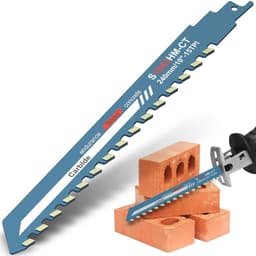
A 9 inch grinder feels like too much mess for a cat flap or a few bricks, so you are choosing between a reciprocating saw and an angle grinder for brick. Use a carbide-tooth sabre blade when the brick is ordinary or soft and a disc will not fit. Use a diamond disc only with the dust control that belongs to that tool. Use neither when the wall is structural or the brick is engineering brick. Model choice stays on the [reciprocating saw blade masonry comparison](/hub/saw-accessories/reciprocating-saw-blade-masonry). Peter F. wrote this on 20 October 2026 from Health and Safety Executive sheets and UK forum experience.

A 9 inch grinder feels like too much mess for a cat flap or a few bricks, so you are choosing between a reciprocating saw and an angle grinder for brick.

Our top picks

On this page

Three differences that decide the tool

Speed favours the disc. DIYnot users describe a grinder as much faster than a carbide reciprocating blade on soft brick. Nobody timed the bricks, so faster is a description, not a stopwatch result. Dust favours the sabre saw only as a visual impression. Less visible dust is not a pass against the silica limit of 0.1 mg/m³ over eight hours. Access favours whichever tool can sit on the cut. A sabre blade reaches a corner where a 230 mm disc cannot. A 115 mm grinder can score a line. A 230 mm grinder is the high-mess tool. None of those differences makes masonry dust safe.

When the reciprocating saw is the better fit

Choose the reciprocating saw for a short cut in ordinary facing brick or soft block, where a 230 mm disc will not sit flat. A cat flap, a few bricks, or a short doorway in soft block is that job. UK reviews often describe less dust than a grinder when a vacuum hose stays beside the blade. That is review experience, not a COSHH assessment. The blade has to be a carbide tooth, not a fine bi-metal blade and not a grit edge meant for tile. Which short blade is the top pick in this set is on the best reciprocating saw blade for brick page, and it is about 228 mm, not a 450 mm blade in a small cordless saw. Hard brick is the failure the same forums describe. If you cannot ventilate the room or wear respiratory protection at APF 20, stop.

When a diamond disc is the better fit

Choose a diamond disc when you need a faster line in suitable brick and you will use the control HSE writes down for that tool. On a cut-off saw, the CN6 sheet specifies a diamond blade, water suppression and respiratory protection at APF 20. Peaks up to 70 mg/m³, and a water flow of at least 0.5 litres per minute in INDG461, belong to cut-off saws. Do not copy either figure onto a sabre saw. For a hand-held grinder, the CN2 sheet points to on-tool extraction at M or H class where reasonably practicable. Do not dry-cut brick with an abrasive disc. A 230 mm grinder is the messy end of that choice.

When neither tool should make the opening

Use neither tool when the wall may be load-bearing, when the opening needs a lintel, when the brick is engineering brick, or when the concrete is reinforced. A sabre blade that UK reviews already reject on dense block does not become suitable because a grinder is messier. Uncontrolled indoor silica is a stop for both. Stitch drilling is the lower-dust alternative people name on UK forums. It is still dusty, and it is still not a measurement against 0.1 mg/m³. The stroke itself, from an edge or a starter hole, is on how to cut brick with a reciprocating saw. If the brick is suitable and the access is tight, the sabre saw is the better fit. If you need speed and you will run water or extraction and a proper mask, the diamond disc is the better fit. If the wall is doing structural work, neither is.

Common questions

Is a reciprocating saw less dusty than an angle grinder on brick?
People say so. UK forum posts and amazon.co.uk review themes describe less dust from a sabre saw than from a large grinder. That is not a Health and Safety Executive test, and it is not a pass against the silica limit of 0.1 mg/m³ over eight hours. Less visible dust is still silica dust if the masonry contains it. The cut still throws dust.
Which is faster for a few bricks?
The grinder or a petrol disc cutter, in the way forum users describe the job. A carbide reciprocating blade on soft brick is the slow cut. There is no timed comparison in these sources. Faster is only useful if you also run the dust control that belongs to the disc. Speed without water or extraction is a worse job, not a better one.
Can you use a 115 mm grinder instead of a 230 mm one?
Yes, for scoring a line, which is how some forum users mark external brick before a drill and bolster finish the opening. A 115 mm disc is not a 230 mm cutter, and it is still a silica tool. HSE’s chasing guidance is on-tool extraction at M or H class where practicable, and respiratory protection at APF 20. Do not dry-cut with an abrasive wheel.
Does less dust mean you can skip a mask indoors?
No. Indoor masonry dust that you cannot ventilate is a reason to stop, for a sabre saw and for a grinder. Respiratory protection at APF 20 means an FFP3 or a P3 half mask, face-fit tested if it seals. A vacuum hose beside a blade reduces mess. It does not replace that mask, and a slotted blade is not a COSHH control.
What should you do if the brick is engineering brick?
Stop. Neither a domestic sabre blade nor a quick grinder pass is the method for engineering brick, dense concrete or reinforced concrete. UK review themes already call dense block and engineering brick the wrong material for short carbide teeth. Call someone who can specify the opening, including a lintel if the wall needs one.

Related pages

Sources

Public UK sources and the amazon.co.uk listings compared on this page. Prices and stars stored on 20 October 2026.

  1. Bosch Professional GB, S 1141 HM aerated-concrete blade (retrieved 20.10.2026)
  2. Hilti UK aerated-concrete saw blades (retrieved 20.10.2026)
  3. Hilti UK brick saw blades (retrieved 20.10.2026)
  4. Rawlplug RT-RSB-AB reciprocating saw blades for aerated concrete (retrieved 20.10.2026)
  5. Eclipse reciprocating blade for brick (retrieved 20.10.2026)
  6. HSE CIS36, construction dust (retrieved 20.10.2026)
  7. HSE, cutting paving blocks, kerbs and flags (retrieved 20.10.2026)
  8. HSE, hand-arm vibration initial values (retrieved 20.10.2026)