Independent comparisons. We may earn from shop links. More info

How to cut brick with a reciprocating saw

Updated: 22 October 2026

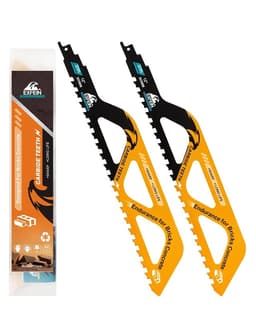
The carbide-tooth blade is already in the saw and you still do not have a safe place to start. You can cut ordinary facing brick or soft block with a reciprocating saw if you start from an edge or a drilled hole, keep the shoe planted, and stop when the wall or the dust outgrows a DIY cut. This is the sequence, not a ranking. Blade choice sits on the [reciprocating saw blade masonry comparison](/hub/saw-accessories/reciprocating-saw-blade-masonry). Peter F. wrote this on 20 October 2026 from UK public guidance. This is not a lab cut.

The carbide-tooth blade is already in the saw and you still do not have a safe place to start.

Our top picks

On this page

Cut only the brick this blade is for

Ordinary facing brick, soft block, and a material the blade listing actually names are the jobs this sequence is for. A cat flap, a short doorway in soft block, or a few bricks match a slow carbide-tooth cut. Engineering brick, dense concrete, stone and reinforced concrete are stop points, not slower versions of the same cut. Listings that name aerated concrete still exclude cement blocks and stone. A title that says concrete does not reopen that exclusion. DIYnot describes soft brick and light block as slow but usable, and hard brick and concrete block as the wrong job. Treat that as forum experience, not as a Health and Safety Executive method. If you are not sure which brick you have, do not find out by leaning on the saw.

Start from an edge or a hole, not a plunge

Start from an exposed edge, a mortar joint you can enter, or a drilled starter hole. Do not plunge the tooth tips into the middle of a brick. Forum posts describe a tungsten-carbide plunge bending the blade. That is UK forum experience, not a certified technique. Plant the shoe so the blade is guided by the saw rather than by your wrists. Support any brick that will come loose, so it does not pinch the teeth as it drops. If there is no open edge, drill a starter hole on the line and work out from that hole.

Let the saw cut, and keep the shank outside

Let the teeth cut. Do not add body weight. A light feed feels slow on clay brick, and that slowness is the cut working. Forcing the shoe forward is how a review loses several teeth across a run of hard bricks, and how the saw heats up. If the blade stalls, back it out and check you are still in ordinary brick. Keep the shank outside the wall. Bosch’s S 1141 HM is 225 mm overall for a stated maximum cut of about 175 mm. The difference is the holder. A blade of about 228 mm will not cross a thick cavity wall. A 450 mm blade is the wrong example in a small cordless saw. One UK note on a 380 mm blade in an 18 V DeWalt describes heavy vibration in mortar and a user who stopped.

Dust and vibration are stop rules

People report less visible dust from a sabre saw than from a grinder. That is not a measurement. The Health and Safety Executive limit for respirable crystalline silica is 0.1 mg/m³ over eight hours. Peaks up to 70 mg/m³ on HSE’s paving page belong to a cut-off saw, not a sabre saw. If you still cut masonry that can contain silica, use respiratory protection at APF 20, an FFP3 or a P3 half mask. A room you cannot ventilate is a reason to stop. HSE’s initial hand-arm figure for a reciprocating saw is 18 m/s². The action value is 2.5 m/s² A(8) and the limit is 5 m/s² A(8). Those numbers are not a reading from your tool.

When the opening is not a DIY cut

Stop and call a builder when the wall may be load-bearing, when the opening needs a lintel, when the brick is engineering brick or the concrete is reinforced, or when indoor silica dust cannot be controlled. Hidden services are the same stop. A cat flap in one soft leaf is a different job from a new doorway in a party wall. A neat kerf does not create a lintel. If you are still choosing length or edge, use the buying guide. Aircrete thickness is on the aerated concrete blade page.

Common questions

Should you plunge the blade into the middle of a brick?
No. Start from an exposed edge, a mortar joint, or a drilled starter hole. UK forum experience describes a plunge bending a carbide blade. Plant the shoe and let the teeth enter a kerf that already exists. A mid-brick plunge loads the tips sideways.
How hard should you push?
Push only enough to keep the teeth in contact. Extra body weight snaps teeth and heats the saw, which is what UK reviews describe on hard brick. If the blade stalls, withdraw it and check the material. Slow progress on clay brick is normal. Forcing a stall is not.
Is the dust low enough to skip a mask indoors?
No. People report less dust than a grinder, and that is not a measurement against the silica limit of 0.1 mg/m³ over eight hours. Use respiratory protection at APF 20 if you cut masonry that can contain silica. A room you cannot ventilate is a reason to stop. A slotted blade is not extraction.
What length of blade do you need for one brick thickness?
You need a working length that clears the brick while the shank stays outside. A 225 mm blade with a stated 175 mm cut is the short example. A blade of about 228 mm will not cross a thick cavity wall. Measure the leaf. Do not assume overall length equals depth of cut.
When do you stop and call a builder?
Stop if the wall may be load-bearing, if the opening needs a lintel, if you hit engineering brick or reinforced concrete, or if you cannot control indoor dust. Hidden pipes and cables are the same stop. A short cut in one soft leaf is the DIY case. A structural opening is not.

Related pages

Sources

Public UK sources and the amazon.co.uk listings compared on this page. Prices and stars stored on 20 October 2026.

  1. Bosch Professional GB, S 1141 HM aerated-concrete blade (retrieved 20.10.2026)
  2. Hilti UK aerated-concrete saw blades (retrieved 20.10.2026)
  3. Hilti UK brick saw blades (retrieved 20.10.2026)
  4. Rawlplug RT-RSB-AB reciprocating saw blades for aerated concrete (retrieved 20.10.2026)
  5. Eclipse reciprocating blade for brick (retrieved 20.10.2026)
  6. HSE CIS36, construction dust (retrieved 20.10.2026)
  7. HSE, cutting paving blocks, kerbs and flags (retrieved 20.10.2026)
  8. HSE, hand-arm vibration initial values (retrieved 20.10.2026)