Independent comparisons. We may earn from shop links. Our editors compare products independently. Some links go to shops, and we may earn a commission. More info
Top pick: Bosch S 1531 L 5-piece – 4.8 from 8,420 reviews at about £11.79, for nail-free coarse wood at 240 mm, the largest review file in this set. Best value: SabreCut SCRS1531L 5-piece – Lowest price in this twelve, about £7.99, with 240 mm and 5 TPI stated and 4.6 from 2,587 reviews. Updated October 2026.
A reciprocating saw blade, often called a sabre blade in the UK, locks into a corded or cordless reciprocating saw and cuts on the push and on the pull. You buy one for pruning, pallets, firewood, sheet, pipe, or a mixed DIY job. Match the blade that will touch the work.
Check the steel, the teeth per inch, the length, and the shank. High-carbon steel or chromium-vanadium is for nail-free or green wood. Bi-metal is for pipe, sheet, screws, and timber that may hide a nail. About 5–6 teeth per inch suits thick wood. About 14–24 teeth per inch suits metal. About 240 mm is the pruning class, with a stated capacity around 180–190 mm. About 150 mm is the pallet class. A longer blade flexes on a thin section. The usual tang is a 1/2 inch universal shank. Seat it and pull-test the lock.
Those checks are set out in the [reciprocating saw blades buying guide](/hub/saw-accessories/reciprocating-saw-blades/sub/reciprocating-saw-blades-buying-guide). Keep the shoe on the work, and remove the battery or unplug before you change a blade.
A reciprocating saw blade, often called a sabre blade in the UK, locks into a corded or cordless reciprocating saw and cuts on the push and on the pull.
A reciprocating saw blade, often called a sabre blade in the UK, locks into a corded or cordless reciprocating saw and cuts on the push and on the pull. You buy one for pruning, pallets, firewood, sheet, pipe, or a mixed DIY job. Match the blade that will touch the work.
Check the steel, the teeth per inch, the length, and the shank. High-carbon steel or chromium-vanadium is for nail-free or green wood. Bi-metal is for pipe, sheet, screws, and timber that may hide a nail. About 5–6 teeth per inch suits thick wood. About 14–24 teeth per inch suits metal. About 240 mm is the pruning class, with a stated capacity around 180–190 mm. About 150 mm is the pallet class. A longer blade flexes on a thin section. The usual tang is a 1/2 inch universal shank. Seat it and pull-test the lock.
Those checks are set out in the [reciprocating saw blades buying guide](/hub/saw-accessories/reciprocating-saw-blades/sub/reciprocating-saw-blades-buying-guide). Keep the shoe on the work, and remove the battery or unplug before you change a blade.
A reciprocating saw blade, often called a sabre blade in the UK, locks into a corded or cordless reciprocating saw and cuts on the push and on the pull. You buy one for pruning, pallets, firewood, sheet, pipe, or a mixed DIY job. Match the blade that will touch the work. Check the steel, the teeth per inch, the length, and the shank. High-carbon steel or chromium-vanadium is for nail-free or green wood. Bi-metal is for pipe, sheet, screws, and timber that may hide a nail. About 5–6 teeth per inch suits thick wood. About 14–24 teeth per inch suits metal.
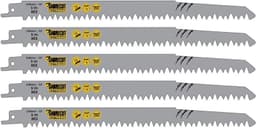
Bosch’s S 1531 L five-pack, part 2 608 650 676, is 240 x 19 x 1.5 mm and leads this set on review volume: about £11.79 and 4.8 from 8,420 amazon.co.uk reviews. UK reviewers use it on green wood, dead wood, oak, birch, Leylandii, and branches around 4 inches, on Milwaukee, Makita, DeWalt, Ryobi, and Bosch saws, and more than one review still had a blade going after substantial lopping. The amazon.co.uk application line says rough wood, nail-free and living wood, and firewood. Bosch’s page for the same part adds high-carbon steel, 5 TPI, and a capacity under 190 mm. Those tooth and capacity figures are not printed in the Amazon bullets, and the teeth field says 5, which is also the pack count. The material field says Wood and the compatible-material field says Iron, which conflicts with the nail-free line. A few of the early reviews had not used the blades yet. For clean coarse wood under that stated capacity, this is the strongest review signal in the comparison. A likely nail puts it on the wrong job.
Pros
4.8 from 8,420 reviews at about £11.79
Application line: rough wood, nail-free and living wood, firewood
Five blades, 240 x 19 x 1.5 mm
UK reviews cover oak, birch, Leylandii, and branches around 4 inches
Cons
Amazon bullets do not state TPI
Material field says Wood and compatible material says Iron
Limited to nail-free wood on the application line
Unit-count field says 1 against an include line of five
Best for: Nail-free coarse wood, green pruning, and firewood under the stated 190 mm
Less suitable: Nails, screws, pipe, sheet, and soil
The Bosch Professional Tough Box is the highest price in this twelve at about £29.99, and it shares the 4.8 star line with the S 1531 L five-pack, from 2,285 reviews. The include line is five S 922 EF and five S 922 BF for metal, five S 922 HF for wood and metal, five S 644 D for wood, and the box. UK reviews repeat Bosch quality and a robust case, and one wood blade made short work of conifer roots. The same sample says the wood blades were shorter than a previous set and may not suit wide stock, and one reviewer likes the blades and the case but says they do not fit that saw. The bullets also give diameter 14 mm and effective length 550 mm, which do not describe these codes, and one line says Made in Switzerland while the origin field says China. TPI and shank are not stated. S 644 D remains a wood code, even though it shares a box with the wood-and-metal code S 922 HF.
Pros
Named codes: five each of S 922 EF, S 922 BF, S 922 HF, and S 644 D
Tough Box, which UK reviews call robust
4.8 from 2,285 reviews
The only set here with a stated Bosch wood-and-metal code beside wood and metal codes
Cons
About £29.99, the highest price in this twelve
Diameter 14 mm and effective length 550 mm do not match the include line
Made in Switzerland in a bullet, China in the origin field
One reviewer says the blades do not fit their saw, and the wood blades were shorter than expected
Best for: Someone who already works from Bosch codes and cuts both wood and metal
Less suitable: A single pruning job, or anyone treating 550 mm as the blade length
Saxton’s R644D twenty-pack is 150 mm carbon steel at 6 TPI, about £14.99, with 4.7 from 245 reviews and a reusable pouch. UK reviewers say the length is right for pallets, and they also mention 90 mm fence-post tops, firewood, window work, and roots up to about 4 inches. Pallet users are clear that the blades do not like nails, and that you should keep nails out of the cut if you want the edge to last. Window fitters say they do not last long, though they match other brands they know, and repeat buyers still say the edge goes sooner than they would like. The material field says Iron, which contradicts the carbon-steel bullet, and the teeth field says 20, the pack count, rather than the 6 TPI in the bullet. The shank is stated as universal 1/2 inch (13 mm), and the thickness field is 1.25 mm. A 150 mm blade is the pallet class. It is short beside the 240 mm pruning packs when the stem is thick.
Pros
150 mm and 6 TPI stated in the bullets
Pack of 20 in a reusable pouch
4.7 from 245 reviews, with pallet length praised
1/2 inch shank, and UK reviews of pallets, 90 mm post tops, and firewood
Cons
Pallet reviews say they do not like nails
Edge life called short by window fitters and repeat buyers
Material field says Iron against a carbon-steel bullet
Teeth field of 20 copies the pack count, and 245 reviews is a modest sample
Best for: Pallets, boards, and construction timber with the nails kept out of the cut
Less suitable: Pipe, nail-embedded timber, and thick branches that need a 240 mm blade
Saxton’s R1021L ten-pack is 240 mm carbon steel for wood and pruning, at about £13.99 with 4.6 from 4,059 reviews, and UK reviewers use it on Makita and DeWalt saws for branches, wet wood, a trunk of about 127 mm, roots, stumps, pallets, and a shed that included felt roofing. One reviewer cut about 100 thick branches on a single blade. The bullets never state a TPI, and the teeth field says 10, which is the pack count, so that number is not a tooth pitch. The shank line does say universal 1/2 inch (13 mm), and it names DeWalt, Bosch, Hitachi, Flex, Makita, Metabo, and Skil. Size fields on the same listing are unusable as blade measurements: weight 0.37 g, thickness 0.5 inches, and dimensions 24 x 24 cm. A reviewer found a blade flexed and vibrated, feared it would snap, and said the edge wore fairly quickly. Another called the blades a little flimsy. The review count is large, and the missing pitch is still the gap.
Pros
Ten 240 mm carbon-steel blades in a reusable pouch
4.6 from 4,059 reviews
Shank stated as 1/2 inch (13 mm), with several saw brands named
UK reviews include a trunk of about 127 mm and about 100 thick branches on one blade
Cons
TPI is not stated in the bullets
Teeth field of 10 copies the pack count
Weight 0.37 g and thickness 0.5 inches do not describe the pack
Reviews mention flex, vibration, and a thin feel
Best for: Long wood and pruning cuts when you can accept an unstated tooth pitch
Less suitable: Metal cuts, and any job where you need the TPI printed before you buy
The SabreCut SCRS1531L five-pack is a 240 mm, 5 TPI high-carbon blade, and UK reviewers on amazon.co.uk use it on joists of about 5 inches, branches of about 80 mm, bushes, apple-tree wood, bamboo, rotten decking, and shed timber. At about £7.99 it is the lowest price in this twelve, with 4.6 from 2,587 reviews, and one reviewer still found the edges sharp after about two hours of mixed wood. Others report the opposite: blades that were not very sharp, or that blunted after a couple of cuts so the job took longer. One person said they did not do well on that green wood, so the pruning line is not a promise on every live stem. The listing prints a universal 1/5 inch shank, which is a different figure from the 1/2 inch tang on the Saxton packs, and one reviewer found a blade a little difficult to remove. The stated capacity is up to 190 mm. These teeth are for nail-free wood, and a screw or a pocket of soil sits outside that job.
Pros
240 mm and 5 TPI stated, with a capacity up to 190 mm
About £7.99 for five blades, 4.6 from 2,587 reviews
UK reviews cite joists, branches of about 80 mm, decking, and shed timber
One review still found an edge after about two hours of mixed wood
Less side-to-side wobble than the Erbauer blades supplied with one saw
Cons
Some reviewers report dulling after a couple of cuts
One reviewer said they did not suit that green wood
Shank is printed as 1/5 inch
One blade was a little difficult to remove
Best for: Nail-free coarse wood, pruning, and firewood under the stated 190 mm, once the saw locks this shank
Less suitable: Nails, screws, soil, and saws that will not hold a shank the listing calls 1/5 inch
SabreCut’s SCRSKW10A ten-pack costs about £10.99 and is rated 4.6 from 1,825 reviews. The bullets name high-carbon codes S644D, S1531L, and S2345X for flush cuts, pallets, timber, plastics, MDF, chipboard, and wet or dry wood. UK reviewers use the mixed lengths on branches, rotten wood, a trunk, a 4-inch branch on a Ryobi saw, and a railway sleeper, and a boatbuilder who usually buys Bosch called them acceptable at this price. The pack does not include metal blades, and reviewers who expected them say the set would be more useful with some. They also say the edges wear quickly and suit odd jobs, and that the blades do not lock in a Black & Decker Scorpion. The shank is printed as universal 1/5 inch. TPI numbers are not stated, and the thickness field says 0.2 inches. One review says made in the UK, while the origin field says China. It is a wood-only mix. Pipe or a screw needs a different blade.
Pros
Three high-carbon wood codes in one ten-pack: S644D, S1531L, and S2345X
About £10.99, 4.6 from 1,825 reviews
UK reviews cover branches, a railway sleeper, and a 4-inch cut on a Ryobi saw
Lower price than the mixed pouches that include bi-metal
Cons
No metal blades in the bullets, which reviewers noticed
Shank stated as 1/5 inch
Did not lock in a Black & Decker Scorpion, in one UK review
Short edge life in reviews, and TPI numbers are not stated
Best for: Nail-free wood in more than one length, if the saw locks this shank
Less suitable: Pipe, screws, and a Black & Decker Scorpion if that lock review matches your saw
KRETLAW’s 36-piece pouch costs about £19.99 and is rated 4.6 from 336 reviews, the smallest count among these mixed sets. The bullets state TPI groups of 5, 6, 8, and 9 for wood and 14, 18, and 24 for metal, in chromium-vanadium and bi-metal. Length is not stated. UK reviewers fitted the blades to a Ryobi saw, cut timber during a house renovation, and cite exhausts and scaffold poles as metal cuts that worked, with one week of use and no broken teeth in a single review. Other reviewers call the blades too flimsy for anything beyond light cutting, say the print came off so the spec was no longer readable, and report an edge that went blunt after a few uses. One person had only tried the chromium-vanadium blades, not the bi-metal ones. The teeth field says 8, and the shank size is not stated. The printed TPI split is the useful part. Missing lengths and the light-duty comments set the limit.
Pros
TPI groups printed: wood 5, 6, 8, 9 and metal 14, 18, 24
Chromium-vanadium and bi-metal, so wood and metal are different blades
Pouch included; UK reviews cite a Ryobi fit and scaffold-pole cuts
4.6 from 336 reviews
Cons
Lengths are not stated
Reviewers call them flimsy on anything beyond light cutting
Markings rubbed off, and edges dulled after a few uses
336 reviews, and the teeth field says 8
Best for: Light mixed DIY when you want the wood and metal TPI bands written down
Less suitable: Heavier cuts, or a job that needs a known blade length before you order
The Amazon Basics pouch holds 32 blades at about £18.04 and is rated 4.5 from 1,813 reviews. The include line is the part to read: bi-metal M2 blades marked 14T, 18T, and 24T, and CRV wood blades marked 3T, 5T, 6T, and 8T, from 10 cm to 22.8 cm. UK reviewers praise the mix and the organiser pouch, and they mention branches, garden jobs, and a deep root, with wood blades praised more often than the metal ones. One reviewer said the blades seem sharp but are not when used on wood, and another treats the set as a backup rather than a match for heavier brands. They are also said to struggle if the stance is crooked or the angle is poor. The material field says Metal, Plastic, the teeth field says 24, the items field says 1, and the shank size is not stated. You still fit the blade that matches the next cut. The piece count is not a measure of how long an edge lasts.
Pros
Include line splits metal marks (14T, 18T, 24T) from wood marks (3T, 5T, 6T, 8T)
Lengths from 10 cm to 22.8 cm
Organiser pouch, praised in UK reviews
4.5 from 1,813 reviews at about £18.04
Cons
One reviewer found blades that felt sharp and then cut poorly in wood
Shorter life if the cut is crooked, in the review notes
Shank size is not stated
Material field says Metal, Plastic, and the teeth field says 24
Best for: Occasional DIY across wood, metal, plastic, and plasterboard, if you swap blades
Less suitable: A single heavy material all day, or a saw whose shank size you need printed
SHALL’s 34-piece pouch costs about £18.99 and sits at 4.5 from 1,601 reviews. The package bullet splits it into 23 heat-treated carbon-steel blades for wood and 11 bi-metal blades for metal, stored in a 600D nylon bag. UK reviews praise the wood blades, an easy metal cut, and seized subframe bolts, and one person cut a tree with about 10 cm of wood. The title says carbide steel. A reviewer says that claim is wrong, and the bullets do not describe tungsten-carbide teeth. TPI and length are absent, and the teeth field says 34, which matches the piece count. One blade bent on first use, which the reviewer allowed might have been their own error. Teeth were damaged after three attempts in another review, and blades folded on 3.2 mm scaffold tube. The split can cover wood and metal when you fit the matching blade, and pitch and length stay unknown until the bag arrives.
Pros
23 carbon-steel wood blades and 11 bi-metal metal blades
600D nylon bag
4.5 from 1,601 reviews
UK reviews cite wood cuts, a metal cut, and seized subframe bolts
Cons
Title says carbide; a reviewer and the bullets say otherwise
TPI and length are not stated
Teeth field of 34 copies the pack count
Reviews include bent blades, early tooth damage, and folding on 3.2 mm scaffold tube
Best for: A householder who wants wood blades and metal blades in one bag and can sort them by eye
Less suitable: Anyone expecting carbide demolition teeth, or a known TPI and length before delivery
EZUVITA’s 36-piece pouch is about £20.99, the highest price among the mixed pouches here, at 4.5 from 424 reviews. Only 26 of the first 50 review slots were marked United Kingdom, and several of those say the blades had not been used yet. The readable include line counts 11 bi-metal metal blades, including 100 mm at 24 TPI and 152 mm at 14, 18, and 24 TPI, plus CR-V wood blades at 152 mm and 230 mm. The pruning clause stops after 5 T, so that pair is not fully specified in the saved listing. UK comments that name a job mention a Makita saw, a Ryobi saw, and conifer branches, and they praise the pouch. The material field says high-carbon steel and high-speed steel, which disagrees with the bi-metal and CR-V bullets. Shank size is not stated, and there is little UK comment on how long the edges last. Use the readable lengths, and leave the cut-off pruning line unread.
Pros
Lengths named at 100 mm, 152 mm, 230 mm, and 240 mm
11 bi-metal metal blades with 14, 18, and 24 TPI in the readable line
Organiser pouch, fitted to Makita and Ryobi saws in UK reviews
4.5 from 424 reviews
Cons
Pruning include line is cut off after 5 T
Material field disagrees with the bi-metal and CR-V bullets
Many of the first 50 reviews are unused blades or non-UK lines
Shank size is not stated, and about £20.99 is the top of the mixed pouches here
Best for: A mixed kit when you can work from the readable metal and wood lengths
Less suitable: Buying it for a fully specified pruning pair, or treating the material field as the contents
Saxton’s R825BF is the single-code metal pack in this set: ten bi-metal blades, 200 mm, 14 TPI, milled and wavy set, at about £15.99 and 4.4 from 540 reviews. The bullet states medium-thick sheet of 2–8 mm and solid pipes or profiles of 10–150 mm, on a universal 1/2 inch (13 mm) shank. UK reviewers use them on nails and screws in pallet timber, on a caravan’s metal, wood, and insulation, and on aluminium and steel bolts, including in a Black & Decker saw. The same sample is hard on dirtier or thicker steel. Blades in one session went blunt at different rates, rusted car parts were bounced off, and only mild steel was called acceptable in that review. A 50 x 50 x 3 mm steel angle took one blade per cut, while aluminium was fine. One reviewer said the blades burn out quickly and the cut takes longer. The part number RPR825BF05 looks like a five-pack, while the title and the unit count say ten. This is a metal blade, and a poor spare for green pruning.
Pros
14 TPI bi-metal, 200 mm, with sheet stated at 2–8 mm and pipe or profile at 10–150 mm
1/2 inch shank, and a UK review fitted a Black & Decker saw
Ten blades at about £15.99
UK reviews cover pallet screws, a caravan, aluminium, and steel bolts
Cons
4.4 from 540 reviews, level with the lowest stars in this set
Uneven life in one session, and a quick burn-out in another review
Rusted car parts and 50 x 50 x 3 mm angle used blades up fast
Part number RPR825BF05 against a ten-piece title
Best for: Sheet around 2–8 mm and pipe or profile inside the stated 10–150 mm band
Less suitable: Green pruning, and thick rusty steel if you expect one blade to finish the job
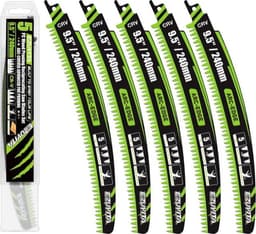
EZUVITA’s arc pruning five-pack is chromium-vanadium steel at 5 TPI, with a total length of 240 mm and a stated working length of 210 mm, for round wood up to a stated 180 mm. It costs about £15.99 and is rated 4.4 from 444 reviews. UK reviews include two telegraph poles on two blades, one reviewer cutting a 20-foot plum tree on one blade, 4-inch branches, stump and privet roots, and an already felled ash. Other reviews in the same sample say the blade was too long for the job, dulled after a single cut, and clogged in the teeth. Anything over about 3 inches was a struggle with harsh vibration in one review, which is that person’s experience and sits against reviews that cut thicker wood. One review says the tang snapped on each blade, and others say the blades snap once they are dull or if they are pushed. A bullet describes a plastic case with a hanging hole, while included components say a storage pouch. The shank is called universal without a width. At about £15.99 it sits above the Bosch and SabreCut pruning five-packs in this set, with a lower star rating.
Pros
5 TPI stated, with total length 240 mm and working length 210 mm both printed
Stated cut up to 180 mm on round wood
Arc edge described as triple-ground offset teeth in chromium-vanadium
UK reviews include thick green wood, roots, and a felled ash
Cons
4.4 from 444 reviews
Reviews of blades that were too long, dulled after one cut, or clogged
Snapped tangs, and blades that break once dull or if pushed
Case versus pouch, shank width unstated, and a higher price than the other pruning five-packs here
Best for: Green wood and firewood under the stated 180 mm, from the ground
Less suitable: Thin sections where a 240 mm blade will flex, soil, nails, and saws that need a stated shank width
Total length 240 mm and working length 210 mm, for round wood up to 180 mm.
Is the storage a case or a pouch?
A bullet describes a plastic case with a hanging hole. Included components say storage pouch.
What breakage shows up in UK reviews?
A snapped tang on each blade, and blades that snap after they dull or if pushed.
How we compared
Twelve amazon.co.uk listings were read from the stored pages. The 0–100 score is the UK star line scaled to 100. It is not a laboratory cut test. The top pick is the Bosch S 1531 L five-pack, which shares 4.8 stars with the Tough Box and has the larger review count, at a lower price, for nail-free wood. The best value is the SabreCut five-pack, the lowest price here with 5 TPI stated. The weights below sum to 100. They describe what was checked. They were not used to override the star score.
1
Blade material
25%
The steel that will touch the work comes first. High-carbon steel or chromium-vanadium is for nail-free or green wood. Bi-metal is for pipe, sheet, screws, and timber that may hide a nail. A mixed title is not one blade that does both.
2
Teeth per inch
20%
About 5–6 TPI suits thick wood. About 14–24 TPI suits metal. A teeth field that copies the pack count, such as 10, 20, 34, or 36, is not the pitch. If the bullets omit TPI, the pitch stays unstated.
3
Length
20%
About 240 mm is the pruning class, with a stated capacity around 180–190 mm where one is printed. About 150 mm is the pallet class. A blade much longer than the section flexes.
4
Shank and lock
15%
The usual tang is a 1/2 inch universal shank. A listing that prints 1/5 inch is kept as that figure. A universal line with no width is not a lock test. Seat the blade and pull it.
5
Reviews and price
20%
Stars and review counts stay the amazon.co.uk line. Shelf price separates the best value after the award on the listing is read. Piece count is not treated as a longer life.
Independent review
Last updated: October 2026
8 sources checked
Reciprocating saw blades buying guide
Match the blade that will touch the work, then the teeth per inch, then the length, then the shank. A mixed pack title is not one blade that does both. Piece count is not a life test. The notes below follow that order for these twelve amazon.co.uk listings. None of the scores is a cut test.
What is a reciprocating saw blade?
A reciprocating saw blade, often sold in the UK as a sabre blade, is a straight blade with a tang that locks into a corded or cordless reciprocating saw. The saw pushes and pulls the blade. The teeth, the steel, and the length decide the cut. A pack can be one code, repeated, or a pouch that splits wood blades from metal blades. Piece count is not a test of how long an edge lasts.
Material is the first check, and it applies to the blade that will touch the work.
Best for
Pruning from the ground with a coarse blade around 240 mm, stopping at soil, ladders, and large stems
Pallets and pipe, with two specialist packs or a pouch that really contains bi-metal
A tradesperson who already works from Bosch wood and metal codes
Not ideal for
Nail-free high-carbon teeth when the timber hides screws
A 240 mm blade on a thin section, where it flexes
Brick, soil, or a wall you have not checked for cables and pipes
Mistakes to avoid
1
Buying high-carbon steel because the title mentions metal
A mixed title is not one blade that cuts wood and metal. Read the include line. High-carbon steel and the S 1531 L application line are for nail-free wood. Bi-metal is the blade for pipe, sheet, and screws.
2
Reading the pack count as teeth per inch
A teeth field of 10, 20, 34, or 36 often copies how many blades are in the pack. Use the TPI in the bullets. If the bullets never state a pitch, the pitch is unknown until you see the blade.
3
Using a long blade on a thin branch, or pushing a dull one
About 240 mm is the pruning class. On a thin section that length flexes, vibrates, and clogs. A dull edge makes the job longer, and pushing it is how tangs snap. Trusting the word universal without a pull test is the same class of mistake.
What to weigh up
Material and teeth per inch
High
Material is the blade that will actually touch the work. High-carbon steel or chromium-vanadium is for clean or green wood. Bi-metal is for pipe, sheet, screws, and nail-embedded timber. A mixed title is not one blade that does both. Read the include line, and prefer it when a material field says Wood or Iron against the application, or when a title says carbide and the bullets say carbon steel and bi-metal.
Teeth per inch follow the material. About 5–6 TPI is the coarse pitch for thick wood.
Length and shank
High
Length decides whether the blade reaches the cut or flexes. A total length of about 240 mm is the pruning class. Where a capacity is printed, it sits around 180–190 mm. A working length, when it is printed beside the total length, is shorter than the overall blade. A 150 mm blade is the pallet class. A 200 mm blade here is the metal code, with sheet stated at 2–8 mm and pipe or profile at 10–150 mm. A blade much longer than the section flexes, vibrates, and clogs.
Which option suits you?
Three typical situations, each with a recommendation from this comparison.
🌳
Pruning from the ground
You want about 240 mm and a coarse pitch for nail-free green wood, and you stop at soil, ladders, and large stems. The Bosch S 1531 L five-pack is about £11.79, with 4.8 from 8,420 reviews. The application line is nail-free wood. The Amazon bullets do not print the TPI.
You cut construction timber and the odd pipe or screw, so you need wood blades and bi-metal blades, not one title that claims both. The Amazon Basics pouch states metal marks and wood marks in the include line, at about £18.04. You still swap the blade for the next cut.
The Tough Box names five each of S 922 EF, S 922 BF, S 922 HF, and S 644 D, plus the box, at about £29.99 and 4.8 from 2,285 reviews. Ignore the 550 mm length field. A cheaper S 1531 L pattern is only a stand-in for nail-free wood.
Which reciprocating saw blade is the top pick in this set?
The top pick is the Bosch S 1531 L five-pack, about £11.79 on amazon.co.uk, with 4.8 from 8,420 reviews. The application line is rough wood, nail-free and living wood, and firewood. The Amazon bullets do not state teeth per inch. Bosch’s page for the same part adds high-carbon steel, 5 TPI, and a capacity under 190 mm. It is not a blade for nails, and the score is not a lab test.
Which reciprocating saw blade pack is the best value?
The best value is the SabreCut SCRS1531L five-pack, about £7.99, with 4.6 from 2,587 reviews. It states 240 mm, 5 TPI, and a capacity up to 190 mm, for coarse wood, pruning, and firewood. UK reviews cite joists, branches, decking, and shed timber, and also blades that dulled after a couple of cuts. The listing prints a 1/5 inch shank, not 1/2 inch. Seat it and pull-test the lock.
How much do reciprocating saw blades cost on amazon.co.uk?
On these twelve amazon.co.uk listings, prices run from about £7.99 to about £29.99. The lower band is about £8 to £12. The middle band is about £14 to £21, including the single-code metal pack and the mixed pouches. The Bosch Tough Box is about £29.99, the highest price here. These are the saved shelf prices, not a promise of the cheapest blade on the day you buy.
What teeth per inch should a reciprocating saw blade have?
About 5–6 teeth per inch suits thick wood, and about 14–24 suits metal. A 150 mm blade at 6 TPI is the pallet class in this set. A 200 mm bi-metal blade at 14 TPI is the metal pack. Do not read a teeth field of 10, 20, 34, or 36 as the pitch when that number matches the pack count. If the bullets never state TPI, the pitch is unknown until the blade arrives.
Will a high-carbon reciprocating saw blade cut nails?
No. High-carbon steel, and the Bosch S 1531 L application line, are for nail-free wood: rough wood, nail-free and living wood, and firewood. A compatible-material field that says Iron does not override that line. Pallet reviews of a carbon-steel 6 TPI blade say the edges do not like nails. Bi-metal is the blade for screws, pipe, and sheet. A mixed title is not one blade that does both.
What shank should the reciprocating saw lock?
The usual tang is a 1/2 inch universal shank, about 13 mm. Saxton’s wood and metal packs print that figure. SabreCut’s listings print 1/5 inch, which is a different number. Do not treat that text as 1/2 inch. Some pouches state no width at all. One UK review said a SabreCut mixed wood pack did not lock in a Black & Decker Scorpion. Seat the blade and pull-test it on your saw.
Can these reciprocating saw blades cut brick or aerated concrete?
These twelve listings are for wood and metal, not brick. Soil, mortar, and aerated concrete need a different blade, and a wood tooth will clog or snap. For that job, see the reciprocating saw blade masonry comparison. Do not cut blind into a wall. Unknown cables or pipes are a reason to stop and call a professional.
Is 18 m/s² the daily vibration limit for a reciprocating saw?
No. At work, the Control of Vibration at Work Regulations 2005 set a hand-arm daily action value of 2.5 m/s² A(8) and a limit of 5 m/s² A(8). HSE’s table gives reciprocating saws an initial magnitude of 18 m/s², with a range of 7–27. That figure is not the daily dose. A blunt blade makes the exposure longer. For longer indoor wood cutting, HSE points to extraction and respiratory protection such as FFP3. This page did not measure vibration.
Our verdict
In this set of twelve amazon.co.uk listings, the top pick is the Bosch S 1531 L five-pack. It is about £11.79, with 4.8 from 8,420 reviews, for rough wood, nail-free and living wood, and firewood, at 240 x 19 x 1.5 mm. The Amazon bullets do not state TPI. Bosch’s page for the same part adds high-carbon steel, 5 TPI, and a capacity under 190 mm. It is the wrong blade for a nail. The best value is the SabreCut SCRS1531L five-pack at about £7.99, with 4.6 from 2,587 reviews, 240 mm and 5 TPI stated, and a capacity up to 190 mm. Some reviews report dulling after a couple of cuts, and the shank is printed as 1/5 inch. The other ten have no award. None of these scores is a lab test.
Best overall
Bosch S 1531 L 5-piece
4.8 from 8,420 reviews at about £11.79, for nail-free coarse wood at 240 mm, the largest review file in this set.
Peter F. is the editor for DIY & tools at productscompared.co.uk. Comparisons in this category are checked against amazon.co.uk listings, review evidence and public UK sources.
Updated: October 2026
8 sources checked
Guides to reciprocating saw blades
Guides on what to look for, how to use a product, and common mistakes.
Public sources from the research digest, used for this page on 22 October 2026. Shelf prices and star lines are the amazon.co.uk figures in the display file.
This page contains affiliate links to amazon.co.uk. If you buy through them, we may earn a commission at no extra cost to you. Prices, stars and review counts are from the UK listings in the display file. We did not lab-test these reciprocating saw blades.