How to change a reciprocating saw blade safely in the UK
The hazard is a shank that looks seated until the first stroke pulls it out. How to change a reciprocating saw blade is the same sequence on most UK corded and cordless saws. Take the power off, clean the clamp, push the blade home, and pull it. Then keep the shoe on the work, slow down for metal, and stop when the tooth is dull. Peter F. drew these steps from DeWalt, Makita and Draper instructions and from HSE pages on 21 October 2026. A qualifying purchase can earn a commission at no extra cost to you. Which blade belongs in the clamp is on the [reciprocating saw blades](/hub/saw-accessories/reciprocating-saw-blades) comparison.
The hazard is a shank that looks seated until the first stroke pulls it out. How to change a reciprocating saw blade is the same sequence on most UK corded and cordless saws.
The hazard is a shank that looks seated until the first stroke pulls it out. How to change a reciprocating saw blade is the same sequence on most UK corded and cordless saws. Take the power off, clean the clamp, push the blade home, and pull it. Then keep the shoe on the work, slow down for metal, and stop when the tooth is dull. Peter F. drew these steps from DeWalt, Makita and Draper instructions and from HSE pages on 21 October 2026. A qualifying purchase can earn a commission at no extra cost to you. Which blade belongs in the clamp is on the reciprocating saw blades comparison.
Our top picks
| Badge | Product | Steel | Length | Shank | Note | Price | Offer |
|---|---|---|---|---|---|---|---|
| Best overall |  Bosch Bosch S 1531 L 5-piece | High-carbon steel on Bosch’s page | 240 mm | Not stated on the Amazon listing | 9.6 | about £11.79 | View offer |
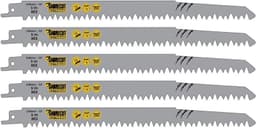
| Best value |  SabreCut SabreCut SCRS1531L 5-piece | High-carbon steel | 240 mm | Printed as 1/5 inch | 9.2 | about £7.99 | View offer |
| Alternative |  Saxton Blades Saxton R825BF 10-piece | Bi-metal, 14 TPI | 200 mm | 1/2 inch (13 mm) | 8.8 | about £15.99 | View offer |


On this page
Take the power off, then seat the blade
Plant the shoe and let the teeth cut
Stop when the blade is dull or the cut is blind
Vibration and dust are not a blade-life claim
Common questions
Do I remove the battery before a blade change on a cordless saw?
How do I know the blade is locked?
Why does the shoe have to stay on the work?
Should metal run slower than wood?
What vibration figure is a daily limit, and what is only a tool magnitude?
Related pages
Sources
Public sources from the research digest, used for this page on 22 October 2026. Shelf prices and star lines are the amazon.co.uk figures in the display file.
- HSE: Hand-arm vibration, employer duties (retrieved 22 October 2026)
- Control of Vibration at Work Regulations 2005, regulation 4 (retrieved 22 October 2026)
- HSE: Assessing hand-arm vibration risk (retrieved 22 October 2026)
- HSE: Cutting and sanding wood (retrieved 22 October 2026)
- Bosch Professional GB: S 922 VF reciprocating blade (retrieved 22 October 2026)
- Bosch: S 1531 L, part 2 608 650 676 (retrieved 22 October 2026)
- Bryson: Choosing recip saw blades (retrieved 22 October 2026)
- Drillfix: HCS and bi-metal reciprocating saw blades (retrieved 22 October 2026)