Independent comparisons. We may earn from shop links. Our editors compare products independently. Some links go to shops, and we may earn a commission. More info
Top pick: Trident TP15-120Z Best value: Anesty – About £35.90, with 4.3 from 82 reviews and printed steps of 46 W, 67 W and 100 W. Updated October 2026.
A heating pump is a wet central-heating circulator: the small pump that pushes hot water around radiators or a cylinder circuit. You are usually here because an old or unit hums, leaks, or leaves radiators cold upstairs. Judge the footprint against the old pump, the head and flow the listing actually prints, noise at the speed you will run, and whether an EEI is on the nameplate rather than an “A-rated” bullet. The order of decisions is in the [heating pump buying guide](/hub/heating/heating-pump/sub/heating-pump-buying-guide).
It is not an air-to-water heat pump, and it is not a condensate pump.
Typical listing signals are a 25-60 or 15-50 style name, about 6 m head, 130 mm length, and three speeds. An auto-boosting circulator adds head when the existing pump lacks pressure. Those rows show higher max head, about 8 m to 12 m, lower max flow, about 20 L/min to 30 L/min, and “automatic” in the title. An inverter or “intelligent flow” listing claims variable duty, a higher price, a decibel line, and several head steps.
A heating pump is a wet central-heating circulator: the small pump that pushes hot water around radiators or a cylinder circuit. You are usually here because an old or unit hums, leaks, or leaves radiators cold upstairs.
A heating pump is a wet central-heating circulator: the small pump that pushes hot water around radiators or a cylinder circuit. You are usually here because an old or unit hums, leaks, or leaves radiators cold upstairs. Judge the footprint against the old pump, the head and flow the listing actually prints, noise at the speed you will run, and whether an EEI is on the nameplate rather than an “A-rated” bullet. The order of decisions is in the [heating pump buying guide](/hub/heating/heating-pump/sub/heating-pump-buying-guide).
It is not an air-to-water heat pump, and it is not a condensate pump.
Typical listing signals are a 25-60 or 15-50 style name, about 6 m head, 130 mm length, and three speeds. An auto-boosting circulator adds head when the existing pump lacks pressure. Those rows show higher max head, about 8 m to 12 m, lower max flow, about 20 L/min to 30 L/min, and “automatic” in the title. An inverter or “intelligent flow” listing claims variable duty, a higher price, a decibel line, and several head steps.
A heating pump is a wet central-heating circulator: the small pump that pushes hot water around radiators or a cylinder circuit. You are usually here because an old or unit hums, leaks, or leaves radiators cold upstairs. Judge the footprint against the old pump, the head and flow the listing actually prints, noise at the speed you will run, and whether an EEI is on the nameplate rather than an “A-rated” bullet. The order of decisions is in the heating pump buying guide.
2 short questions, one recommendation from this comparison.
Question 1 of 2
What is the old pump doing?
The best heating pumps in detail
Rank 1
Trident TP15-120Z
∼£80
Our view
This Trident TP15-120Z boost pump lists 12 m head, 30 L/min, and 150 W—heavier duty than the standard circulators that dominate the table. Eleven UK reviews produce a shiny 4.8 average, but the sample is small enough that one bad week could move the line. Buyers choosing 12 m head usually fight long pipe runs or stubborn upstairs zones; that is not the same problem as a noisy but otherwise fine 25-60. The listing mentions an English manual, which matters if you are wiring speeds yourself after a drain-down. Weight around 3 kg makes one-handed alignment awkward in tight cupboards. Verify 130 mm port spacing on the old pump before you assume this boost unit drops in without pipe work.
Pros
12 m head on the listing for high-resistance layouts
4.8 average in eleven UK reviews at scrape
English manual claimed in listing bullets
Cons
Only eleven UK reviews despite the high star line
150 W and boost duty can add noise if the system was already balanced
Heavier body than entry 25-60 swaps
Best for: Homes where duty calculations or past experience show a standard 6 m pump was insufficient
Less suitable: Routine Grundfos UPS replacements on typical two-storey wet systems
Specifications
Model
Trident TP15-120Z
Brand
Trident
Price
∼£80
Customer rating
4.8/5(11)
Pump type
Auto-boost
Max head
12 m
Max flow
30 L/min
Power
150 W
Speeds
3 speeds
Material
Iron
Common questions
What max head does the amazon.co.uk listing print?
The amazon.co.uk listing prints 12 m for max head. That figure is seller text. We did not bench-test it.
Is this a standard circulator or a boosting pump?
This row is an auto-boost or inverter-style pump, from the listing title and bullets. It is not the default swap for a normal eight-radiator house on a standard 6 m circulator.
What review line sits on the listing?
The amazon.co.uk listing shows 4.8 out of 5 (11 reviews). That count is for this UK listing, not another marketplace.
Unvented Components Europe’s KPS25-6-130 lists 6 m head, 130 mm port length, cast iron, and a scrape price under £40. Eleven UK reviews at 4.7 stars look flattering, but the count is small—similar caution as other double-digit review SKUs. UK-origin bullets contrast with import-heavy rivals; still verify CE or UKCA marks in the box. A “B-rated” energy line on the listing is not the same as reading EEI ≤ 0.23 on the nameplate. Gasket completeness gets positive mention in some UK snippets. If you want the cheapest named 130 mm circulator with printed port length, this competes with Anesty and JASSFERRY—compare connector contents before checkout.
Pros
130 mm port length and 6 m head printed on listing
4.7 average in eleven UK reviews at scrape
Sub-£40 price point with cast-iron body listed
Cons
Only eleven UK reviews—stars may not hold as sales grow
B-rated bullet does not replace EEI verification on the plate
Fewer accessory mentions in UK text than connector-heavy Trident rows
Best for: Budget 130 mm circulators when listing prints port length and you will check ErP on delivery
Less suitable: Shoppers who rely on hundreds of UK reviews before trusting noise and longevity themes
What max head does the amazon.co.uk listing print?
The amazon.co.uk listing prints 6 m for max head. That figure is seller text. We did not bench-test it.
Is this a standard circulator or a boosting pump?
This row is a standard circulator, from the listing title and bullets. It is the usual class for a closed radiator or cylinder circuit at about 6 m head.
What review line sits on the listing?
The amazon.co.uk listing shows 4.7 out of 5 (11 reviews). That count is for this UK listing, not another marketplace.
Across 860 amazon.co.uk reviews, the Trident TP25-60-130 is the most discussed circulator in this batch. UK buyers often report a straight swap into a Grundfos-sized 130 mm footprint with cast-iron connectors in the box, and several mention their installer was surprised at the price for a complete kit. Ceramic shaft and speed-one running get praise compared with an older rattling pump. Recurring negatives include a whine on speeds two and three—sometimes easing after about two weeks of bedding-in—and a feeling the unit pushes harder than the removed 25-60. The listing prints 6 m head and 90 L/min; we did not bench-test those figures. Read the nameplate for EEI before you treat marketing bullets as ErP proof.
Pros
Cast-iron connectors commonly praised for Grundfos-sized swaps
860 UK reviews—deepest social proof in the table
Listing prints 6 m head and 90 L/min flow
Three-speed control at a mid-tier price (~£43 at scrape)
Cons
Whine on middle and high speeds in recurring UK threads
Can feel overpowered versus the old pump if left on speed 3
EEI/ErP must be confirmed on the plate, not from bullets alone
Best for: Typical wet radiator systems replacing a 130 mm three-speed circulator
Less suitable: Buyers who need ErP paperwork visible on the amazon.co.uk page before purchase
What max head does the amazon.co.uk listing print?
The amazon.co.uk listing prints 6 m for max head. That figure is seller text. We did not bench-test it.
Is this a standard circulator or a boosting pump?
This row is a standard circulator, from the listing title and bullets. It is the usual class for a closed radiator or cylinder circuit at about 6 m head.
What review line sits on the listing?
The amazon.co.uk listing shows 4.6 out of 5 (860 reviews). That count is for this UK listing, not another marketplace.
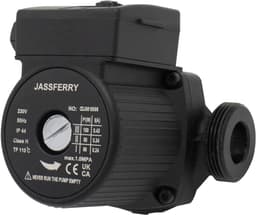
JASSFERRY’s entry at about £38 undercuts several Trident rows while listing BSP 1½″ unions and a 130 mm pump length on the page. Twenty-five UK reviews at 4.6 stars give useful—but not massive—confidence for a budget Grundfos alternative. Trade-style comments in the raw batch say repeat buys and fewer callbacks than premium brands, though that remains reviewer opinion, not our test. IP44 and a five-year warranty appear in bullets; still check CE or UKCA paperwork in the parcel. Flow is not printed clearly on the listing line we captured, so duty matching relies on the 6 m head claim and your old nameplate photo. Pair with inhibitor refill if you open the system.
Pros
Low shelf price (~£38) with 130 mm length stated
25 UK reviews at 4.6 stars
Five-year warranty and IP44 called out on listing
Cons
Max flow not clearly printed on the captured listing
“A-rated” marketing is not the same as a visible EEI on the plate
Fewer reviews than the lead Trident TP25-60
Best for: Cost-conscious 130 mm swaps when the removed pump was a similar 15-50/25-60 class unit
Less suitable: Jobs where you need printed flow figures and ErP labels before ordering online
What max head does the amazon.co.uk listing print?
The amazon.co.uk listing prints 6 m for max head. That figure is seller text. We did not bench-test it.
Is this a standard circulator or a boosting pump?
This row is a standard circulator, from the listing title and bullets. It is the usual class for a closed radiator or cylinder circuit at about 6 m head.
What review line sits on the listing?
The amazon.co.uk listing shows 4.6 out of 5 (25 reviews). That count is for this UK listing, not another marketplace.
Trident’s WRS25/60-130 carries 128 UK reviews at 4.5 stars—second only to the TP25-60 in this batch—yet the captured listing leaves head and flow blank while mentioning three power modes. Treat the modes as three-speed behaviour in practice, but photograph your old pump’s duty before you rely on marketing names. Review narratives sometimes mention connectors included, which saves a merchant trip when they arrive. Smart-home compatibility is claimed without a clear protocol; plan on manual speed selection unless you verify otherwise. At roughly £43 it competes directly with the TP25-60; choose between them using spec clarity and review themes, not stars alone. Missing printed head on the scrape is a genuine minus for online-only buyers.
Pros
128 UK reviews at 4.5 stars—strong social proof
Three power modes align with familiar speed switching
Price parity with other mid Trident 25-60 class rows
Cons
Head and flow not printed on the listing we captured
Smart-home bullet lacks usable protocol detail
Spec gaps force extra nameplate homework before ordering
Best for: Grundfos-sized swaps when you already know duty from the old label and want Trident review depth
Less suitable: Buyers who will not open the cupboard to photograph the old pump plate first
What max head does the amazon.co.uk listing print?
The amazon.co.uk listing we read does not print a max head figure. Photograph the old pump plate before you treat the model name as the duty.
Is this a standard circulator or a boosting pump?
This row is a standard circulator, from the listing title and bullets. It is the usual class for a closed radiator or cylinder circuit at about 6 m head.
What review line sits on the listing?
The amazon.co.uk listing shows 4.5 out of 5 (128 reviews). That count is for this UK listing, not another marketplace.
Trident’s BP25-10-130 markets inverter-style “intelligent” flow with head steps of 6, 8, and 10 m on the listing, plus a ≤45 dB seller claim we did not verify. Only four UK reviews sit behind the 4.5 star line at scrape—pretty enough to tempt, too thin to trust for a whole-house bet. Video reviews in the raw batch suggest quiet running anecdotally, but that is not lab data. At nearly £70 you are paying a premium over standard 25-60 circulators that already have hundreds of UK texts. Choose this when duty measurements show you need variable head, not when a radiator is merely slow to warm. Wiring and speed strategy still follow the same isolate-drain-refill discipline as any swap.
Pros
Stepped head settings (6/8/10 m) on the listing
Inverter positioning for circuits that outgrow fixed three-speed pumps
240 V class supply stated
Cons
Only four UK reviews at scrape despite a high star average
Decibel claim is seller marketing, not our measurement
Premium price without the review depth of the TP25-60
Best for: Experienced fitters who already sized a variable-head pump and accept thin UK feedback
Less suitable: Emergency Grundfos replacements where review depth matters more than inverter features
What max head does the amazon.co.uk listing print?
The amazon.co.uk listing prints 6–10 m for max head. That figure is seller text. We did not bench-test it.
Is this a standard circulator or a boosting pump?
This row is an auto-boost or inverter-style pump, from the listing title and bullets. It is not the default swap for a normal eight-radiator house on a standard 6 m circulator.
What review line sits on the listing?
The amazon.co.uk listing shows 4.5 out of 5 (4 reviews). That count is for this UK listing, not another marketplace.
Anesty’s circulator is the clearest teacher in the table: three speeds map to 46/67/100 W and roughly 3/5/6 m head on the listing, which helps you pick a setting after install. Eighty-two UK reviews at 4.3 stars and a scrape price near £36 make it the comparison’s value badge without hiding the trade-offs. Reviewers praise straightforward Grundfos-sized swaps and cast-iron construction; negatives mention packaging dents and the usual whine if you jump straight to the highest speed. Reducers to 1″ BSP are listed—confirm they match your unions before drain-down. We did not measure efficiency on a bench; treat energy bullets as seller claims until you read the nameplate EEI.
Pros
Explicit watt-to-head steps on the listing (46/67/100 W)
82 UK reviews at 4.3 stars around £36 at scrape
130 mm length and G1½″ BSP with reducers listed
Three-speed control for post-install tuning
Cons
Entry price can mean louder running if you default to speed 3
Some UK comments on cosmetic box damage—not pump failure, but worth noting
ErP compliance still requires nameplate EEI, not Amazon ad copy
Best for: Budget 130 mm replacements where you want readable speed/head steps on the box
Less suitable: Installs demanding OEM Grundfos documentation or wholesaler traceability
What max head does the amazon.co.uk listing print?
The amazon.co.uk listing prints 3–6 m for max head. That figure is seller text. We did not bench-test it.
Is this a standard circulator or a boosting pump?
This row is a standard circulator, from the listing title and bullets. It is the usual class for a closed radiator or cylinder circuit at about 6 m head.
What review line sits on the listing?
The amazon.co.uk listing shows 4.3 out of 5 (82 reviews). That count is for this UK listing, not another marketplace.
This JASSFERRY 25-6/130 row costs more than the cheaper JASSFERRY SKU but adds explicit connector and washer bullets plus a five-year warranty line. Seventy-nine UK reviews at 4.2 stars give a solid middle ground—better depth than boost pumps with four reviews, not as heavy as the 860-review Trident leader. Buyers comparing the two JASSFERRY listings should decide whether the extra ~£10 buys the connector story you need for a Sunday swap. Noise themes mirror other three-speed cast-iron units: fine on speed 1, sharper on speed 3 until the system is bled and balanced. Smart-home wording on the listing lacks protocol detail—do not buy it for HomeKit or Alexa without a spec sheet. Confirm 130 mm centre distance against your old Grundfos plate.
Pros
79 UK reviews at 4.2 stars
Connectors and washers called out on the listing
130 mm length and 6 m head line matches common UPS footprints
Cons
Higher price than the entry JASSFERRY without a large review gap
Smart-home claim is vague on the amazon.co.uk page
Same speed-whine risk as other three-speed budget circulators
Best for: 130 mm swaps when you want connectors listed in the box and moderate UK review depth
Less suitable: Shoppers who only need the lowest price and can source unions locally
What max head does the amazon.co.uk listing print?
The amazon.co.uk listing prints 6 m for max head. That figure is seller text. We did not bench-test it.
Is this a standard circulator or a boosting pump?
This row is a standard circulator, from the listing title and bullets. It is the usual class for a closed radiator or cylinder circuit at about 6 m head.
What review line sits on the listing?
The amazon.co.uk listing shows 4.2 out of 5 (79 reviews). That count is for this UK listing, not another marketplace.
Trident’s TP15-90Z is an auto-boost style pump with 8 m head and 25 L/min on the listing, priced around £60 at scrape. Only twelve UK reviews sit behind the 3.9 star average, so the score looks middling rather than reassuring. Boost pumps can help when a standard 6 m class unit cannot lift upstairs radiators, but they add noise and mis-match risk if your pipework is already balanced. Amazon filed this SKU under Pet Supplies at scrape—a merchandising quirk that does not change physics but shows listing hygiene varies. Positive UK snippets mention successful swaps; negatives echo noise and uncertainty about long-term duty. Match pump type to the old nameplate before you drain down.
Pros
Higher head (8 m) than entry 25-60 circulators
Three-speed switching on the listing
Cast-iron body called out in specs
Cons
Only twelve UK reviews—thin file for a boost purchase
3.9 star average leaves room for disappointment
Miscategorisation on amazon.co.uk at scrape may confuse spare-part searches
Best for: Circuits where a standard 6 m circulator clearly lacked head and boost duty was already confirmed
Less suitable: Default replacement for a UPS/UPS2-sized 25-60 on a typical terrace or semi
What max head does the amazon.co.uk listing print?
The amazon.co.uk listing prints 8 m for max head. That figure is seller text. We did not bench-test it.
Is this a standard circulator or a boosting pump?
This row is an auto-boost or inverter-style pump, from the listing title and bullets. It is not the default swap for a normal eight-radiator house on a standard 6 m circulator.
What review line sits on the listing?
The amazon.co.uk listing shows 3.9 out of 5 (12 reviews). That count is for this UK listing, not another marketplace.
The Trident TP25-90 boost listing sits at 2.4 out of 5 across only sixteen UK reviews—far below the trust line of this comparison. Negative texts call it a waste of money and describe weak or disappointing performance versus the price near £70. The listing claims 10 m head but only 20 L/min max flow, which suits pressure-starved circuits in theory, yet the star line does not back that up in UK feedback. Auto-boost behaviour is harder to diagnose when something fails, and return hassle matters on a weekend swap. Treat this row as a cautionary boost example, not a default pick for a standard eight-radiator house. If your circuit is merely lukewarm upstairs, balancing or air may be cheaper first steps.
Pros
High head figure (10 m) on the listing for weak circuits on paper
Three-speed control like other Trident boost SKUs
Cons
2.4 average from sixteen UK reviews
Repeated “waste of money” themes in UK text
Low max flow (20 L/min) limits whole-house duty if misapplied
Best for: Shoppers who already know they need a boost-class pump and accept thin, poor UK feedback
Less suitable: First-time buyers replacing a standard Grundfos-sized circulator on a normal domestic layout
What max head does the amazon.co.uk listing print?
The amazon.co.uk listing prints 10 m for max head. That figure is seller text. We did not bench-test it.
Is this a standard circulator or a boosting pump?
This row is an auto-boost or inverter-style pump, from the listing title and bullets. It is not the default swap for a normal eight-radiator house on a standard 6 m circulator.
What review line sits on the listing?
The amazon.co.uk listing shows 2.4 out of 5 (16 reviews). That count is for this UK listing, not another marketplace.
How we compared
Ten amazon.co.uk listings are on this page. The score starts from the UK star rating, scaled, with weight on review count on a log scale. Printed head, flow and port length inform the notes. They are not a separate lab test. Fewer than twenty UK reviews, a sub-3.0 star average, a boost pump aimed at a normal eight-radiator layout, a missing port length, and an “A-rated” bullet without a citeable EEI are editorial deductions. Weights sum to 100. The top pick is the Trident TP25-60-130. Best value is the Anesty, a different listing.
1
Amazon evidence
35%
Stars and the review count come from the amazon.co.uk file for that ASIN. The score uses the star line scaled, with review count on a log scale. A file of four or eleven reviews cannot take the same weight as 860. Written reviews from another marketplace are not used.
2
Mechanical fit
20%
130 mm centre distance and 1½ inch BSP unions are the usual domestic swap. A missing port length on the listing is a deduction. Model names that include 130 are not a substitute for checking the old pump before you drain down.
3
Duty match
20%
Head and flow should suit the radiator count. A standard circulator in this set is about 6 m. A boost row with 8 m to 12 m head and about 20 L/min to 30 L/min is a different job. Using a boost pump as the default for a normal layout is a deduction.
4
Control and compliance notes
15%
Three-speed control is the common pattern. An EEI of 0.23 or lower belongs on the nameplate. An “A-rated” bullet without that figure does not score as ErP compliance. Seller decibel claims are not treated as measured quiet running.
5
Price
10%
Shelf price in GBP is read against a page you could act on, from the 20 October 2026 listing files. The lowest price does not win this block when the review sample is thin or the pump type is wrong for the house. The Anesty is best value because the steps are printed and 82 UK reviews sit behind about £35.90.
Independent review
Last updated: October 2026
6 sources checked
Heating pump buying guide
A heating pump pushes hot water around a wet system. The decision is the footprint, then the head and flow, then whether you are buying a standard circulator or a boost pump. Read the nameplate for EEI. A star line of four reviews is a weak sample. This is not a lab test, and an “A-rated” bullet is not ErP proof.
What is a heating pump?
A heating pump here means a wet central-heating circulator. It is the small pump that pushes hot water around radiators or a cylinder circuit, usually mounted on the pipework near the boiler. It is not an air-to-water heat pump, and it is not a condensate pump. UK shoppers usually search when an old Grundfos or Wilo unit hums, leaks, or leaves radiators cold upstairs.
Best for
A failed 130 mm circulator on a closed radiator circuit
A landlord or fitter matching a Grundfos-sized footprint without new pipework
Not ideal for
An open-vented hot-water circuit that needs a bronze body
A single cold radiator that has not been balanced or bled
Mistakes to avoid
1
Ordering 130 mm without measuring 180 mm
UPS-style domestic pumps in this set are mostly 130 mm port-to-port. Some older bodies are 180 mm. The pipe centres do not stretch. Measure before you drain the system.
2
Leaving the new pump on speed 3
Three-speed circulators in this price band often whine on the top speed. UK reviews on the Trident TP25-60-130 mention that whine, sometimes easing after about two weeks. Use the lowest speed that heats the last radiator, and bleed the system after refill.
3
Reading A-rated as ErP, or a boost pump as a cold-radiator cure
An “A-rated” or “B-rated” bullet is not an EEI of 0.23 or lower on the nameplate. A boost pump with 8 m to 12 m head and about 20 L/min to 30 L/min is for a weak circuit, not for one radiator that balancing has not fixed.
What to weigh up
Mechanical fit and duty
High
Mechanical fit comes first. Domestic swaps are usually 130 mm centre distance with 1½ inch BSP unions. Confirm that on the old pump before you drain down. A 180 mm body will not drop onto 130 mm pipe centres. The TP25-60-130, the Anesty, both JASSFERRY rows, the WRS25/60-130, the BP25-10-130 and the KPS25-6-130 carry 130 mm in the name or on the listing. The TP15-90Z and TP15-120Z do not print a port length in the fields we captured. The Anesty lists G1½ inch BSP and reducers to 1 inch.
Speed, compliance and price
High
Fixed three-speed pumps are the common control here. After refill and bleeding, use the lowest speed that heats the last radiator. Speed 3 by default is a recurring noise complaint, including on the TP25-60-130. Some UK reviews say the whine eases after about two weeks. That is reviewer experience, not a measurement we made. Ceramic-shaft claims and seller decibel lines, including on the BP25-10-130, stay unverified.
Which option suits you?
Three typical situations, each with a recommendation from this comparison.
🏠
Emergency swap
The pump failed on a cold weekend and you want a cheap 130 mm replacement with the speeds written on the listing. The Anesty is best value at about £35.90: 4.3 from 82 reviews, 130 mm, and steps of 46 W, 67 W and 100 W for about 3 m, 5 m and 6 m. Confirm the unions before you drain down.
You want a standard circulator with connectors in the box and a review file deep enough to show the noise pattern. The Trident TP25-60-130 is the top pick at about £42.99, with 4.6 from 860 UK reviews, 6 m head and 90 L/min printed. Expect comments about whine on speeds two and three.
You need a receipt-friendly 130 mm pump that matches a Grundfos-sized footprint without pipe alterations. The JASSFERRY at about £37.99 lists 6 m head, 130 mm length and 1½ inch BSP, with 4.6 from 25 UK reviews. Flow is not clearly printed. Check the nameplate for EEI on delivery.
The top pick is the Trident TP25-60-130 at about £42.99. It leads this ten-listing set on review depth: 4.6 from 860 amazon.co.uk reviews, with 6 m head and 90 L/min printed. UK comments describe a Grundfos-sized 130 mm swap with cast-iron connectors. Reviews also mention a whine on speeds two and three. Best value is the Anesty at about £35.90, with 4.3 from 82 reviews and printed watt-to-head steps.
How much does a heating pump cost?
On these amazon.co.uk cards the shelf prices run from about £35.90 for the Anesty to about £79.99 for the Trident TP15-120Z. Entry circulators sit at about £35.90 to £39.97. Mid-price 25-60 rows, including the Trident TP25-60-130, sit at about £42.99 to £48.50. Auto-boost listings sit at about £59.99 to £79.99. These figures are the listing files from 20 October 2026. Recheck the live price before you order.
What should you check before you buy a heating pump?
Check 130 mm against 180 mm centre distance, and 1½ inch BSP unions, before you drain down. Head and flow should suit the radiator count. A pump that is too weak leaves cold zones. A pump that is too strong adds noise. Three-speed control is the common pattern in this price band. An ErP-compliant circulator should show an EEI of 0.23 or lower on the nameplate. An “A-rated” bullet is not that plate. Photograph the old pump before you order.
Is a boost pump the right fix for one cold radiator?
A boost pump is for a circuit that already lacks head, not for one cold radiator. The Trident boost rows print higher head, 8 m to 12 m, and lower max flow, about 20 L/min to 30 L/min, than a standard 25-60 at 6 m. One cold radiator that balancing does not fix may be a blockage. The TP25-90 at about £69.99 sits at 2.4 from 16 reviews. A high head figure is not, by itself, a whole-house upgrade.
Does A-rated on the listing mean the pump meets ErP?
No. Since 1 January 2022, heating circulators placed on the UK market should meet an energy efficiency index of 0.23 or lower. Wilo’s public guidance says three-speed-only legacy designs may be non-compliant. Confirm the nameplate, not the Amazon bullet. “A-rated” and “B-rated” lines on these listings are seller text. We did not efficiency-test any pump in this set. Reports of non-compliant pumps leaving UK listings are not a test of these ten ASINs.
Can you replace a heating pump yourself?
Many people swap an isolated circulator on the heating pipework: isolate the 230 V supply at the fused spur, drain down, fit the unions, refill, and bleed. Work that disturbs the boiler gas train stays with a Gas Safe registered engineer. Stop if you are unsure, if the boiler locks out, if you smell gas, or if the wiring is unfamiliar. Repeated leaks at the flanges after two attempts to reseat them need a professional.
When is a bronze circulating pump the other pump?
A bronze body is the other fitting when the circuit is open-vented domestic hot water, where fresh water would corrode cast iron. The pumps on this page are cast-iron or iron circulators for closed wet radiator or cylinder circuits. If the old pump on the cylinder circuit is bronze, match that metal. Those listings are in the bronze circulating pump comparison. A heating-pump swap does not redesign a heat-pump primary circuit.
Our verdict
The top pick is the Trident TP25-60-130 at about £42.99. It has the deepest UK review file in this set, 4.6 from 860 reviews, with 6 m head and 90 L/min printed and cast-iron connectors often mentioned for a Grundfos-sized swap. Reviews still report a whine on the higher speeds. Best value is the Anesty at about £35.90, with 4.3 from 82 reviews and watt-to-head steps you can read before you fit it. Skip a boost pump unless the old circuit already lacked head. Skip any row whose star line sits under 3.0.
Best overall
Trident TP15-120Z
Best value
Anesty
About £35.90, with 4.3 from 82 reviews and printed steps of 46 W, 67 W and 100 W.
Peter F. is the editor for DIY & tools at productscompared.co.uk. Comparisons in this category are checked against amazon.co.uk listings, review evidence and public UK sources.
Updated: October 2026
6 sources checked
Guides to heating pumps
Guides on what to look for, how to use a product, and common mistakes.
Public UK sources named below. amazon.co.uk prices, stars and review counts on these ten listings were taken from the listing files read on 20 October 2026. Page updated October 2026.
This page contains affiliate links to amazon.co.uk (tag pcuk26-21). If you buy through them, we may earn a commission at no extra cost to you. Prices, stars and review counts are taken from those listings. We did not run a lab test.