Independent comparisons. We may earn from shop links. Our editors compare products independently. Some links go to shops, and we may earn a commission. More info
Top pick: PUIBERS digital caliper, 150 mm, solar assist Best value: Adoric digital caliper, 150 mm – Best value at £6.99, with ±0.2 mm printed and 4.5 from 36,738 reviews, for rough DIY sizes rather than a stiff jaw. Updated October 2026.
A caliper is either a reading tool or a pair of transfer legs. A reading caliper shows outside, inside, depth and step on a vernier scale or a digital display. Transfer legs only copy a size onto a rule. Most people searching amazon.co.uk for calipers or callipers want a 150 mm digital for DIY, woodwork, jewellery or 3D printing. For home use, look for a jaw that returns to zero, a stated accuracy you do not confuse with the display step, and a body that matches the material claim. A listing at 60–100 g, with reviews that say the jaws flex, is not the same object as a stainless tool at 290–399 g. The checks for job, reading type, range and stated error are in the [caliper buying guide](/hub/measuring-and-marking-tools/caliper/sub/caliper-buying-guide).
Eleven listings claim a digital display, including the light tools whose material line is disputed. Trade absolute-encoder calipers keep their origin with the power off. The budget digitals generally need a fresh zero after a cell change. Reviews of the say the datum is lost when that tool sleeps.
A caliper is either a reading tool or a pair of transfer legs. A reading caliper shows outside, inside, depth and step on a vernier scale or a digital display. Transfer legs only copy a size onto a rule.
A caliper is either a reading tool or a pair of transfer legs. A reading caliper shows outside, inside, depth and step on a vernier scale or a digital display. Transfer legs only copy a size onto a rule. Most people searching amazon.co.uk for calipers or callipers want a 150 mm digital for DIY, woodwork, jewellery or 3D printing. For home use, look for a jaw that returns to zero, a stated accuracy you do not confuse with the display step, and a body that matches the material claim. A listing at 60–100 g, with reviews that say the jaws flex, is not the same object as a stainless tool at 290–399 g. The checks for job, reading type, range and stated error are in the [caliper buying guide](/hub/measuring-and-marking-tools/caliper/sub/caliper-buying-guide).
Eleven listings claim a digital display, including the light tools whose material line is disputed. Trade absolute-encoder calipers keep their origin with the power off. The budget digitals generally need a fresh zero after a cell change. Reviews of the say the datum is lost when that tool sleeps.
A caliper is either a reading tool or a pair of transfer legs. A reading caliper shows outside, inside, depth and step on a vernier scale or a digital display. Transfer legs only copy a size onto a rule. Most people searching amazon.co.uk for calipers or callipers want a 150 mm digital for DIY, woodwork, jewellery or 3D printing. For home use, look for a jaw that returns to zero, a stated accuracy you do not confuse with the display step, and a body that matches the material claim.
The PUIBERS PBDC09-EU at £29.99 is a 150 mm digital weighing 340 g. The bullets say stainless steel, inside, outside, depth, and step, a thumb wheel, a locking screw, and a solar panel that assists under suitable light with a CR2032 as backup. The specification field prints ±0.01 mm and does not print a separate resolution. A case and a Phillips screwdriver are in the components line. A thread table for metric ISO and Whitworth is printed on the rear. Waterproof is asked and not answered with an IP code. The listing is 5.0 from 4 reviews. Two are UK and praise the solar assist and the case. That sample is too small to rank the ±0.01 mm line against a Mitutoyo ±0.02 mm, and this file does not make that comparison as a test.
Pros
Solar assist plus a CR2032, as printed
Case and screwdriver in the box line
340 g metal, in the two UK reviews
Depth and step named in the title
Cons
Only four reviews, two of them UK
±0.01 mm is a specification field, not a checked result
No resolution printed as its own figure
No IP code
Best for: You want a 150 mm digital in this set with a printed solar assist and a case, and you accept a four-review sample.
Less suitable: You want a proven accuracy figure, an IP rating, or a large UK review count.
No. The bullets say the solar panel is auxiliary power in suitable light, and the CR2032 is the backup. It is not described as a charger.
Is it waterproof?
The question list asks, and the bullets do not print an IP code. Do not read a waterproof claim into this file.
How many UK reviews are in the file?
The listing count is 4. Two texts are from the United Kingdom and both are positive about the case, the metal body, and the solar assist. One German text and one French text are in the saved listing and are not used as UK opinion.
The Bryze listing at £27.99 weighs 388 g. The title says 200 mm. One bullet prints 0–6 inch and 0–200 mm in the same range line, which cannot both be the capacity. Resolution is 0.01 mm. Accuracy is 0.03 mm in the bullets and ±0.02 mm in the specification field. The bullets say hardened stainless steel and ABS, a locking screw, and inside, outside, depth, and step. One nonstandard battery is included. The rating is 5.0 from 2 amazon.co.uk reviews, both short and both positive about the screen and the slide. Do not treat two stars as confirmation of a 200 mm beam.
Pros
388 g
Locking screw named, and mentioned in one review
0.01 mm resolution printed
Cons
6 inch and 200 mm printed as one range
Accuracy 0.03 mm and ±0.02 mm both printed
Only two reviews
Cell type not named
Best for: Only if you can confirm the beam length on the tool you receive. The listing itself does not settle 150 mm versus 200 mm.
Less suitable: You need a confirmed 200 mm capacity, or a review sample larger than two.
The title says 200 mm. The same bullet prints 0–6 inch and 0–200 mm together. Six inches is not 200 mm. The file does not show a photo measurement that settles it.
What accuracy is printed?
The bullets print 0.03 mm. The specification field prints ±0.02 mm. Resolution in the bullets is 0.01 mm.
What do the two reviews say?
Both are short UK texts from 22 July 2026. One likes the display for DIY. One likes the smooth slide and the locking screw. There is no third review.
The Kesiku pair at £13.99 is two stainless transfer legs, about 350 mm, weighing 50 g on the listing. There is a friction joint and no scale, so they copy a curve or a diameter onto a rule and do not display a number. The specification field prints ±0.5%. The bullets warn that the tips are sharp and that you should wipe the oil off first. The included-components field prints no. The listing is 5.0 from 1 amazon.co.uk review, and that pottery-studio text says the joint holds and that two pieces are better than forcing one leg to do both jobs. Do not compare its star with a 150 mm digital.
Pros
Inside and outside legs in one pack
Friction joint with no bolt, in the one review
About 350 mm, longer than the 150 mm reading tools
Sharp tips are warned in the bullets
Cons
No scale and no number
±0.5% cannot be read on the tool
Only one review
Sharp tips
Best for: You only need to copy a pottery or sculpture size onto a rule.
Less suitable: You need a millimetre reading, a depth rod, or a 150 mm digital.
No. These are inside and outside transfer legs with a friction joint. You set them on the work and carry the gap to a rule. The ±0.5% line is printed on a tool with no scale.
Are the tips sharp?
Yes. The bullets say the tips are sharp and to use caution. They also say to wipe the anti-rust oil before first use.
What does the one UK review say?
A pottery buyer says the friction joint holds without a bolt, the pair feels solid, and they ordered another size. There is no second review in the file.
The HARDELL listing at £19.99 is a 150 mm digital that weighs 360 g and states stainless steel. The bullets print accuracy of ±0.03 mm and resolution of 0.01 mm, while the specification field prints ±0.02 mm. It says waterproof and does not print an IP code. Two LR44 cells are included, and the bullets say the OFF button cuts power. Across 4.6 from 1,291 amazon.co.uk reviews, the 50 UK texts mostly describe a sturdy metal body, a spare cell, and use on coins or 3D prints. The same sample includes a battery cover with tiny screws, a tool that would not hold zero, a screen that failed within three months, and tools that stopped within a year. Dimensions on the listing are 6 x 6 cm.
Pros
360 g and reviews describe metal, not plastic
4.6 from 1,291 reviews
OFF claimed to cut power
Spare LR44 and a lock mentioned in reviews
Cons
Accuracy lines disagree: 0.03 mm and ±0.02 mm
Waterproof has no IP code
Battery cover screws are fiddly
Screen and zero failures appear in the 50-review sample
Best for: You want a heavier stainless-pattern 150 mm digital in this set and you will check zero yourself.
Less suitable: You need one accuracy figure you can quote, or a printed IP code.
The bullets print ±0.03 mm and a 0.01 mm resolution. The specification field prints ±0.02 mm. Both figures are in the saved listing. Neither is a gauge-block result.
Is an IP rating printed?
No. The bullets say waterproof and stain-resistant. They do not print IP54 or IP67.
What fails in the UK reviews?
Of 50 reviews, several praise the metal body and a spare cell. Repeated complaints are a fiddly two-screw battery cover, a zero that walks, a screen that failed within three months, and a unit that stopped within a year.
The EVRU at £6.79 is a 150 mm digital weighing 100 g. The bullets print a 50 x 20 mm screen, accuracy ±0.2 mm, resolution 0.1 mm, and carbon fibre composite. The specification field prints ±0.01 inches. Country of origin and battery type are not in the specification block. Across 4.6 from 351 amazon.co.uk reviews, the 50 UK texts mostly accept it for pipes, jewellery, and light DIY, and several mention a spare cell. The same sample says the body is plastic, that flex changes the reading, that there is no lock, and that the on/off switch leaves the tool on. One review says plastic tips would melt on a hot part. Do not treat the carbon-fibre line as an engineering material claim.
Pros
£6.79 with a large screen on the bullets
4.6 from 351 reviews
±0.2 mm printed in the bullets
Spare cell mentioned in reviews
Cons
100 g and reviews describe plastic
Carbon-fibre claim contradicted by moulding marks
No locking screw in one review
On/off does not switch off in one review
Best for: You want a light, cheap digital for occasional home sizes and a large screen.
Less suitable: You need a stiff jaw, a lock, or a carbon-fibre beam in the engineering sense.
The material field and the bullets say carbon fibre composite, and the weight is 100 g. UK reviews in the file describe plastic and moulding marks. One review still calls the jaws carbon fibre. Another says they are not.
What accuracy is printed?
The bullets print ±0.2 mm and resolution 0.1 mm. The specification field prints ±0.01 inches, which is not the same number as ±0.2 mm.
What do the reviews say about stiffness?
Of 50 reviews, many call it fine for occasional DIY. Several say it is flimsy, that flex changes the reading, that there is no locking screw, and that the on/off control does not switch it off.
The Adoric KC24 at £6.99 is the rank 1 Digital Callipers listing in this file, with 4.5 from 36,738 amazon.co.uk reviews. The bullets print 0–150 mm, resolution 0.1 mm, and accuracy ±0.2 mm, plus a five-minute auto-off and a zero button. The material field says stainless steel and the weight is 68 g. Of the 50 UK reviews read, the repeated praise is the price, the screen, and a spare LR44. The repeated complaint is a plastic body, including one buyer who says the silver finish is paint. A sticky slide, wandering disc-brake readings until extra pressure, and a refusal to trust it for CNC are also in that sample. The star count is popularity, not a gauge-block result.
Pros
£6.99 with a printed ±0.2 mm accuracy
4.5 from 36,738 reviews and rank 1 in Digital Callipers
Large screen and inch/mm switch
Spare cell described in many reviews
Cons
68 g and reviews say plastic, against a stainless field
Resolution is 0.1 mm, not 0.01 mm
Sticky slide until oiled
Thin parts need extra jaw pressure in one review
Best for: You want a cheap 150 mm digital for rough DIY sizes and you accept a 0.1 mm step and a light body.
Less suitable: You need a stiff jaw, a 0.01 mm step, or a body that matches a stainless claim.
The material field and the bullets say stainless steel. The weight is 68 g. Several of the 50 UK reviews say the body is plastic, and one says the silver colour is painted plastic.
What resolution and accuracy are printed?
Resolution 0.1 mm / 0.01 inch and accuracy ±0.2 mm. One buyer says that 0.01 inch is coarser than the 0.001 inch they needed, and that the coarser figure is what the listing states.
Where do the reviews say it is enough?
Most of the 50 texts call it good value for coins, screws, models, and occasional DIY. One disc-brake check wandered until the buyer added jaw pressure. One buyer would not use it for CNC.
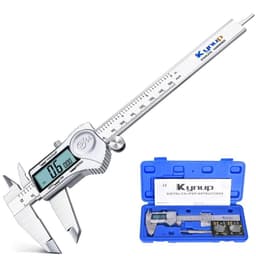
The Kynup 170-2 at £21.99 is the only file in this twelve that prints IP54. It weighs 399 g, the material field says stainless steel, and both the bullets and the specification field print ±0.02 mm with a 0.01 mm resolution. The specification line says three lithium metal cells; the components line says two backup cells, a screwdriver, and a case. Across 4.5 from 13,556 amazon.co.uk reviews, the 50 UK texts mostly describe a solid metal body and a lock that woodturners use. The same sample includes a tool that stopped after about two months, a unit left outside overnight that then ignored the keys, and more than one report that it switches on in the case. There is no UKAS certificate in the file.
Pros
IP54 printed on the listing
Accuracy lines agree at ±0.02 mm
399 g, and reviews describe metal rather than plastic
4.5 from 13,556 amazon.co.uk reviews
Case, lock, and fraction display
Cons
Switches on in the case and flattens the cell, in more than one review
Low cell makes the reading poor
Stopped after about two months in one review
No calibration certificate in the file
Best for: You want a 150 mm stainless digital in this set that actually prints IP54, and you can live with a button cell.
Less suitable: You need a UKAS certificate, or you keep the tool in a damp place and expect IP54 to mean immersion.
Yes. The bullets say an IP54 splash-proof and dust-resistant housing. That is splash, not a claim that the tool can be immersed. One UK review left a unit outside overnight and it then ignored the keys.
What accuracy figure is printed?
Both the bullets and the specification field print ±0.02 mm, with a resolution of 0.01 mm. The file does not include a UKAS certificate. One reviewer says the lack of a calibration record rules it out for professional sign-off.
What do the UK reviews repeat about power?
Of the 50 reviews read, several praise spare cells and a sealed cover. Others say the tool switches itself on in the case, and that a low cell makes the reading poor until the cell is changed.
The Preciva CS45002 at £16.99 is a 150 mm digital weighing 290 g. The bullets say hardened stainless steel and ABS, splash from any direction, resolution 0.01 mm, and accuracy 0.03 mm. The specification field prints 0.02 mm, and the material field says Black. Two LR44 cells are included. There is no IP code and no country of origin in the raw head. Across 4.5 from 12,668 amazon.co.uk reviews, the 50 UK texts include a 50 mm block check with outside jaws inside 49.98–50.00 mm and inside jaws 0.06 mm out, plus a depth rod 0.05 mm short. Other texts praise the weight for 3D printing. The battery hatch, a lost zero, and a slider that left the beam after six weeks are also in that sample.
Pros
290 g and many reviews describe a metal tool
4.5 from 12,668 reviews
0.01 mm resolution printed
Outside-jaw check on a 50 mm block stayed within 0.02 mm in one detailed review
Cons
Accuracy 0.03 mm and 0.02 mm both printed
Inside jaws 0.06 mm out in that block check
Battery hatch opens when the slider is pulled back
One unit came apart after six weeks
Best for: You want a mid-price 150 mm digital with a large UK review count and you will zero it before use.
Less suitable: You need inside and depth readings to match the outside jaws, or a single printed accuracy figure.
No. The bullets print 0.001 inch / 0.03 mm. The specification field prints 0.02 mm. Resolution in the bullets is 0.01 mm.
What did one UK buyer find on a 50 mm block?
Outside jaws read 49.98 to 50.00 mm. Inside jaws differed by 0.06 mm. The depth rod was about 0.05 mm short of the end face. Two body screws were loose on arrival.
What else repeats in the 50 reviews?
Buyers praise the weight and the screen for 3D printing and woodturning. Others say the battery hatch opens when the slider is drawn back, the tool does not always zero, and one slider left the beam after six weeks.
The Spurtar at £12.99 is the only manual vernier in this twelve. Range is 0–150 mm, weight 310 g, and the bullets say carbon steel, pre-oiled, with no battery. Accuracy is printed as ±0.02 mm under 100 mm and ±0.03 mm from 100 to 150 mm. The material field is the French phrase Acier au carbone. The box lists a caliper, a ruler, a manual, and a case. Across 4.5 from 10,189 amazon.co.uk reviews, the 50 UK texts praise the lack of a cell and the steel body. They also repeat a gap between closed jaws, zeros that do not line up, a dummy wheel, a stiff slide, and a vernier that covers part of the inch scale. Several buyers say you need good eyes.
Pros
No battery
4.5 from 10,189 reviews
Carbon steel at 310 g
Case and a steel rule in the components line
Cons
Closed jaws show a gap in more than one review
The wheel is not a real fine adjust
Stiff slide until oiled
Hard to read if your eyesight is poor
Best for: You refuse button cells and you can read a vernier scale, including with a magnifier.
Less suitable: You want a large digit display, or jaws that meet along their faces when closed.
No. The bullets say manual operation with no battery. That is why several of the 50 UK reviews chose it.
What accuracy is printed?
±0.02 mm under 100 mm and ±0.03 mm from 100 to 150 mm. The specification field prints 0.03 mm. One review found agreement with two digitals within 0.05 mm, not 0.02 mm.
What do buyers say about the jaws and the wheel?
More than one review shows a gap along the jaw faces when closed, and zeros that do not line up. The small wheel is described as a dummy, not a fine-adjust roller. The slider is often stiff until oiled.
Kynup KY-21S at £19.99 is a 150 mm digital weighing 200 g. The bullets and the specification field both print ±0.02 mm, with 0.01 mm resolution. The material field says stainless steel. Splash-proof is printed and no IP code is printed. The specification line says one LR44 included; the components line says two extra button cells and a case. Across 4.5 from 1,332 amazon.co.uk reviews, the 50 UK texts mostly describe metal jaws and spare cells. One review says the datum is lost whenever the tool sleeps. Another says the sensors failed within three months after four uses. Soft battery-cover screws that strip are also in the sample. This is not the IP54 Kynup.
Pros
Accuracy lines agree at ±0.02 mm
OFF claimed to cut power
Case and spare cells in the components line
Reviews describe metal jaws
Cons
200 g, lighter than the IP54 Kynup at 399 g
Datum lost on sleep, in one review
Sensors failed within three months in one review
No IP code
Best for: You want the Kynup with a full OFF button and matching ±0.02 mm lines, and you will re-zero after it sleeps.
Less suitable: You want the IP54 housing, or a tool that keeps its zero while switched off.
No. This file is model KY-21S. The bullets say splash-proof and do not print IP54. The IP54 listing in this set is ASIN B07X8JQ8L5.
What happens when it sleeps?
One UK review says it loses its datum each time it goes to sleep, and that the slide itself is smooth. The bullets say the OFF button cuts power completely.
What else is in the 50 reviews?
Many describe metal jaws, a case, and spare cells. Faults in the sample include sensors that failed within three months after four uses, a cell that dies quickly, and soft cover screws that strip.
The TYL listing, brand Generic, is £6.45 and weighs 60 g. The title says stainless. The bullets say woven carbon fibre, a 0–150 mm range, resolution 0.1 mm, accuracy ±0.2 mm, and a two-minute auto-off. The manufacturer field is TYL. Across 4.5 from 41 amazon.co.uk reviews, 17 UK texts are in the file. They mostly praise the large screen and the price for home sizes. One review says the body is plastic. Another says the light is too sensitive. Another says it is not the tool for frequent use or for a professional machinist. The sample is small next to Adoric’s review count at a similar price.
Pros
£6.45, the lowest price in this set
±0.2 mm and 0.1 mm resolution printed
Large screen praised for ageing eyes
Home sizes of pipes and fasteners called good enough
Cons
Title, material field, and a review disagree on the material
60 g
Only 41 reviews, 17 in the file
Light switches on too easily in one review
Best for: You want the cheapest digital in this set for occasional home checks and a large screen.
Less suitable: You measure often, or you need the material claim to match the object in your hand.
The title says stainless. The bullets say woven carbon fibre composite. The material field says Carbon Fibre. The weight is 60 g. One of the 17 UK reviews says plastic.
What accuracy is printed?
Resolution 0.01 inch / 0.1 mm and accuracy ±0.02 inch / 0.2 mm. The specification field prints ±0.2.
Who do the reviews say it is for?
Most of the 17 texts call it good value for home pipes, cables, and gemstones. One says the light comes on too easily. One says a metal tool is better if you measure often.
The Sundonix listing at £18.99 weighs 355 g. The title says stainless steel and a hardened shaft. The included-components line says one plastic digital vernier caliper, and the material field says Plastic. The bullets print 0–150 mm, resolution 0.01 mm, and accuracy 0.02 mm. The specification field prints 0.1. Two nonstandard batteries are included. The listing rating is 2.8 from 2 amazon.co.uk reviews, and both texts are in the file. One says the display died after two weeks and the reading stuck at half. The other says it looks sturdy. Do not treat the stainless title as settled, and do not rank it on two stars.
Pros
355 g, heavier than the £7 listings
A case is named in the bullets
0.01 mm resolution is printed in the bullets
Cons
Stainless title against a plastic components line
Accuracy 0.02 mm versus a specification field of 0.1
2.8 from 2 reviews
One unit stopped displaying after two weeks
Best for: The file does not support a clear job for this listing over a heavier stainless tool with more reviews.
Less suitable: You want the material and the accuracy line to agree, or a review sample larger than two.
The title says stainless steel. The included-components line says one plastic digital vernier caliper. The material field says Plastic. The weight is 355 g. The file does not resolve that clash.
What happened in the two UK reviews?
One says the display stopped after two weeks, the reading stayed at half unless restarted, and a battery change did not fix it. The other says it looks sturdy and is good value.
Which accuracy figure is printed?
The bullets print 0.02 mm. The specification field prints 0.1 with no unit beside the figure.
How we compared
Twelve amazon.co.uk listings were scored from the stored stars, review counts and the figures printed on each listing. The weights below are the split used for those scores. They are not a gauge-block test and not a UKAS calibration. The top pick and best value are the awards already stored on the Kynup IP54 and the Adoric listings. No separate methodology note was filed for this comparison.
1
Amazon stars
40%
Stars are the amazon.co.uk figure on that listing. A 4.5 contributes less than a 4.6, and a 2.8 contributes much less. Stars are not a measure of accuracy.
2
Review count
25%
The review count on the same listing caps this part of the score. Two or four reviews cannot outrank a file of several thousand on stars alone.
3
Printed accuracy, range and protection
20%
Matching accuracy lines, a coherent range, and a printed IP code add points. A second, different accuracy figure, a 6 inch line paired with 200 mm, or waterproof with no IP code does not.
4
Material, weight and price
15%
Weight and the material field are read against the UK reviews in the file. A 60–100 g listing whose reviews say plastic does not score as a stainless or carbon-fibre beam. Price is the captured amazon.co.uk figure.
Independent review
Last updated: October 2026
8 sources checked
Caliper buying guide
Choose the job before the brand. A reading caliper shows a number. Transfer legs only copy a size onto a rule. Digital is the usual amazon.co.uk pattern in this twelve. The Spurtar is the only manual vernier, and there is no dial. Then separate the display step from the printed error, and the title’s material from the weight.
What is a caliper?
A caliper in this UK set is a reading instrument or a pair of transfer legs. A reading caliper measures outside, inside, depth and step, and it shows the size on a vernier scale or a digital display. Transfer legs, here the Kesiku pair at £13.99, copy a gap onto a rule and do not show a number. Dial calipers are a third reading type. None of these twelve is a dial.
Eleven listings claim a digital display, including the light tools whose material line is disputed.
Best for
Home DIY where a readable 150 mm digital is enough and the part is not a tight fit
Frequent measuring on a heavier stainless listing, or with a manual vernier checked against a known size
Not ideal for
A quality system or a safety-critical part, without a named trade caliper and a UKAS certificate
An outside-diameter tolerance tighter than the error printed on the caliper
Mistakes to avoid
1
Reading the screen step as the error
A 0.01 mm resolution is the smallest step the display shows. It is not ±0.01 mm accuracy. Quote the error the listing prints, and quote both figures when the bullets and the specification field disagree.
2
Trusting a stainless or carbon-fibre title
TYL, Adoric and EVRU weigh 60 g, 68 g and 100 g. Reviews in those files describe plastic. A carbon-fibre or stainless line on a light listing is not an engineering material claim.
3
Expecting transfer legs to display a size
The Kesiku pair has no scale. You set the leg and carry the gap to a rule. The printed ±0.5% cannot be read on the tool. Sharp tips are warned in the bullets.
What to weigh up
Stated accuracy versus resolution
High
Stated accuracy is the error printed on the listing. Resolution is the smallest step the display or the vernier can show. On the three listings around £6 to £7, the bullets state about ±0.2 mm and a 0.1 mm resolution: Adoric at £6.99, TYL at £6.45, and EVRU at £6.79. The EVRU specification field also prints ±0.01 inches, which is not the same number as ±0.2 mm.
Material, weight and protection
High
Tell a stainless or carbon-fibre claim from the weight and from what UK reviewers say about flex. The weights in the files are TYL 60 g, Adoric 68 g and EVRU 100 g, against HARDELL 360 g, the IP54 Kynup 399 g and Preciva 290 g. Adoric’s material field says stainless steel; reviews in the file say plastic or painted plastic. EVRU and TYL say carbon fibre; reviewers describe plastic.
Which option suits you?
Three typical situations, each with a recommendation from this comparison.
🏠
Occasional home sizes
You want a readable 150 mm digital for DIY, woodwork, jewellery or a rough check, and the part is not a tight fit. The Adoric at £6.99 is best value in this set: ±0.2 mm and a 0.1 mm step are printed, with 4.5 from 36,738 reviews. The material field says stainless steel, the weight is 68 g, and reviews in the file say plastic.
You measure often and want a heavier stainless-pattern listing. The Kynup IP54 at £21.99 is the top pick: 399 g, accuracy lines that agree at ±0.02 mm, 0.01 mm resolution, and the only IP54 line in this twelve. Check zero yourself. The file has no UKAS certificate.
You refuse batteries and you can read a vernier, with a magnifier if you need one. The Spurtar at £12.99 is the only manual vernier here: carbon steel, 310 g, no cell, and printed bands of ±0.02 mm under 100 mm and ±0.03 mm to 150 mm. Reviews also report a gap on closed jaws.
The top pick is the Kynup digital caliper at £21.99. It is the only listing in this twelve that prints IP54. Bullets and the specification field both print ±0.02 mm, with 0.01 mm resolution, at 399 g. amazon.co.uk shows 4.5 from 13,556 reviews. That score is not a gauge-block test, and the file has no UKAS certificate. Skip it if you need a certificate, or if you read IP54 as permission to immerse the tool.
How much does a caliper cost on amazon.co.uk?
In this set, entry digitals are £6.45 to £6.99 and state about ±0.2 mm with a 0.1 mm step. The mid band, £12.99 to £21.99, holds the manual vernier and the heavier stainless-pattern digitals. The two dearest listings are £27.99 and £29.99, with two and four reviews. The Mitutoyo 500-196-30 was £120 including VAT on the Mitutoyo UK shop, a promo seen on 19 October 2026, not an amazon.co.uk price for these twelve.
What should you check before you buy a caliper?
Start with the job. You need a reading caliper if you need a number, and transfer legs if you only copy a size. Then choose digital or vernier, then the range, then the stated accuracy as a separate figure from the resolution. Check the weight against the material claim: 60–100 g with plastic in the reviews is not a 300 g stainless beam. Read the protection line for an IP code. None of these twelve includes a UKAS certificate.
Is 0.01 mm on the screen the accuracy?
No. Resolution is the smallest step the display or the scale can show. Accuracy is the error the listing prints, and the two numbers are not the same. The Adoric prints a 0.1 mm resolution and ±0.2 mm accuracy. Several stainless-pattern listings print a 0.01 mm resolution and an error around 0.02–0.03 mm, and some files print a second figure in another field. Quote both. Do not treat 0.01 mm on the screen as ±0.01 mm.
Are the cheap calipers stainless or carbon fibre?
Judge that from the weight and the reviews, not the title alone. The TYL is listed at 60 g, the Adoric at 68 g and the EVRU at 100 g. Adoric’s material field says stainless steel, while UK reviews say plastic. EVRU and TYL say carbon fibre, and reviewers describe plastic. HARDELL at 360 g, the IP54 Kynup at 399 g and Preciva at 290 g are heavier, and reviews there describe metal.
When is a micrometer the better tool?
Use a micrometer when the outside-diameter tolerance is tighter than a caliper’s permissible error. A caliper in this set is the tool for outside, inside, depth and step at the accuracy printed on that listing. For the budget digitals that printed error is about ±0.2 mm. The outside micrometer comparison is the page for that tighter outside-only job. Do not expect the Kesiku transfer legs to show a measurement at all.
Does any listing include a UKAS certificate?
No. None of the twelve listings includes a UKAS certificate, and none cites BS EN ISO 13385-1:2019. A formal certificate is a UKAS laboratory job, with simpler in-house checks between times. A maker’s inspection sheet is not that certificate. If the reading will be audited, or the part is safety-critical, buy a named trade caliper and the calibration, rather than a marketplace best-seller from this set.
Our verdict
The top pick is the Kynup 150 mm IP54 at £21.99. It is the only listing in this twelve that prints IP54, both accuracy lines say ±0.02 mm, the resolution is 0.01 mm, and the weight is 399 g. amazon.co.uk shows 4.5 from 13,556 reviews. Reviews also say it can switch on in the case, and there is no UKAS certificate. Best value is the Adoric at £6.99, with ±0.2 mm and a 0.1 mm step printed, and 4.5 from 36,738 reviews, for rough sizes on a light body that reviews call plastic. If the reading will be audited, leave this price band and buy a named trade caliper plus a UKAS certificate.
DIY & toolsMeasuring and marking toolsamazon.co.uk listings
Peter F. is the editor for DIY & tools at productscompared.co.uk. Comparisons in this category are checked against amazon.co.uk listings, review evidence and public UK sources.
Updated: October 2026
8 sources checked
Guides to Calipers
Guides on what to look for, how to use a product, and common mistakes.
Public UK and standards sources first, then the amazon.co.uk listings for these twelve ASINs. The Mitutoyo UK shop promo of £120 including VAT for the 150 mm 500-196-30 was seen on 19 October 2026 and is not an amazon.co.uk price. Scores use the weights above. They are not a gauge-block result. No methodology file was stored beside the display data.
This page contains affiliate links. If you buy through them, we may earn a commission at no extra cost to you. Prices, stars and review counts are the amazon.co.uk figures already stored for this set. This is not a laboratory test.