Caliper for 3D printing
You have pulled a metre of 1.75 mm filament, closed the jaws hard, and typed that one number into the slicer. A caliper for 3D printing is only useful if you average several light touches and you know what the screen can actually show. This page stays on filament, walls, and holes. Peter F. used filament makers' own inspection notes and the UK review text behind our [caliper comparison](/hub/measuring-and-marking-tools/caliper). He did not print a test part with each listing. Prices in the comparison are GBP on amazon.co.uk. A qualifying purchase can earn a commission at no extra cost to you.
You have pulled a metre of 1.75 mm filament, closed the jaws hard, and typed that one number into the slicer.
You have pulled a metre of 1.75 mm filament, closed the jaws hard, and typed that one number into the slicer. A caliper for 3D printing is only useful if you average several light touches and you know what the screen can actually show. This page stays on filament, walls, and holes. Peter F. used filament makers' own inspection notes and the UK review text behind our caliper comparison. He did not print a test part with each listing. Prices in the comparison are GBP on amazon.co.uk. A qualifying purchase can earn a commission at no extra cost to you.
Our top picks
| Badge | Product | Resolution | Stated accuracy | Weight | Note | Price | Offer |
|---|---|---|---|---|---|---|---|
| Best overall |  Adoric Adoric digital caliper, 150 mm | 0.1 mm | ±0.2 mm | 68 g | 7.0 | about £6.99 | View offer |
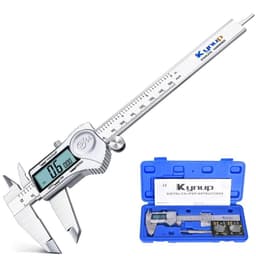
 Kynup Kynup digital caliper, 150 mm, IP54 | 0.01 mm | ±0.02 mm | 399 g | 8.2 | about £21.99 | View offer | |
| Alternative |  Preciva Preciva digital caliper, 150 mm | 0.01 mm | 0.02–0.03 mm | 290 g | 7.6 | about £16.99 | View offer |


On this page
What the print actually needs
Average the filament
Walls and holes
When to stop trusting the number
Common questions
Are the £7 calipers in this set fine for a tight filament note?
Why take a second filament reading at 90 degrees?
Should I retune the slicer when one short piece is thin?
Can I trust the inside jaws on a printed hole to the last hundredth?
What if the caliper loses its zero after it sleeps?
When should I use a micrometer instead of a caliper?
Related pages
Sources
Public UK and standards sources first, then the amazon.co.uk listings for these twelve ASINs. The Mitutoyo UK shop promo of £120 including VAT for the 150 mm 500-196-30 was seen on 19 October 2026 and is not an amazon.co.uk price. Scores use the weights above. They are not a gauge-block result. No methodology file was stored beside the display data.
- BSI, BS EN ISO 13385-1:2019 (retrieved 19 October 2026)
- ISO 13385-1:2019 (retrieved 19 October 2026)
- Rhopoint Metrology, vernier calipers (retrieved 19 October 2026)
- Mitutoyo UK shop, 500-196-30 (retrieved 19 October 2026)
- Cutwel, digital calipers explained (retrieved 19 October 2026)
- Rapid Electronics, how to read vernier calipers (retrieved 19 October 2026)
- Accu, how to use vernier calipers (retrieved 19 October 2026)
- Consumer Rights Act 2015 (retrieved 19 October 2026)