Independent comparisons. We may earn from shop links. More info

Caliper buying guide

Updated: 22 October 2026

You are about to measure a pin, a hole, or a printed wall, and the amazon.co.uk titles all say the caliper is accurate and stainless. This caliper buying guide is the decision that comes before any model row. Peter F. compared twelve listings on amazon.co.uk in October 2026 from the printed specification and the UK review text, not from a gauge-block laboratory. Prices here are the shelf prices in that file, in GBP. A qualifying purchase through our links can earn a commission at no extra cost to you. The rows, stars, and badges sit on the [caliper comparison](/hub/measuring-and-marking-tools/caliper). By the end you should know the job, the reading type, the range, and whether a printed error of ±0.2 mm is enough for the part in your hand.

You are about to measure a pin, a hole, or a printed wall, and the amazon.co.uk titles all say the caliper is accurate and stainless. This caliper buying guide is the decision that comes before any model row. Peter F.

Our top picks

On this page

What you are actually buying

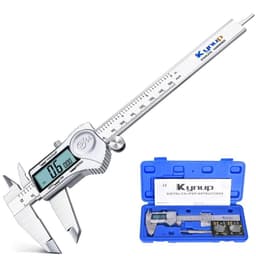
A reading caliper shows a number. Transfer legs do not. The Kesiku pair in this set is two stainless legs, about 350 mm, listed at £13.99, with a friction joint and no scale. You open them across a curve or a round, then hold that gap against a steel rule. The tips are sharp, and the listing tells you to wipe the shipping oil off first. That is a copying tool for a potter or a pattern maker, not a replacement for a 150 mm digital when you need 19.0 mm across a spanner jaw. If the job is a number, leave the Kesiku pair on the shelf. Digital, vernier, and dial are the three readouts that do show a size: a slider on a beam, jaws for outside and inside, a depth rod, and often a step face. This twelve has eleven files that claim a display and one manual vernier, the Spurtar at £12.99. There is no dial listing here. A dial is a needle on a rack, easier than a vernier for many people and still free of a cell, though dirt and a knock can spoil the rack. You would buy that third type outside this set. British standards use the spelling calliper. Shoppers still search caliper, so that is the spelling here. If you already want a pattern matched to a person, use the best caliper page.

Range, resolution, and stated error

Cutwel’s explanation of digital calipers splits the step from the error: a 0.01 mm step is common, and about ±0.02 mm is a typical stated accuracy on a better digital, not a laboratory result for every cheap tool. Heavier listings in this file often print about 0.02 mm or 0.03 mm, and some print a second figure in another field. The HARDELL bullets say ±0.03 mm while the specification field says ±0.02 mm. When both numbers are on the same listing, believe neither until you have checked the jaws yourself. The reference temperature commonly used for this class of tool is 20 °C. A cold shed and a warm hand will move a cheap beam before the last digit means anything. Once the printed error is clear, the body is the next check, because a flexible jaw can invent a larger error than the label. The screen-versus-scale choice is in digital vs vernier caliper.

Stiffness, cells, and splash

Weight on the listing is a rough clue, not a material certificate. A 60 g tool can still be useful for a one-off pipe or a piece of jewellery. It is a poor bet when you close the jaws on a steel pin every day, because flex changes the number. The Adoric field says stainless steel, and reviewers describe a plastic body, including paint on a silver finish. The EVRU field says carbon fibre, and reviewers describe moulding marks. If the object in your hand does not match the title, the accuracy line is advertising. A digital needs a cell, usually an LR44 or a CR2032, and a flat cell is the complaint that comes up again and again. Some tools switch themselves on in the case. Some lose the datum when they sleep, which is what buyers report on the Kynup KY-21S. A manual vernier has no cell. You pay for that with a scale you must read square-on. The reading method is in how to read a vernier caliper. Protection is a printed claim, not a dunk test. Splash-proof with no code is a marketing line until a standard number is attached. Electronics are what that rating is trying to protect. Oil wiped on a steel vernier is a different problem from coolant in a circuit board.

When this price band is the wrong buy

Stay in this band when the part can tolerate the printed error and you will check zero yourself. Leave it when someone will ask for a certificate. Rhopoint’s notes on vernier calipers point buyers who need a certificate toward UKAS and the buyer notes in BS 887:2008. If the drawing says the size must be traceable, this price band is the wrong shop. A micrometer’s spindle is the more repeatable outside check, though it will not measure an inside width, a depth, or a step in one tool. If you only need to copy a curve, the Kesiku legs are the relevant row, and a digital is the wrong shape of tool. If you need the number, go back to range, printed error, and whether the body is actually metal. The main comparison holds the twelve rows so you can apply that order without treating the best-seller chip as a measurement.

Common questions

What should I decide before I compare calipers?
Decide the job first, then the reading type, the range, and the printed error. A number needs a digital, a vernier, or a dial. A copied curve needs transfer legs, which do not display a size. Only after that should you look at weight, a cell, and whether anyone will ask for a certificate. The star count on amazon.co.uk does not measure the jaw.
Is 0.01 mm the accuracy?
No. On these listings 0.01 mm is usually the resolution, the smallest step the screen or the scale can show. Accuracy is the separate error the maker prints, often about ±0.02 mm on a heavier digital and about ±0.2 mm on the Adoric, the TYL, and the EVRU. A fine step does not shrink a coarse error. If two fields on one listing disagree, treat both as unproven.
Is 150 mm enough in the UK?
For sockets, hinges, filament, and small brackets, 150 mm is the length most DIY buyers use. Trade catalogues often price a 200 mm caliper only a little above a 150 mm one. This set does not include a listing whose 200 mm claim is clean. The Bryze bullet prints 0–6 inch and 0–200 mm together, which cannot both be the capacity.
How do I tell a stainless caliper from a light plastic one?
Compare the weight and the reviews with the material field. The TYL is listed at 60 g, the Adoric at 68 g, and the EVRU at 100 g, against about 290–399 g for the Preciva, the HARDELL, and the IP54 Kynup. Reviewers of the light tools often say plastic even when the title says stainless or carbon fibre. If the object feels like a moulding, the metal claim has already failed.
What does IP54 mean on a caliper, and is waterproof the same?
IP54 means limited dust and water splashed from any direction. In this twelve only the Kynup 170-2 prints that code. It is not IP67, the class trade guides associate with coolant. A line that says waterproof or splash-proof, with no IP code, is not the same claim. The HARDELL says waterproof and prints no code.
Do I need a UKAS certificate for DIY?
For a home shelf, a hinge, or a hobby print, you do not. You need one when the size must be traceable, or when a customer asks for a certificate. A maker’s inspection note is not UKAS calibration. None of these twelve listings includes a UKAS certificate. BS EN ISO 13385-1:2019 is the British standard title for this family of callipers, and none of the twelve cites it.
When is a caliper the wrong tool?
Use a micrometer when the outside diameter is tighter than the caliper’s printed error, because jaw rock and finger pressure move the reading. Use transfer legs when you only need to copy a gap onto a rule. If the tool arrives dead, the Consumer Rights Act 2015 covers a refund or a replacement. That right is not a substitute for a checked gauge.

Related pages

Sources

Public UK and standards sources first, then the amazon.co.uk listings for these twelve ASINs. The Mitutoyo UK shop promo of £120 including VAT for the 150 mm 500-196-30 was seen on 19 October 2026 and is not an amazon.co.uk price. Scores use the weights above. They are not a gauge-block result. No methodology file was stored beside the display data.

  1. BSI, BS EN ISO 13385-1:2019 (retrieved 19 October 2026)
  2. ISO 13385-1:2019 (retrieved 19 October 2026)
  3. Rhopoint Metrology, vernier calipers (retrieved 19 October 2026)
  4. Mitutoyo UK shop, 500-196-30 (retrieved 19 October 2026)
  5. Cutwel, digital calipers explained (retrieved 19 October 2026)
  6. Rapid Electronics, how to read vernier calipers (retrieved 19 October 2026)
  7. Accu, how to use vernier calipers (retrieved 19 October 2026)
  8. Consumer Rights Act 2015 (retrieved 19 October 2026)