Independent comparisons. We may earn from shop links. More info

Digital vs vernier caliper

Updated: 22 October 2026

You are choosing between a screen and a battery-free scale, and the names sound like a quality ladder: digital at the top, vernier underneath. A digital vs vernier caliper choice is mostly about how you read, not about which jaw is closer to the true size. Peter F. compared the twelve amazon.co.uk listings in our [caliper comparison](/hub/measuring-and-marking-tools/caliper) in October 2026. Prices are GBP. We did not run a gauge-block test. A qualifying purchase can earn a commission at no extra cost to you. This page says when to pick a digital, when to pick a vernier, and where a dial sits even though this set has none.

You are choosing between a screen and a battery-free scale, and the names sound like a quality ladder: digital at the top, vernier underneath.

Our top picks

On this page

Same jaws, different readout

A caliper measures with a beam, a slider, and jaws. The readout is what changed between the types. A digital puts one number on a screen. A vernier makes you add a main scale and a sliding scale. A dial puts a needle on a small round face, driven by a rack. Cutwel’s type guide sets those three side by side and treats the dial as mechanical: easier than a vernier for many people, still free of a battery, and still able to suffer if dirt or a shock reaches the rack. This twelve has no dial listing. Eleven files claim a display. The Spurtar, at £12.99, is the manual vernier. Shop titles muddy the words. A listing that says digital vernier is almost always a digital with jaws, not a vernier scale hiding under the screen. In this article a vernier means the manual scale. A digital means the screen. The mechanism in front of the jaws is the same idea in both, which is why a nicer screen does not, by itself, make the size more true. The criteria that are not about the readout are in the caliper buying guide.

Accuracy is not the screen

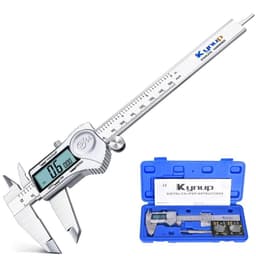
In this file the light digitals, including the Adoric at £6.99, state about ±0.2 mm and a 0.1 mm step. Heavier digitals often state about ±0.02 mm or ±0.03 mm and a 0.01 mm step. The Spurtar prints ±0.02 mm under 100 mm and ±0.03 mm from 100 to 150 mm. A £7 digital can therefore be the coarser tool even though it looks modern, and a steel vernier can print a tighter error while remaining harder to read. Resolution is still only the step. A screen that shows 0.01 mm can display a number the jaws are not holding. Finger pressure, a tilted jaw, and a beam that flexes move the reading by more than that last digit. Trade absolute encoders, such as a Mitutoyo ABS, keep an origin when the power is off. That is a different electronic design. It is not what you should assume from a budget digital in this set. Budget digitals generally need a fresh zero after a cell change, and some lose the datum when they sleep. The Kynup KY-21S reviews include that lost datum. The screen was working. The zero was not the zero you set. The reading steps are in how to read a vernier caliper.

Eyes, units, and batteries

Choose a digital if you wear glasses, if you share the tool, or if the drawing mixes millimetres and inches. The buttons switch units. You do not look for a coincident line. MQS’s buyers’ guide makes the same practical point: if you have never read a vernier, pick a digital. ACCUMEASURE’s comparison, which is a commercial page, puts eyesight, a unit switch, and shared users on the digital side, and puts a refusal to own a cell on the vernier side. That split matches this set. Choose the Spurtar if you will not depend on a battery and you can see the scale. It weighs 310 g, the bullets say carbon steel, and the listing is 4.5 from 10,189 reviews. There is no cell to flatten in a drawer. Reviewers also say you need good eyes, that a gap can remain at the closed jaws, and that the zeros do not always line up. A vernier beam is often graduated in millimetres on one edge and inches on the other. You turn the tool and read the other scale, if it is printed and if the slider is not covering it. Spurtar reviewers say the vernier can cover part of the inch scale. If your work is mixed units all day, that is a reason to prefer the digital switch, provided you check which unit is showing before you cut.

Dial, damp, and the recommendation

A dial caliper is the third column, and you will not find it in this twelve. Buy one from a trade seller if you want a mechanical needle, no battery, and an easier read than a 0.02 mm vernier. Expect to keep the rack clean. A knock that would only scuff a plain beam can leave a dial sticky. Do not import American claims about magnets and inches as if they were a UK specification. This comparison stays with the readout. Damp, oil, and coolant fall differently on each type. A steel vernier wants a wipe and a light oil so the slide does not rust, which is why some listings arrive pre-oiled. A digital wants the circuit board kept out of coolant. An IP rating, where one is printed, is there to protect the electronics. Only one listing in this set prints IP54, and waterproof without a code is not the same sentence. Buy a digital if eyesight, mixed units, or speed matter, and accept that you will replace a cell and zero again after it dies. Buy a vernier if you refuse batteries and you can read the scale in the light you actually work in. If the closed jaws will not zero, neither readout is the repair. Who each pattern suits is in best caliper.

Common questions

Is a digital caliper more accurate than a vernier?
Cutwel’s guide says a digital is not inherently more accurate than a dial or a vernier. The printed error and the stiffness of the beam decide more than the style of readout. In this file a £7 digital can state about ±0.2 mm while the Spurtar prints ±0.02 mm under 100 mm and ±0.03 mm to 150 mm. A finer-looking screen does not shrink a coarse printed error.
What does a listing that says digital vernier actually mean?
A listing that says digital vernier is almost always a digital with jaws, not a vernier scale hiding under the screen. In this article a vernier means the manual scale and a digital means the screen. Shop titles muddy the words. The mechanism in front of the jaws is the same idea in both.
When should I pick the digital?
Pick a digital if you wear glasses, if you share the tool, or if the drawing mixes millimetres and inches. The buttons switch units, so you do not look for a coincident line. If you have never read a vernier, the practical advice from a buyers’ guide is to pick a digital. Check which unit is showing before you cut.
Is the vernier the cheaper option in this set?
No. A vernier is not automatically the cheaper option here. The Adoric, the TYL, and the EVRU are all under £7, and the Spurtar is £12.99. You are paying to delete the cell, not to win a discount. There is no cell to flatten in a drawer, and you still have to read the scale.
Where does a dial caliper fit if this set has none?
Buy a dial from a trade seller if you want a mechanical needle, no battery, and an easier read than a 0.02 mm vernier. Expect to keep the rack clean. A knock that would only scuff a plain beam can leave a dial sticky. This twelve has no dial listing, so it is not ranked here.
What if the closed jaws will not zero?
If the closed jaws will not zero, neither readout is the repair. A gap after cleaning is a jaw problem. Extra force moves the jaw line and bends a light beam. Clean, then stop using the number for a size you cannot afford to scrap. A fresh cell only helps a digital whose fault is power.

Related pages

Sources

Public UK and standards sources first, then the amazon.co.uk listings for these twelve ASINs. The Mitutoyo UK shop promo of £120 including VAT for the 150 mm 500-196-30 was seen on 19 October 2026 and is not an amazon.co.uk price. Scores use the weights above. They are not a gauge-block result. No methodology file was stored beside the display data.

  1. BSI, BS EN ISO 13385-1:2019 (retrieved 19 October 2026)
  2. ISO 13385-1:2019 (retrieved 19 October 2026)
  3. Rhopoint Metrology, vernier calipers (retrieved 19 October 2026)
  4. Mitutoyo UK shop, 500-196-30 (retrieved 19 October 2026)
  5. Cutwel, digital calipers explained (retrieved 19 October 2026)
  6. Rapid Electronics, how to read vernier calipers (retrieved 19 October 2026)
  7. Accu, how to use vernier calipers (retrieved 19 October 2026)
  8. Consumer Rights Act 2015 (retrieved 19 October 2026)