Independent comparisons. We may earn from shop links. Our editors compare products independently. Some links go to shops, and we may earn a commission. More info
Top pick: Polycell multi-purpose Polyfilla, 330 g tube – Highest score: 330 g ready-mixed tube at about £3.49, 4.6 from 14,595 reviews. Hard to squeeze, skins in the tube, and no depth on the listing. Best value: Sika SikaWall – Best filler per pound among tubs with several thousand reviews: 600 g at about £4.49, 4.4 from 5,464, listed to 9 mm by 25 mm. Not water resistant, and hard when thick. Updated 22 October 2026.
A filler, for a UK decorator, is the paste or powder you press into a static crack, screw hole or shallow dent so you can sand and paint. It is not a flexible bead for a joint that moves.
You tell a suitable pack by the depth and width on the label, whether it says interior or exterior, and the surface you are filling. Fine-surface paste is for hairline cracks. Ready-mixed paste covers screw holes and modest cracks. Lightweight paste is for overhead work. Powder is mixed with water. Wood filler is separate if you may stain the timber. Those checks are in the [filler buying guide](/hub/fillers-adhesives-and-sprays/filler/sub/filler-buying-guide).
A cure you can sand, and a lid that seals, matter as much as pack size. Ready-mixed paste skins if air gets into the tub. A thick layer can set too hard to sand by hand. Open a hairline slightly, leave a damp crack until it is dry, and sand as little as you can. Gypsum dust from plaster is construction dust.
A filler, for a UK decorator, is the paste or powder you press into a static crack, screw hole or shallow dent so you can sand and paint. It is not a flexible bead for a joint that moves.
A filler, for a UK decorator, is the paste or powder you press into a static crack, screw hole or shallow dent so you can sand and paint. It is not a flexible bead for a joint that moves.
You tell a suitable pack by the depth and width on the label, whether it says interior or exterior, and the surface you are filling. Fine-surface paste is for hairline cracks. Ready-mixed paste covers screw holes and modest cracks. Lightweight paste is for overhead work. Powder is mixed with water. Wood filler is separate if you may stain the timber. Those checks are in the [filler buying guide](/hub/fillers-adhesives-and-sprays/filler/sub/filler-buying-guide).
A cure you can sand, and a lid that seals, matter as much as pack size. Ready-mixed paste skins if air gets into the tub. A thick layer can set too hard to sand by hand. Open a hairline slightly, leave a damp crack until it is dry, and sand as little as you can. Gypsum dust from plaster is construction dust.
A filler, for a UK decorator, is the paste or powder you press into a static crack, screw hole or shallow dent so you can sand and paint. It is not a flexible bead for a joint that moves. You tell a suitable pack by the depth and width on the label, whether it says interior or exterior, and the surface you are filling. Fine-surface paste is for hairline cracks. Ready-mixed paste covers screw holes and modest cracks. Lightweight paste is for overhead work. Powder is mixed with water. Wood filler is separate if you may stain the timber.
The Polycell multi-purpose Polyfilla tube, at about £3.49, is a ready-mixed white 330 g paste you squeeze onto a dry crack or screw hole. It is 4.6 from 14,595 amazon.co.uk reviews, and the first 50 texts describe small drilled holes, cracks and a finish that sands and takes paint on those small jobs. Several reviewers say it dries quickly to a solid fill, and repeat buyers treat it as the same tube they have used for years. The listing says it will not shrink or crack, which is a claim rather than a measured result, and the page does not state a maximum depth. The tube is hard to squeeze, and the paste skins or hardens inside even with the lid tight, so some people treat it as a single use. It does not always dry fully white, and one review says you should prime it or the filler shows through the paint. With that review count and the shelf price on 19 October 2026, it is the top pick in this set for a small repair, while a deep chase sits outside anything the listing specifies.
Pros
Ready-mixed 330 g tube at about £3.49
4.6 from 14,595 amazon.co.uk reviews
Reviewers use it on screw holes, cracks and drilled holes
Sands and takes paint on small jobs
Repeat buyers recognise the same paste
Cons
Hard to squeeze out of the tube
Skins or hardens in the tube after opening
Does not always dry fully white, and one review says prime first
No maximum depth on the listing
Best for: You want a small ready-mixed tube for dry screw holes and modest cracks, and you can squeeze a stiff tube.
Less suitable: You need a stated depth, a tub you will reopen for months, or a fill you will leave unprimed under a pale paint.
Yes. The listing says it is ready mixed, with a smooth creamy consistency, and that you should make sure the surface and the crack are dry before applying.
How big is the tube?
The unit count is 330 g. The shelf price in this file is about £3.49. Included components are the tube only.
Does the listing say it will not shrink?
Yes. A bullet says it will not shrink or crack. That is a listing claim. Reviews in the file also say the paste can harden inside the tube.
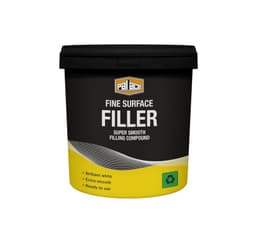
Palace fine surface filler is listed at about £1.25 as a ready-mixed white paste for shallow cracks and fine nicks, with deeper repairs in layers of no more than 3 mm. It is 4.6 from 2,247 amazon.co.uk reviews, and that same star line, model 68-4 and review text also sit on the Langlow listing B0G51LQMSN, so this is not a separate sample of 2,247. Reviewers praise the price, easy spreading and sanding on fine cracks, skirting, door gaps, walls and ceilings. Lids arrive open, split or leaking, the paste goes hard once air gets in, and some say the cure is grey rather than white. Left thick it is hard and dusty to sand, and one review says it was still shrinking after a few days. The water-resistance field says water resistant, while the use line is interior. At about £1.25 it is a cheap fine-surface tub when you stay at 3 mm a layer. It is not the best value in this set, because the review file is shared.
Pros
About £1.25 shelf price on 19 October 2026
Stated layers of no more than 3 mm
Ready mixed for interior hairline cracks and fine nicks
Reviewers spread and sand it on skirting, walls and ceilings
Paintable with most domestic oil or water-based paints once cured and sanded
Cons
The 2,247-review block is shared with the Langlow listing
Lids arrive open, split or leaking
Hard to sand, and it can shrink once a layer is thick
Not a true white for some reviewers
Best for: You are feathering hairline cracks and shallow nicks indoors, in layers of 3 mm or less.
Less suitable: You need a deep hole filled in one go, or you are treating this star rating as a sample independent of the Langlow page.
The listing says that for deeper repairs you apply layers of no more than 3 mm and let each layer dry. It is for shallow cracks and fine nicks.
Is it for outside walls?
The bullets describe interior surfaces, including plasterwork, render, skirting and timber-based structures. The water-resistance field says water resistant.
Are the 2,247 reviews only for this tub?
No. The same star line, model 68-4 and review text also appear on the Langlow pack listing B0G51LQMSN.
The Langlow title says a pack of two 600 g fine-surface tubes at about £2.50, while the brand field says Palace, the item type name says Langlow Fine Surface Filler 600 g, model 68-4, and included components say one filler. Item weight is 650 g against a 1,200 g unit count. It is 4.6 from 2,247 amazon.co.uk reviews, the same figure and the same review text as Palace B07XGMLGRX, and one review mentions £1.25, which matches the Palace shelf price. Those shared texts praise easy spreading on fine cracks and also describe split tubs, a grey cure, hard sanding and shrinkage. Pack language in the reviews is not proof this ASIN shipped two tubs. There is no 3 mm layer line on this listing, unlike the Palace page. It is a conflicting pack page that borrows another ASIN's reviews, not a second tested filler.
Pros
Shelf price about £2.50 on 19 October 2026
Title describes fine-surface filler for interior wood, plaster and masonry
Shared reviews describe easy spreading on fine cracks
Listing says little sanding and paint once cured
Cons
Same 2,247-review block as Palace B07XGMLGRX
Pack of 2 in the title, one filler in included components, weight 650 g
Brand field says Palace and the item type name says Langlow
No stated 3 mm layer limit on this page
Best for: You already understand this is the same model 68-4 review file, and you will check how many tubs arrive.
Less suitable: You want a confirmed two-pack, or a star rating that belongs only to this ASIN.
The title says pack of 2. Included components say 1 x fine surface filler. Number of pieces is 2 and item package quantity is 1. Item weight is 650 g against a 1,200 g unit count.
Which brand is on the listing?
The brand field says Palace. The item type name says Langlow Fine Surface Filler 600 g, model 68-4, made by Palace Chemicals.
Is the star rating a separate sample?
No. It is 4.6 from 2,247, the same figure and the same review text as Palace B07XGMLGRX. Reviews mention about £1.25.
This kit is listed at about £13.90 as a 396 g Polycell Polyfilla tube, a 3 inch Decex scraper and a flexible 120 grit sanding block. The brand field says Decex. The listing says it fills holes up to 10 mm, indoors and outdoors, on plaster, masonry, concrete and brickwork, and that it is surface-dry in 1 to 2 hours. It is 4.6 from 15 amazon.co.uk reviews. Six United Kingdom reviews are in the file, and they are short: useful for cracks and crevices, easy, and as described. None of those six describes a repeated defect. A 4.6 on 15 reviews is not the same evidence as the 14,595-review Polycell tube at about £3.49, and you are paying for the scraper and block as well as the paste. It is a starter kit if you do not already own a scraper, and it is not the top pick.
Pros
396 g tube plus a 3 inch scraper and a 120 grit block
Listing says holes up to 10 mm, indoors and outdoors
Surface-dry in 1 to 2 hours on the listing
The six UK reviews call it useful for small cracks
Cons
4.6 from only 15 reviews, with six short UK texts
Brand field says Decex while the tube is described as Polycell
About £13.90 against about £3.49 for the 330 g Polycell tube without tools
The written sample is too small to show a repeated defect
Best for: You want one box with paste, a scraper and a sanding block for holes the listing puts at up to 10 mm.
Less suitable: You already own a scraper, or you are choosing on a 4.6 that rests on 15 reviews.
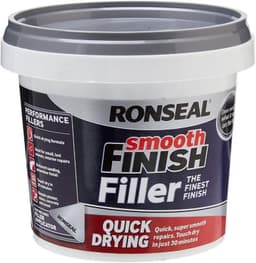
Ronseal smooth finish filler is a white 600 g tub at about £7.24, described for small last-minute interior repairs on plaster, stone, concrete and wood. It is 4.5 from 3,894 amazon.co.uk reviews. In the first 50 texts, people spread it on small gaps and holes, and some say it sands with less effort than other fillers. Reviewers mention a small plastic triangle spreader in the pot, which helps a hairline and is useless on a larger hole. The title is one 600 g tub, while the number-of-items field says 12 and the number of packs says 2. Applied thickly it shrinks a little, sets so hard that hand sanding is difficult, and does not always dry white. It is wet enough to fall off a spatula, awkward on a ceiling, and the lid can arrive broken or fail to click shut, so the paste dries in the tub within months. It suits a modest interior hole when you can ignore the conflicting piece-count fields and keep the layer thin.
Pros
4.5 from 3,894 amazon.co.uk reviews
Smooth and quick-drying on small interior gaps, in reviews
Listed for plaster, stone, concrete and wood
Some reviewers sand it with less effort than denser fillers
A small spreader is described in the pot
Cons
Piece-count fields say 12 items and 2 packs against a 600 g title
Sets very hard and shrinks a little when applied thickly
Wet and awkward on a ceiling
Lids arrive chipped or do not seal, so the paste dries out
Best for: You have a small interior crack or hole on plaster, stone, concrete or wood, and you will keep the layer thin.
Less suitable: You are filling a ceiling chase, or you need the listing to confirm one tub rather than 12 items.
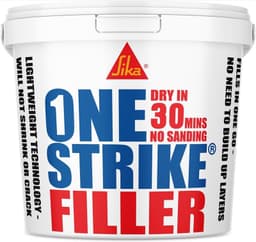
Sika One Strike is listed at about £13.20 as a white 2.5 litre tub, while the size field also says 875 g and the weight field says 900 g. It is 4.5 from 937 amazon.co.uk reviews. Reviewers describe a very light, whipped paste that spreads easily, fills chases and ceiling work without the sag they report on heavier filler, and sands more readily than a dense ready-mixed paste. One reviewer sanded after about three hours. The listing itself does not state a maximum depth, so a deep fill is a review story rather than a printed limit. The repeated complaint is that a deep hole stays finger-nail soft under a dry crust, sometimes for weeks, and sanding can roll the surface into small balls. One review says the tub was under-filled against the 2.5 litre claim, and a reviewer who read the tub says it is not for structural use. It is the lightweight option in this set when you can wait for a deep fill to go hard.
Pros
Reviewers call it light and easy to spread
Used on chases, corners and ceilings without the sag reported on heavier paste
Sands more easily than dense ready-mixed filler for many reviewers
4.5 from 937 amazon.co.uk reviews
Cons
Title says 2.5 litre, size field says 875 g, weight field says 900 g
Deep fills can stay soft under a dry skin
Sanding can roll the surface into balls
No maximum depth on the listing
Best for: You want a lightweight paste for overhead or chase work, and you will check that a deep fill has gone hard before you paint.
Less suitable: You need a hard structural fill, or you are buying on the 2.5 litre figure without checking the weight fields.
The Sika SikaWall all-purpose filler, at about £4.49, is a ready-mixed white 600 g paste the listing limits to 9 mm deep and 25 mm wide. It is 4.4 from 5,464 amazon.co.uk reviews. In the first 50 texts, people use it on plaster dents, interior masonry, wood window frames and concrete ledges, and they say a small repair dries and sands if you shape it before it cures. The bullets say interior and exterior, and they tell you to seal outdoor fixes with an oil-based paint, while the water-resistance field says not water resistant. Left thick, it sets too hard for hand sanding, and some reviewers say even an electric sander struggles. It is sticky, wet and heavy, so it sags, and it goes off quickly in the tub if the lid is not airtight. One reviewer would not use it outdoors because the dry finish looked transparent. At this price, with a stated depth and several thousand reviews, it is the best value in this set when you stay inside 9 mm and paint an outdoor patch with oil-based paint.
Pros
Stated limit of 9 mm deep and 25 mm wide
4.4 from 5,464 amazon.co.uk reviews at about £4.49
Ready mixed for plaster, masonry and small holes
Listing covers interior and exterior, with oil-based paint on outdoor fixes
Reviewers say small repairs sand if shaped before they cure
Cons
Too hard to sand if you leave it thick
Sticky, wet and heavy, so it can sag
Not water resistant, and the paste goes hard in the tub
One review found the dry finish looked transparent outdoors
Best for: You are filling a dry crack or hole within 9 mm by 25 mm, and you will shape it before it sets hard.
Less suitable: You want a lightweight paste that sands easily when thick, or a filler you can leave outdoors without oil-based paint.
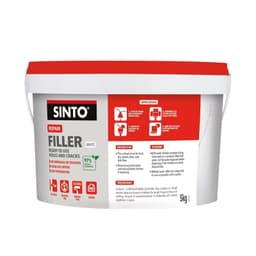
The Sinto hole and crack filler is a ready-to-use white 5 kg pail at about £16.33. A bullet says repairs up to 1 cm, zero shrinkage and no cracking, with a full cure of 12 hours. It is 4.4 from 768 amazon.co.uk reviews. Of the first 50 texts, 23 are United Kingdom reviews: they call it easy to spread and sand, and one painter used it on walls, a ceiling and woodwork. Those same UK texts also report shrink, cracks and sag, lumps that made about half a tub unusable, and a pail that arrived open and spilled. The material field says silicone and the compatible-material field says plastic, while the bullets describe a filler paste, so those lines conflict. It is a large pail for a bigger area of static cracks if you accept that the zero-shrinkage bullet is disputed in the UK reviews, and if 1 cm is enough.
Pros
5 kg ready-to-use pail at about £16.33
Bullet states repairs up to 1 cm and a 12 hour full cure
UK reviewers say it spreads, sands and takes paint
One painter used it on walls, a ceiling and woodwork
Cons
UK reviews report shrink, cracks and sag despite the zero-shrinkage bullet
Lumps, and one reviewer says about half the tub was unusable
Material field says silicone and compatible material says plastic
A pail arrived opened and spilled
Best for: You have a larger area of static cracks within the stated 1 cm, and you will add another layer if it shrinks.
Less suitable: You want a small tube, or you are buying because the bullet says zero shrinkage.
The listing says repairs up to 1 cm deep, with zero shrinkage and no cracking stated as a bullet. UK reviews in the file also report shrink, cracks and sag.
How long is the full cure on the listing?
The full cure time field says 12 hours. It is a ready-to-use paste in a pail.
What material does the listing name?
The material field says silicone and the compatible-material field says plastic. The bullets describe a hole and crack filler paste. Those lines conflict.
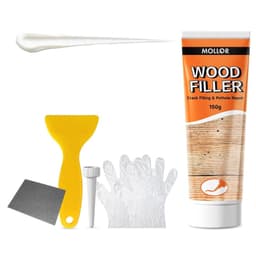
The Mollor kit is 150 g of white water-based wood putty at about £9.99, with a scraper, sandpaper and gloves listed in the bullets. The title says stainable. It is 4.3 from 211 amazon.co.uk reviews, and 16 United Kingdom texts were used from the saved listing. Those reviews say it is easy to apply and sand, and that it did the job on wood for several people. They also say it is too thin: it ran down a vertical hole and had barely set after 8 hours. It dries white, not a natural timber colour, and one review says paint did not cover it well. The listing itself warns that large areas may sink because it is water-based, and the special-features line says non-toxic, which is a listing word rather than a test. It is a small white wood-putty kit when you will paint rather than stain, and when the hole is not a deep vertical pocket.
Pros
150 g kit with scraper, sandpaper and gloves at about £9.99
Easy to apply and sand in the UK reviews that liked it
Title aimed at wooden furniture, doors and frames
Listing tells you to add another layer if a large area sinks
Cons
Runny on a vertical hole, with one fill barely set after 8 hours
White, so it does not match bare timber
One review says it does not paint over well
Included-components field also names a nozzle extender and a wall patch
Best for: You are filling a small defect in furniture or a door frame you will paint, and you can wait for a thin water-based putty to dry.
Less suitable: You want a stainable timber colour, a plaster skim, or a putty that stays in a vertical hole.
The bullets list wood putty, a scraper, sandpaper and gloves. The included-components field also names a nozzle extender and a wall repair patch.
Is it stainable?
The title says stainable. The colour is white. UK reviews say it is white rather than a natural wood colour, and one says paint did not cover it well.
Will a large fill sink?
The listing says that because it is water-based, large areas may sink after drying, and that you can apply another layer once it is dry.
How we compared
Nine amazon.co.uk filler listings were scored on a 0–100 scale. Amazon evidence is 30 points, from the star rating, with a deduction when the count is small or when two ASINs share one review block. Listing fit is 35 points. A stated depth, a clear interior or exterior line, and a pack that matches the title score higher. Contradictory brand, weight, piece-count or material lines are deducted. Review outcome is 20 points. Reviews that describe a filled crack or screw hole score higher than a file that repeats a tub that will not sand, a soft core, or a lid that arrives open. Value is 15 points, from the shelf price in GBP against a pack a review says will do a small job. The lowest price does not score when the review file is shared or the depth is only a fine-surface layer. The highest score is the top pick. The best filler per pound among tubs with several thousand reviews, after hardness and the exterior paint line are already noted, is the best value. One of each. A 4.6 on 15 reviews is not scored as the best household filler. The about £1.25 tub is not scored as best value when its review file is shared with another ASIN. A bullet that says the paste will not shrink or crack is not scored as a measured result. Prices are the amazon.co.uk shelf prices on 19 October 2026. This is not a laboratory test.
1
Amazon evidence
30%
Star rating on amazon.co.uk, then a deduction when the count is small or when two ASINs share one review block.
2
Listing fit
35%
A stated depth, a clear interior or exterior line, and a pack that matches the title score higher. Contradictory brand, weight, piece-count or material lines are deducted.
3
Review outcome
20%
Reviews that describe a filled crack or screw hole score higher than a tub that will not sand, a soft core, or a lid that arrives open.
4
Value
15%
Shelf price in GBP against a pack a review says will do a small job. The lowest price does not score when the review file is shared or the depth is a fine-surface layer.
Independent review
Last updated: 22 October 2026
8 sources checked
Filler buying guide
Match the printed depth, the interior or exterior line, and the surface to a static crack you will sand and paint. A will-not-shrink bullet is a listing claim. A shared review file is one sample.
What is filler?
A filler is the paste or powder you press into a static crack, screw hole or shallow dent so you can sand and paint. Caulk is for a gap that moves. Expanding foam fills a cavity. Powder filler is mixed with water. None of the tubs and tubes in this table is a powder. Coat depth on a powder sheet, and when a lightweight paste is the overhead choice, are set out in [ready-mixed or powder filler](/hub/fillers-adhesives-and-sprays/filler/sub/filler-ready-mixed-or-powder).
Best for
Dry screw holes and modest static cracks you will sand and paint
Hairline cracks in thin layers, or a hole inside the depth printed on the tub
Not ideal for
A hollow wall, a damp crack, or a crack that keeps opening
A moving joint, a cavity, or a gap between floorboards
Mistakes to avoid
1
Deeper than the tub allows
A fine-surface tub is the wrong buy for a deep chase. Palace limits deeper repairs to layers of no more than 3 mm. SikaWall states 9 mm deep and 25 mm wide. One Strike's listing states no depth. The 75 mm figure is on the data sheet, and some reviews describe a soft core.
2
A skin over a soft core
Painting while the core is soft, or believing a will-not-shrink bullet that reviews contradict, leaves a crack you have to fill again. Sinto's bullet says zero shrinkage. UK reviews on that pail report shrink, cracks and sag.
3
One review file, counted twice
Palace and the Langlow pack-of-2 title share one 4.6 from 2,247 block and model 68-4. That is not two samples. A loose lid skins ready-mixed paste, so the rest of the tub is lost.
What to weigh up
Depth and substrate
High
Read the depth and width on the listing before the pack size. Palace says layers of no more than 3 mm. SikaWall says up to 9 mm deep and 25 mm wide. The kit listing says holes up to 10 mm. Sinto's bullet says repairs up to 1 cm. One Strike's amazon.co.uk listing states no depth. The data sheet says up to 75 mm in one application and excludes plastic and metal. That sheet figure was not proved by the reviews, and some reviews describe a soft core.
Sanding, evidence and price
High
A cure you can sand matters as much as the tub size. UK reviews on SikaWall, Ronseal and Palace include fills that were too hard to sand once a thick layer had cured. Ready-mixed paste skins if the lid does not seal. Score the review file before the shelf price. Polycell 330 g is 4.6 from 14,595 reviews at about £3.49. The scraper kit is 4.6 from 15 reviews at about £13.90.
Which option suits you?
Three typical situations, each with a recommendation from this comparison.
🔧
Small dry repairs
You want a small ready-mixed tube for dry screw holes and modest cracks. Polycell multi-purpose Polyfilla is the top pick: 330 g at about £3.49, 4.6 from 14,595 reviews. Reviewers sand and paint small jobs. The tube is stiff, the paste skins inside, and no maximum depth is printed.
You are skimming a room of hairline cracks, rather than buying a 5 kg pail. Palace fine surface filler states layers of no more than 3 mm, at about £1.25, for interior nicks. The 4.6 from 2,247 reviews is shared with the Langlow listing, so it is not the best value in this set. Keep each layer thin.
You are filling timber you may stain. The Mollor kit is 150 g of white wood putty at about £9.99, 4.3 from 211 reviews, with a scraper, sandpaper and gloves. The title says stainable. UK reviews say it dries white and can run on a vertical hole. Test a patch. Do not fill gaps between floorboards with wall paste.
Match the depth on the label to the hole. Fine-surface filler is for hairline cracks, in thin layers. An all-purpose tub with a printed depth and width is for a modest crack inside that limit. Lightweight paste is the low-density option for chases and ceilings, and a deep fill can stay soft under a dry skin. A large pail suits a bigger area of static cracks, not one screw hole. If the plaster is hollow or the crack keeps opening, call a plasterer.
Is ready-mixed filler the same as powder?
No. Ready-mixed filler is a paste you open and press in. Powder filler is mixed with water, and it is a different product. A powder sheet from a UK maker says about 12 mm in one coat and points overhead work to a lightweight paste. None of the ranked tubs and tubes here is a powder. Ready-mixed paste also skins in the tub if the lid does not seal, so a tub you will reopen needs a lid that actually clicks shut.
Can you use filler outside?
Only when the label says interior and exterior, and only with the paint that label asks for. SikaWall says both, then says the paste is not water resistant and that outdoor fixes should be sealed with an oil-based paint. Palace is described for interior surfaces even where a field says water resistant. That field is not a wet-room rating. Leave a damp crack until it is dry. A joint that moves is caulk, not filler.
Can wall filler be used on wood?
Wall paste on plaster is not a stainable wood filler. Use a wood filler on timber, and test the stain on a cured patch. Ronseal's wood-filler page says not to fill gaps between floorboards. The Mollor kit is white water-based wood putty. The title says stainable. UK reviews say it dries white, not a timber colour, and one says paint did not cover it well. A vertical hole ran, and the listing says a large area may sink because it is water-based.
Will filler shrink or crack?
A bullet that says the paste will not shrink or crack is a listing claim, not a measured result. UK reviews on the Sinto 5 kg pail report shrink, cracks and sag even though the bullet says zero shrinkage and repairs up to 1 cm. Thick fills on other tubs set very hard or shrink a little. On One Strike, reviewers describe a dry crust over a soft centre. Paint only after the core has gone hard. If a crack keeps opening, the wall is moving or the plaster is loose.
How should you sand filler at home?
Sand as little as you can. HSE classes gypsum from plasterboard as general construction dust, and COSHH treats high dust levels as hazardous. Commercial sanding of taped plasterboard joints needs on-tool extraction, and HSE points to FFP3 where the dust level is high. At home that means a thin layer and less sanding, not a claim that filler is non-toxic. GB CLP covers labelling of hazardous mixtures. Only the Mollor listing uses the words non-toxic. Northern Ireland uses EU CLP for products placed on that market.
When should you call a plasterer?
Call a plasterer when the plaster is hollow or missing, when a crack keeps opening, when the wall is damp, or when you are not sure what is behind the hole. Filling deeper than the tub allows, or painting while the core is still soft, fails on a sound wall as well. Open a hairline slightly, keep each layer inside the stated depth, and close the lid so the paste does not skin. The General Product Safety Regulations 2005 are the GB baseline for consumer products. They do not set a hole depth.
Is filler the same as expanding foam?
No. Filler is a paste or powder for a static crack, screw hole or shallow dent you will sand and paint. The expanding foam comparison covers a cavity fill, which is a different job from a feathered skim on plaster. Caulk is for a gap that moves. Do not fill a deep chase with a fine-surface tub limited to thin layers. If you are unsure what is behind the hole, stop and get the wall checked before you fill it.
Our verdict
The top pick is the Polycell multi-purpose Polyfilla 330 g tube at about £3.49. It is 4.6 from 14,595 amazon.co.uk reviews. Reviewers use it on screw holes, cracks and drilled holes, and small jobs sand and take paint. The tube is hard to squeeze, the paste skins inside, and the listing states no maximum depth. The best value is Sika SikaWall, 600 g at about £4.49, 4.4 from 5,464 reviews, listed to 9 mm deep and 25 mm wide. The listing says interior and exterior if you seal outdoor fixes with oil-based paint. It is not water resistant, and a thick fill sets too hard to sand. The Palace tub at about £1.25 is not best value here, because its 2,247-review file is shared with the Langlow listing. A 4.6 from 15 reviews on the scraper kit is not scored as the best household filler. This is not a laboratory test.
Best overall
Polycell multi-purpose Polyfilla, 330 g tube
Highest score: 330 g ready-mixed tube at about £3.49, 4.6 from 14,595 reviews. Hard to squeeze, skins in the tube, and no depth on the listing.
Best filler per pound among tubs with several thousand reviews: 600 g at about £4.49, 4.4 from 5,464, listed to 9 mm by 25 mm. Not water resistant, and hard when thick.
Peter F. is the editor for DIY & tools at productscompared.co.uk. Comparisons in this category are checked against amazon.co.uk listings, review evidence and public UK sources.
Updated: 22 October 2026
8 sources checked
Guides to fillers
Guides on what to look for, how to use a product, and common mistakes.
This page contains affiliate links to amazon.co.uk (tag pcuk26-21). If you buy through them, we may earn a commission at no extra cost to you. Prices, stars and review counts are from the listings. This is not a laboratory test.