Independent comparisons. We may earn from shop links. More info

Ready mixed filler or powder

Updated: 23 October 2026

The paste in a chase has sunk, or it is still soft under a dry skin. Buy a ready-mixed paste for a small, static repair you will do today. Buy a powder for a larger area or a plasterboard joint, and mix only what you can use before it goes off. None of the nine listings on the [filler comparison](/hub/fillers-adhesives-and-sprays/filler) is a powder. Paste prices are GBP on 19 October 2026. This is not a lab test. A qualifying purchase through our amazon.co.uk links can earn us a commission at no extra cost to you.

The paste in a chase has sunk, or it is still soft under a dry skin. Buy a ready-mixed paste for a small, static repair you will do today.

Our top picks

On this page

What each one is

Ready-mixed filler is a paste you open and press in. You are not adding water, and each stated depth is its own number. Powder is a bag you mix with water. Polycell’s powder page says about 2 to 2½ parts powder to 1 part water, about 60 minutes, indoor use, and a fill you can drill once cured. Everbuild’s powder sheet says about 12 mm in one coat and points overhead work elsewhere. Gyproc EasiFill notes give working times of 20, 45 or 60 minutes. EasiFill 20 is not the jointing product in that note, and there is no EasiFill price here. Brewers’ guide puts powder on a large area and ready-mixed paste on small gaps. That is a shop guide, not a depth for every tub.

When ready-mixed paste is the right tub

A screw hole or a static crack you can measure is a paste job, if the lid seals what you do not use. Palace, at about £1.25, says layers of no more than 3 mm. SikaWall, at about £4.49, says up to 9 mm by 25 mm. The Decex kit, at about £13.90, says holes up to 10 mm. Sinto, at about £16.33, says up to 1 cm, and United Kingdom reviews also report shrink. The Polycell 330 g tube at about £3.49 states no depth. The brand page talks about 10 mm. Do not borrow that line for the tube. The best ready mixed filler page names the tube and the 600 g tub. Past SikaWall’s coat, another scoop is how the repair sinks.

When powder is the better exit

Powder earns its place on a larger area or a plasterboard joint you want hard enough to sand and, on the Polycell page, to drill. Mix only what you will use in about 60 minutes, or 20, 45 or 60 on the EasiFill bags. Do not add water to a skinned ready-mixed tub. A jointing powder uses tape, then a sand and a seal. A fine-surface tub is not that system. Everbuild’s sheet stops at about 12 mm in one coat. Paste steps are on how to fill cracks in walls. A tub that is in the table is the wall filler buying guide.

Lightweight paste is not powder

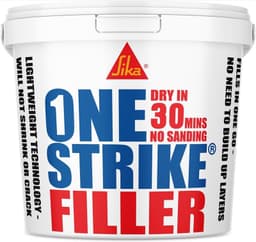
Sika One Strike, 2.5 litres at about £13.20, is a whipped paste that sags less on a ceiling. It is still a paste. The listing states no depth. The data sheet says up to 75 mm. These reviews did not prove that figure. A deep hole can stay finger-nail soft under a dry crust. One reviewer who read the tub says it is not for structural use. A small static repair today stays with a ready-mixed tub, inside the depth it prints. A joint you need to drill is a powder, bought outside this table.

Common questions

Is ready-mixed filler worse than powder?
It is worse past its own coat, and it is the better buy for a small static hole today. Everbuild’s powder sheet says about 12 mm in one coat. Palace says 3 mm layers. SikaWall says 9 mm by 25 mm. There is no single rule that every ready-mixed tub stops at a few millimetres.
When is powder the better buy?
Buy powder for a plasterboard joint, a wide patch, or a hole deeper than the ready-mixed coat you would overload. Mix only what you can place before it sets. Polycell’s powder page says about 60 minutes, indoor use, and a cured fill you can drill. No powder price sits among these nine shelf figures.
Can I keep leftover powder?
Keep the dry powder you have not mixed, in a dry bag. Once it is mixed it is on the clock, about 60 minutes on the Polycell powder page, or 20, 45 or 60 on the EasiFill bags. A bowl that has started to go off is waste. Do not stir it back into a fresh mix.
Can I keep leftover ready-mixed paste?
You can, if the lid and any membrane seal. Reviews of Polycell, Palace and Ronseal describe tubs that go hard once air gets in. A split lid will not save the rest. Do not thin a skinned tub with water and treat it as a new mix.
What do decorators use on plasterboard joints?
A jointing powder such as Gyproc EasiFill, with tape, then a sand and a seal. EasiFill 20 is not the jointing product in British Gypsum’s note. Working times are 20, 45 or 60 minutes. There is no EasiFill price here. A fine-surface tub is for a hairline, not a taped seam.
Is lightweight paste a substitute for powder on a deep hole?
Not in this set. One Strike is ready mixed, the listing states no depth, and reviews describe a soft core under a dry crust. The sheet’s 75 mm figure was not proved by those reviews. For a joint, or a fill you need to drill, use a powder.
Which page lists the tubs I can buy now?
The nine pastes, with scores and prices, are on the filler comparison. The top pick and the best value are on the best ready mixed filler page. This page adds no powder row. If the hole is inside a stated coat, buy the paste. If it is not, leave the table.

Related pages

Sources

Public UK sources used for this comparison. amazon.co.uk prices, stars and review counts were taken from the listings on 19 October 2026.

  1. Everbuild One Strike filler data sheet (retrieved 19 October 2026)
  2. Everbuild all purpose powder filler data sheet (retrieved 19 October 2026)
  3. HSE CIS36, gypsum dust (retrieved 19 October 2026)
  4. HSE, sanding taped plasterboard joints (retrieved 19 October 2026)
  5. HSE, GB CLP (retrieved 19 October 2026)
  6. General Product Safety Regulations 2005 (retrieved 19 October 2026)
  7. Ronseal multi purpose wood filler (retrieved 19 October 2026)
  8. amazon.co.uk listings for the nine ASINs in this set (retrieved 19 October 2026)