Independent comparisons. We may earn from shop links. Our editors compare products independently. Some links go to shops, and we may earn a commission. More info
Top pick: GRAIN GUARD raw linseed, 1 L Best value: Materialix boiled linseed, 1 L – Lowest listed price per litre, about £13.95 for 1 litre, with stated coverage and a drying estimate, and 4.7 from 433 reviews. Updated October 2026.
Wood oil on amazon.co.uk is a penetrating finish for bare or already oiled timber. You may be treating furniture, garden softwood, a kitchen worktop or a chopping board. The right tin depends on whether the oil must cure, touch food, or live outdoors.
Drying oils, including linseed, tung and oil, harden by oxidation. Food-grade mineral oil does not cure: it conditions a board and you have to renew it. The listing excludes exterior oak and does not claim food contact.
Look for a clear job on the label, a stated dry time, and a food-contact or exterior-oak line that matches your work. The decision between oil families, before you compare tins, is set out in the [wood oil buying guide](/hub/paints-and-varnishes/wood-oil/sub/wood-oil-buying-guide).
UK buyers use it on furniture, garden softwood, kitchen worktops and chopping boards.
Split the tin into a cure or a conditioner.
Wood oil on amazon.co.uk is a penetrating finish for bare or already oiled timber. You may be treating furniture, garden softwood, a kitchen worktop or a chopping board.
Wood oil on amazon.co.uk is a penetrating finish for bare or already oiled timber. You may be treating furniture, garden softwood, a kitchen worktop or a chopping board. The right tin depends on whether the oil must cure, touch food, or live outdoors.
Drying oils, including linseed, tung and oil, harden by oxidation. Food-grade mineral oil does not cure: it conditions a board and you have to renew it. The listing excludes exterior oak and does not claim food contact.
Look for a clear job on the label, a stated dry time, and a food-contact or exterior-oak line that matches your work. The decision between oil families, before you compare tins, is set out in the [wood oil buying guide](/hub/paints-and-varnishes/wood-oil/sub/wood-oil-buying-guide).
UK buyers use it on furniture, garden softwood, kitchen worktops and chopping boards.
Split the tin into a cure or a conditioner.
Wood oil on amazon.co.uk is a penetrating finish for bare or already oiled timber. You may be treating furniture, garden softwood, a kitchen worktop or a chopping board. The right tin depends on whether the oil must cure, touch food, or live outdoors. Drying oils, including linseed, tung and oil, harden by oxidation. Food-grade mineral oil does not cure: it conditions a board and you have to renew it. The listing excludes exterior oak and does not claim food contact. Look for a clear job on the label, a stated dry time, and a food-contact or exterior-oak line that matches your work.
GRAIN GUARD raw linseed oil is the slow, no-additive choice in this set, supplied in a 1 L bottle for interior wood, boards and worktops. The listing claims no solvents or additives and cites DIN EN 71-3 for wooden toys, while its food-safe wording does not name a food-contact regulation. Its 4.8 out of 5 score is the highest star average here but rests on only 34 amazon.co.uk reviews, so it does not outrank products with far stronger evidence on that number alone. Reviewers explicitly describe it as slower than boiled linseed, and the listing gives no hours-to-dry figure. One buyer decided against using it on a clear floor, which is useful caution rather than a formal failure test. Choose it because you deliberately want raw linseed and accept the wait, not because 4.8 appears at the top of a sort.
Pros
Raw linseed with no-solvent and no-additive claims
Full 1 L bottle
Toy-standard claim is identified
Straight oil choice for buyers avoiding added driers
Cons
Only 34 reviews
No stated drying time
Food-safe claim lacks a food-contact regulation number
Slow drying is repeated in reviews
Best for: Interior projects where a raw, no-additive linseed oil is the priority and a long drying period is acceptable.
Less suitable: Fast turnarounds, floors without a product-specific specification, or buyers judging solely by star average.
Materialix mineral oil conditions chopping boards and similar food-contact surfaces without forming the cured film expected from boiled linseed or Danish oil. It carries 4.7 out of 5 from 6,083 amazon.co.uk reviews, giving it the strongest review base among the board oils in this set. Buyers repeatedly mention no noticeable smell, richer-looking grain and economical use. The listing calls it food grade, additive-free and non-evaporating, although it does not cite a food-contact regulation number. Because mineral oil does not cure, a board will need renewing as washing and use remove the treatment. The safety line also matters: do not overheat it, and keep vapour away from flame.
Pros
Large review base for a specialist board oil
Odourless and additive-free claims
Suitable for boards, bamboo, slate and stone
A little is reported to go a long way
Cons
Does not cure into a hard film
Food-grade claim has no regulation number
Requires periodic renewal
Best for: Chopping boards, butcher blocks and wooden utensils where an odourless mineral conditioner is wanted.
Less suitable: Garden furniture, a hard-wearing cured worktop finish, or any surface exposed to high heat.
The listing sells it as food-grade mineral oil that does not evaporate. It is a conditioner for boards and similar surfaces, not a boiled-linseed cure.
What safety line is on the listing?
Never overheat the oil. The listing says the vapours are highly flammable and to keep it away from fire.
What do reviewers repeat?
No smell on chopping boards, a richer grain, and a little goes a long way. Complaints are scarce in the reviews read for this comparison.
Osmo TopOil 3058 is the specialist interior-worktop option here, sold as a clear matt, high-solid oil in a 500 ml tin. It has 4.7 out of 5 from 3,755 amazon.co.uk reviews, and users commonly apply thin coats to beech and oak worktops. The listing claims food safety and water resistance, but the extract does not name a food-contact regulation number. A pale-oak reviewer found that the supposedly clear matt finish yellowed the timber, so “clear” should not be read as colourless in use. The page also conflicts between model 3058 clear matt and a bullet for 3028 clear satin; verify the code on the tin before opening it. At £23.82 it costs more than the general linseed options, but its job is a finished interior worktop rather than the cheapest oil by litre.
Pros
Large review base for an interior worktop finish
High-solid formulation aimed at worktops and joinery
Food-safe and water-resistant listing claims
Clear matt model is specified in the title
Cons
Shade code conflicts with a clear-satin bullet
Can yellow very pale oak
Higher shelf price than general linseed oils
Best for: Interior kitchen worktops where you want a dedicated high-solid finish and can verify model 3058.
Less suitable: Outdoor timber, a colour-neutral pale-oak result, or a shopper choosing solely on price per litre.
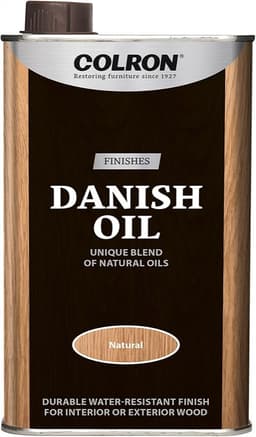
Ronseal Colron Danish oil leaves indoor or outdoor timber with a satin, low-sheen finish rather than the plainer look of a straight mineral conditioner. Its amazon.co.uk rating is 4.7 out of 5 from 2,276 reviews, a useful evidence base for a familiar furniture finish. Reviewers find that sparing coats dry well, while a flooded coat can remain sticky, so restraint and thorough wipe-off matter. The listing describes high coverage but does not provide a square-metre figure or a drying time. It also makes no food-contact claim, and the unanswered toy question is not evidence that the finish is suitable for children’s items. Choose it for the satin furniture result, not merely because “Danish oil” sounds like a single, standard recipe.
Pros
Established rating from more than 2,000 reviews
Satin, low-sheen furniture finish
Listed for interior and exterior wood
Thin coats are reported to dry well
Cons
Heavy application can stay sticky
No food-contact claim
No numerical coverage or drying time in the extract
Best for: Furniture and joinery where you want an easy-to-recognise satin Danish-oil appearance.
Less suitable: Chopping boards, toys requiring a documented claim, or anyone wanting a pure single oil.
Materialix supplies a full litre of boiled linseed oil for £13.95, with listed coverage of roughly 12–15 m² per litre. The amazon.co.uk line is 4.7 out of 5 from 433 reviews, and buyers repeatedly like the way it brings out grain on garden timber. Its listing gives about 18 hours to dry and 5–10 days to harden, so this is a finish you plan around rather than use just before the furniture is needed. It is the best-value pick here because its price per litre is lower than the other priced tins, not because it has the largest review base. The seller also claims testing under Regulation (EC) No 1935/2004 for food-contact uses, but that remains a listing claim rather than our own certification. A hard-to-open, awkward-pouring tin and a noticeable fresh-oil smell are the practical complaints to allow for.
Pros
Lowest listed price per litre in this comparison
Useful 1 L size for fences, sheds and garden furniture
Coverage and drying estimates are stated
Food-contact regulation claim is identified on the listing
Cons
Tin can be difficult to open and pour
Fresh oil smell is noticeable
Full hardening is listed as taking 5–10 days
Best for: Larger indoor or outdoor projects where low cost per litre matters and you can leave the finish to harden.
Less suitable: A quick same-day job, or buyers who need independently verified food-contact documentation rather than a seller claim.
GRAIN GUARD provides 500 ml of UK-made mineral oil for boards, worktops, bamboo, stone and stainless steel. Its 4.7 out of 5 rating is based on 80 amazon.co.uk reviews, so the positive line is encouraging but much less settled than Materialix mineral oil’s larger sample. The listing describes the liquid as colourless, odourless and tasteless and correctly presents it without a curing time. One reviewer’s practical method is to leave it for 20–30 minutes and wipe away the excess, but that is user experience rather than a universal label instruction. Another buyer reported different colours on apparently similar pine tops, which makes an offcut or hidden-area test sensible. It is a larger board-oil bottle, not a curing exterior furniture finish.
Pros
500 ml size for several boards
Made in the United Kingdom
Colourless, odourless and tasteless claims
No misleading cure-time promise
Cons
Only 80 reviews
No square-metre coverage figure
One report of uneven colour between similar pine tops
Best for: Several boards or kitchen items where you want a larger bottle of UK-made mineral oil.
Less suitable: A cured worktop film, exterior furniture, or anyone wanting evidence from thousands of reviews.
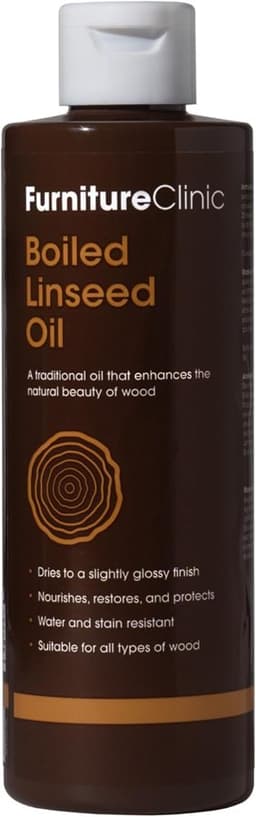
Furniture Clinic boiled linseed oil gives indoor and suitable outdoor timber a slightly glossy oil finish, with the 250 ml bottle listed to cover 50 square feet. Its 4.6 out of 5 rating comes from 9,272 amazon.co.uk reviews, the largest review base in this comparison, which makes it the most established all-round furniture option here. The treatment is intended for wood as well as porous stone and terracotta, but the listing expressly excludes exterior oak. There is no food-contact claim, so this is not the tin to choose for a chopping board simply because it is the top pick. The product wording also shifts between boiled linseed oil and linseed-oil varnish, so check the current label before matching it to an older finish. Reviewers flag the self-heating cloth warning as easy to miss on the back of the bottle; used cloths need safe handling rather than being left crumpled in a bin.
Pros
Largest amazon.co.uk review base in this comparison
Listed for interior and suitable exterior wood
Also usable on porous stone and terracotta
Compact bottle for a small furniture project
Cons
Explicitly excluded for exterior oak
No food-contact claim
Product wording conflicts between oil and varnish
Best for: Small indoor furniture and non-oak exterior jobs where you want an established boiled-linseed option with a light sheen.
Less suitable: Exterior oak, chopping boards, or anyone who needs an unambiguous additive and food-contact declaration.
No. The listing says it suits all woods except exterior oak. It also names interior and exterior wood, terracotta, concrete and stone.
Does the listing say it is food-safe?
It does not. One reviewer said they would not use it on food-contact or frequently handled wood because of metallic driers. That is one review, not a test.
What do reviewers say about the fire warning?
Reviews say a self-combustion warning is on the back of the bottle and is easy to miss. The feature bullets do not repeat that warning.
Bartoline boiled linseed oil is a £7.65, 500 ml option aimed primarily at softwood garden furniture, doors and interior timber. The listing gives two or three coats with 24 hours between them, which is more useful than a generic “quick drying” promise. Its 4.6 out of 5 score comes from 484 amazon.co.uk reviews. The formula uses drying additives and names white spirit for tool cleaning, so it is not interchangeable with a no-additive raw oil. Hardwood suitability is unclear in the bullets, while a reviewer says the bottle excludes oak; that uncertainty is a reason to choose another labelled product for exterior oak. Cap problems, cloudy-looking oil and dried residue around the closure also appear in reviews, and the cloth fire warning must be followed.
Pros
Low shelf price for 500 ml
Clear two-to-three-coat instruction
24-hour recoat interval is stated
Purpose is clear for softwood garden furniture
Cons
Hardwood and oak suitability is unclear
Reports of difficult caps and old-looking contents
No food-contact claim
Best for: Softwood garden furniture or interior timber where a budget boiled linseed oil is appropriate.
Less suitable: Exterior oak, chopping boards, or buyers seeking a solvent- and additive-free oil.
Brandon Bespoke offers 500 ml of oil described as pure tung for a matt finish on furniture, worktops, boards, slate and stone. It has 4.6 out of 5 from 394 amazon.co.uk reviews, and the listing makes a food-safe claim without naming a regulation or test. Pure tung oil can suit someone deliberately choosing that oil family, but this particular page is too inconsistent to plan a large job from confidently. It prints both about 15 m² and 160 m² for coverage, and it mixes a matt description with a gloss phrase. Reviews also mention oil creeping past the cap, colour that was too light for a stair, and a smell that persisted for weeks in a camper. Buy for the claimed pure formulation and test on an offcut, not for the contradictory coverage figure.
Pros
Pure tung-oil claim
Matt finish listed for wood and stone
Indoor and outdoor uses are named
Food-safe claim includes chopping boards
Cons
Coverage figures conflict sharply
Matt and gloss wording conflicts
Reports of cap leakage and a persistent smell
Best for: A small tung-oil project where you can test colour and calculate quantity without relying on the listing’s coverage.
Less suitable: A measured floor or large-area job, or buyers who require a named food-contact standard.
Lazzaro is a £7.99, 250 ml mineral oil sold for chopping boards, butcher blocks, spoons and bamboo. The directions are practical: apply it to clean, dry wood, leave the excess overnight, buff, and repeat until water beads. However, the amazon.co.uk listing contains no star rating, review count or written reviews, so there is no customer evidence to score alongside the other products. The bullets call the oil colourless, odourless and tasteless, while the product field says brown. Its food-grade wording also comes without a named regulation number. The low shelf price may suit a small board, but verify the liquid and label on arrival rather than treating the unreviewed listing as a proven bargain.
Pros
Low shelf price
Clear overnight application directions
Sold specifically for boards, blocks and utensils
Colourless, odourless and tasteless bullet claims
Cons
No rating or review evidence in the extract
Colour field conflicts with the bullets
No named food-contact regulation
Best for: A small board-oiling job where you can inspect the product on arrival and follow the label.
Less suitable: Anyone wanting review-backed performance or an unambiguous colour specification.
No. The listing has no customer-review line and no review texts, so the rating is not available.
How does the listing say to apply it?
Clean dry wood, apply liberally, leave excess overnight, buff, and repeat until water beads.
Which colour should you trust on the page?
The colour field says brown. The bullets say colourless, odourless and tasteless. Both are printed.
How we compared
We compared 10 wood-oil listings on amazon.co.uk. Shelf prices, stars and review counts are the UK lines in the mid-October 2026 extracts. Each score is an editorial figure from 0 to 100 using the weights below. It is not a laboratory test, and it is not the star rating multiplied by 20. A seller’s food-safe line is not treated as our own certification. Awards apply only inside this set. The right oil still depends on the job.
1
Review confidence
35%
Up to 35 points from star sentiment, review count, and whether recurring comments support the listing. A missing amazon.co.uk rating receives no review-confidence credit. A very small sample is marked down.
2
Job fit and evidence
25%
Up to 25 points for how clearly the oil type, suitable surfaces, finish and important exclusions are stated. Conflicting shade, finish, coverage or colour fields reduce the score.
3
Value
20%
Up to 20 points from shelf price, pack size and usable coverage information where the listing provides it. A missing coverage figure cannot score as if a number were printed.
4
Practical ownership
20%
Up to 20 points for application clarity, drying information, packaging and repeated complaints. Missing food-contact evidence matters when the tin is promoted for boards or worktops.
Independent review
Last updated: October 2026
8 sources checked
Wood oil buying guide
Wood oil on these ten amazon.co.uk listings is not one product. Boiled linseed, raw linseed, Danish oil, tung oil, a high-solid worktop oil and food-grade mineral oil sit on the same shelf and do different jobs. Read the job, whether the oil cures, and any food-contact or exterior-oak line before you read the stars. Prices below are the mid-October 2026 extracts. Nothing here is a laboratory ranking, and a bullet that says waterproof is not an outdoor season test.
What is wood oil?
Wood oil is a penetrating finish for bare or already oiled timber. UK buyers use it on furniture, garden softwood, kitchen worktops and chopping boards. Quality shows up as a clear job on the label, an honest dry time, and a food-contact or exterior-oak line that matches the work, not as a star rating alone.
Split the tin into a cure or a conditioner. Linseed, tung, Danish oil and an Osmo-type high-solid oil are drying oils: they harden by oxidation. Food-grade mineral oil does not cure.
Best for
Indoor furniture where you want boiled linseed or a satin Danish oil and you will wipe off the excess
Chopping boards where a food-grade mineral oil is named and you will re-oil after washing
Not ideal for
Exterior oak when the label excludes it, including the Furniture Clinic listing
A clear floor, failed worktop joints, or any job where old paint may contain lead
Mistakes to avoid
1
Leaving a flooded coat
Excess oil can stay sticky. Ronseal reviewers say thin coats dry and a heavy coat does not. Wipe off what the timber does not take. One dry time does not fit every brand: Materialix prints about 18 hours, Bartoline prints 24 hours between coats, and raw linseed reviews only say it is slower.
2
Oiling exterior oak against the label
Furniture Clinic’s listing excludes exterior oak. Bartoline is aimed at softwood garden furniture, and a UK reviewer found a “not for oak” line on that bottle. If the label excludes the species, choose another tin. A missing exclusion is not proof that the oil suits oak.
3
Binning a screwed-up drying-oil cloth
Linseed oxidises, and piled cloths can ignite. Wash them in warm soapy water and do not crumple them, as Bartoline’s safety data sheet states. A finished table in the open air is a different case. Mineral oil’s printed warning here is flammable vapour if you overheat it, not the same rag warning unless that tin says so.
What to weigh up
Job, cure and food contact
High
Start with the surface. Indoor furniture, a chopping board, an interior worktop and softwood garden furniture are four jobs, and the star rating does not pick across them. Furniture Clinic boiled linseed is the top pick for small furniture because 9,272 reviews support a known oil with a stated oak limit. It is the wrong tin for a board. Materialix mineral oil, with 6,083 reviews, is the board conditioner with the stronger review base.
Species, sheen, cloths and price
High
Outdoors, read the species line before the word exterior. Furniture Clinic excludes exterior oak and also names stone and terracotta. Bartoline names softwood garden furniture, doors and interior wood, with two or three coats and 24 hours between them, and white spirit for tools. Materialix boiled linseed names garden furniture, fences, sheds and decking, at about 12–15 m² per litre. Do not turn a waterproof bullet into a season of weather protection. No listing here is an EN 927 result.
Which option suits you?
Three typical situations, each with a recommendation from this comparison.
🪑
Indoor furniture
You want a soft sheen on furniture and you will wipe off the excess. Furniture Clinic boiled linseed, 250 ml, is about £9.99, with 4.6 from 9,272 reviews. It excludes exterior oak and does not claim food contact, so it is not the board tin.
You want an odourless conditioner and you will re-oil the board. Materialix mineral oil, 250 ml, is about £8.95, with 4.7 from 6,083 reviews. It does not cure, and the food-grade line has no regulation number.
You can wait for a cure and you want the lowest listed price per litre. Materialix boiled linseed, 1 litre, is about £13.95, with 4.7 from 433 reviews. The listing says about 18 hours to dry and 5–10 days to harden. Its 1935/2004 line is the seller’s claim.
The top pick is Furniture Clinic boiled linseed, 250 ml, at about £9.99. Amazon.co.uk shows 4.6 from 9,272 reviews, the largest review base in this set. The listing covers interior and suitable exterior wood, and it expressly excludes exterior oak. There is no food-contact claim, so do not buy it for a chopping board on the strength of the score. Used cloths can self-heat. The score is an editorial ranking of these listings, not a laboratory test.
How much does wood oil cost on amazon.co.uk?
In the mid-October 2026 extracts, these shelf prices run from about £7.65 to £23.82. Under about £10: Bartoline 500 ml at about £7.65, Lazzaro 250 ml at about £7.99, Materialix mineral oil 250 ml at about £8.95, and Furniture Clinic 250 ml at about £9.99. Around £14 buys 500 ml to 1 litre of a general oil. The lowest listed price per litre is Materialix boiled linseed at about £13.95. Osmo TopOil 500 ml is about £23.82. Treat that spread as a rule of thumb, not a live price.
Is boiled linseed or Danish oil food-safe?
Only if that tin says so. Retained Regulation (EC) No 1935/2004 is enforced in England by the Materials and Articles in Contact with Food Regulations 2012 (SI 2012/2619). Materialix boiled linseed claims a test to that regulation. That remains the seller’s claim. Furniture Clinic, Ronseal Colron and Bartoline do not claim food contact in these extracts. Mineral oils here say food grade without a regulation number. Do not treat every boiled linseed or Danish oil as food-safe.
What is the difference between mineral oil and a drying oil?
A drying oil, such as linseed, tung, Danish oil or a high-solid oil such as Osmo TopOil, hardens by oxidation if you want a finish that sets. Food-grade mineral oil does not cure. Materialix, GRAIN GUARD and Lazzaro mineral oils condition boards and need renewing as washing removes them. Do not treat mineral-oil cloths as linseed cloths unless that tin says so. The mineral-oil hazard printed here is flammable vapour if you overheat the oil.
Can oily cloths catch fire?
Drying oils oxidise. East Sussex Fire and Rescue Service explains that piled oily rags can ignite, while a finished table in the open air does not. Northamptonshire Fire and Rescue Service recorded a 2020 domestic smoulder from folded linseed cloths. Bartoline’s safety data sheet says wash cloths in warm soapy water, never crumple them, and that cotton raises the risk. Call the fire service if cloths are already smoking. This page did not run a burn test.
Can I use these oils on exterior oak?
Furniture Clinic’s listing suits woods except exterior oak. Bartoline is aimed at softwood garden furniture. A UK reviewer found a “not for oak” line on that bottle, while the bullets leave hardwood unclear, so treat oak as unconfirmed on that tin. Materialix boiled linseed does not print an oak exclusion. That is not a guarantee that the oil suits exterior oak. If the label excludes the timber, do not use it there.
How does Danish oil differ from linseed in this set?
Danish oil is a blend, often oil plus solvent and varnish, and recipes differ. Ronseal Colron is a satin finish for interior and exterior wood, at about £13.80, with 4.7 from 2,276 reviews, and it does not claim to be food-safe. Thin coats are reported to dry; a flooded coat can stay sticky. The Ronseal trade data sheet describes three coats and about 6 hours, which this amazon.co.uk extract does not repeat. Boiled linseed is a different oil, and any food-safe claim is tin by tin. Raw linseed is slower.
When should I leave this job, or choose wax instead?
Leave excess and the surface can stay sticky. One dry time does not fit every brand. Oiling exterior oak against the label, and treating every Danish oil as food-safe, are common mistakes. Call a professional if old paint may contain lead, if a clear floor is the job, or if a worktop has failed joints or mould. If you want wax rather than a penetrating oil, the wood wax comparison is a separate set. Wax is not the same finish as an oil that soaks in.
Our verdict
The top pick is Furniture Clinic boiled linseed, 250 ml, at about £9.99. It has the highest editorial score in this set, led by 4.6 from 9,272 reviews, and the listing states a clear exterior-oak exclusion. It is not a chopping-board oil. The best value is Materialix boiled linseed, 1 litre, at about £13.95, the lowest listed price per litre here, with coverage and drying figures on the listing. Choose mineral oil when the job is a board that you will re-oil, and skip any tin whose label excludes your timber.
Peter F. is the editor for DIY & tools at productscompared.co.uk. Comparisons in this category are checked against amazon.co.uk listings, review evidence and public UK sources.
Updated: October 2026
8 sources checked
Guides to wood oils
Guides on what to look for, how to use a product, and common mistakes.
Public UK sources used for the food-contact, VOC and cloth-safety points on this page. Prices, stars and review counts are from the amazon.co.uk listings in the mid-October 2026 extracts.
This page contains affiliate links to amazon.co.uk with the tag pcuk26-21. If you buy through them, we may earn a commission at no extra cost to you. Prices, stars and review counts are the amazon.co.uk listing lines in the mid-October 2026 extracts. We did not run a laboratory test.