Independent comparisons. We may earn from shop links. More info

How to apply wood oil without a sticky finish

Updated: October 2026

You have sanded the table, opened the tin and now need to know how to apply wood oil without finding a tacky surface the next morning. The shared principle is simple: prepare bare or previously oiled wood, give it enough oil to absorb, then remove everything still sitting on top. Timings, coat counts and thinners are product-specific, so the current label always overrides a general method. Before you begin, compare the oil families in our [wood oil comparison](/hub/paints-and-varnishes/wood-oil), then plan where every wet cloth will go.

You have sanded the table, opened the tin and now need to know how to apply wood oil without finding a tacky surface the next morning.

Our top picks

On this page

Start with bare, dry wood

Oil needs access to the fibres. A sound varnish, lacquer or paint film blocks absorption, so rubbing oil over it normally creates an uneven greasy layer rather than renewing the wood. If you cannot identify an old finish, test a discreet patch before stripping an entire door or worktop. The timber should be clean and dry. Sand in the grain to the finish level specified by the oil maker and remove dust from pores and joints. Use white spirit for a final dust wipe only where the product instructions permit it, and let the solvent evaporate fully before oiling. Test an offcut or hidden area with the actual tin. “Clear” oil can deepen grain, warm pine and yellow very pale oak. If you have not chosen a formula, the wood oil buying guide maps boards, furniture, worktops and garden timber to the appropriate family.

Apply, wait and wipe until it looks dry

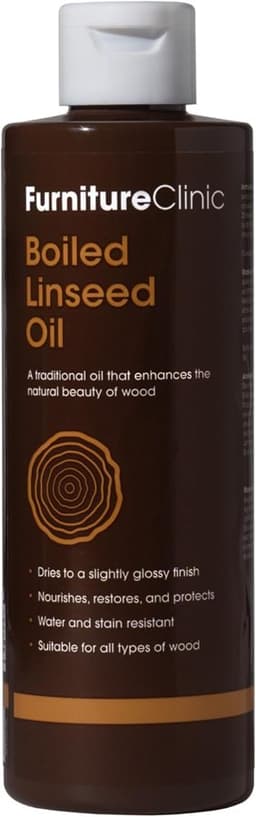
Stir the product if the label tells you to, rather than shaking a finish that may trap bubbles. Apply with the specified brush, lint-free cloth or pad, working along the grain. The aim is even wetting, not a deep puddle. Allow the oil to penetrate for the time on the tin. Liberon’s boiled-linseed guidance uses about 20 minutes as one product example. Do not turn that number into a rule for Danish oil, tung oil, high-solid worktop oil or mineral oil. Then wipe away all excess until the wood looks dry rather than wet from a surface pool. Furniture Clinic specifically advises this wipe-dry approach and notes that the first coat can bleed back from the pores. Do not add another coat to cure a sticky one. Liberon advises white spirit for lifting a wet sticky film from its boiled-linseed treatment, but that remedy is product-specific.

The clock is on your tin

There is no honest universal answer to “how long between coats?” Ronseal Trade Danish oil specifies three coats and six hours for its product. Liberon gives at least five hours for its Danish oil, while another Danish-oil technical sheet uses 16 hours. Bartoline boiled linseed calls for two or three coats at 24-hour intervals. Raw linseed can take several days under some maker instructions. Dry and fully hardened are also different states. Materialix boiled linseed lists about 18 hours to dry but 5–10 days to harden. A fan or heater is not permission to shorten a stated cure. Mineral board oil does not cure into a hard film. For a food-contact surface, use the method in our chopping board oil guide rather than borrowing a boiled-linseed schedule.

Cloths, white spirit and the sink

Drying-oil cloths can self-heat as the oil oxidises. East Sussex Fire and Rescue Service warns that a pile of linseed-oil rags can retain that heat until it ignites. The danger is the crumpled cloth, not a properly finished table. Do not leave cloths bunched together, in an apron pocket or in a household bin. Some manufacturers direct you to lay cloths flat outdoors to dry, or to place them in a sealed non-combustible container. If a cloth is already smoking or unusually hot, move away, call 999 and follow fire-service instructions. Never pour leftover oil or solvent into a sink or drain. Once the surface is sound, our Danish oil versus linseed oil comparison can help choose the finishing family.

Common questions

Do I wipe wood oil off or leave a wet coat?
For the drying oils covered here, wipe off everything the timber has not absorbed at the time stated on the label. Continue until the face looks dry, then check for bleed-back from pores. Leaving a wet surface coat is a common cause of tackiness unless your exact product instructs otherwise.
How long should I wait between coats?
Use the current tin. Product examples range from about five or six hours for some Danish oils to 24 hours for Bartoline boiled linseed, while raw linseed can take days. Temperature, airflow and timber absorption matter, but they do not justify applying before the maker’s recoat stage.
What if the oil is still sticky tomorrow?
Do not add more oil. Remove any obvious excess with clean cloths and consult the product instructions. Some makers permit white spirit to lift a still-wet sticky film, but test first because that advice is not universal. Cold conditions or an incompatible old finish may also be responsible.
Can I oil over varnish?
Not as a normal oil treatment. Varnish forms a film that prevents oil reaching the fibres, producing poor or patchy absorption. Remove the film safely or maintain it with a compatible varnish product. If the old coating is unknown or may contain lead, seek professional advice before sanding.
Should I use a brush or a cloth?
Use the applicator named by the manufacturer. A brush reaches mouldings and joints, while a lint-free cloth or pad gives control on a flat face. Both can apply too much. Whichever tool you choose, spread a thin even coat and complete the required wipe-off.
Should the first coat be thinned?
Only if the exact instructions say so. Liberon permits a particular thinning method for one boiled-linseed product, but that does not apply automatically to Ronseal Danish oil, tung oil or high-solid worktop finishes. Adding an unapproved solvent can change drying, sheen and safety.

Related pages

Sources

Public UK sources used for the food-contact, VOC and cloth-safety points on this page. Prices, stars and review counts are from the amazon.co.uk listings in the mid-October 2026 extracts.

  1. SI 2012/1715 — VOC in paints, varnishes and vehicle refinishing products (retrieved 17 October 2026)
  2. GOV.UK — Food contact materials regulations (retrieved 17 October 2026)
  3. SI 2012/2619 — Materials and Articles in Contact with Food (England) Regulations 2012 (retrieved 17 October 2026)
  4. East Sussex Fire and Rescue Service — The fire hazards of linseed oil (retrieved 17 October 2026)
  5. Northamptonshire Fire and Rescue Service — Oil-cloth combustion warning, 2020 (retrieved 17 October 2026)
  6. Bartoline boiled linseed oil safety data sheet (retrieved 17 October 2026)
  7. Furniture Clinic — Tung oil vs Danish oil (retrieved 17 October 2026)
  8. Ronseal Trade Danish Oil technical data sheet (retrieved 17 October 2026)