Independent comparisons. We may earn from shop links. More info

Best wood oil UK: a practical buying guide

Updated: October 2026

You may be oiling a chopping board, a pale-oak worktop, a dining table or a softwood bench, yet all four tins can appear in the same shop category. The best wood oil UK choice therefore starts with the job, not the highest star rating. Mineral oil, Danish oil and boiled linseed oil can all score 4.7 on amazon.co.uk while producing different finishes and requiring different upkeep. Use our [wood oil comparison](/hub/paints-and-varnishes/wood-oil) to check the current products and prices after you have chosen the right family. This guide narrows that decision by surface, finish and practical limits.

You may be oiling a chopping board, a pale-oak worktop, a dining table or a softwood bench, yet all four tins can appear in the same shop category.

Our top picks

On this page

Start with the job, not the star rating

A star score tells you whether buyers liked a particular product; it does not tell you whether that product belongs on your timber. In this comparison, Materialix mineral oil and Ronseal Colron Danish oil both have a 4.7 rating, but the first conditions chopping boards without curing and the second creates a satin furniture finish. Define the surface before looking at price. A board that is washed daily needs a product sold for food contact and easy renewal. A softwood garden bench needs an exterior-labelled treatment, and exterior oak deserves a separate check because several boiled-linseed products exclude it. Danish oil is a recipe rather than one fixed substance. If the labels seem interchangeable, the Danish oil versus linseed oil guide explains why they are not.

Four UK jobs and the family that fits

For a chopping board, butcher block or wooden spoon, food-grade mineral oil is the straightforward starting point. Our chopping board oil guide covers food-contact claims and renewal in detail. For an interior kitchen worktop, Osmo TopOil 3058 is the high-solid option in this set, but its “clear” finish can still warm or yellow very pale oak. For indoor furniture, Danish oil is the satin option, boiled linseed is slightly glossy, and pure tung oil is matt. For a softwood picnic bench, shed door or garden chair, an exterior-labelled boiled linseed oil can be economical. Bartoline specifically names softwood garden furniture and calls for two or three coats with 24 hours between them.

Food contact and exterior oak change the answer

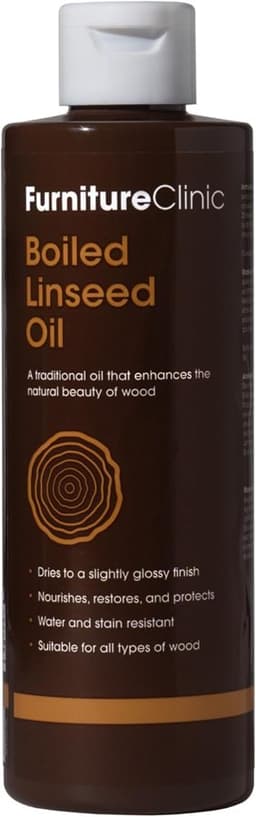
“Natural” and “food safe” are not synonyms. Materialix boiled linseed cites Regulation (EC) No 1935/2004 on its listing; other products merely say food safe or food grade without naming a standard. These are seller or manufacturer claims, not certifications performed by Products Compared. Food-contact materials sold in Great Britain sit within a legal framework that includes retained Regulation (EC) No 1935/2004 and the relevant UK regulations. Northern Ireland has its own implementing rules. Ronseal Colron Danish oil in this comparison has no food-contact line. Exterior oak is the other important exception. Furniture Clinic expressly excludes exterior oak, explaining that porous oak can remain wet and develop mould. If your project is an oak gate or bench, use a product whose current label specifically allows that timber and exposure.

What to check on the tin

First check the finish in ordinary words: matt, satin, sheen or glossy. “Clear” describes the absence of pigment, not a promise that pale timber will keep exactly the same colour. A hidden-area test is particularly useful on pale oak and pine. Next check the full clock: time before wiping, time between coats and time before normal use. Bartoline lists 24 hours between coats, Materialix lists about 18 hours to dry and 5–10 days to harden. The current tin wins whenever a general guide gives a different number. Drying-oil cloths can self-heat when left screwed up together, so follow the maker’s disposal directions and never drop a wet rag into an ordinary pile. The wood-oil application guide explains wipe-off, sticky surfaces and cloth handling. A £13.95 litre is better value than a £9.99 250 ml bottle only if it suits the timber, finish and food-contact requirement.

Common questions

Danish oil or boiled linseed for a dining table?
Choose Danish oil when you want a satin blended finish and the exact tin suits the table’s use. Choose boiled linseed for a more traditional oil appearance and a product-specific drying schedule. If food will routinely contact the bare surface, neither name is enough: require an explicit claim on that tin.
What should I buy if the board touches food?
A food-grade mineral oil sold specifically for chopping boards is the simplest renewable option in this set. It does not cure, so reapplication is expected. A drying oil can be considered only where the exact product makes a suitable food-contact claim and you can follow its complete curing instructions.
Can I use boiled linseed oil on outdoor oak?
Not by default. Furniture Clinic excludes exterior oak, and another listing in this set has an oak exclusion reported from the bottle. Select a treatment whose current technical sheet explicitly covers exterior oak; a broad “indoor and outdoor wood” phrase is not enough when the manufacturer lists an exception.
Is a higher star rating the better oil?
No. A 4.8 average from 34 reviews is less settled than a 4.6 average from 9,272, and neither number establishes job fit. Compare review volume, repeated complaints, suitable surfaces, finish and label evidence before using stars as a tie-breaker.
Raw or boiled linseed if I can wait?
Raw linseed suits buyers deliberately avoiding added driers and accepting a slow set. Boiled linseed is processed to dry faster, although formulas and timings vary. “Boiled” does not establish food safety, so still check the exact label for your surface.
Do I need teak oil for a softwood picnic bench?
Not necessarily. Bartoline lists its boiled linseed oil for softwood garden furniture, making that a plausible family for the job. Teak oil may be recommended for particular hardwoods, but timber, exposure and the maker’s current label matter more than the product name alone.

Related pages

Sources

Public UK sources used for the food-contact, VOC and cloth-safety points on this page. Prices, stars and review counts are from the amazon.co.uk listings in the mid-October 2026 extracts.

  1. SI 2012/1715 — VOC in paints, varnishes and vehicle refinishing products (retrieved 17 October 2026)
  2. GOV.UK — Food contact materials regulations (retrieved 17 October 2026)
  3. SI 2012/2619 — Materials and Articles in Contact with Food (England) Regulations 2012 (retrieved 17 October 2026)
  4. East Sussex Fire and Rescue Service — The fire hazards of linseed oil (retrieved 17 October 2026)
  5. Northamptonshire Fire and Rescue Service — Oil-cloth combustion warning, 2020 (retrieved 17 October 2026)
  6. Bartoline boiled linseed oil safety data sheet (retrieved 17 October 2026)
  7. Furniture Clinic — Tung oil vs Danish oil (retrieved 17 October 2026)
  8. Ronseal Trade Danish Oil technical data sheet (retrieved 17 October 2026)