Independent comparisons. We may earn from shop links. More info

Dust extractor comparison 2026

The best dust extractors, compared.

Top pick: Bosch GAS12-25LS Best value: Vacmaster Power 30 PTO – About £87.99 with 4.4 from 1,801 reviews, 240 V stated and a printed 1,490 W take-off, and no dust class. Updated October 2026.

Peter F.
Peter F.Editor

A dust extractor pulls dust through a hose into a drum and a filter. Many add a socket so a corded tool starts the vacuum with the trigger. In a UK workshop you separate the serious machines by the dust class on the label, the supply voltage, and whether that socket is printed. HSE points wood dust and most construction dust at an M or H class unit with a low-flow indicator. An unit is for lower-toxicity dusts such as gypsum. The, the 171182 and the 30 state no class. It will not run from a 13 A house socket. What to check on class, volts and the socket is in the [dust extractor buying guide](/hub/workshop/dust-extractor/sub/dust-extractor-buying-guide).

A dust extractor pulls dust through a hose into a drum and a filter. Many add a socket so a corded tool starts the vacuum with the trigger.

Bosch GAS12-25LS

Best overall

Bosch GAS12-25LS
3.7/10∼ £193

24 products checked · 58 hrs invested · +19,200 readers

7 of 7: Best dust extractors compared

Swipe for more

1-2 of 7
Best overall
Bosch GAS12-25LS
KATSU 171182
Evolution R15VAC
Best value
Vacmaster Power 30 PTO
Trend T32
Trend T35A
Trend T33AL 110 V
3.7/10
3.0/10
6.2/10
7.4/10
8.2/10
7.5/10
5.9/10
∼ £193
∼ £87
∼ £78
∼ £88
∼ £115
∼ £334
∼ £227
5.0(4)
5.0(4)
4.6(759)
4.4(1,801)
4.1(142)
4.0(55)
3.3(11)
View offer
View offer
View offer
View offer
View offer
View offer
View offer

Personal buying guide

Question 1 of 2

What are you trying to control?

The best dust extractors in detail

Bosch GAS12-25LS

Rank 1

Bosch GAS12-25LS

∼£193

Our view

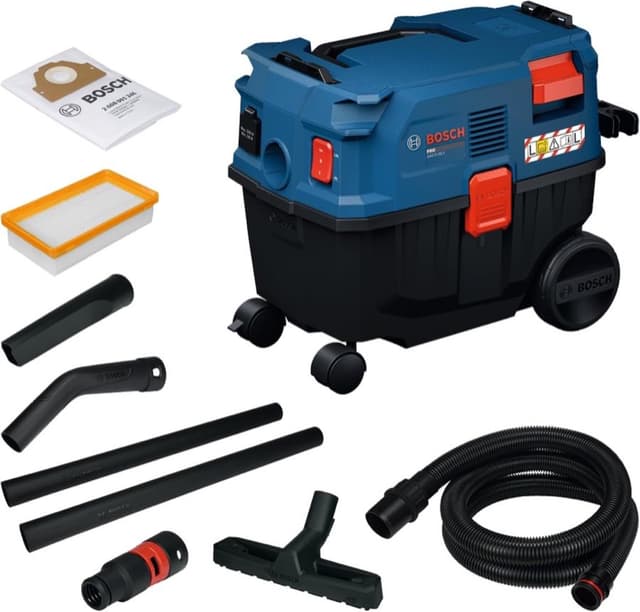
The Bosch GAS12-25LS is a 1,200 W L-class wet and dry extractor listed at £192.98, with a 3.1 m hose and a flat-pleated filter. A UK review says you clear fine dust with the push-button, and the bullets claim that button restores over 90% of suction. The same bullets say IPX4 wet and dry use, though one of the three UK reviews had only used the machine dry. A review from 7 September 2026 describes a power take-off that starts the extractor when you pull the tool trigger. The socket wattage, the drum volume and the supply voltage are not stated. At 5.0 from 4 reviews the sample is too small to show how the filter behaves after a season of sanding. HSE treats L-class as the band for lower-toxicity dusts such as gypsum, so this is the wrong label when the job is hardwood or MDF.

Pros

  • L-class label, 1,200 W, and a stated push-button filter clean
  • 3.1 m hose plus floor, crevice and a universal adapter in the box
  • A UK review describes an auto socket that starts with the tool
  • IPX4 wet and dry use is claimed on the listing

Cons

  • Only 4 amazon.co.uk reviews, and one of them is dry use only
  • Voltage, drum volume and socket wattage are not stated
  • L-class, so not the M-class label HSE points at for wood dust

Best for: You want a compact L-class canister for gypsum and similar lower-toxicity dust, and you can live with a four-review sample.

Less suitable: Hardwood, MDF or site dust, or you need a stated socket wattage before you plug a saw in.

Specifications

Model
Bosch GAS12-25LS
Brand
Bosch
Price
∼£193
Customer rating
5.0/5(4)
Dust class
L-class
Power
1200 W
Take-off
Auto socket
Hose
3.1 m
Filter clean
Button
Wet pickup
Claimed

Common questions

Is the Bosch GAS12-25LS wet and dry?

The bullets say it is suitable for wet and dry use and quote IPX4. The listing questions are unanswered. One of the three UK reviews says the machine had only been used dry so far.

Does the GAS12-25LS clean its own filter?

The bullets describe an SFC system that restores over 90% of suction at the press of a button. A UK review also mentions push-button filter cleaning when fine dust slows the airflow.

Can you plug a tool into the GAS12-25LS?

The bullets say it connects directly to power tools. A UK review from 7 September 2026 describes a power take-off socket that starts the extractor when the tool trigger is pulled. The socket wattage limit is not stated.

KATSU 171182

Rank 2

KATSU 171182

∼£87

Our view

The KATSU 171182 is a 1,200 W workshop collector at £86.99, with a 55 litre drum, a 2 m hose and five adapters from 31 mm to 85 mm. The bullets claim a HEPA filter down to 0.5 microns. They do not state L, M or H, and they do not state a power take-off, a supply voltage or an airflow figure. The four UK reviews are short. Three praise dust pickup and value, one says the jubilee clips slipped and had to be replaced, and one calls it a bit noisy. A 5.0 from four reviews is not evidence you can set beside 1,801 ratings on the Vacmaster. The large drum holds more than the Trend T32’s 20 litres. It does not tell you what leaves the exhaust.

Pros

  • 55 litre drum at about £86.99
  • Five hose adapters, from 31 mm to 85 mm
  • HEPA claim to 0.5 microns, as a filter line only
  • Three of four short reviews praise pickup and price

Cons

  • No dust class and no power take-off stated
  • Only four short reviews
  • Jubilee clips slipped in one review
  • Voltage and airflow are not stated

Best for: You want a large drum and several port sizes for chips, and you will not treat the HEPA line as an M-class label.

Less suitable: Wood-dust control that needs a stated class, or a socket that starts the collector with the tool.

Specifications

Model
KATSU 171182
Brand
KATSU
Price
∼£87
Customer rating
5.0/5(4)
Dust class
Not stated
Power
1200 W
Container
55 litres
Hose
2 m

Common questions

What suction does the KATSU 171182 list?

The listing question is unanswered. The bullets claim a 1200 W motor for workshop dust, wood chips and fine particles. No airflow or vacuum figure is given.

Which tools do the adapters fit?

The bullets list a five-piece set at 31 mm, 35 mm, 39 mm, 63 mm and 85 mm for saws, sanders and planers. There is no power take-off on the listing.

What do the four UK reviews say?

They are short. Three praise dust pickup and value. One says the jubilee clips slipped and had to be replaced, and one calls it a bit noisy. That is the whole review set.

Evolution R15VAC

Rank 3

Evolution R15VAC

∼£78

Our view

The Evolution R15VAC is a 1,000 W wet and dry workshop vac at £78.00, with 4.6 from 759 reviews, a 1.8 m hose and a tool socket that reviewers put near 1,700 W. Many of the first 50 UK reviews use it on saws, and several say it still misses dust from a mitre saw and that the filter clogs on fine sanding dust unless a bag is added. The hose, described as about 32 mm outside, often needs a separate adaptor for Evolution and DeWalt ports. The listing states no dust class. The voltage field says 15 V on a corded 1,000 W page, and the capacity is given as 15, 8 and 9 litres in different places, so those cells are not a spec you can buy against. It is the cheapest machine here, and it is not an M-class extractor.

Pros

  • About £78.00 with 4.6 from 759 reviews
  • Wet and dry, with a cartridge, a foam filter and a take-off reviewers cite around 1,700 W
  • Widely used on saws in the UK review sample
  • The bullets say it starts when the tool starts

Cons

  • No L, M or H class on the listing
  • The hose often needs an adaptor, and fine dust clogs the filter
  • The voltage field says 15 V and the drum litres conflict
  • Saws at 1,800 W, 2,000 W and 2,700 W were too much for the socket in reviews

Best for: Chips, spills and a corded tool under about 1,700 W, if you accept that no dust class is stated.

Less suitable: Hardwood or MDF as the dust you are trying to control, or a saw above the take-off reviewers describe.

Specifications

Model
Evolution R15VAC
Brand
Evolution
Price
∼£78
Customer rating
4.6/5(759)
Dust class
Not stated
Supply
15 V listed
Power
1000 W
Take-off
About 1700 W
Container
15, 8, 9 l
Hose
1.8 m
Wet pickup
Yes
Noise
80 dB

Common questions

Will the Evolution R15VAC pick up sawdust?

The title calls it a dust extractor for sawdust, and many of the first 50 UK reviews use it on saws. Several also say it does not catch all the dust from a mitre saw, and that the filter clogs on fine sanding dust unless a bag is added.

Does the hose fit Evolution saws?

Reviews repeatedly say the 1.8 m hose, described as about 32 mm outside, does not fit Evolution mitre and table saws or many DeWalt ports without a separate adaptor or tape. One reviewer says an included adaptor did fit their planer, router and mitre saw.

What is the power take-off limit?

The bullets say the vac starts with the tool. They do not state a wattage. Reviews put the pass-through at about 1700 W, which excluded 1800 W, 2000 W and 2700 W saws. The voltage field on the listing says 15 V.

Vacmaster Power 30 PTO

Rank 4

Vacmaster Power 30 PTO

∼£88

Our view

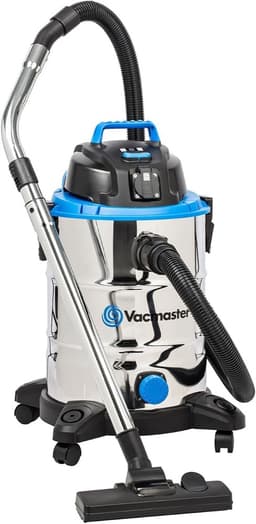
The Vacmaster Power 30 PTO is a 240 V, 1,500 W wet and dry cleaner at £87.99, with a 30 litre steel tank, a 2.5 m hose of 35 mm and a listed 1,490 W power take-off. The star line is 4.4 from 1,801 reviews, the largest sample in this set. In the first 50 UK reviews people describe glass, rubble, gravel, leaves and sawdust. One review says the floor head rolls over debris, one says the hose is too narrow, and one says the tool switch worked once and then failed. Noise is listed at 87 dB, louder than the 80 dB on the Trend rows. There is no dust class. A drainage plug lets you empty liquid without tipping the tank, which is a workshop convenience and not a wood-dust control.

Pros

  • About £87.99, 240 V stated, and 4.4 from 1,801 reviews
  • 1,490 W power take-off printed on the listing
  • 30 litre tank, a blower and a liquid drain plug
  • UK reviews cover rubble, leaves and sawdust as well as household mess

Cons

  • No L, M or H class
  • 87 dB, louder than the 80 dB Trend rows
  • The hose is called too narrow, and the floor head can roll over debris
  • One review lost the tool-socket switch after a single use

Best for: A 240 V shed or garage that wants a widely reviewed wet-and-dry vac with a stated socket limit around 1,490 W.

Less suitable: Fine wood dust where HSE is describing an M or H class machine.

Specifications

Model
Vacmaster Power 30 PTO
Brand
Vacmaster
Price
∼£88
Customer rating
4.4/5(1,801)
Dust class
Not stated
Supply
240 V
Power
1500 W
Take-off
1490 W
Container
30 litres
Hose
2.5 m
Wet pickup
Yes
Noise
87 dB

Common questions

Can the Vacmaster Power 30 pick up large debris?

The bullets say wet or dry mess in a workshop or at home. In the first 50 UK reviews people describe glass, rubble, gravel, leaves and sawdust. One review says the floor head rolls over debris, and one says the hose is too narrow.

Does it include a tool socket?

Yes. The bullets say you attach a 240 V tool so the cleaner runs while you sand or drill. A special-features line lists a 1490 W power take-off. One review says that switch worked once and then failed.

How do you empty liquid?

The bullets describe a drainage plug so you do not lift the tank to tip water out. Dry dust can be bagged or bagless. A runtime field of 30 minutes sits on a corded listing and is not explained.

Trend T32

Rank 5

Trend T32

∼£115

Our view

The Trend T32 is an 800 W, 240 V M-class extractor at £114.95, with a 20 litre drum, a 3 m hose, a filter-clean button and an airflow LED. It is the cheapest M-class row in this set, and 4.1 from 142 reviews is the largest sample among the classed machines. Those reviews praise suction for a home workshop. Across 38 written reviews they also describe flimsy clips and hose, suction that drops as the bag fills, expensive bags, and a motor that stopped after about three years of light use. The listing does not state a power take-off, so a corded saw will not start this unit unless you switch it yourself. The weight field says 1 kg beside dimensions of 49 x 49 x 39 cm, which does not describe a 20 litre canister. Wet pickup is not stated.

Pros

  • M-class on 240 V at about £114.95, with an airflow LED and a clean button
  • 4.1 from 142 reviews, the widest classed sample here
  • 3 m hose and a dust spout adaptor in the box
  • Home-workshop suction is the main praise in the UK reviews

Cons

  • No power take-off is stated
  • Clips, hose and bags draw repeated complaints
  • A motor failed after about three years of light use in one review
  • The 1 kg weight field is not credible next to the drum size

Best for: A house or shed on a 13 A socket where wood dust needs an M-class label and you will switch the extractor yourself.

Less suitable: You need the vacuum to start from the tool trigger, or you want a large drum and a long hose in one box.

Specifications

Model
Trend T32
Brand
Trend
Price
∼£115
Customer rating
4.1/5(142)
Dust class
M-class
Supply
240 V
Power
800 W
Take-off
Not stated
Container
20 litres
Hose
3 m
Filter clean
Button
Airflow warning
LED
Noise
80 dB

Common questions

Does the Trend T32 have a power take-off?

The bullets say it is for power tool applications, and a dust spout adaptor is in the box. They do not name an auto-start socket. Cable length is also not stated, though reviews call the lead a useful length.

How large is the T32?

The listing says a 20 litre container, an 800 W motor, a 3 m hose and 240 V. The weight field says 1 kg, which is the figure on the page, next to dimensions of 49 x 49 x 39 cm.

What do UK reviews say fails on the T32?

Across 38 reviews, repeated points are flimsy clips and hose, suction that drops as the bag fills, expensive bags, and a motor that stopped after about three years of light use. Suction for a home workshop is the main praise.

Trend T35A

Rank 6

Trend T35A

∼£334

Our view

The Trend T35A is the 1,400 W, 240 V M-class extractor in this set, listed at £334.48 with a 27 litre drum, an auto-start socket and a 7 m hose on the amazon.co.uk page. Across 4.0 from 55 reviews, UK comments cover the class and the reach, and they also complain about bags, the listed 80 dB, and switches. One review says the take-off suited routers up to 2.2 kW, while Trend’s own page lists 2,300 W and a 5 m hose at a different price. Use the Amazon hose and the Amazon price for this ASIN. Wet and dry is claimed, but none of the 17 UK reviews in the file describes a wet job in detail. The included-components line only names the extractor, so the HEPA cartridge and micro-filter bag stay bullet claims.

Pros

  • M-class, 240 V, 1,400 W, auto-start and an airflow LED
  • 27 litres and a 7 m hose on the Amazon listing
  • Automatic filter vibration is claimed
  • A review cites routers up to 2.2 kW on the socket

Cons

  • About £334.48 is the dearest row here, with bag, noise and switch complaints
  • Amazon’s 7 m hose clashes with the 5 m hose on Trend’s own page
  • Wet pickup is claimed and barely described in the UK reviews
  • A separate tool list in the box is not stated

Best for: A 240 V workshop that wants the fullest M-class spec in this folder, including auto-start, and can budget about £334.48.

Less suitable: You want the cheapest M-class label, or you will treat Trend’s website hose as the Amazon specification.

Specifications

Model
Trend T35A
Brand
Trend
Price
∼£334
Customer rating
4.0/5(55)
Dust class
M-class
Supply
240 V
Power
1400 W
Take-off
Auto-start
Container
27 litres
Hose
7 m
Filter clean
Vibration
Airflow warning
LED
Wet pickup
Claimed
Noise
80 dB

Common questions

Which tools does the Trend T35A name?

The bullets name routers and sanders, plus workshop, garage and jobsite cleaning. One UK review says the power take-off suited routers up to 2.2 kW. That limit is not in the specification table.

Does the T35A include a filter?

The listing questions are unanswered. The bullets describe a HEPA cartridge and a reinforced micro-filter bag. The included-components line only says the 240 V 1400 W class M extractor.

Can the T35A pick up liquid?

The bullets say wet and dry extraction. None of the 17 UK reviews in the raw file describes a wet job in detail. Reviews do complain about bags, noise and switches.

Trend T33AL 110 V

Rank 7

Trend T33AL 110 V

∼£227

Our view

The Trend T33AL is an 800 W M-class wet and dry extractor listed at £226.95 for 110 V, with a 5 m hose, a 25 litre dry drum and 17 litres wet. It will not run from a 230 V BS 1363 socket. You already need a 110 V site supply. Six of the UK reviews focus on the front wheels, which break off on site, including on a month-old machine, and one company reports the same fault on three units. The switch failed in two reviews. Suction is praised when the unit is not moved much. The star line is 3.3 from 11 reviews, so the wheel pattern is visible and the sample is still small. The title names a power take-off, and the bullets claim an auto-stop when the liquid capacity is reached.

Pros

  • M-class on 110 V, the only site-voltage row in this set
  • 5 m hose, a power-tool adaptor, and a stated wet auto-stop
  • Airflow LED and a filter-clean button
  • Suction is praised when the extractor stays put

Cons

  • Front wheels break in the UK reviews, including on a month-old unit
  • The switch failed in two reviews
  • 3.3 from only 11 reviews
  • It will not run from a house 13 A socket

Best for: A site that already has a 110 V supply and will not roll this extractor across rough ground every day.

Less suitable: A garage on 230 V, or any job where the wheels have to survive being dragged around site.

Specifications

Model
Trend T33AL 110 V
Brand
Trend
Price
∼£227
Customer rating
3.3/5(11)
Dust class
M-class
Supply
110 V
Power
800 W
Take-off
Named
Container
25 dry / 17 wet
Hose
5 m
Filter clean
Button
Airflow warning
LED
Wet pickup
Yes

Common questions

Will the Trend T33AL run from a UK wall socket?

The listing says 110 V. It will not run from a 230 V BS 1363 socket unless you already have a 110 V site supply. The listing does not name the plug type.

Does the T33AL pick up water?

The bullets say wet and dry pickup, with an auto-stop when the liquid capacity is reached. Dry capacity is given as 25 litres and wet capacity as 17 litres.

What breaks on the T33AL in UK reviews?

Six reviews focus on the front wheels. They break off on site, including on a month-old machine, and one company reports the same fault on three units. The switch also failed in two reviews. Suction is praised when the unit is not moved much.

How we compared

Shelf prices are the figures already stored for these seven amazon.co.uk listings, not a live re-check and not a laboratory test. A star row is amazon.co.uk’s figure. Dust class, voltage, wattage, hose length and filtration percentages are the seller’s claim unless a UK review contradicts them. A HEPA line without L, M or H is not a dust class. The highest score is the top pick. Best value is the strongest price-for-evidence row that is not the same model.

1

Amazon evidence

25%

Star rating on amazon.co.uk, then the size of the sample. 4.4 from 1,801 is stronger evidence than 5.0 from 4. Under 10 reviews the sample block is capped, because four perfect scores cannot outrank a season of comments.

2

Spec fit

35%

A stated L, M or H class, a clear supply voltage, a power take-off printed on the listing, an airflow warning, a stated filter-clean method, a single hose length and a single container figure. A missing class, a voltage field that says 15 V on a corded page, and two or three drum sizes on one listing lose points. This is not an airflow measurement.

3

Review outcome

25%

UK comments that describe a real job score higher when the sample is large enough to read. Broken wheels, torn bags, a socket that dies, a hose that needs tape, and a motor that stops are deductions. One or two reviews cannot fill this block.

4

Value

15%

Shelf price in GBP against a stated job, only when the listing is readable and the review pool is not tiny. The about £78 row does not take this block while its voltage and capacity cells contradict themselves. The highest total is not also the value award.

Independent review
Last updated: October 2026
8 sources checked

Dust extractor buying guide

Buy the dust class, the voltage and the socket limit before the drum size. A dust extractor only does the job on the label. HEPA without L, M or H is not that label. House sockets are about 230 V, often printed as 240 V. The 110 V Trend will not run from a 13 A plug. A tool socket matters only when a corded tool is meant to start the vacuum, and only inside the wattage that is actually printed or described. Under about £100 in this set, no listing states a dust class.

What is a dust extractor?

A dust extractor, for a UK workshop, is a portable machine that pulls dust through a hose into a drum and a filter. Many add a socket so a corded tool starts the vacuum. You tell the serious machines apart by the dust class on the label, the supply voltage, and whether that socket exists. The word HEPA on its own is not a dust class. HSE points wood dust and most construction dust at an M or H class unit with a low-flow indicator. An L-class unit is for lower-toxicity dusts such as gypsum.

Best for

  • Home woodworkers on a 240 V socket who want an M-class label
  • A shed that wants a widely reviewed wet-and-dry vac and will state that no class is printed

Not ideal for

  • A 13 A house socket if the only machine you are looking at is the 110 V Trend T33AL
  • Hardwood or MDF if the listing does not state M or H, including a HEPA line with no class

Mistakes to avoid

  1. 1

    Buying 110 V for a house socket

    The Trend T33AL is 110 V. It will not run from a 230 V BS 1363 socket. HSE describes 110 V centre-tapped supplies for sites, so the voltage to earth does not exceed 55 V. A garage on a 13 A plug needs a 240 V machine.

  2. 2

    Reading HEPA as M-class

    A HEPA line without L, M or H is not the class. The KATSU claims 0.5 microns and states no class. The Evolution and the Vacmaster state no class. HSE reserves L-class, the Bosch row, for lower-toxicity dusts such as gypsum.

  3. 3

    Tape, a full bag, or four reviews

    HSE says use an adaptor, not tape. Reviews on the Evolution and the T32 say suction dies before the drum is full. Do not put a saw above the take-off that is printed or described. A 5.0 from four reviews is not the same evidence as 4.4 from 1,801.

What to weigh up

Dust class

High

The first check is the class printed for the dust you make. HSE points wood dust and most construction dust at an M or H class unit with a low-flow indicator, and treats L-class as the band for lower-toxicity dusts such as gypsum. A HEPA line without L, M or H is not that class. HSE CIS69 says a HEPA filter in a general vacuum is not enough. In this set the Trend T32, T35A and T33AL say M-class. The T32 and the T35A also list an airflow LED.

Supply, socket and hose

High

House and most workshops are about 230 V, often printed as 240 V. The Trend T32, the T35A and the Vacmaster say 240 V. The T33AL says 110 V and will not run from a 13 A socket. HSE says site tools should be cordless or 110 V centre-tapped to earth so the voltage to earth does not exceed 55 V. The Evolution listing’s voltage field says 15 V on a corded page, so that cell is not a supply you can buy against.

Which option suits you?

Three typical situations, each with a recommendation from this comparison.

Home woodwork on 240 V

You work from a house or shed socket and the dust is wood. The Trend T32 is the top pick: M-class, 240 V, 800 W, 20 litres, about £114.95, with 4.1 from 142 reviews. No power take-off is stated, so you switch the extractor yourself. Clips, bags and one motor failure after light use are the limits.

Our recommendation

View offer

Wet and dry with a socket

You want a cheap 240 V vac with a printed tool socket, and you will say in the same breath that no dust class is stated. The Vacmaster Power 30 PTO is best value at about £87.99, with 4.4 from 1,801 reviews and a listed 1,490 W take-off. It is not the machine HSE describes for hardwood.

A site that already has 110 V

You already have a 110 V supply. The Trend T33AL is the only site-voltage row here, M-class at about £226.95, with 3.3 from 11 reviews. It will not run from a 13 A socket. UK reviews centre on front wheels that break, including on a month-old machine.

Our recommendation

View offer

Common questions about dust extractors

Which dust extractor is the top pick in 2026?
The top pick is the Trend T32 at about £114.95. It scores 82. The listing says M-class, 240 V, 800 W, a 20 litre drum, a 3 m hose, a filter-clean button and an airflow LED. On amazon.co.uk it shows 4.1 from 142 reviews, the largest sample among the classed machines here. No power take-off is stated, so a saw will not start it. UK reviews also describe flimsy clips, bags, and a motor that stopped after about three years of light use.
How much does a dust extractor cost on amazon.co.uk?
The seven amazon.co.uk rows kept here run from about £78.00 to about £334.48. The Evolution is about £78.00, the KATSU about £86.99 and the Vacmaster about £87.99, and none states a dust class. The Trend T32, the first M-class label in the set, is about £114.95. The Bosch L-class is about £192.98 and the 110 V Trend T33AL is about £226.95. The Trend T35A is about £334.48 on Amazon, with a 7 m hose. Trend’s own page showed a different price and a 5 m hose. Use the Amazon row. These are stored shelf prices, not a live check.
What should you check before you buy a dust extractor?
Check the dust class before the word HEPA. Wood dust and most construction dust sit with an M or H class unit and a low-flow indicator, on HSE guidance. L-class is the band HSE describes for dusts such as gypsum. Then check the voltage. A 240 V machine suits a house socket. The Trend T33AL is 110 V and needs a site supply. If a corded tool must start the vacuum, read the take-off limit. Vacmaster prints 1,490 W. The T32 does not state a socket. Use an adaptor on the hose, not tape.
Is a HEPA filter the same as M-class?
No. A HEPA line without L, M or H is not a dust class. HSE CIS69 says a HEPA filter in a general vacuum is not enough for the dusts that need M or H. The KATSU 171182 claims a HEPA filter to 0.5 microns and states no class. The Evolution and the Vacmaster state no class either. Bosch Professional GB summarises the standard as L above 99%, M above 99.9% with an alarm, and H above 99.995%. Read the class on the label. The choice between a classed extractor and an unclassed vac is set out in M-class or shop vac.
Will the Trend T33AL run from a UK wall socket?
No. The listing says 110 V. It will not run from a 230 V BS 1363 socket unless you already have a 110 V site supply. HSE says site tools should be cordless or 110 V centre-tapped to earth so the voltage to earth does not exceed 55 V. Do not buy this machine for a house 13 A socket. UK reviews centre on broken front wheels, including a month-old unit, and on switches. Suction is praised when the extractor is not moved much. The star line is 3.3 from 11 reviews.
Do you still need a mask when sanding?
Sanding can still need one. HSE says clean wood dust with at least a class M vacuum, and do not sweep or blow it. Sanding can still need respiratory protection at assigned protection factor 20, such as FFP3. An extractor on this page does not remove that. Hardwood dust is limited to 3 mg/m³ and softwood dust to 5 mg/m³ over 8 hours. A mixture uses 3 mg/m³ for all the wood dust. None of these listings is for asbestos.
When should you call someone else?
Call a competent person for an employer’s 14-month LEV examination under COSHH regulation 9. A hobbyist is not that employer. Call an electrician if you are creating a 110 V site supply. Call a licensed contractor for asbestos. Call a doctor for chest or skin symptoms. Do not send those jobs to a product page. A missing dust class is a buying limit. It is not a reason to treat the Evolution, the KATSU or the Vacmaster as M-class.
Is a portable canister the same as a Holzmann extractor?
No. The seven machines here are portable canisters with a hose, a drum and a filter, and some have a tool socket. A Holzmann dust extractor is a different comparison. If you want that range rather than these amazon.co.uk canisters, use the Holzmann dust extractor page. A Holzmann name on another page is not an M-class label for the Evolution, KATSU or Vacmaster rows here.

Our verdict

The top pick is the Trend T32 at about £114.95. It scores 82, the highest here: M-class, 240 V, 800 W, a 20 litre drum, a 3 m hose, a filter-clean button and an airflow LED, with 4.1 from 142 reviews. No take-off is stated. Clips, bags, and a motor that stopped after about three years of light use are the deductions. Best value is the Vacmaster Power 30 PTO at about £87.99. It is the strongest price-for-evidence row that is not the T32: 240 V stated, a printed 1,490 W take-off, and 4.4 from 1,801 reviews. It has no dust class. The Evolution at about £78.00 does not take the value award, because its voltage field says 15 V and its drum litres conflict.

Best overall
Bosch GAS12-25LS

Bosch GAS12-25LS

View offer
Best value
Vacmaster Power 30 PTO

Vacmaster Power 30 PTO

About £87.99 with 4.4 from 1,801 reviews, 240 V stated and a printed 1,490 W take-off, and no dust class.

View offer

Editorial

Peter F. - Editor
Editor
DIY & toolsWorkshop toolsamazon.co.uk listings

Peter F. is the editor for DIY & tools at productscompared.co.uk. Comparisons in this category are checked against amazon.co.uk listings, review evidence and public UK sources.

Updated: October 2026
8 sources checked

Guides to dust extractors

Guides on what to look for, how to use a product, and common mistakes.

Related comparisons

Sources

Public UK sources and the amazon.co.uk listings compared on this page. Updated October 2026.

  1. HSE: Wood dust (retrieved October 2026)
  2. HSE: CIS69 Controlling construction dust with on-tool extraction (retrieved October 2026)
  3. HSE: Cutting and sanding wood (retrieved October 2026)
  4. HSE: WD7 Wood dust (retrieved October 2026)
  5. COSHH regulation 9 (retrieved October 2026)
  6. HSE: Electrical systems in buildings (retrieved October 2026)
  7. Bosch Professional GB: Dust extractors (retrieved October 2026)
  8. Trend UK: T35A 1400 W M-class dust extractor (retrieved October 2026)

This page contains affiliate links. If you buy through them, we may earn a commission at no extra cost to you. Prices, stars and review counts are the amazon.co.uk figures already stored for this set. This is not a laboratory test.