Independent comparisons. We may earn from shop links. More info

Dust extractor buying guide

Updated: 2026-10-21

You are in a shed with a 13 A socket, or on a site with a yellow 110 V lead, and the amazon.co.uk page calls several different machines a dust extractor. Some print M-class, one prints L-class, and three print neither. This dust extractor buying guide puts the class, the supply and the power take-off ahead of the star row, because those three decide the shortlist before the brand does. Prices and stars below are the amazon.co.uk figures stored for this comparison. The Products Compared editorial team did not lab-test these machines. A qualifying purchase can earn us a commission at no extra cost to you. The shelf table sits on the [dust extractor comparison](/hub/workshop/dust-extractor).

You are in a shed with a 13 A socket, or on a site with a yellow 110 V lead, and the amazon.co.uk page calls several different machines a dust extractor. Some print M-class, one prints L-class, and three print neither.

Our top picks

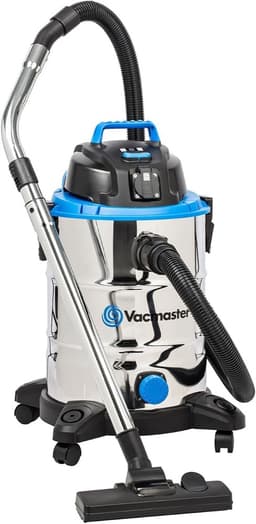
Vacmaster Vacmaster Power 30 PTO

Best overall

Vacmaster Vacmaster Power 30 PTO
7.4/10about £87.99
Trend Trend T32

Rank 2

Trend Trend T32
8.2/10about £114.95
Trend Trend T33AL 110 V

Alternative

Trend Trend T33AL 110 V
5.9/10about £226.95
On this page

What the dust class is asking you to check

Dust class is a label on the whole machine, not a slogan on the filter. HSE's CIS69 tells you to choose an M or H class unit, with a low-flow indicator, for wood dust and for most construction dust. It reserves L-class for lower-toxicity dusts such as gypsum. In this set only the Trend T32, the T35A and the 110 V T33AL print M-class. The Bosch GAS12-25LS is L-class. The Evolution, the KATSU and the Vacmaster state no class. Exposure limits and masks are on the wood dust extractor page.

230 V at home, 110 V on a site

A normal UK workshop socket is about 230 V, often printed as 240 V, with a BS 1363 plug. HSE's guidance on electrical systems in buildings says site tools should be cordless or 110 V centre-tapped to earth, so the voltage to earth does not exceed 55 V. It is not a reason to buy one for a house. The T33AL is the only 110 V ASIN in this folder. Plug it into a 13 A wall socket and it will not run. The T32 and the T35A both say 240 V. The Evolution voltage field says 15 V on a corded page. Treat that cell as a listing error, not as a battery vac.
Vacmaster Vacmaster Power 30 PTO

Testsieger

Vacmaster Vacmaster Power 30 PTO
7.4/10about £87.99

Socket, hose and drum

You want a power take-off only if a corded tool should start the vacuum. The Vacmaster prints 1,490 W. Evolution reviews put the pass-through near 1,700 W, which excluded saws at 1,800 W, 2,000 W and 2,700 W. The T32 listing does not state a socket, so you switch that extractor yourself. HSE says use an adaptor, not tape. The T35A Amazon row says 7 m. Trend's own page the same comparison used a 5 m hose and a higher price. A bigger drum is not automatically the better buy. How that split feels in use is on the M class dust extractor or shop vac page.

What to ignore until those three are settled

A perfect score on four reviews is not the same evidence as the Vacmaster's 1,801. The T32's 4.1 from 142 is the largest sample among the machines that print M-class. On the KATSU, HEPA sits alone. Under about £100 none of the Evolution, the KATSU or the Vacmaster states a class. The first M-class price here is the T32 at about £114.95. Settle class, then volts, then whether the socket wattage covers your saw. Who should leave each machine is on the best dust extractor page.

Common questions

What class do I need for wood dust?
For wood dust, HSE CIS69 and the woodworking cleanup pages describe an M or H class vacuum, not an L-class unit and not a HEPA line on its own. In this comparison the Trend T32, T35A and T33AL state M-class. The Bosch GAS12-25LS states L-class. The Evolution, KATSU and Vacmaster state no class. Class is the first filter. It does not by itself prove the air in your shed meets a limit.
Is L-class the same as M-class with less power?
No. Bosch Professional GB describes L as above 99% and M as above 99.9% with an alarm. HSE keeps L-class for lower-toxicity dusts such as gypsum. The Bosch here is 1,200 W, which is more power than the 800 W Trend T32, and it is still L-class at about £192.98. Watts do not promote a machine into the next class.
Will a 110 V extractor run from a house socket?
The Trend T33AL is listed as 110 V. It will not run from a 230 V BS 1363 socket. HSE expects 110 V centre-tapped supplies on sites, not in a domestic ring as a substitute plug. If you do not already have that supply, leave this ASIN off a shed shortlist. Creating a site supply is an electrician's job.
Does every workshop vacuum have a power take-off?
No. The Vacmaster prints 1,490 W. The T35A listing says auto-start. Evolution reviews describe a socket near 1,700 W that is not in the specification table. The T32 and the KATSU do not state a socket. A Bosch review describes one, without a wattage. If your saw must start the vacuum, confirm the limit before you rely on the word extractor.
Is a bigger drum always the better buy?
The KATSU's 55 litres will hold more debris than the T32's 20 litres, at about £86.99 against about £114.95. It does not state a dust class, a voltage or a take-off. Reviews on the T32 and the Evolution say suction falls while the drum still looks empty, because the filter or the bag is the limit. Buy litres after class and hose fit, not before.
Why do some listings say HEPA and no class?
A HEPA claim is a filter description. Dust class is a rating of the machine, including how it warns you when airflow drops. HSE says a HEPA filter in a general vacuum is not enough for the dusts it points at M or H. The KATSU's 0.5 micron line is that kind of claim. The Trend M-class rows are the ones that print the class as well.

Related pages

Sources

Public UK sources and the amazon.co.uk listings compared on this page. Updated October 2026.

  1. HSE: Wood dust (retrieved October 2026)
  2. HSE: CIS69 Controlling construction dust with on-tool extraction (retrieved October 2026)
  3. HSE: Cutting and sanding wood (retrieved October 2026)
  4. HSE: WD7 Wood dust (retrieved October 2026)
  5. COSHH regulation 9 (retrieved October 2026)
  6. HSE: Electrical systems in buildings (retrieved October 2026)
  7. Bosch Professional GB: Dust extractors (retrieved October 2026)
  8. Trend UK: T35A 1400 W M-class dust extractor (retrieved October 2026)