Independent comparisons. We may earn from shop links. Our editors compare products independently. Some links go to shops, and we may earn a commission. More info
Top pick: Level Plus 02 deep primer Best value: Level Plus 03 deep primer, 1 litre – Smallest shelf price in this set, about £8.38, for a deep primer whose bullets name plaster. Updated 22.10.2026.
A penetrating primer is a thin binding coat that soaks into dusty, chalky or very absorbent plaster, render, masonry or old paint and glues the loose particles so the next coat has something sound to hold. You meet it as a stabilising primer, a stabilising solution, a deep primer or a wall hardener. You need a penetrating primer when a wiped wall still comes away white. You do not need one on sound new plaster, which usually takes a mist coat, or on a wall that is still wet.
This comparison scores six amazon.co.uk listings. Shelf prices run from about £8.38 to about £39.95. The top pick is the Toupret wall hardener at about £22.62, because five UK reviews name dusty plaster, cement, wood and loose sandstone. The lowest shelf price is Level Plus 03, 1 litre, at about £8.38. That best-value row is the smallest outlay, not a UK performance proof. Two 5 litre listings print both solvent and water-based claims.
Judge a tin by the job, the solvent or water line, the dilution instruction, and whether UK reviews describe dusty plaster. Those checks, in order, are in the [penetrating primer buying guide](/hub/paints-and-varnishes/penetrating-primer/sub/penetrating-primer-buying-guide).
A penetrating primer is a thin binding coat that soaks into dusty, chalky or very absorbent plaster, render, masonry or old paint and glues the loose particles so the next coat has something sound to hold.
A penetrating primer is a thin binding coat that soaks into dusty, chalky or very absorbent plaster, render, masonry or old paint and glues the loose particles so the next coat has something sound to hold. You meet it as a stabilising primer, a stabilising solution, a deep primer or a wall hardener. You need a penetrating primer when a wiped wall still comes away white. You do not need one on sound new plaster, which usually takes a mist coat, or on a wall that is still wet.
This comparison scores six amazon.co.uk listings. Shelf prices run from about £8.38 to about £39.95. The top pick is the Toupret wall hardener at about £22.62, because five UK reviews name dusty plaster, cement, wood and loose sandstone. The lowest shelf price is Level Plus 03, 1 litre, at about £8.38. That best-value row is the smallest outlay, not a UK performance proof. Two 5 litre listings print both solvent and water-based claims.
Judge a tin by the job, the solvent or water line, the dilution instruction, and whether UK reviews describe dusty plaster. Those checks, in order, are in the [penetrating primer buying guide](/hub/paints-and-varnishes/penetrating-primer/sub/penetrating-primer-buying-guide).
A penetrating primer is a thin binding coat that soaks into dusty, chalky or very absorbent plaster, render, masonry or old paint and glues the loose particles so the next coat has something sound to hold. You meet it as a stabilising primer, a stabilising solution, a deep primer or a wall hardener. You need a penetrating primer when a wiped wall still comes away white. You do not need one on sound new plaster, which usually takes a mist coat, or on a wall that is still wet. This comparison scores six amazon.co.uk listings. Shelf prices run from about £8.38 to about £39.95.
Level Plus 02 is a 10 litre acrylic deep primer at £14.98, and the bullets say it penetrates plasterboard, plaster, cement board, and concrete, then leaves virtually no film. The listing prints a 2.0 hour dry time and coverage of 0.20 litres per square metre, and it gives no dilution ratio. The star line is 4.6 from 25, the largest count in this set, but the only two review texts are headed Reviewed in Germany. Between those texts, one calls it excellent for their purpose, one reports no problems during application, and the file also records a warning that it is not usable for every job. Neither text is a UK review, and neither describes coverage, smell, or how long the coat lasted. The use line says floor and the surface line says ceramic, which clash with the plaster bullets. It scores 65, from evidence 18, fit 24, reviews 8 and value 15. The £14.98 tin is the lowest price per litre here, and it is a weak choice when you want UK comments about dusty plaster.
Pros
10 litres at £14.98, the lowest price per litre in this set
Bullets name plasterboard, plaster, cement board, and concrete
Solvent-free and vapour-permeable on the bullets, with a 2.0 hour dry time
4.6 from 25 amazon.co.uk ratings, the largest count here
Cons
The only review texts are two German reviews, not UK ones
The file records a warning that it is not usable for every job
Use says floor and surface says ceramic, against the plaster bullets
No dilution ratio on this tin
Best for: A large absorbent plaster or concrete area where you want a solvent-free 10 litre tin and will ignore the floor and ceramic attribute lines.
Less suitable: A chalky wall where you need UK reviews that describe the result, or a listing with one consistent surface.
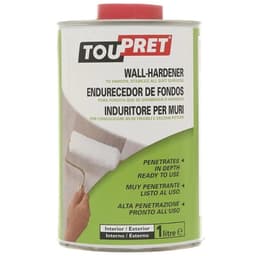
Across five UK reviews, the Toupret wall hardener at £22.62 is described as turning dusty plaster, cement, and wood into workable material and as hardening very loose sandstone. The amazon.co.uk line behind those texts is 4.6 from 9, and none of the five says the treated wall failed to harden. One reviewer found a spray bottle easy and the drying quick, while others say brushes and rollers are hard to clean. Overspray and spills are described as setting into a hard plastic resin on surrounding surfaces, and one reviewer said to wear a mask. The bullets say it hardens powdery substrates, can be left unpainted, and is moisture-vapour permeable, but they do not print coverage or a dry time. The capture also disagrees with itself: item form says powder, volume says 1 litre, the title says 1 kg, and a best-sellers line ranks it in Super Glue. It scores 80, the highest in this set, from evidence 22, fit 30, reviews 17 and value 11. It is the top pick for a powdery substrate the UK reviews actually name, and a poor fit if you need a coverage figure or a listing that agrees it is a liquid. Toupret's own UK page describes an alcohol-resin penetrant, overcoatable in about 24 hours, and says to ventilate and keep flames away.
Pros
Five UK reviews name dusty plaster, cement, wood, and loose sandstone
4.6 from 9 on amazon.co.uk at £22.62
Bullets say it can be left unpainted and is moisture-vapour permeable
None of the five UK texts says the treated wall failed to harden
Cons
UK reviews say brushes and rollers are hard to clean
Overspray and spills are described as setting hard
Item form says powder while the volume line says 1 litre
No coverage or dry time on the capture
Best for: Powdery plaster, cement, or loose sandstone you want to harden before a filler or a coat, and you can accept a 1 kg can with no coverage figure.
Less suitable: A job that needs a printed coverage rate, or a listing that clearly says the product is a liquid.
The bullets say it hardens and stabilises loose or powdery substrates. They do not use the word plaster. One UK review says it made dusty plaster workable.
Is it a powder or a liquid on this capture?
The item-form line says powder. The same capture prints a volume of 1 litre and a unit count of 1000 g. Both stay on the card.
What do the UK reviews complain about?
Brush and roller cleaning, and product that lands off the wall and sets hard. The five UK texts do not say the treated wall failed to harden.
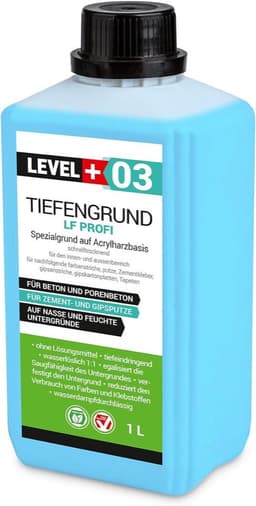
The 1 litre Level Plus 03 is £8.38, the smallest shelf price in this set, and the bullets call it a solvent-free deep primer for absorbent plaster, plasterboard, and concrete. A blue tint is there to show coverage, and weakly absorbent surfaces can be diluted 1:1 with water. The listing prints 5–20 m² per litre and a dry time of 2.0 hours, a wide band if you are only treating a patch. The amazon.co.uk line is 4.4 from 9, with no review text in the file, so those stars do not say which surface was primed. The outdoor attribute disagrees with indoor and outdoor in the bullets, the surface line says ceramic, and the weight prints 2 kg on a 1 litre bottle. It scores 58, from evidence 12, fit 26, reviews 6 and value 14. It is the best value row only as the cheapest way to buy this deep-primer wording, not as a tested result. Leave it when the area is a whole room or when you need UK reviews that describe dusty plaster.
Pros
£8.38 for 1 litre, the smallest shelf price in this set
Bullets name plaster, plasterboard, and concrete, with a blue coverage tint
1:1 dilution stated for weakly absorbent surfaces
Coverage printed as 5–20 m² per litre and a dry time of 2.0 hours
Cons
4.4 from 9 with no review text in the file
Outdoor-only attribute against indoor and outdoor bullets
Surface says ceramic, and the weight line says 2 kg on 1 litre
A 1 litre bottle is a patch, not a room
Best for: A small absorbent plaster or concrete patch where you want the cheapest tin in this set and a stated 1:1 dilution.
Less suitable: A whole room, or a chalky wall you want UK reviews to describe before you buy.
This Level Plus 03 row is titled 10 litres at £27.55, while the size attribute says 5 litres, pack of 2, so the page does not settle what arrives. The bullets repeat the 1 litre 03: solvent-free, blue tint, plaster, plasterboard, and concrete, plus 1:1 dilution on weakly absorbent surfaces. The dry-time field prints 0.5 hours, against 2.0 hours on that 1 litre sibling, and coverage is the bare number 1 with no unit. A dilution field prints 2, which is not the 1:1 sentence in the bullets. The star line is 3.7 from 2 with no review text, the surface line says ceramic and plastic, and the indoor/outdoor attribute says outdoor. You cannot plan a wall from a coverage figure of 1, and you should not copy the 5–20 m² per litre from the other Level Plus 03 listing onto this one. It scores 40, the lowest in this set, from evidence 6, fit 22, reviews 4 and value 8, because the pack, the dry time, and the coverage line do not agree.
Pros
Bullets name plaster, plasterboard, and concrete, with a blue coverage tint
Solvent-free on the bullets, and 1:1 dilution for weak suction
Listed at £27.55 with a 10 litre volume line
Fast-drying is named as a special feature
Cons
Title says 10 litres; size says 5 litres, pack of 2
Coverage prints as 1 with no unit, and dry time is 0.5 hours against 2.0 on the 1 litre sibling
3.7 from 2, with no review text
Surface says ceramic and plastic
Best for: A buyer who has confirmed the pack that will arrive and wants the same Level Plus 03 bullets in a larger volume.
Less suitable: Anyone who needs one agreed pack size, a usable coverage figure, or UK review text.
The title says 10 litres and the volume is 10 litres. The size attribute says 5 litres, pack of 2. The capture does not say which you will receive.
What coverage does the listing give?
The coverage field is the number 1, with no unit. The 1 litre Level Plus 03 listing prints 5–20 m² per litre. This card does not copy that figure across.
Are there written reviews?
The star line is 3.7 from 2. The saved listing has no review text, so praise and complaints are not available.
The Landlords 5 litre stabilising primer is £39.95, and the bullets say it penetrates porous masonry, concrete, render, plaster, and pebbledash and binds loose material. The title says water-based and also names wood and furniture, while a bullet and the paint-type line say solvent. The only amazon.co.uk review, dated 16 July 2026, is 1.0 from 1. That buyer expected a primer under an undercoat and then Dulux emulsion, found a very liquid product in a large 5 litre plastic container, and asked whether it was meant for plaster. The text does not describe a coat that failed, and there is no second review. It scores 42, from evidence 8, fit 26, reviews 3 and value 5. The same £39.95 as the HQC tin buys you one confused UK review rather than a record of chalky walls, so this is a poor match if you wanted an ordinary emulsion primer.
Pros
Bullets name masonry, concrete, render, plaster, and pebbledash
Interior and exterior agree on the title, the bullets, and the attributes
Bullets say developed and manufactured in the UK
5 litres at £39.95
Cons
1.0 from 1 review on 16 July 2026
The buyer expected a conventional paint primer and found a very liquid pack
Title says water-based; a bullet and the paint type say solvent
Wood and furniture appear in the title and not on the surface list
Best for: Chalky masonry or plaster if you already know you want a binding liquid and you can check solvent versus water on the tin.
Less suitable: A conventional primer under emulsion, or a buy you want more than one UK review to support.
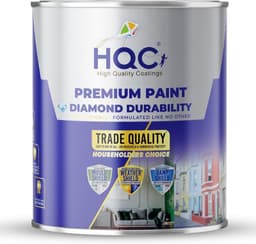
HQC's 5 litre stabilising primer is £39.95, and the bullets say a solvent-based formula binds chalky, dusty masonry, concrete, render, plaster, and pebbledash before paint. The paint-type line on the same capture says water-based, so you cannot tell from the page which chemistry is in the tin. The title also calls it a primer and undercoat for plaster, brick, concrete, and wood, while the indoor/outdoor attribute says outdoor and the bullets say interior and exterior. The bullets add a UK manufacture claim and say the surface can breathe. There is no customer-review line, no coverage, and no dry time. It scores 43, from evidence 4, fit 28, reviews 4 and value 7. At £39.95 for 5 litres, that missing review line is the limit, and the solvent versus water clash is the reason to read the tin before you use it in a room you cannot ventilate.
Pros
Bullets name chalky masonry, render, plaster, and pebbledash
5 litres at £39.95, with a UK manufacture claim on the bullets
Title also names brick, concrete, and wood
Bullets describe a penetrating binder for dusty surfaces
Cons
Paint type says water-based while the bullets say solvent-based
No customer-review line, coverage, or dry time
Indoor/outdoor attribute says outdoor against interior and exterior bullets
£39.95 with no UK review text
Best for: Chalky masonry once you have checked the tin in your hand for solvent or water.
Less suitable: A small room you cannot ventilate, or any buy that needs a star rating and one chemistry line.
Is this stabilising primer solvent-based or water-based?
The bullets say solvent-based. The paint-type attribute says water-based. The capture does not resolve that.
Does the listing include plaster?
Yes. The title names plaster, and the bullets name masonry, concrete, render, plaster and pebbledash.
Is there a star rating?
No customer-review line is in the saved listing, so this card does not show a star score.
How we compared
Six amazon.co.uk penetrating primer listings were scored from the stored listing files, shelf date 21 October 2026, not in a lab. No pull-off value and no VOC figure was measured. Weights sum to 100: Amazon evidence 30, listing fit for a penetrating or stabilising primer 35, review outcome 20, and shelf value 15. A missing review line scores low on evidence. A title that says water-based and solvent-based loses fit points. German-only text cannot fill the review score. Value is the shelf price against pack size inside this set. The highest score is the top pick. The lowest shelf price for a deep primer whose bullets describe the job is the best value, and that award is not a UK performance proof.
1
Amazon evidence
30%
Stars and review counts are the amazon.co.uk figures in the stored files. A missing review line scores low. A larger count with no UK text does not outrank a smaller count whose UK texts name the job.
2
Listing fit
35%
The listing should describe a penetrating or stabilising primer for powdery, chalky or absorbent plaster, render or masonry. A title that says both water-based and solvent-based loses fit points. A powder line against a litre volume also keeps the score off the ceiling.
3
Review outcome
20%
UK review text that names plaster, cement, masonry or sandstone fills this share. German-only text cannot. A star line with no review text stays thin. A buyer who expected a conventional emulsion primer is not a note that the wall hardened.
4
Shelf value
15%
Value is the shelf price against pack size inside this set only. The lowest price per litre and the smallest shelf price are not the same award. The best-value row is the smallest outlay for a deep primer whose bullets describe the job.
Independent review
Last updated: 22.10.2026
8 sources checked
Penetrating primer buying guide
Start with the hand test, then the chemistry on the tin you will open, then the dilution line for that product, then the pack. The notes below follow that order. None of these listings was lab-tested, and a score is not a pass mark from BS 6150.
What a penetrating primer is for
A penetrating primer, in UK decorating, is a thin binding coat that soaks into dusty, chalky or very absorbent plaster, render, masonry or old paint and glues the loose particles so the next coat has something sound to hold. Shoppers meet the same job under several names: stabilising primer, stabilising solution, deep primer and wall hardener. You need it when a wiped wall still comes away white.
Best for
A homeowner with chalky plaster or dusty masonry who needs a binder before emulsion or masonry paint
A decorator buying a 5 litre tin who will resolve solvent and water claims before using it indoors
A filler user who wants a wall hardener on soft plaster and can ventilate for an alcohol-resin product
Not ideal for
Sound new plaster, which usually takes a mist coat, or a wall that is still wet
A small room you cannot ventilate if the tin in your hand is solvent-based
Crumbling render, salty masonry, or pre-1980s paint that must be stripped
Mistakes to avoid
1
Neat PVA on new plaster
PVA, a mist coat and a binding primer are three different jobs. Neat PVA on new plaster is a common mistake. Sound new plaster usually takes a mist coat. A stabiliser is for loose particles, not for a sound surface the maker wants left alone.
2
Diluting a do-not-dilute tin
Everbuild 406 and Bostik Stabilising Solution say do not dilute. Level Plus 03 says 1:1 with water on weakly absorbent surfaces. Mixing those instructions up is how a wall goes glassy or stays dusty. Follow the line on the tin you opened.
3
Painting over damp, or buying the wrong family
A penetrating primer does not cure damp or rebuild crumbling render. Rust converter, damp-seal paint and plasterer's grit are different jobs. Call a professional for a wet or salty wall, crumbling render, pre-1980s paint that must be stripped, or a solvent tin in a room you cannot ventilate.
What to weigh up
Amazon evidence
High
Stars and counts are the amazon.co.uk lines in the six stored files, dated to the shelf capture of 21 October 2026. Toupret is 4.6 from 9. Level Plus 02 is 4.6 from 25. Level Plus 03, 1 litre, is 4.4 from 9. HQC has no customer-review line. Landlords is 1.0 from 1, dated 16 July 2026. The Level Plus 03 row titled 10 litres is 3.7 from 2. A missing line scores low on this share, which is 30 of 100. A larger count is not automatically stronger evidence.
Listing fit
High
This share is 35 of 100. The listing should read as a penetrating or stabilising primer for powdery, chalky or absorbent plaster, render or masonry. Toupret's bullets harden powdery substrates. Level Plus bullets name plaster and concrete. HQC and Landlords name masonry, render, plaster and pebbledash. Fit falls when the same capture disagrees with itself. HQC bullets say solvent-based and the paint type says water-based. Landlords' title says water-based and a bullet says solvent.
Review outcome
Medium
This share is 20 of 100, and it looks at what the written reviews say, not only at the star average. Five UK texts on Toupret name dusty plaster, cement, wood and loose sandstone, and none says the treated wall failed to harden. Complaints are brush cleaning and overspray that sets hard. Level Plus 02's only texts are German, so they cannot fill a UK outcome. Level Plus 03, both sizes, has no review text. HQC has no review line.
Shelf value
Medium
This share is 15 of 100. Value is the shelf price against pack size inside this set, not a market average and not a live re-check. Level Plus 02 at about £14.98 for 10 litres is the lowest price per litre, so its value points are full. Level Plus 03, 1 litre, at about £8.38 is the smallest shelf price, which is why it takes the best-value award even though its value points are 14, not 15. Toupret is about £22.62. The conflicting Level Plus 03 pack is about £27.55.
Which option suits you?
Three typical situations, each with a recommendation from this comparison.
🏠
Homeowner with chalky plaster
The wall still comes away white after you brush it, and you want UK reviews that name dusty plaster before you buy. Toupret at about £22.62 is the row whose five UK texts describe that job. There is no coverage figure on the capture, and the powder line disagrees with 1 litre.
You want a 10 litre solvent-free tin whose bullets name plaster, plasterboard, cement board and concrete. Level Plus 02 is about £14.98, with a printed coverage of 0.20 litres per square metre. The only review texts are German, and the floor and ceramic lines clash with those bullets.
A small absorbent patch, and you want the lowest shelf price in this set. Level Plus 03, 1 litre, is about £8.38, with a stated 1:1 dilution on weak suction and no review text. It is a patch, not a room.
Which penetrating primer is the top pick in this set?
Toupret wall hardener scores 80, the highest of these six amazon.co.uk listings. It is about £22.62, with 4.6 from 9 reviews. Five UK texts name dusty plaster, cement, wood and loose sandstone, and none says the treated wall failed to harden. Brushes are hard to clean, and overspray is described as setting hard. The listing says powder and also 1 litre. This is not a lab test.
How much do these penetrating primers cost?
Shelf prices in the six amazon.co.uk captures run from about £8.38 to about £39.95. Level Plus 03, 1 litre, is about £8.38. Level Plus 02 is about £14.98 for 10 litres, the lowest price per litre here. Toupret is about £22.62. The other Level Plus 03 row is about £27.55. HQC and Landlords are both about £39.95 for 5 litres. These are stored shelf prices, not a live check and not a market average.
What should you check before you buy a penetrating primer?
Confirm the wall is powdery, chalky or highly absorbent, and that damp and mould are already dealt with. Mould is a different job, covered in the mildew treatment comparison. Choose a binding primer, not a film primer. Read solvent versus water, because two 5 litre listings contradict themselves. Follow that product's dilution line. Prefer UK review text that names plaster or masonry, and match 1 litre to a patch.
Do you need a penetrating primer on new plaster?
Sound new plaster usually takes a mist coat, not a stabilising primer. You need a penetrating primer when a wiped wall still comes away white. You do not need it on a wall that is still wet. Dulux Trade Weathershield Stabilising Primer is described as not for sound surfaces. Everbuild 406 will not rebuild disintegrated render. Call a professional for a wet or salty wall, crumbling render, or old paint that must be stripped.
Is a solvent-based stabilising primer suitable indoors?
HSE solvent guidance is to prefer water-based products where the job allows, to ventilate, and to keep solvent out of a small closed room. HQC and Landlords each print both solvent and water-based claims, so the page does not tell you which chemistry is in the tin. Check the tin in your hand. Toupret's sheet says ventilate and keep flames away. A room you cannot air is the wrong place for a solvent tin.
Can the coverage figure on the tin be treated as your wall's result?
No. Trade sheets in this category run from about 5 m² to 10 m² per litre, and a second coat is only for surfaces that are still hungry. Level Plus 03, 1 litre, prints 5–20 m² per litre. The 10 litre Level Plus 03 row prints coverage as 1 with no unit, so do not copy the other figure across. Toupret and HQC print no coverage. A printed rate is a planning figure, not what your wall will take.
Our verdict
Toupret wall hardener at about £22.62 scores 80, the highest here, with five UK reviews that name dusty plaster, cement, wood and loose sandstone. Level Plus 02 scores 65 on a 10 litre tin at about £14.98, and the only review texts are German. Level Plus 03, 1 litre, at about £8.38 is the best value as the smallest shelf price, score 58, with no review text. HQC scores 43, Landlords 42, and the Level Plus 03 row titled 10 litres scores 40. This was not a lab test.
Paints and varnishesPenetrating primeramazon.co.uk listings
Peter F. is the editor for DIY & tools at productscompared.co.uk. Comparisons in this category are checked against amazon.co.uk listings, review evidence and public UK sources.
Updated: 22.10.2026
8 sources checked
Guides to Penetrating primers
Guides on what to look for, how to use a product, and common mistakes.
Public sources from the research digest, last checked on 21 October 2026. Shelf prices and star lines are the amazon.co.uk figures in the display file. The price band is this set, not a market average. No listing was lab-tested.
This page contains affiliate links to amazon.co.uk. If you buy through them, we may earn a commission at no extra cost to you. Prices, stars and review counts are the stored amazon.co.uk figures, not a live crawl. We did not lab-test these primers.