Independent comparisons. We may earn from shop links. Our editors compare products independently. Some links go to shops, and we may earn a commission. More info
Top pick: Double boiled linseed oil, 250 ml Best value: Bartoline boiled linseed oil, 5 litres – Lowest price per litre for a stated softwood outdoor job with a UK review file above 50. Updated October 2026.
Boiled linseed oil is a flax-seed drying oil sold in the UK to feed bare timber and leave a light sheen. It dries by oxidation, so a thin coat on open wood is a normal DIY job and a piled oily cloth is a fire risk. Makers treat boiled as hot air, oxidation, or metallic driers, not as a pan of boiling oil. You tell a useful tin from a vague one by the wood it names, the dry time it prints, whether it claims food contact, and the pack size in millilitres.
Softwood outdoors, interior bare wood, and a food-contact board are different jobs. Exterior oak and teak are a limit many labels state. A review that worked on oak does not cancel that label. Raw linseed oil and stand oil are different products. Those checks are in the [boiled linseed oil buying guide](/hub/paints-and-varnishes/boiled-linseed-oil/sub/boiled-linseed-oil-buying-guide).
Hang oily cloths outside, soak and bag them, or put them in a metal container. Do not store them indoors in a pile. This category was not lab-tested.
Boiled linseed oil is a flax-seed drying oil sold in the UK to feed bare timber and leave a light sheen. It dries by oxidation, so a thin coat on open wood is a normal DIY job and a piled oily cloth is a fire risk.
Boiled linseed oil is a flax-seed drying oil sold in the UK to feed bare timber and leave a light sheen. It dries by oxidation, so a thin coat on open wood is a normal DIY job and a piled oily cloth is a fire risk. Makers treat boiled as hot air, oxidation, or metallic driers, not as a pan of boiling oil. You tell a useful tin from a vague one by the wood it names, the dry time it prints, whether it claims food contact, and the pack size in millilitres.
Softwood outdoors, interior bare wood, and a food-contact board are different jobs. Exterior oak and teak are a limit many labels state. A review that worked on oak does not cancel that label. Raw linseed oil and stand oil are different products. Those checks are in the [boiled linseed oil buying guide](/hub/paints-and-varnishes/boiled-linseed-oil/sub/boiled-linseed-oil-buying-guide).
Hang oily cloths outside, soak and bag them, or put them in a metal container. Do not store them indoors in a pile. This category was not lab-tested.
Boiled linseed oil is a flax-seed drying oil sold in the UK to feed bare timber and leave a light sheen. It dries by oxidation, so a thin coat on open wood is a normal DIY job and a piled oily cloth is a fire risk. Makers treat boiled as hot air, oxidation, or metallic driers, not as a pan of boiling oil. You tell a useful tin from a vague one by the wood it names, the dry time it prints, whether it claims food contact, and the pack size in millilitres. Softwood outdoors, interior bare wood, and a food-contact board are different jobs. Exterior oak and teak are a limit many labels state.
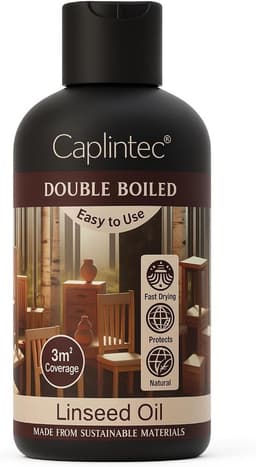
The Caplin Tec 250 ml bottle, titled as double boiled linseed oil, is £11.99 with 4.9 from 24 reviews, and the review file holds only four UK texts, two of them a single word of praise. One reviewer timed about three hours on a light oak table top with a lint-free cloth, which matches the bullet, and another restored a fading willow bin screen. That is the whole concrete file. A bullet says the oil can be used similarly to chopping-board oil and is safe for children, pets, and wildlife, yet the non-toxic question is unanswered and no regulation or toy standard is named. The brand field is empty, the manufacturer is CAPLIN TEC LIMITED, and the part number reads CT-LO-500 on a 250 ml listing. At about £47.96 a litre it is the dearest pack in this set, and one reviewer said it cost almost twice what they had paid five years earlier. The 4.9 does not outrank a 4.6 from hundreds of reviews as a durability result.
Pros
About 3 hours a coat in the bullets, matched by one UK review on a light oak table top
A willow bin screen and an oak top are the concrete jobs in the four UK texts
250 ml if you only want a small trial of this listing
One reviewer found the odour milder than other oils
Cons
4.9 from 24 reviews, with two of four UK texts only one line long
About £47.96 a litre, and one reviewer called it almost double a previous price
Chopping-board and children-and-pets wording cites no regulation
Brand, coverage, container, and cloth-fire warning are not stated
Best for: A buyer who wants this 250 ml listing's 3-hour claim on a small indoor piece and accepts a thin review file.
Less suitable: Anyone choosing by stars alone, or oiling a board, a toy, or a large outdoor job.
The non-toxic question is unanswered. A bullet says the oil is safe for children, pets, and wildlife. No toy standard and no food-contact regulation are named.
How long does the listing say a coat takes to dry?
The bullets say about 3 hours per coat. One of the four UK reviews timed about 3 hours on a light oak table top.
Can you use it on outdoor furniture?
The outdoor-furniture question is unanswered. A bullet names wooden benches outdoors and tool protection. Two UK reviews describe an oak table top and a willow bin screen.
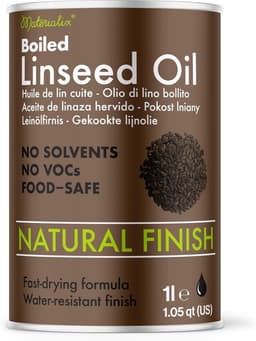
Materialix is the 1 litre tin at £13.95, 4.7 from 433 reviews, and 27 of the 50 review texts are marked United Kingdom. It is the only listing in this set that claims a DAkkS-accredited test to Regulation (EC) No 1935/2004 for chopping boards, blocks, worktops, and dining tables, and the bullets describe heated linseed without synthetic drying agents. Two UK reviews say they bought it for that reason. The same bullets give about 18 hours to dry, hardening in five to ten days, and roughly 12–15 m² per litre, indoors and outdoors. One UK review says a litre covered a large table and two chairs with some left; another says the tin is hard to open and pour and traps about 30–40 ml, and a third reports a strong smell. The toys question and the UV question are unanswered, and no cloth-fire line is in the bullets. Open this tin first when the job is a board or a worktop in this comparison, and do not treat the food-contact sentence as a toy finish.
Pros
Only listing here that cites Regulation (EC) No 1935/2004
1 litre at £13.95, 4.7 from 433 amazon.co.uk reviews
Heated linseed without synthetic drying agents, as the listing states
About 18 hours to dry, 5–10 days to harden, and 12–15 m² per litre stated
UK reviewers use it on tables, chairs, stairs, and garden furniture
Cons
UK review: tin hard to open and traps about 30–40 ml
Strong smell in a UK review
Toys and UV questions unanswered
No cloth-fire line in the captured bullets
Best for: A chopping board, block, or worktop when you want the only food-contact regulation claim in this set.
Less suitable: A child's toy, a UV coating with a stated test, and anyone who needs a cloth warning printed on the listing.
The bullets say it was tested to Regulation (EC) No 1935/2004 by a DAkkS-accredited laboratory for chopping boards, blocks, worktops, and dining tables. That claim is not printed on the other tins in this set.
Does the listing say it is safe for children's toys?
The toys question is unanswered. The bullets do not name a toy standard such as EN 71-3.
What do UK reviews say about the tin?
One UK review says the tin is hard to open and pour and traps about 30–40 ml. Another UK review reports a strong smell. Two UK reviews chose it because it is described as heated linseed without synthetic drying agents.
The Furniture Clinic 1 litre bottle is £19.99 with 4.6 from 9,273 reviews, one review more than the 250 ml listing, and the sampled UK themes match that smaller bottle: grain brought back on tired furniture, tacky oak cabinets after two or three days, white patches, and a rag that became red hot. You are buying volume, about £19.99 a litre, not a separate long-term test. One bullet excludes exterior oak, while recommended uses say except oak, and both the model number and the part number read BLO_250 on a 1 litre product. The colour field says mahogany. Kitchen utensils are named, but the kitchen question is unanswered and a UK review would not use the oil on food-contact wood because of metallic driers. A dry time is not stated. Take the litre when you already want this brand and will use more than 250 ml, and read the oak line on the bottle before any exterior oak.
Pros
1 litre at £19.99, cheaper per litre than the 250 ml bottle
4.6 from 9,273 amazon.co.uk reviews
Glossy finish and hot-air treatment stated
Country of origin United Kingdom
Exterior oak excluded in one bullet
Cons
Model number and part number both read BLO_250
Colour field says mahogany
UK reviews: tacky after 2–3 days, white patches, and a rag that became red hot
Dry time not stated, and no food-contact regulation cited
Best for: A Furniture Clinic buyer who will use more than 250 ml on interior bare wood and stone or terracotta the bullets also name.
Less suitable: Exterior oak, food-contact wood, and anyone who needs the model number to match the litre on the label.
The kitchen question is unanswered. Recommended uses name kitchen and dining furniture and utensils. A UK review would not use it on food-contact wood because of metallic driers, and the bullets do not cite a food-contact regulation.
Which woods does the listing exclude?
One bullet says all types of wood except exterior oak. The recommended-uses line says except oak. The pine question is unanswered, and the title names oak and pine.
What do the reviews say about drying and cloths?
UK reviews include oak cabinets still tacky after 2–3 days, white patches, and a rag that became red hot. Reviewers say the self-combustion warning is on the reverse of the bottle.
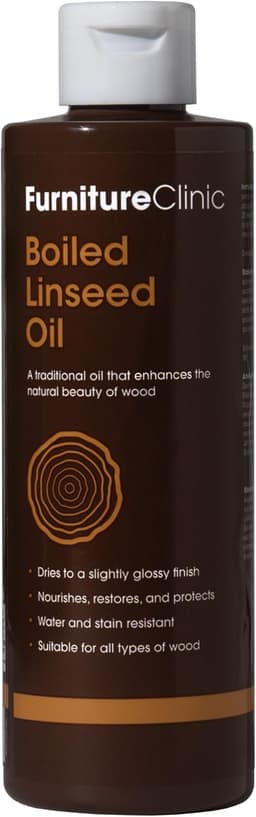
Furniture Clinic's 250 ml bottle is £9.99 with 4.6 from 9,272 reviews, and the 50 review texts are all marked United Kingdom. Buyers rub it onto tired furniture, blanket boxes, axe handles, and garden pine, and several say a little goes a long way, which is the practical answer to a bottle that works out at about £39.96 a litre. The bullets say the oil is hot-air treated, slightly glossy, and suitable for raw wood except exterior oak, with coverage stated as 50 square feet. A dry time is not printed. UK reviews describe oak cabinets still tacky after two or three days, white patches, a lingering smell, and a self-combustion warning on the reverse of the bottle rather than the front. One reviewer would not use it on food-contact wood because of metallic driers, and the bullets cite no food-contact test. The pine question is unanswered even though the title names oak and pine. Choose it when you want this brand's most-reviewed small bottle for interior bare wood and you will keep it off exterior oak.
Pros
4.6 from 9,272 amazon.co.uk reviews, all 50 sampled texts marked United Kingdom
Exterior oak excluded in the bullets
Hot-air treated, glossy finish, coverage stated as 50 square feet
Country of origin United Kingdom
UK reviewers revive tired furniture, handles, and garden pine with a cloth
Cons
About £39.96 a litre at the £9.99 shelf price
Dry time not stated on the listing
Tacky oak cabinets, white patches, and a strong smell in UK reviews
No food-contact regulation; a UK review cites metallic driers
Best for: Someone refreshing interior bare wood who wants the most-reviewed small bottle and will stay off exterior oak.
Less suitable: A fence or shed, a chopping board, and any job where £40 a litre is the wrong way to buy volume.
The pine question on the listing is unanswered. The bullets say all types of wood except exterior oak, and the title names oak and pine.
Is a food-contact use stated?
The bullets do not state a food-contact test. A UK review says they would not use it on food-contact or routinely handled items because of metallic driers.
Where do reviewers say the fire warning sits?
UK reviews say cloths can self-heat and that the self-combustion warning is on the reverse of the bottle, not the front.
The Bartoline 500 ml flask lists at £7.65 on amazon.co.uk, 4.6 from 484 reviews, and all 50 texts in the review file are marked United Kingdom. Reviewers say a little soaks into dry softwood garden furniture, planed wood, and tool handles, which matches the bullets: softwood, interior and exterior, a natural sheen, and 24 hours between coats. Special additives are named to speed drying, and the same bullets tell you to dispose of application cloths so they do not become a fire hazard, then to clean tools with Bartoline white spirit. The hardwood question is unanswered, and one UK review found a not-for-oak line on the bottle only after coating a new oak bench. Stuck caps and a cloudy bottle with dried oil on the thread and no foil seal also come up. Food contact and children's toys are not stated. It is the top pick here for a small softwood job at about £15.30 a litre, not a finish for exterior oak or a chopping board.
Pros
£7.65 for 500 ml, 4.6 from 484 amazon.co.uk reviews
Softwood, interior and exterior, and 24 hours between coats stated
Cloth-fire disposal is in the bullets
Natural sheen and drying additives named on the listing
UK reviewers say a little goes a long way on garden wood and handles
Cons
Stuck caps from dried oil in the thread
One UK review found a not-for-oak line only after coating a bench
No food-contact test and no toy standard stated
Coverage is not stated, and one bottle arrived cloudy with no foil seal
Best for: A first tin for softwood garden furniture, doors, or tool handles when 500 ml will cover the job.
Less suitable: Exterior oak, teak, chopping boards, and anyone who needs a cited food-contact regulation.
The hardwood question on the listing is unanswered. The title and bullets name softwood garden furniture, doors, and wooden surfaces. One UK review says the bottle said not to use it on oak, after they had already coated a new oak bench.
Does the listing say it is safe for toys or food?
The children's-toys question is unanswered, and the bullets do not state a food-contact test. Treat both as not stated.
What does the listing say about oily cloths?
The bullets say to dispose of application cloths responsibly to prevent fire hazards. They also say to clean tools with Bartoline white spirit.
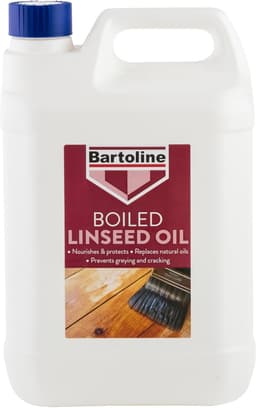
Bartoline's 5 litre bottle is £29.95, about £5.99 a litre, with 4.6 from 374 reviews, and all 50 review texts are marked United Kingdom. Reviewers buy it for fences, sheds, gates, and summerhouses, and say it soaks into weathered softwood with a satin, amber tone, which is the job the bullets name. Touch dry is about 14–24 hours from added drying agents, the indoor/outdoor field says outdoor, and the water-resistance level is water resistant against cracking, greying, and sun damage on softwood garden furniture. More than one UK review could not unscrew the cap because oil had dried in the thread, and one buyer was going to cut the top off the bottle. A long review calls it siccative-treated linseed and says cloths can self-ignite, a warning that is not in the captured bullets. The indoor question and the toys question are unanswered, even though some reviewers used it on floors and a kitchen terracotta floor. It is the best value when you will use several litres on softwood outdoors, and a frustrating buy if the cap is already seized or the timber is oak.
Pros
£29.95 for 5 litres, about £5.99 a litre, 4.6 from 374 reviews
Softwood garden furniture, outdoor use, and a satin finish stated
Touch dry in about 14–24 hours from added drying agents
Water-resistant wording for cracking, greying, and sun damage on softwood
UK reviewers use it on fences, sheds, gates, and summerhouses
Cons
Stuck caps are a repeated UK complaint
Cloth self-ignition is in a UK review, not in the captured bullets
Indoor use and children's toys are unanswered on the listing
Water resistant does not state a year count, and coverage is not printed
Best for: Fences, sheds, and several softwood pieces when you will actually use most of 5 litres.
Less suitable: A single bench you could finish from 500 ml, exterior oak, and a bottle whose cap will not turn.
The indoor-wood question is unanswered. The indoor/outdoor field says outdoor and specific uses say exterior. UK reviews still mention floors, doors, and a kitchen terracotta floor.
Does the listing say it is waterproof?
The waterproof field is true and the water-resistance level is water resistant. The bullets say a water-resistant finish against cracking, greying, and sun damage on softwood garden furniture.
Is it stated as safe for children's toys?
The toys question is unanswered. No food-contact test is stated. A UK review describes the oil as linseed with siccatives and says cloths can self-ignite.
How we compared
Six amazon.co.uk boiled linseed oil listings were scored from the stored listing files on 20 October 2026, not in a weathering, fire, or food-contact lab. Amazon evidence is 40: stars as (rating divided by 5) times 30, plus a review-count band of 10 at 1,000 or more, 8 from 400 to 999, 6 from 200 to 399, 4 from 50 to 199, and 2 under 50. A 4.9 from 24 reviews cannot fill the count band. Listing fit is 25, for a named wood limit, a printed dry time, a clear indoor or outdoor line, an honest food-contact position, a cloth-fire line on the listing itself, and a real container or coverage figure. Contradictions cost points. Review outcome is 20, from United Kingdom texts that describe oil soaking into the wood the label names. Value is 15, from the shelf price in GBP divided by litres. Worked scores are 85, 83, 83, 74, 66 and 50. The top pick is the highest score. The best value is the lowest price per litre among bottles with a stated softwood outdoor job and a UK review file above 50. A maker coverage figure, such as 10 m² per litre on a technical sheet, is not scored as if it were printed on every tin.
1
Amazon evidence
40%
Stars on amazon.co.uk are scaled as (stars divided by 5) times 30, then a review-count band is added: 10 points at 1,000 or more, 8 from 400 to 999, 6 from 200 to 399, 4 from 50 to 199, and 2 under 50. The score is rounded to a whole number. A 4.9 from 24 reviews cannot fill the count band. It is the listing average, not a lab result.
2
Listing fit
25%
Points for a named wood limit, a printed dry time, a clear indoor or outdoor line, an honest food-contact position, a cloth-fire line on the listing itself, and a real container or coverage figure. Contradictions cost points: a 250 ml model number on a 1 litre bottle, a mahogany colour field on a clear oil, except oak beside except exterior oak, and a children-and-pets sentence with no regulation.
3
Review outcome
20%
United Kingdom texts that describe oil soaking into the wood the label names score higher than a file that is mostly tacky coats, stuck caps, or one-line praise. One tin uses only the 27 United Kingdom texts inside a 50-review cap. The other five files are marked United Kingdom throughout that cap.
4
Value
15%
Shelf price in GBP divided by litres. The lowest price per litre scores the block. A 250 ml bottle at about £40 to £48 a litre does not win value because the star line is high. The best value is the lowest price per litre among bottles with a stated softwood outdoor job and a UK review file above 50.
Independent review
Last updated: October 2026
9 sources checked
Boiled linseed oil buying guide
Start with the wood the listing names, then exterior oak and teak, then driers and any food-contact citation, then the printed dry time and wipe-off, then the pack against the job. The notes below follow that order. None of these listings was lab-tested.
What to check before you buy boiled linseed oil
Boiled linseed oil is a flax-seed drying oil sold in the UK to feed bare timber and leave a light sheen. It dries by oxidation, so a thin coat on open wood is a normal DIY job and a piled oily cloth is a fire risk. UK makers such as Bartoline, Libéron and Furniture Clinic treat boiled as hot air, oxidation, or metallic driers, not as a pan of boiling oil.
Best for
Softwood garden furniture, a fence or a shed when the listing names that job
Interior bare wood and handles when you will wipe excess and wait for the printed dry time
A chopping board or worktop only when the tin cites a food-contact regulation
Not ideal for
Exterior oak or teak, where the label sends you elsewhere
A child's toy, or any tin you are treating as food-safe without a cited regulation
A coloured one-coat floor oil, raw linseed oil, or stand oil
Mistakes to avoid
1
Leaving a thick coat
A thick coat is why finishes stay tacky. Wipe excess. Libéron says wipe after about 20 minutes. Bartoline prints about 16 hours at 23°C, or 14–24 hours touch-dry on the 5 litre listing, with 24 hours between coats on the smaller flask.
2
Using it on exterior oak
Libéron and Furniture Clinic say not on exterior oak. Bartoline sends oak and teak to teak oil. A review that worked on oak does not cancel the label. Water resistant on the 5 litre bottle is not a year count for oak.
3
Calling every tin food-safe
Only Materialix, in this set, claims a DAkkS test to Regulation (EC) No 1935/2004 for boards and blocks. A children-and-pets sentence with no regulation is not that test, and it is not a toy standard.
What to weigh up
The job and the wood limit
High
The job comes first. Softwood garden furniture, sheds and fences match Bartoline's technical sheet. Interior bare wood, handles and tired furniture match a general oil such as Furniture Clinic, which still excludes exterior oak. A chopping board or a child's toy needs a stated food-contact basis. A coloured one-coat floor oil is a different product. Raw linseed oil has no drying treatment and is slower. Furniture Clinic says it can take up to three days. It is not this category.
Driers, dry time and pack
High
Driers are normal for this category. Bartoline's safety data sheet says boiled linseed oils use one or more metallic siccatives (CAS 68649-95-6). That is not a reason to call every tin food-safe. Only Materialix cites a DAkkS-accredited test to Regulation (EC) No 1935/2004 for chopping boards, blocks, worktops and dining tables. The bullets describe heated linseed without synthetic drying agents.
Which option suits you?
Three typical situations, each with a recommendation from this comparison.
🪵
Softwood bench
You are oiling softwood garden furniture, a door, or tool handles, and 500 ml will cover the job. The Bartoline flask at about £7.65 is the top pick, 4.6 from 484 reviews, with 24 hours between coats and a cloth-fire line in the bullets. The hardwood question is unanswered.
You will use several litres on softwood outdoors. The Bartoline 5 litre bottle at about £29.95 is the best value, about £5.99 a litre, 4.6 from 374 reviews, touch dry in about 14–24 hours. Stuck caps are a repeated UK complaint, so check the cap turns before you rely on it.
You want a stated food-contact basis, not the highest star line. Materialix at about £13.95 is the only tin here that cites a DAkkS test to Regulation (EC) No 1935/2004 for boards, blocks, worktops and dining tables. The toys question is unanswered. Do not treat that sentence as a toy finish.
Which boiled linseed oil is the top pick in this comparison?
The top pick is the Bartoline 500 ml flask, about £7.65, 4.6 from 484 amazon.co.uk reviews. It has the highest score because the listing names softwood, interior and exterior use, 24 hours between coats, and a cloth-fire disposal line in the bullets. Special additives are named to speed drying. The hardwood question is unanswered, and one UK review found a not-for-oak line only after coating a bench. Food contact and children's toys are not stated. It was not lab-tested.
Which boiled linseed oil is the best value?
The best value is the Bartoline 5 litre bottle at about £29.95, about £5.99 a litre, with 4.6 from 374 reviews. It is the lowest price per litre here among bottles with a stated softwood outdoor job and a UK review file above 50. Touch dry is about 14–24 hours. Stuck caps are a repeated UK complaint, and a cloth self-ignition warning is in a UK review rather than the captured bullets. Indoor use and toys are unanswered.
How much does boiled linseed oil cost on amazon.co.uk?
In this amazon.co.uk set the shelf prices run from £7.65 for 500 ml to £29.95 for 5 litres. The 250 ml bottles are £9.99 and £11.99, about £39.96 and about £47.96 a litre. The 1 litre listings are £13.95 and £19.99. Five litres is about £5.99 a litre. Those figures are the stored shelf prices, not a live crawl, and price per litre is arithmetic, not a durability result. Prices move.
What should you check before you buy boiled linseed oil?
Check the wood the listing names, then whether exterior oak or teak is excluded, then the printed dry time and whether you must wipe excess, then whether any food-contact regulation is actually cited, then the pack in millilitres against the job. A cloth-fire line on the listing is safer than one that appears only in a review. A 4.9 from 24 reviews does not outrank a 4.6 from hundreds of reviews as a durability result. No British Standard was found that a shopper must match to buy the oil itself.
Are oily cloths a fire risk with boiled linseed oil?
Yes. East Sussex Fire & Rescue Service and Northamptonshire Fire and Rescue Service say linseed oil oxidises, the reaction makes heat, and folded cloths can smoulder. Hang cloths outside, soak and bag them, or use a metal container. Do not store them indoors in a pile. The open film on furniture is not the same hazard. One maker's sheet says wash cloths in soapy water and dispose of them outside. If cloths have already smoked, call the fire service.
Is boiled linseed oil food-safe or safe for toys?
No. The category is not food-safe, and it is not a toy finish. Only one tin in this set claims a DAkkS-accredited test to Regulation (EC) No 1935/2004 for chopping boards, blocks, worktops and dining tables. GOV.UK points to assimilated Regulation 1935/2004: a wooden board is a food-contact article, and the finish must suit that use. A bullet that likens an oil to chopping-board oil, or says it is safe for children and pets, is not that regulation. Do not spread a food-safe claim across the other tins.
Can you use boiled linseed oil on exterior oak?
Many labels say not on exterior oak. A review that worked on oak does not cancel the label. Teak is often sent to a teak oil instead. For another outdoor wood oil, see the larch oil comparison. Read the oak line on the bottle before any exterior oak. Boiled linseed oil is not a waterproofing treatment for exterior oak for a stated number of years. A rotten or listed exterior is a specification job, not a tin from this set.
How is boiled linseed oil different from raw linseed oil?
Raw linseed oil has no drying treatment and is slower. Furniture Clinic says it can take up to three days. It is not this category. Boiled linseed oil is the oxidised oil, usually with metallic driers, sold for wood. Double boiled is a synonym some makers use for that oil, and on one listing it is a product name with a faster claimed dry time. It is not a proven second boiling unless that maker says so. Artist refined linseed oil, cosmetic flaxseed oil and stand oil are other products.
Our verdict
The top pick is the Bartoline 500 ml flask at about £7.65. It has the highest score, on a stated softwood job, 24 hours between coats, and a cloth-fire disposal line in the bullets, with 4.6 from 484 amazon.co.uk reviews. The hardwood question is unanswered, and one UK review found a not-for-oak line only after coating a bench. The best value is the Bartoline 5 litre bottle at about £29.95, about £5.99 a litre, for softwood outdoors, with 4.6 from 374 reviews. Its score is tied with the Materialix 1 litre tin and is not the only high score. Stuck caps are a repeated UK complaint, and a cloth self-ignition warning is in a UK review rather than the captured bullets. Materialix is the tin to open first when the job is a board or a worktop, because it is the only listing here that cites Regulation (EC) No 1935/2004.
Paints and varnishesBoiled linseed oilamazon.co.uk listings
Peter F. is the editor for DIY & tools at productscompared.co.uk. Comparisons in this category are checked against amazon.co.uk listings, review evidence and public UK sources.
Updated: October 2026
9 sources checked
Guides to Boiled linseed oils
Guides on what to look for, how to use a product, and common mistakes.
Public sources from the research digest, last checked on 20 October 2026. Shelf prices and star lines are the amazon.co.uk figures in the display file. The price band is this set, not a market average. No listing was lab-tested.
This page contains affiliate links to amazon.co.uk. If you buy through them, we may earn a commission at no extra cost to you. Prices, stars and review counts are the stored amazon.co.uk figures, not a live crawl. We did not lab-test these oils.