Independent comparisons. We may earn from shop links. More info

Boiled linseed oil vs raw

Updated: 23 October 2026

The bottle says boiled, the next one says raw, and a third says double boiled. Boiled linseed oil vs raw is mostly a difference in drying treatment and in whether metallic driers are in the tin, not a ranking of the six amazon.co.uk bottles. Those prices sit on the [boiled linseed oil comparison](/hub/paints-and-varnishes/boiled-linseed-oil). Peter F. set this distinction out on 20 October 2026 from UK maker sheets. He did not test dry times in a lab. A qualifying purchase can earn a commission at no extra cost to you.

The bottle says boiled, the next one says raw, and a third says double boiled.

Our top picks

On this page

Raw linseed oil is the slow, untreated oil

Raw linseed oil is flax-seed oil without the drying treatment the boiled tins are sold for. Furniture Clinic says it can take up to three days to dry, against about 24 hours for boiled oil. Raw oil is not one of the six listings here. A food-safe search that sets it beside mineral oil is not a boiled oil.

Boiled means oxidised, usually with a drier

Boiled on a UK wood oil is usually hot air, controlled oxidation, or metallic driers, not a rolling boil. Bartoline’s sheet of 11 July 2014 cites metallic siccatives and CAS 68649-95-6, without naming the metal. The buying guide is where you match a tin to softwood or to a board.

Double boiled is a synonym, a product name, or a sales word

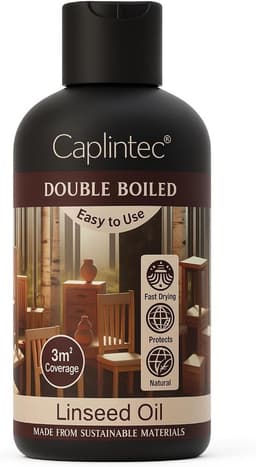
Double boiled is not one process. Bartoline’s safety data sheet lists it, with blown linseed oil and linseed oil oxidized, as a synonym, not a second boil. Caplin Tec’s 250 ml title uses it as the product name, about 3 hours a coat, and no metallic drier is stated. For Bartoline, plan around about 16 hours at 23°C, or 14–24 hours touch dry on the 5 litre.

Food contact follows the tin, not the word boiled

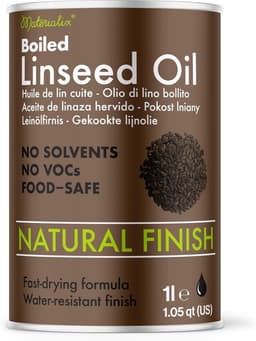
A chopping board is a food-contact article. GOV.UK points to assimilated Regulation 1935/2004, and neither the word boiled nor the word raw grants it. Only Materialix states a DAkkS-accredited test to Regulation (EC) No 1935/2004, as heated linseed without synthetic drying agents. The toys question is unanswered. Deer & Oak’s default is not to use ordinary boiled oil with chemical driers on a board. That does not erase a tin that cites a test.

Common questions

Is boiled linseed oil actually boiled?
Not in the sense of a pot left at a rolling boil. Furniture Clinic says hot air and additives, and the blog says it is not literally boiled, even where another line says the oil is then boiled. Bartoline’s safety data sheet describes controlled oxidation and metallic siccatives. The 250 ml Furniture Clinic bullets say hot-air treated so it dries quicker. Treat boiled as the trade name for that faster-drying wood oil.
How much slower is raw linseed oil?
Furniture Clinic says raw oil can take up to three days, against boiled oil they still quote at up to about 24 hours. Brouns & Co says raw oil has no added driers and needs very thin coats. Raw oil is not one of the six listings in this comparison. A cold room can push a boiled coat past a day as well, which UK reviews show as tacky cabinets after two or three days when the coat is thick.
What is a metallic siccative, and does every tin have one?
A siccative is a drying agent. Bartoline’s sheet says its boiled oil uses one or more metallic siccatives and cites CAS 68649-95-6, without naming cobalt or manganese for that product. The bullets say additives or added drying agents. Furniture Clinic reviews mention metallic driers. Materialix says heated linseed without synthetic drying agents. Caplin does not state driers. Do not assume the Bartoline metal list applies to every brand.
Does double boiled mean a second boiling?
Not as a single fact. Bartoline uses double boiled as a synonym on its safety data sheet. Caplin uses it as a product name on a 250 ml listing with a 3-hour bullet. Brouns & Co calls boiling twice a sales idea. Ask which maker printed the words. Paying more for double on the Caplin tin is about £47.96 a litre, with 4.9 from only 24 reviews.
Which type is the one for food contact?
The tin that states a test, not the type name. Materialix cites Regulation (EC) No 1935/2004. Raw oil is not automatically food-safe because it is raw, and boiled oil is not automatically unsafe if that one tin documents a test. Ordinary boiled oil with driers remains the wrong default for a board, which is Deer & Oak’s point. Caplin’s chopping-board sentence does not cite the regulation.
Once both are dry, is the protection the same?
Furniture Clinic says the results of protection do not differ once the oil is dry. That is their claim. It is not a weathering result from this comparison, and it does not make raw and boiled equal on dry time. Exterior oak is still excluded on their boiled oil. A board still needs the food-contact basis on the tin, whether the film feels similarly hard.
Why were artist oils and hardwax oils left out?
Artist refined linseed oil, cosmetic flaxseed oil, and two-part coloured hardwax oils are different products. Stand oil is a thicker heat-polymerised linseed oil and is not in this set either. The comparison kept boiled wood oil sold for timber. A search page that mixes Danish oil or raw oil into boiled linseed oil is not a reason to score those bottles here.
Does the rag risk apply to raw oil as well as boiled?
East Sussex Fire & Rescue Service describes linseed oil as a class: oxidation makes heat, and folded cloths can smoulder. The warning is not limited to the boiled label. Bartoline’s sheet repeats it for the boiled oil, including the synonym double boiled. Hang cloths flat, soak them, or use a metal container. The open film on a wiped table is not the same hazard as the rag.

Related pages

Sources

Public sources from the research digest, last checked on 20 October 2026. Shelf prices and star lines are the amazon.co.uk figures in the display file. The price band is this set, not a market average. No listing was lab-tested.

  1. East Sussex Fire & Rescue Service: fire hazards of linseed oil (retrieved 20 October 2026)
  2. Northamptonshire Fire and Rescue Service: oil-cloth combustion (retrieved 20 October 2026)
  3. Bartoline boiled linseed oil safety data sheet (retrieved 20 October 2026)
  4. Bartoline boiled linseed oil technical data sheet (retrieved 20 October 2026)
  5. Bartoline boiled linseed oil product sheet (retrieved 20 October 2026)
  6. Libéron boiled linseed oil (retrieved 20 October 2026)
  7. Furniture Clinic: raw vs boiled linseed oil (retrieved 20 October 2026)
  8. GOV.UK: food contact materials authorisation guidance (retrieved 20 October 2026)
  9. Fiddes boiled linseed oil (retrieved 20 October 2026)