Independent comparisons. We may earn from shop links. More info

Boiled linseed oil buying guide

Updated: 22 October 2026

You have a bare bench, a tired table, or a chopping board, and the bottles on amazon.co.uk all say boiled linseed oil. The useful difference is the job the label names, not the star rating in the corner. This boiled linseed oil buying guide sorts softwood outdoors, interior bare wood, and a board or toy into three buys, then the limits that stop a tin being the right one. Shelf prices and the six-row table stay on the [boiled linseed oil comparison](/hub/paints-and-varnishes/boiled-linseed-oil). Peter F. wrote this on 20 October 2026 from those listings and public UK maker sheets, not from a lab test. A qualifying purchase can earn a commission at no extra cost to you.

You have a bare bench, a tired table, or a chopping board, and the bottles on amazon.co.uk all say boiled linseed oil. The useful difference is the job the label names, not the star rating in the corner.

Our top picks

On this page

Start with the job, not the star rating

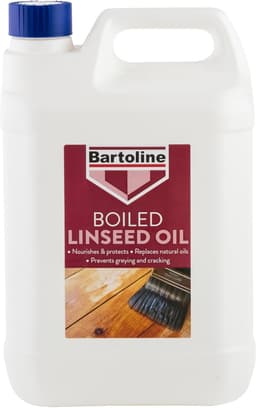
Start with the surface in front of you. Softwood garden furniture, a shed, or a fence is the job Bartoline’s technical sheet is written for, and it is a different buy from a dining table or a board that touches food. Interior bare wood, handles, and tired furniture sit closer to a general oil such as Furniture Clinic, which still prints an exterior-oak exclusion. A chopping board or a child’s toy needs a stated food-contact basis. A coloured one-coat floor oil is another product and is not in this set. You oil a softwood bench and you stay with a tin that says softwood. You revive an indoor pine table and you can look at a general boiled oil that names interior wood, though you still wipe the excess and you still keep exterior oak off the list. You oil a chopping board and you start from the one listing here that cites a food-contact regulation.

Exterior oak, teak, and a food-contact claim

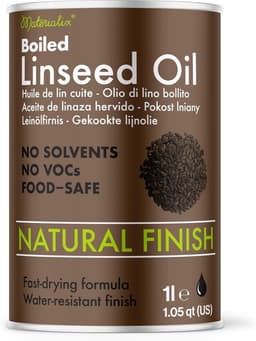
Exterior oak and teak are the stop that UK labels repeat. Bartoline’s technical data sheet sends oak and teak to teak oil and keeps boiled linseed oil for softwood garden furniture. Furniture Clinic and Libéron exclude exterior oak. Furniture Clinic’s product page says oak is porous, the oil soaks deep, and damp weather can leave the wood wet long enough for mould before the oil dries. A review that worked on oak does not cancel the sentence on the bottle. One UK review of the Bartoline 500 ml flask found a not-for-oak line only after a new oak bench had already been coated. Food contact is a separate stop. GOV.UK points to assimilated Regulation 1935/2004, and a wooden board is a food-contact article, so the finish has to suit that use. In this set only Materialix states a DAkkS-accredited test to Regulation (EC) No 1935/2004 for boards, blocks, worktops, and dining tables. Do not copy that sentence onto the other five tins. Wickes, which is outside this set, also says its boiled linseed oil is not for hardwoods such as oak or teak and not for food-contact surfaces. That pattern is the buying rule, not a licence to import Wickes’ price onto these listings.

Pack size and what the label prints for drying

Buy the litres you will use before the cap welds itself shut. UK reviews of the Bartoline 5 litre bottle include caps seized by dried oil in the thread, so a large bottle you cannot open is not a saving. The 500 ml flask is the entry size for one bench or a set of handles. Five litres is the fence-and-shed buy only if you will get through it. A 250 ml bottle is the dearest way to buy a litre in this set. Materialix at 1 litre is the volume buy when you want the food-contact claim. Dry time belongs to the tin you open, not to the category. Bartoline’s product sheet prints about 16 hours at 23°C. The 5 litre listing says touch dry in about 14–24 hours, and the 500 ml bullets say 24 hours between coats. Caplin’s bullet says about 3 hours a coat, and one of four UK reviews timed about that on a light oak table top. “Double boiled” is not a second decision from the words alone. On Bartoline’s safety data sheet it is a synonym for the boiled oil. On the Caplin title it is a product name attached to that 3-hour bullet.

What a high score does not prove

A 4.9 from 24 reviews is not a durability ranking over a 4.6 from hundreds or thousands. Caplin’s sample is four UK texts, and two of them are a single word. Furniture Clinic’s 9,272 reviews are people oiling furniture, handles, and garden pine, and they also include tacky coats and white patches. Materialix at 4.7 from 433 is the food-contact claim, not an automatic winner on a shed. Use the count beside the stars, then the label’s wood, the food-contact line if you need one, the litres, and the dry-time sentence, in that order. This page does not name a single top pick. If the timber is rotten, or the exterior is listed, that is a specification job rather than a bottle choice.

Common questions

Is every boiled linseed oil suitable for a chopping board?
No. In this set only Materialix states a test to Regulation (EC) No 1935/2004 for boards, blocks, worktops, and dining tables. Bartoline does not state a food-contact test. Caplin’s bullet talks about chopping-board oil and about children, pets, and wildlife without naming a regulation. A UK review of Furniture Clinic refuses food-contact use because of metallic driers. Treat the food-contact sentence as a claim on one tin, not as a property of the category.
Is 250 ml enough, or do you want a litre or 5 litres?
250 ml is a trial of a small piece, and at Furniture Clinic or Caplin prices it is the dearest way to buy a litre. Furniture Clinic 250 ml is about £39.96 a litre, and Caplin’s 250 ml is about £47.96 a litre. Bartoline 500 ml at about £7.65 is about £15.30 a litre. Five litres at about £29.95 is about £5.99 a litre if the cap opens and you will use the oil. The Furniture Clinic 1 litre listing’s model number reads BLO_250, which is a quirk of that page, not proof the bottle contains 250 ml.
Can the same tin go on garden softwood and an indoor table?
Sometimes the listing says both, and sometimes it does not. Bartoline 500 ml says interior and exterior, and the bullets name softwood garden furniture, doors, and wooden surfaces. The 5 litre listing’s indoor/outdoor field says outdoor, and the indoor question is unanswered, even though some UK reviews mention floors. Furniture Clinic’s title says interior and exterior wooden surfaces and still excludes exterior oak. Read the field on the bottle you have.
What should the label say before you oil a child’s toy?
It should name a toy standard or a food-contact basis you can check. None of these six listings names a toy standard such as EN 71-3. Materialix leaves the toys question unanswered even though it cites Regulation (EC) No 1935/2004 for boards and worktops. Caplin’s children-and-pets bullet does not cite a standard. If you are making toys to sell, ask the supplier for a declaration rather than relying on a review score.
Which coverage figure should you quote?
Quote the figure on the tin or the sheet you are using. Bartoline’s product information sheet says about 10 m² per litre. Furniture Clinic’s 250 ml listing says 50 square feet. Materialix says roughly 12–15 m² per litre. A Wickes page has quoted 2 m² per litre for its own tin, which is outside this set. Those numbers disagree because they are different makers’ sheets, not one coverage for boiled linseed oil.
Does a 4.9 from 24 reviews beat a 4.6 from thousands?
Not as a durability result. Caplin’s 4.9 sits on 24 reviews. Furniture Clinic’s 4.6 sits on more than 9,000 reviews, with praise for tired furniture and complaints about slow drying. Bartoline’s 4.6 sits on 484 reviews for the 500 ml flask and 374 for the 5 litre bottle. Use the count beside the stars, then check the wood and the food line before you treat the highest average as the buy.

Related pages

Sources

Public sources from the research digest, last checked on 20 October 2026. Shelf prices and star lines are the amazon.co.uk figures in the display file. The price band is this set, not a market average. No listing was lab-tested.

  1. East Sussex Fire & Rescue Service: fire hazards of linseed oil (retrieved 20 October 2026)
  2. Northamptonshire Fire and Rescue Service: oil-cloth combustion (retrieved 20 October 2026)
  3. Bartoline boiled linseed oil safety data sheet (retrieved 20 October 2026)
  4. Bartoline boiled linseed oil technical data sheet (retrieved 20 October 2026)
  5. Bartoline boiled linseed oil product sheet (retrieved 20 October 2026)
  6. Libéron boiled linseed oil (retrieved 20 October 2026)
  7. Furniture Clinic: raw vs boiled linseed oil (retrieved 20 October 2026)
  8. GOV.UK: food contact materials authorisation guidance (retrieved 20 October 2026)
  9. Fiddes boiled linseed oil (retrieved 20 October 2026)