Independent comparisons. We may earn from shop links. Our editors compare products independently. Some links go to shops, and we may earn a commission. More info
Top pick: Aicevoos A1 – Highest score in this comparison, 9.2 out of 10, from 1,726 amazon.co.uk reviews. Best value: Aicevoos A1 – About £7.99, 4.6 from 1,726 reviews. A non-contact pen, and silence is not a dead-circuit proof. Updated October 2026.
A voltage tester on amazon.co.uk is either a non-contact pen or a two-pole contact tester, and those are different jobs. You might be changing a faceplate, or proving a circuit dead. HSE guidance note says a non-contact stick identifies live equipment. Proving dead wants a two-pole detector that states BS EN 61243-3, checked before and after use. Also says not to use a multimeter for that proof.
Choose the type first, then the standard printed on the listing, then the star line. Silence from that pen is not proof a conductor is dead.
The [voltage tester buying guide](/hub/measuring-equipment/voltage-tester/sub/voltage-tester-buying-guide) is the order of those decisions and does not crown one model. Scores are the amazon.co.uk star line times 20.
A non-contact pen senses an AC field near a cable or a fitting. A two-pole tester puts two probes on the conductors and indicates whether voltage is present. The buyers in view are householders changing an accessory, and electricians proving a circuit dead.
A voltage tester on amazon.co.uk is either a non-contact pen or a two-pole contact tester, and those are different jobs. You might be changing a faceplate, or proving a circuit dead.
A voltage tester on amazon.co.uk is either a non-contact pen or a two-pole contact tester, and those are different jobs. You might be changing a faceplate, or proving a circuit dead. HSE guidance note says a non-contact stick identifies live equipment. Proving dead wants a two-pole detector that states BS EN 61243-3, checked before and after use. Also says not to use a multimeter for that proof.
Choose the type first, then the standard printed on the listing, then the star line. Silence from that pen is not proof a conductor is dead.
The [voltage tester buying guide](/hub/measuring-equipment/voltage-tester/sub/voltage-tester-buying-guide) is the order of those decisions and does not crown one model. Scores are the amazon.co.uk star line times 20.
A non-contact pen senses an AC field near a cable or a fitting. A two-pole tester puts two probes on the conductors and indicates whether voltage is present. The buyers in view are householders changing an accessory, and electricians proving a circuit dead.
A voltage tester on amazon.co.uk is either a non-contact pen or a two-pole contact tester, and those are different jobs. You might be changing a faceplate, or proving a circuit dead. HSE guidance note says a non-contact stick identifies live equipment. Proving dead wants a two-pole detector that states BS EN 61243-3, checked before and after use. Also says not to use a multimeter for that proof. Choose the type first, then the standard printed on the listing, then the star line. Silence from that pen is not proof a conductor is dead.
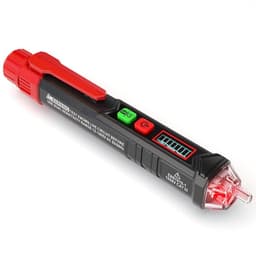
The Aicevoos A1 is a non-contact pen you hold near an outlet or a flex, and it is the best value listing in this set at £7.99. Amazon.co.uk shows 4.6 out of 5 from 1,726 reviews, and the page ranks it first in Voltage Testers. A red light and a faster beep mean you are closer to an AC field; yellow is the lower indication, and an H/L key switches the stated ranges of 12–1000 V AC and 48–1000 V AC. The listing prints CE, a torch, a pocket clip and a class 2 laser under 1 mW, and it does not print a CAT rating, BS EN 61243-3 or GS38 probe caps. The technical table does not list batteries; one UK review says the AAA cells arrived corroded and worked after they were replaced. Another buyer found the indication unsteady while changing a switch. There is no numeric screen, which matches the LED-and-buzzer description, and silence from this pen is not proof a conductor is dead.
Pros
£7.99 with 4.6 out of 5 from 1,726 reviews
Dual AC ranges, a torch and a pocket clip
Buyers describe it as a light household tracer
Low-battery indication stated under 2.5 V
Cons
Non-contact only, so silence is not a dead-circuit proof
CE only, with no CAT line and no BS EN 61243-3 line
One set of AAA cells arrived corroded
No numeric voltage on a screen
Best for: Tracing a break in a flex or seeing whether a fitting looks live, without touching the conductor.
Less suitable: Proving a circuit dead, a DC vehicle circuit, or anyone who needs a voltage number.
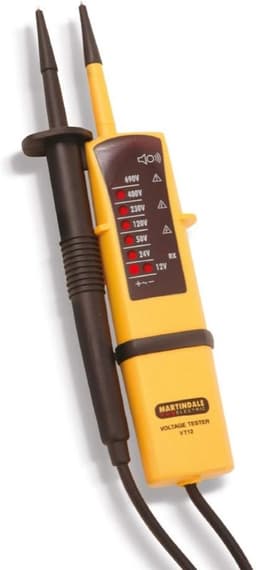
The Martindale VT12 puts two probes on the conductors and indicates 12–690 V AC/DC, with continuity in the same instrument. On amazon.co.uk it is £33.48, rated 4.6 out of 5 from 1,408 reviews, and it is the only listing in this set that states BS EN 61243-3:2014 and GS38 probe tip caps. Reviewers treat the LEDs as a rough voltage guide and the tip-to-tip beep as a battery check, which does not prove the voltage ranges. One UK review says live indication still worked with the batteries removed, while others say the cells ran down within a few days and that the battery cover is fiddly. The included-components line lists batteries, yet one buyer reported none in the box. At least one unit failed after about two weeks, and another became intermittent after about a year. It is the top pick for a contact check, and it is still a yes-or-no indicator rather than a numeric meter. The amazon technical table does not print a CAT rating.
Pros
Listing states BS EN 61243-3:2014 and GS38 probe tip caps
12–690 V AC/DC with continuity
4.6 out of 5 from 1,408 amazon.co.uk reviews at £33.48
One UK review reports live indication with the batteries out
Cons
Batteries reported to drain within a few days, and one box arrived without them
Battery cover described as fiddly
LED steps are a rough guide, not a numeric reading
One early failure and one intermittent unit after about a year
Best for: A contact check before you work on a domestic socket, switch or light, once you have proved the tester.
Less suitable: Phase rotation, a numeric LCD, or scanning a cable without touching the conductors.
Does the Martindale VT12 listing state a British Standard?
Yes. The specification-met line says BS EN 61243-3 2014, and a bullet says it is GS38 compliant with probe tip caps. The amazon technical table does not print a CAT rating.
Does the VT12 test continuity?
Yes. Continuity is in the bullets. A UK review also says it does continuity, after another comment had said it did not.
Are batteries included?
The included-components line says the tester and batteries. One UK review says batteries were not supplied, and another says the cells run down in a few days.
The Kaiweets pen is the largest review line in this comparison: 4.5 out of 5 from 16,240 amazon.co.uk reviews, at £10.99, rank 2 in Voltage Testers. The title says HT100 and the model field on the same page says HT101. It states 12–1000 V AC and 48–1000 V AC, a high-voltage alert above 90 V, CAT III 1000 V / CAT IV 600 V, two AAA batteries in the box and a 3-year warranty. That category mark does not turn a pen into the instrument you use to prove a circuit dead. One buyer returned a unit that was sensitive one minute and missed a live wire the next. Another said it worked through plastic conduit and not through armoured cable, and that 240 V mains was clearer than 12 V on a car. The box line lists the tester, two AAA cells and a manual.
Pros
4.5 out of 5 from 16,240 amazon.co.uk reviews
CAT III 1000 V / CAT IV 600 V printed on the listing
Two AAA batteries and a 3-year warranty stated
Clearer on 240 V mains than on a 12 V car circuit, in one review
Cons
A non-contact pen, so it does not prove a circuit dead
Title says HT100 while the model field says HT101
One return after a missed live wire
One review: no detection through armoured cable
Best for: Household tracing when you want the largest UK review count on a pen in this set.
Less suitable: Safe isolation, armoured cable, or a DC vehicle battery.
The Venlab VD-200 is a non-contact pen at £9.99, with 4.5 out of 5 from 5,221 amazon.co.uk reviews and rank 3 in Voltage Testers. The listing states 12–1000 V AC and 48–1000 V AC, IEC 61010-1, CAT III 1000 V / CAT IV 600 V, a torch and a low-battery warning under 2.5 V, with auto shut-off after three minutes. It describes an LED and a buzzer, and one UK review lists the missing numeric reading as a drawback. The included-components line says two AAA batteries, yet one review found the fitted cells flat and another said the battery was not included. A long-term reviewer reports about two years of use and loosens the end cap so the cells do not stay connected. A UK review mentions a laser, which the bullets in this extract do not name. The CAT line still leaves this as a field pen, not a two-pole proving instrument.
Pros
4.5 out of 5 from 5,221 reviews at £9.99
IEC 61010-1 and CAT III 1000 V / CAT IV 600 V on the listing
Dual AC range, torch and three-minute auto shut-off
One reviewer reports about two years of household use
Cons
No numeric voltage on the listing
Battery line conflicts with reviews of flat or missing cells
AC field sensing only
A laser appears in a review and not in the bullets
Best for: A mid-priced pen for ordinary household cables when LED-and-buzzer indication is enough.
Less suitable: A numeric reading, proving a circuit dead, or buyers who need the box to match the included line every time.
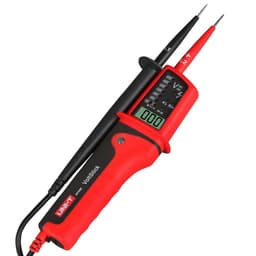
The Atuten UT15C is the second two-pole tester here, at £35.69, with an LCD for 12–690 V AC/DC plus continuity, polarity, phase rotation and a single-pole test. Amazon.co.uk shows 4.5 out of 5 from 58 reviews, rank 14 in Voltage Testers, and 11 UK review texts were read. The specification line states IEC 61010-1:2000-1 and IP 67. It does not state BS EN 61243-3 or GS38 probe caps. IP 67 is a listing mark, not an instruction to use the tester in the rain. One unit was returned because it did not work, and another became unreliable within seven months of daily use, with false readings and repeated battery changes. The included-components line says no. A reviewer who identifies as a professional electrician says theirs works, which sits beside those two fault reports on a small sample.
Pros
LCD plus LEDs for 12–690 V AC/DC
Continuity, polarity, phase rotation and a single-pole test
£35.69, close to the VT12, with functions that listing does not state
One reviewer who identifies as an electrician reports it works
Cons
Does not state BS EN 61243-3 or GS38 probe caps
4.5 out of 5 from only 58 reviews
One return on arrival and one failure within about seven months
Included components listed as no; IP 67 is not a rain instruction
Best for: A contact tester when you want phase rotation and a numeric LCD and you accept the missing standard line.
Less suitable: Anyone who needs the listing to state BS EN 61243-3, or daily site use without a spare.
No. The specification-met line says IEC 61010-1:2000-1 and IP 67. GS38 probe caps are not stated.
What extra tests does the listing name?
Continuity, polarity, phase rotation and a single-pole test, plus an LCD for 12–690 V AC/DC.
What did UK reviews report after daily use?
One review says it was sent back because it did not work. Another says it became unreliable within seven months, with false readings and repeated battery changes. The star line is 4.5 from 58.
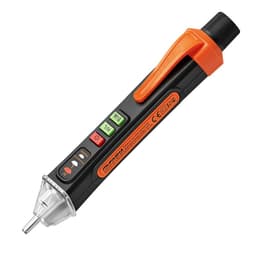
The Mufasha T-02a is a non-contact pen at £8.99 that states 12–1000 V AC and 48–1000 V AC, IEC 61010-1 and CAT III 1000 V / CAT IV 600 V. The bullets also name a class II laser under 1 mW and a 3-year warranty. Amazon.co.uk shows 4.4 out of 5 from 31 reviews, rank 37 in Voltage Testers, and 13 UK review texts sit beside that star line, which is a thin sample next to the other pens. One buyer, trying a 12 V camper circuit, said the pen lit on wood, metal and fabric. Another called it flimsy for site use by a trainee, and one review raises laser safety. UK reviews say two AAA cells were supplied even though the technical table does not list batteries. The 12 V figure on the listing is an AC minimum, so it is not evidence the pen can read a DC vehicle battery.
Pros
Dual AC range and a CAT line at £8.99
Torch and high/low settings
3-year warranty stated in the bullet
Small enough for a toolkit, according to reviewers
Cons
Only 31 amazon.co.uk ratings
One review: it lit on wood, metal and fabric
Described as flimsy for site work
One buyer raises laser safety; the bullet says class II under 1 mW
Best for: A spare household pen if you accept a small review sample and AC tracing only.
Less suitable: Site work, a camper or car 12 V circuit, or proving a socket dead.
One buyer, using it on a camper van, said it lit on wood, metal and fabric. The listing still states a 12 V AC minimum.
Does the listing mention a laser?
Yes. A bullet says class II laser, under 1 mW. One UK review raises laser safety.
How many reviews are on the star line?
4.4 from 31. Thirteen UK review texts were read. That is a thin sample next to the other pens.
How we compared
The score on each of the six amazon.co.uk listings is the star line times 20. A 4.6 becomes 92. A 4.5 becomes 90. A 4.4 becomes 88. Price is not inside the score. It is used only for the best value badge. A thin review sample, a missing British Standard line, a battery clash and a false-reading review stay in the assessment. They are not subtracted. The Martindale VT12 and the Aicevoos A1 both score 92. The top-pick badge goes to the VT12 because it is the only listing here that states BS EN 61243-3:2014 and GS38 probe caps. The Aicevoos is a non-contact pen, so the shared score does not make it the top pick. This is not a laboratory test. The five weights below are the order of the buying checks. They sum to 100. They are not a second score.
1
Type
30%
If you will touch the conductor, buy a two-pole tester. If you are picking a live cable out of trunking, a pen is what GS38 allows for identification. A pen is not the instrument for proving a circuit dead, so the two types are not ranked against each other on price.
2
Standard on the listing
25%
The Martindale VT12 states BS EN 61243-3:2014 and GS38 probe caps. The Atuten UT15C states IEC 61010-1:2000-1 and IP 67, not BS EN 61243-3. A CE mark, or a CAT line on a pen, is not that standard.
3
Range and current
20%
Pens here are AC only, advertised as 12–1000 V and 48–1000 V. Both two-pole listings say 12–690 V AC/DC. A 12 V AC claim is not evidence a pen can read a DC vehicle battery. UK mains are 230 V.
4
Probe and category marks
15%
GS38 wants a finger barrier and no more than 4 mm of exposed metal, preferably 2 mm. CAT III is the building installation and CAT IV is the origin. A CAT mark on a pen does not make the pen a proving tool. The VT12 amazon table does not print a CAT rating.
5
Reviews, then price for the badge
10%
Review volume is a tie-break inside one type, not across types. Kaiweets is 4.5 from 16,240, and that does not outrank a two-pole tester for isolation. Price is not inside the score. The best value badge is the Aicevoos at £7.99, not the dearer Kaiweets pen.
Independent review
Last updated: October 2026
8 sources checked
Voltage tester buying guide
Choose the job before the brand. A pen identifies a live AC field. A two-pole tester is the contact tool for a yes-or-no voltage check. Neither one is a numeric meter, and a pen does not prove a circuit dead.
What is a voltage tester?
A voltage tester in this comparison is one of two tools. A non-contact pen senses an AC field near a cable or a fitting. A two-pole tester puts two probes on the conductors and indicates whether voltage is present. The buyers in view are householders changing an accessory, and electricians proving a circuit dead. Those jobs do not share one instrument.
HSE guidance note GS38 says a non-contact stick is for identifying live equipment, not for proving it dead.
Best for
A contact check on a domestic socket or light, after you have proved the tester
Tracing a break in a flex with a pen, without treating silence as dead
Not ideal for
Anyone using a pen, a neon screwdriver or a multimeter to decide a cable is dead
A consumer unit, or any circuit you cannot lock off
Mistakes to avoid
1
Treating pen silence as dead
GS38 limits a non-contact stick to identifying live equipment. HSG85 says not to use a volt stick to prove dead. A UK review of the Kaiweets says it missed a live wire and did not see armoured cable. A Mufasha review says the pen lit on wood. Silence, or a light on the wrong material, is not a dead-circuit proof.
2
Reading CE or CAT IV as GS38 approval
Kaiweets, Venlab and Mufasha print CAT III 1000 V / CAT IV 600 V. The Aicevoos prints CE and no CAT line. A category mark on a pen does not make it the instrument for proving a circuit dead, and it is not a statement of GS38 probe caps. Only the VT12 listing in this set states those caps.
3
Treating both two-pole testers as the same standard
The VT12 states BS EN 61243-3:2014. The UT15C states IEC 61010-1:2000-1 and IP 67, not BS EN 61243-3. IP 67 is not an instruction to use the tester in the rain. A continuity beep, including the VT12 tip-to-tip check, does not prove the voltage ranges.
What to weigh up
Type and the standard on the listing
High
If you will touch the conductor, buy a two-pole tester. If you are picking a live cable out of trunking, a pen is what GS38 allows for identification. It is not a dead-circuit proof. The Martindale VT12 and the Atuten UT15C are the contact testers. The Aicevoos, Kaiweets, Venlab and Mufasha listings are pens.
Read the standard before the extra functions. The VT12 states BS EN 61243-3:2014 and GS38 probe tip caps, at £33.48 with 4.6 from 1,408 reviews.
Range, category marks and the star line
High
Pens in this set are AC only, advertised as 12–1000 V and 48–1000 V. Both two-pole listings say 12–690 V AC/DC, with continuity. A 12 V figure on a pen is an AC minimum, not evidence it can read a DC vehicle battery. UK mains are 230 V. HSE's FAQ says injury can start above about 50 V AC.
CAT III is the building installation and CAT IV is the origin. Kaiweets, Venlab and Mufasha print CAT III 1000 V / CAT IV 600 V.
Which option suits you?
Three typical situations, each with a recommendation from this comparison.
🔌
Changing a faceplate
A like-for-like faceplate needs a two-pole tester and a lock-off, or you should stop. The Martindale VT12 is about £33.48, with 4.6 from 1,408 reviews. The listing states BS EN 61243-3:2014 and GS38 probe caps. A proving unit is not in this set.
A pen can trace a break in a flex. Do not treat silence as dead. The Aicevoos A1 is about £7.99, with 4.6 from 1,726 reviews. It is the best value. The listing prints CE only, with no CAT line.
You want a numeric LCD, polarity and phase rotation, and you accept a listing that does not state BS EN 61243-3. The Atuten UT15C is about £35.69, with 4.5 from 58 reviews. IP 67 on that listing is not an instruction to use it in the rain.
The top pick is the Martindale VT12 at about £33.48, with 4.6 from 1,408 amazon.co.uk reviews. It is a two-pole tester for 12–690 V AC/DC with continuity, and the only listing here that states BS EN 61243-3:2014 and GS38 probe tip caps. The amazon table does not print a CAT rating. Battery drain stays in the assessment. A pen with the same star score is not the tool for proving a circuit dead.
Which voltage tester is the best value?
The best value is the Aicevoos A1 at about £7.99, with 4.6 from 1,726 reviews. It is a non-contact pen with dual AC ranges, a torch and a CE mark, and it does not print BS EN 61243-3. The Kaiweets pen costs about £10.99 with a much larger review count, so it does not take the badge. The Mufasha is about £8.99 with 31 ratings. Silence from the Aicevoos is not proof a conductor is dead.
How much does a voltage tester cost on amazon.co.uk?
On these six amazon.co.uk listings, shelf prices run from about £7.99 to about £35.69. The pens are £7.99, £8.99, £9.99 and £10.99. The two-pole testers are the Martindale VT12 at £33.48 and the Atuten UT15C at £35.69. A rule of thumb for this extract: under £11 is a pen, and the mid-£30s is a two-pole tester. Trade kits with a proving unit are not included. Prices move.
Can a non-contact pen prove a circuit dead?
A non-contact pen identifies live equipment. GS38 does not treat it as proof a circuit is dead, and HSG85 says the same of a volt stick. A red light means you are near an AC field. Silence does not mean the conductor is dead. The safe isolation guide sets out prove, test, prove for a two-pole tester, and where you stop. A CAT mark on a pen does not change that limit.
What does BS EN 61243-3 cover?
BS EN 61243-3:2014 covers contact two-pole detectors up to 1000 V AC or 1500 V DC, in dry and humid conditions, not in rain. They are not measuring devices. Only the Martindale VT12 listing here states that standard, with GS38 probe tip caps. The Atuten UT15C states IEC 61010-1:2000-1 and IP 67, which is a different line. IP 67 is not permission to test in the rain. A CE mark on a pen is not this standard.
When should you stop and call a competent person?
Stop if you cannot lock the isolator, if more than one source can feed the circuit, if the job is a consumer unit, or if the tester fails its proving check. Regulation 14 of the Electricity at Work Regulations 1989 restricts work near live conductors. HSR25 says you prove the indicator before and after the dead test. A faceplate change needs a two-pole tester and a lock-off. A continuity beep is not a voltage proof.
Is a voltage tester the same as a multimeter?
A voltage tester here is a non-contact pen or a two-pole yes-or-no indicator. A multimeter reads voltage, current and resistance as numbers. HSG85 says you should not use a multimeter or a volt stick to prove a circuit dead. BS EN 61243-3 says a two-pole detector of that type is not a measuring device. If the job is a consumer unit, or you cannot lock the isolator, stop and use a competent person.
Our verdict
The top pick is the Martindale VT12 at about £33.48, with 4.6 from 1,408 reviews. It is the only listing in this set that states BS EN 61243-3:2014 and GS38 probe tip caps, for 12–690 V AC/DC with continuity. The amazon technical table does not print a CAT rating, and battery drain stays in the assessment. The best value is the Aicevoos A1 at about £7.99, with 4.6 from 1,726 reviews. It is a non-contact pen with a CE mark only, and silence from it is not proof a conductor is dead. The Kaiweets pen is 4.5 from 16,240 at about £10.99, so the larger review count does not take the value badge. The Atuten UT15C is a two-pole tester at about £35.69 and does not state BS EN 61243-3.
Best overall
Aicevoos A1
Highest score in this comparison, 9.2 out of 10, from 1,726 amazon.co.uk reviews.
Peter F. is the editor for DIY & tools at productscompared.co.uk. Comparisons in this category are checked against amazon.co.uk listings, review evidence and public UK sources.
Updated: October 2026
8 sources checked
Guides to voltage testers
Guides on what to look for, how to use a product, and common mistakes.
Public UK sources on safe isolation, two-pole detectors and the danger threshold. Shelf prices, stars and review counts are the amazon.co.uk lines in the six listings dated 15 October 2026. Prices move.
This page contains affiliate links to amazon.co.uk. A qualifying purchase can earn us a commission at no extra cost to you. Scores are the star line times 20. They are not a laboratory test.