Independent comparisons. We may earn from shop links. More info

USB multimeter comparison 2026

The best USB multimeters, compared.

Top pick: YEREADW KWS-2303C – 4.6 from 774 reviews at about £11.97, USB-C, with a stated curve inside 4–30 V. Best value: YEREADW 066C – About £9.27, 4.5 from 532 reviews, USB-C, with double-click rotation. Updated October 2026.

Peter F.
Peter F.Editor

A USB multimeter sits in the lead and shows voltage, current, and usually watts, milliampere-hours and watt-hours. It is not a handheld mains multimeter, and it is not a cable e-marker tester. You separate them by the plug, a stated ceiling of 30 V or 32 V, and whether a capacity counter or a curve is named. A stated 12 A range is not 36 V or 48 V charging. The [USB multimeter buying guide](/hub/measuring-equipment/usb-multimeter/sub/usb-multimeter-buying-guide) takes the ceiling, the plugs and the price in that order. Match the charger, the screen and the leads you still own.

A USB multimeter sits in the lead and shows voltage, current, and usually watts, milliampere-hours and watt-hours. It is not a handheld mains multimeter, and it is not a cable e-marker tester.

YEREADW KWS-2303C

Best overall

YEREADW KWS-2303C
9.2/10∼ £12

18 products checked · 48 hrs invested · +16,800 readers

5 of 5: Best USB multimeters compared

Swipe for more

1-2 of 5
Best overall
YEREADW KWS-2303C
YOJOCK FT-ut003
YEREADW UT003
Best value
YEREADW 066C
Aideepen TM962
9.2/10
9.0/10
9.0/10
9.0/10
8.8/10
∼ £12
∼ £17
∼ £16
∼ £9
∼ £9
4.6(774)
4.5(3,408)
4.5(609)
4.5(532)
4.4(211)
View offer
View offer
View offer
View offer
View offer

Personal buying guide

Question 1 of 2

Which plug are you testing?

The best USB multimeters in detail

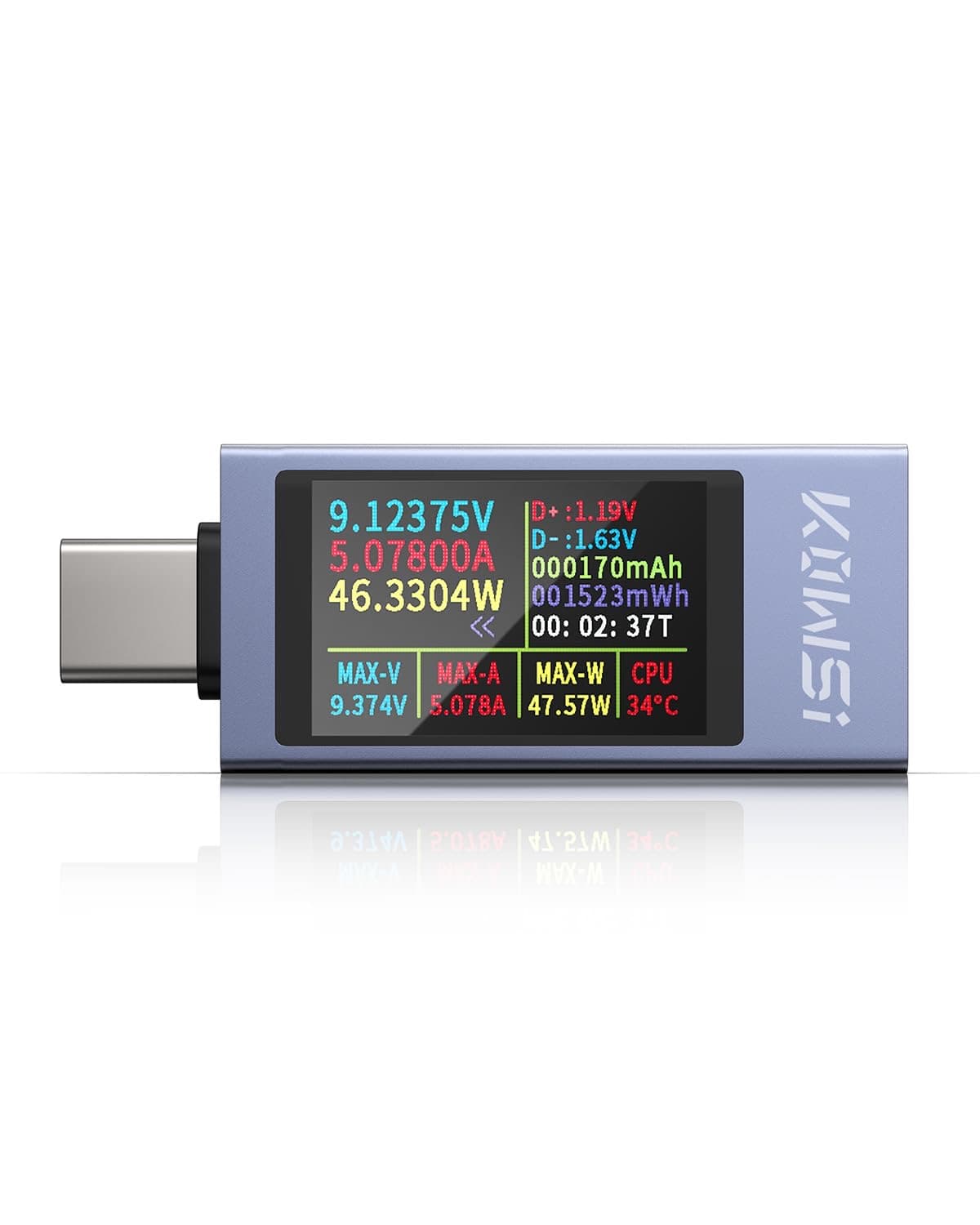
YEREADW KWS-2303C

Rank 1

YEREADW KWS-2303C

∼£12

Our view

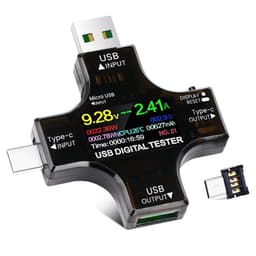
The YEREADW KWS-2303C is the USB-C meter stated at 4–30 V and 0–12 A, with a 1.06 inch screen and a curve the listing sets to 5 minutes, 15 minutes, 60 minutes, or 2 hours. The amazon.co.uk extract shows £11.97 and 4.6 out of 5 from 774 reviews, the highest star line in this set, which is why it is our top pick for USB-C leads inside that voltage ceiling. The score of 92 is 4.6 times 20, a listing conversion, not a lab rank. UK reviews describe a bright display, a double-click that flips the screen, a phone session at 3 A and 15 V (45 W), and a microcontroller at about 0.02 W. One review says the mAh figure was still there after unplugging. Other reviews say the type is still small, the digits change too fast, and some units never lit. One review says a laptop charge stayed at 5 V and 0 A, and one review claims a Steam Deck charging IC, SSD, and SD card were damaged; that damage claim is a single report and is not treated as a measured rate. The 0–12 A line does not make this a 48 V or 240 W meter, so you stop if a device behaves oddly once the meter is in the lead.

Pros

  • Highest star line in the set: 4.6 from 774 reviews
  • Curve page and a stated 0–12 A range on USB-C
  • 1.06 inch screen with double-click rotation
  • UK reviews mention a readable display and mAh memory after unplugging

Cons

  • Still small for some readers, and digits can change quickly
  • Some units never lit, according to UK reviews
  • One uncorroborated damage claim, so stop if a device behaves oddly
  • 4–30 V ceiling, so not a 48 V meter

Best for: USB-C charging checks where you want a short curve as well as volts, amps, and watts.

Less suitable: USB-A chargers, 36 V or 48 V bricks, and anyone who needs an e-marker or a PD log.

Specifications

Model
YEREADW KWS-2303C
Brand
YEREADW
Price
∼£12
Customer rating
4.6/5(774)
Ports
USB-C
Voltage
4–30 V
Current
0–12 A
Protocols
PD, QC, others
Capacity
Yes
Energy
Yes
Curve
5 min to 2 h
Screen rotate
Yes, double-click
Power source
USB supply
Accuracy
±(1%+5)
Weight
32 g

Common questions

What does the KWS-2303C curve page record?

The listing says a long press sets the curve to 5 minutes, 15 minutes, 60 minutes, or 2 hours, for voltage and current.

Is 0–12 A the same as 240 W charging?

The listing states 4–30 V and 0–12 A. It does not state 48 V or 240 W extended power range.

Can the screen be turned?

Yes. The listing says a double-click rotates the display. UK reviews also describe that 180 degree flip.

YOJOCK FT-ut003

Rank 2

YOJOCK FT-ut003

∼£17

Our view

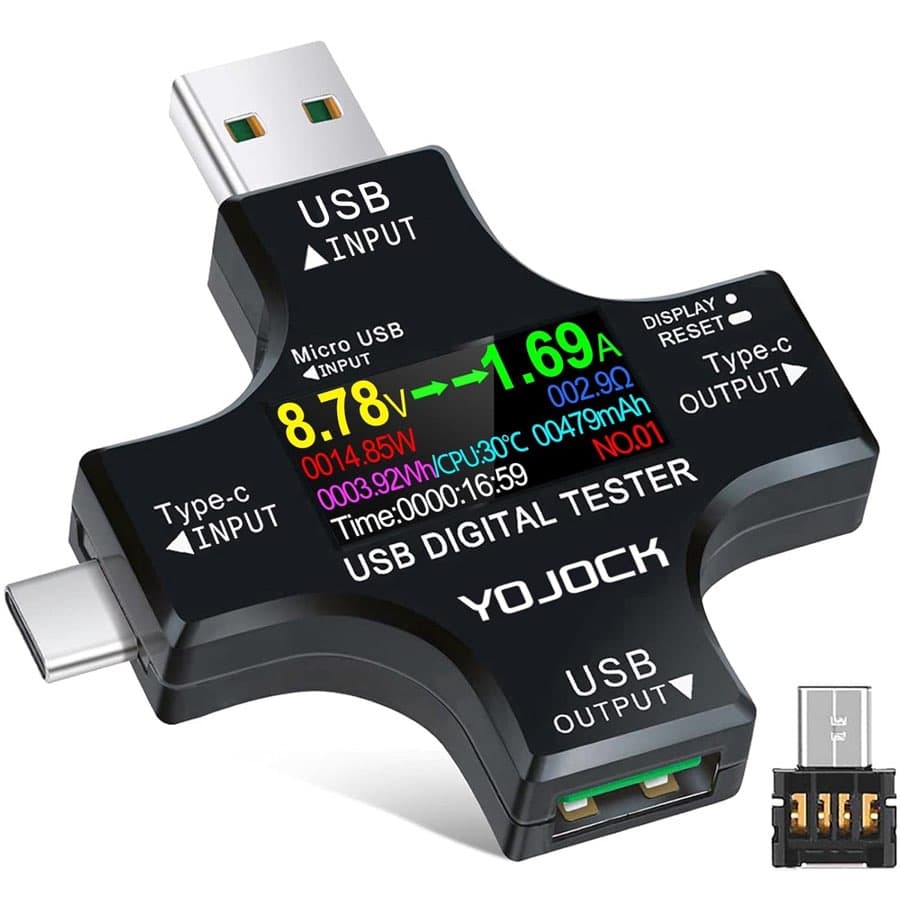
The YOJOCK FT-ut003 is the other USB-A and USB-C meter, at £16.97 with 4.5 out of 5 from 3,408 amazon.co.uk reviews, the largest count in this set. The title states 3.6–32 V and 0–8.0 A, while a bullet states measuring current of 0–5.1 A, and the extract does not reconcile the two. Bullets mention graphs, an OTG adapter, and a shortcut that multiplies the mAh reading by 1.35 at 5 V or by 2.45 at 9 V, which is the seller’s rule of thumb, not IEC 61960. UK reviews like one body for charger and cable checks, and they also call the type small and the plastic fragile. They disagree on the ports: one review says only USB-C to USB-C or USB-A to USB-A passes, and another says the USB-C port is reversible. A further review says there is no USB-C input for a captive USB-C lead, and that the shape can block a neighbouring port. A UK review calls this hardware generic and says two brands read the same, which is why we keep this ASIN separate from the YEREADW UT003 at £15.79. You pay £1.18 more than that listing mainly for the longer review history, and you should check the live port photo before you mix plugs.

Pros

  • USB-A and USB-C, with 4.5 from 3,408 reviews
  • Graphs mentioned on the listing and in reviews
  • USB powered, so no separate cell to fit
  • UK reviews use it to sort chargers and leads

Cons

  • Title says 0–8.0 A and a bullet says 0–5.1 A
  • Reviews disagree on which port pairs pass power
  • Small type and fragile plastic
  • £16.97, which is £1.18 above the YEREADW UT003

Best for: Mixed USB-A and USB-C checks when the larger review count matters more than the £15.79 alternative.

Less suitable: Buyers who need one clear current ceiling, a rotating screen, or a meter for 36 V or 48 V.

Specifications

Model
YOJOCK FT-ut003
Brand
YOJOCK
Price
∼£17
Customer rating
4.5/5(3,408)
Ports
USB-A and USB-C
Voltage
3.6–32 V
Current
8.0 A / 5.1 A
Protocols
PD, QC, BC 1.2
Capacity
Yes
Energy
Yes
Curve
Yes
Power source
USB supply
Weight
40 g

Common questions

Why are there two current ratings?

The title says 0–8.0 A. A bullet says measuring current 0–5.1 A. Both are in the extract and they are not reconciled.

What power-bank sum does the bullet print?

It says to multiply the mAh reading by 1.35 at 5 V discharge and by 2.45 at 9 V. That is the seller’s method, not a British standard.

Does every review agree the ports can be mixed?

No. One UK review says USB-C is reversible. Another says the sample only passes USB-C to USB-C or USB-A to USB-A.

YEREADW UT003

Rank 3

YEREADW UT003

∼£16

Our view

The YEREADW UT003 puts USB-A and USB-C on one body, stated at 3.6–32 V and 0–8.0 A, at £15.79 with 4.5 out of 5 from 609 amazon.co.uk reviews. The listing names PD, QC, and BC 1.2, and it prints 35 Wh divided by 3.7 V equals 9.46 Ah, which is the seller’s sum rather than a test of a named power bank. UK reviews use it to check charge ports and car USB sockets that switch off when the car locks. The same reviews say the manual does not explain the screens, some screens are in Chinese, the type is tiny, and a USB-A wall socket leaves the display facing the floor. One unit is described as failing to turn on about half the time, the button may not line up, and a micro-USB adapter is called poor. The model field UT003 also appears on YOJOCK B09T3KHBFL, so this £15.79 listing is a separate ASIN, not the same page. Choose it when you need both plugs and want to stay at £15.79, and skip it if you need a rotating screen.

Pros

  • USB-A and USB-C on one meter at £15.79
  • Stated range 3.6–32 V and 0–8.0 A
  • UK reviews use it on car USB ports as well as wall chargers
  • Capacity and energy counters are on the listing

Cons

  • Screen can face the skirting board, and rotation is not stated
  • Some screens in Chinese, and the manual does not explain them
  • At least one UK review describes unreliable power-up
  • The model name UT003 is shared with the YOJOCK listing

Best for: A mixed drawer of USB-A chargers and USB-C leads when £15.79 is the price you want to stay under.

Less suitable: Anyone who needs a rotating screen, large digits, or a meter rated for 36 V or 48 V.

Specifications

Model
YEREADW UT003
Brand
YEREADW
Price
∼£16
Customer rating
4.5/5(609)
Ports
USB-A and USB-C
Voltage
3.6–32 V
Current
0–8.0 A
Protocols
PD, QC, BC 1.2
Capacity
Yes
Energy
Yes
Power source
Battery stated
Weight
50 g

Common questions

Which plugs does this YEREADW listing include?

The title says a 2 in 1 USB-C tester at 3.6–32 V and 0–8.0 A, and the bullets cover USB and Type-C ports.

How does the listing turn watt-hours into amp-hours?

It prints one example: 35 Wh divided by 3.7 V equals 9.46 Ah. That is the seller’s arithmetic, not a measured power bank.

Is model UT003 unique to this ASIN?

No. The same model field appears on YOJOCK B09T3KHBFL. The ASINs and prices in these extracts differ.

YEREADW 066C

Rank 4

YEREADW 066C

Our view

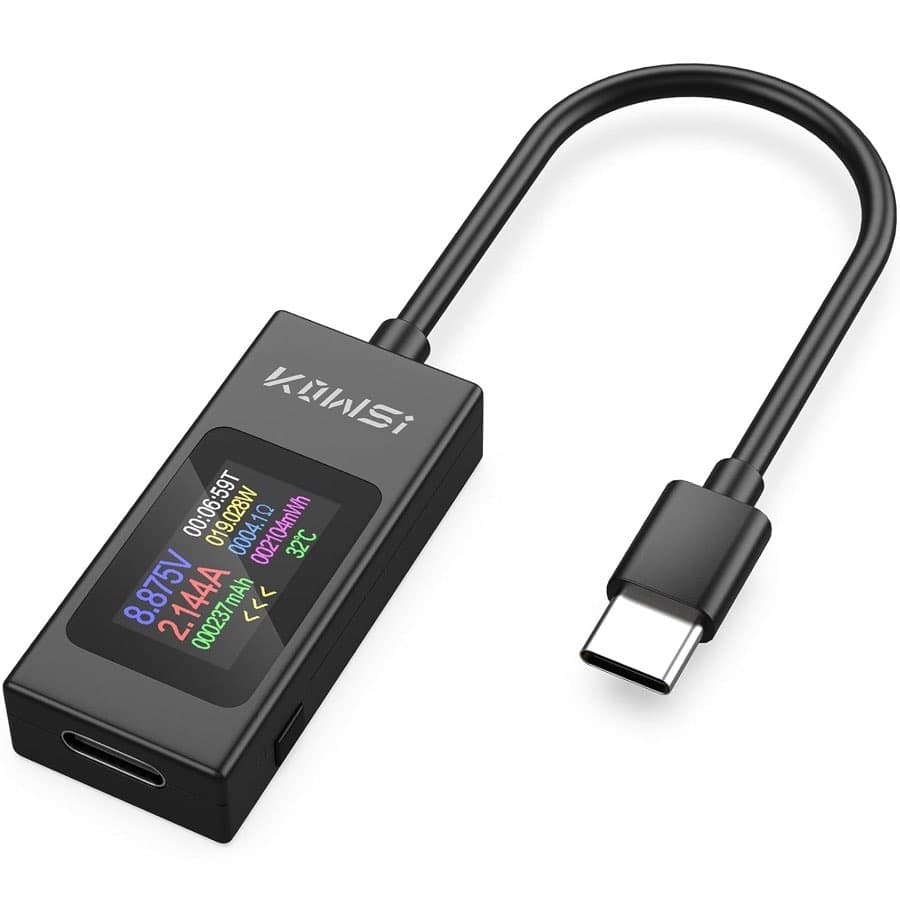
The YEREADW 066C is a USB-C meter stated at 4–30 V and 0–6.5 A, listed at £9.27 with 4.5 out of 5 from 532 amazon.co.uk reviews. A double-click rotates the screen, and the listing shows current direction, capacity, energy, and protocol names that include PD and QC. The printed accuracy is ±(1%+5), and the listing does not define the 5, so that line is not a calibration. The power-source field says battery powered, while UK reviews say there is no cell and the screen runs from the USB supply. Several of the first 50 reviews call the display very small, and one Samsung Fold charge showed about 2,168 mAh against a 4,000 mAh-class cell, which is what you can see when the meter counts output charge at a higher voltage. One review reports interference with Samsung super-fast charging, and others mention a unit that arrived dead or failed after about two months. A connector that only made contact when pushed hard also appears in those reviews. It is our best value here because USB-C and rotation cost 48p more than the USB-A Aideepen and £2.70 less than the KWS-2303C, as long as you stay inside 30 V.

Pros

  • USB-C at £9.27 with a stated 0–6.5 A ceiling
  • Double-click screen rotation
  • Capacity, energy, and current direction on the listing
  • 4.5 from 532 amazon.co.uk reviews

Cons

  • UK reviews call the display very small
  • Power-source field says battery; reviews say it runs from USB
  • ±(1%+5) is printed without a defined second term
  • One report of Samsung super-fast charging interference, plus dead-on-arrival units

Best for: USB-C phone chargers and cable sorting when you do not need a curve page.

Less suitable: USB-A-only drawers, 36 V or 48 V links, and anyone who needs large digits.

Specifications

Model
YEREADW 066C
Brand
YEREADW
Price
∼£9
Customer rating
4.5/5(532)
Ports
USB-C
Voltage
4–30 V
Current
0–6.5 A
Protocols
PD, QC, others
Capacity
Yes
Energy
Yes
Screen rotate
Yes, double-click
Power source
USB, no cell
Accuracy
±(1%+5)
Weight
59 g

Common questions

What voltage and current does the 066C listing state?

4–30 V and 0–6.5 A. The accuracy line is printed as ±(1%+5). The listing does not define the 5.

Does it need a battery?

The power-source field says battery powered. UK reviews say there is no battery and the screen runs from the USB supply.

Does a UK review mention the display size?

Yes. Several of the first 50 reviews call the display very small and mention reading glasses.

Aideepen TM962

Rank 5

Aideepen TM962

Our view

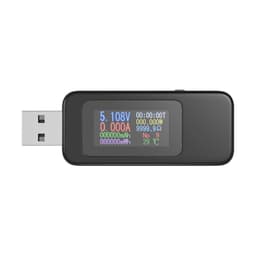
The Aideepen TM962 is a 10 g inline meter that UK reviews plug into a USB-A charger, and the listing states 4–30 V and 0–5.1 A. On amazon.co.uk the extract shows £8.79 and 4.4 out of 5 from 211 reviews. A button stores capacity and energy in groups 1–9 when a power bank switches off, which is the job the bullets describe. Reviewers use the numeric screen to find a tablet that would not charge, though one hobby user wanted three decimal places of current. The same reviews call the manual useless, say the display cannot rotate, and describe accuracy as not perfect. At least one unit died after a short time, and a single review says a power bank caught fire with a cordless vacuum attached, which is one report rather than a failure rate we measured. At £8.79 it is the lowest shelf price in this set for USB-A checks, and you should leave it if your chargers are USB-C only or if the load is a vacuum or a heater.

Pros

  • USB-A inline meter at £8.79, stated at 4–30 V and 0–5.1 A
  • Capacity and energy stored in groups 1–9
  • UK reviews praise a readable numeric screen for charger checks
  • Listed weight 10 g

Cons

  • UK reviews say the screen does not rotate
  • No protocol names on the listing
  • Manual called useless, and at least one unit died after a short time
  • One review links a power bank fire to a vacuum on the lead

Best for: USB-A wall chargers and low-current hobby checks, if the live photo still shows a USB-A plug.

Less suitable: USB-C-only leads, 36 V or 48 V chargers, and high-draw loads such as a vacuum or a heater.

Specifications

Model
Aideepen TM962
Brand
Aideepen
Price
∼£9
Customer rating
4.4/5(211)
Ports
USB-A
Voltage
4–30 V
Current
0–5.1 A
Capacity
Yes, groups 1–9
Energy
Yes
Screen rotate
No
Power source
USB supply
Weight
10 g

Common questions

Does the Aideepen listing name USB-C?

No. The listing says a USB tester at 4–30 V and 0–5.1 A. UK reviews describe plugging it into a USB-A charger.

Can the listing’s meter store a power-bank reading?

Yes. The bullets say it saves capacity and power when a power bank switches off, in groups 1–9.

Does the screen rotate?

The listing does not say so. One UK review says this display cannot be rotated.

How we compared

The score on each of the five amazon.co.uk listings is the star line times 20. A 4.4 becomes 88, a 4.5 becomes 90 and a 4.6 becomes 92. Review count is not added. Dead-on-arrival reports, the YOJOCK current conflict, a tiny screen and a single damage claim stay in the assessment. They are not subtracted. Price is not inside the score. It is used only for the best-value badge. This is not a lab test and not a calibration. The five weights below are the order of the buying checks. They sum to 100. They are not a second score.

1

Voltage ceiling

30%

Every meter kept here states 30 V or 32 V maximum. A 12 A line on a 30 V meter is not 240 W extended power range. Do not put these meters on a link that may negotiate 36 V or 48 V.

2

Plugs

25%

The Aideepen is USB-A in UK reviews. The 066C and the KWS-2303C are USB-C. The UT003 and the YOJOCK put USB-A and USB-C on one body. Check the live photo before you mix plugs.

3

Screen

20%

Volts, amps and watts are the buying trio. Capacity and energy matter for a power-bank discharge. A timed curve is stated only on the KWS-2303C. Rotation is stated on the two USB-C YEREADW meters.

4

Protocol names

15%

Printed PD and QC names are not a handshake decode. None of these listings states e-marker reading, PPS or AVS. Certifying a cable needs a protocol tool.

5

Conflicts and review themes

10%

The YOJOCK title says 0–8.0 A and a bullet says 0–5.1 A. The 066C power-source field says battery powered, while UK reviews say it runs from USB. Small type, dead-on-arrival units and one fast-charge note stay in the assessment.

Independent review
Last updated: October 2026
8 sources checked

USB multimeter buying guide

Match the voltage ceiling and the plug before the brand. A 30 V meter does not become a 48 V meter because the current line says 12 A.

What is a USB multimeter?

A USB multimeter is an inline meter in a USB lead. It shows voltage, current, and usually watts, milliampere-hours and watt-hours. It is not a handheld mains multimeter, and it is not a tool that reads a cable e-marker. The five meters kept here run from £8.79 to £16.97 on amazon.co.uk extracts dated 15 October 2026. Stars run from 4.4 from 211 reviews to 4.6 from 774. The YOJOCK is 4.5 from 3,408. Those are listing lines.

Best for

  • People sorting phone cables who do not own a 140 W or 240 W brick
  • Hobbyists checking USB-A chargers, small boards or car USB sockets

Not ideal for

  • Anyone whose charger may negotiate 36 V or 48 V
  • Anyone who needs an e-marker reading, a PD log or a mains test

Mistakes to avoid

  1. 1

    Treating meter mAh as the cell label

    IEC/EN 61960 capacity is marked in whole milliampere-hours at cell conditions. A USB meter counts charge leaving the port, often at 5 V, 9 V or higher. Compare watt-hours. A lower mAh figure does not, by itself, show a fake power bank.

  2. 2

    Reading 12 A as 240 W permission

    The KWS-2303C states 4–30 V and 0–12 A. Extended power range uses 28 V, 36 V and 48 V. Every meter in this set stops at 30 V or 32 V. Leave the meter out of a lead that may negotiate 36 V or 48 V.

  3. 3

    Ignoring the YOJOCK current conflict

    The YOJOCK title says 0–8.0 A and a bullet says 0–5.1 A. The extract does not reconcile them. The YEREADW UT003 states 0–8.0 A on a separate ASIN at £15.79. Check the live photo before you mix USB-A and USB-C.

What to weigh up

Voltage ceiling and plugs

High

Voltage comes before current. Every meter in this set states 30 V or 32 V maximum. The Aideepen, the 066C and the KWS-2303C state 4–30 V. The UT003 and the YOJOCK state 3.6–32 V. USB PD 3.1 extended power range uses 28 V, 36 V and 48 V, up to 240 W, in public descriptions from Plugable and ChargerLAB. A 0–12 A line on the KWS-2303C does not raise that 30 V ceiling. Do not put any of these meters on a link that may negotiate 36 V or 48 V. Then match the plug to the drawer.

Screen, protocols and conflicts

High

Volts, amps and watts are the readings that sort a charger. Capacity and energy matter when you discharge a power bank, and you should compare watt-hours rather than the cell milliampere-hour label. A timed curve, set to 5 minutes, 15 minutes, 60 minutes or 2 hours, is stated only on the KWS-2303C. Double-click rotation is stated on the 066C and the KWS-2303C. Where rotation is missing, UK reviews say a wall-socket USB port can leave the screen facing the floor.

Which option suits you?

Three typical situations, each with a recommendation from this comparison.

USB-C phone leads

You are sorting USB-C phone leads and you do not own a 140 W or 240 W brick. The KWS-2303C is about £11.97, with 4.6 from 774 reviews, a stated curve and a 4–30 V ceiling. It is the top pick for that job. Stop if a device behaves oddly once the meter is in the lead.

Our recommendation

View offer

USB-A chargers and small boards

You are checking USB-A wall chargers or a low-current board. The Aideepen TM962 is about £8.79, with 4.4 from 211 reviews, stated at 4–30 V and 0–5.1 A. UK reviews say the screen does not rotate. Leave it if your chargers are USB-C only.

Our recommendation

View offer

A power-bank label on USB-C

You want capacity and energy on a USB-C lead and you do not need a curve. The 066C is about £9.27, with 4.5 from 532 reviews. Compare watt-hours with the label. A lower milliampere-hour figure is not, by itself, a fake power bank.

Our recommendation

View offer

Common questions about USB multimeters

Which USB multimeter is the top pick here?
The top pick is the YEREADW KWS-2303C at about £11.97, with 4.6 from 774 amazon.co.uk reviews. It is a USB-C meter stated at 4–30 V and 0–12 A, with a 1.06 inch screen and a curve set to 5 minutes, 15 minutes, 60 minutes or 2 hours. The score of 92 is 4.6 times 20, not a lab rank. The 0–12 A line does not make it a 48 V or 240 W meter. Skip it for USB-A chargers.
Which USB multimeter is the best value?
The best value is the YEREADW 066C at about £9.27, with 4.5 from 532 reviews. It is USB-C, stated at 4–30 V and 0–6.5 A, and a double-click rotates the screen. That is 48p more than the USB-A Aideepen at £8.79, and £2.70 less than the KWS-2303C. UK reviews call the display very small. The printed accuracy is ±(1%+5), and the listing does not define the 5. Stay inside 30 V.
How much does a USB multimeter cost on amazon.co.uk?
On these five amazon.co.uk listings, shelf prices run from about £8.79 to about £16.97. The entry band is the Aideepen at £8.79, the YEREADW 066C at £9.27 and the KWS-2303C at £11.97. The dual-port band is the YEREADW UT003 at £15.79 and the YOJOCK FT-ut003 at £16.97. A KM003C was £90 on a UK shop page and sold out, and about £75 on eBay UK. That meter is not in this table. Prices move.
Does 0–12 A mean 240 W charging?
No. The KWS-2303C listing states 4–30 V and 0–12 A. It does not state 48 V or 240 W extended power range. USB PD 3.1 extended power range uses 28 V, 36 V and 48 V in public descriptions from Plugable and ChargerLAB. Every meter in this set stops at 30 V or 32 V. Do not put one on a link that may negotiate 36 V or 48 V. A high current figure does not raise the voltage ceiling.
Is a USB multimeter the same as a handheld multimeter?
No. A USB multimeter sits in a USB lead and shows volts, amps and usually watts on a charger or a power bank. A multimeter comparison covers handheld meters for voltage, current and continuity. These five listings are not CAT-rated mains testers. Do not use them on 230 V, and do not put probes in a USB socket. If a laptop port has failed, stop and use a professional.
Why is a power-bank mAh reading below the label?
Often, and that does not by itself show a fake power bank. Retained Regulation (EU) No 1103/2010 marks lithium capacity to IEC/EN 61960 in whole milliampere-hours at cell conditions, not as USB-output charge. Compare watt-hours. An IEEE Access study of two banks found output milliampere-hours near 60 percent of the label and watt-hours nearer 80 percent, and that was those two models only. The power bank capacity guide is that full-discharge job. Listing multipliers are not a British standard.
Do protocol names mean the meter reads the cable?
No. The £9.27 and £11.97 listings print PD, QC and several vendor names. The two dual-port meters print PD, QC and BC 1.2. None of the five states e-marker reading, PPS or AVS. A printed name is not a handshake decode, and it does not certify a cable. USB-IF publishes a laboratory method for e-marker checks. If you need that log, this set is the wrong tool.

Our verdict

The top pick is the YEREADW KWS-2303C at about £11.97, with 4.6 from 774 reviews, for USB-C leads inside 4–30 V. It states a curve and a 0–12 A range. That range is not 48 V or 240 W. The best value is the YEREADW 066C at about £9.27, with 4.5 from 532 reviews, because USB-C and screen rotation cost 48p more than the USB-A Aideepen. The Aideepen scores 88, and UK reviews treat it as USB-A only. The YOJOCK has the largest review count, 4.5 from 3,408, and its title and a bullet disagree on current. None of these scores is a calibration.

Best overall
YEREADW KWS-2303C

YEREADW KWS-2303C

4.6 from 774 reviews at about £11.97, USB-C, with a stated curve inside 4–30 V.

View offer
Best value
YEREADW 066C

YEREADW 066C

About £9.27, 4.5 from 532 reviews, USB-C, with double-click rotation.

View offer

Editorial

Peter F. - DIY & tools editor
DIY & tools editor
DIY & toolsMeasuring equipmentamazon.co.uk listings

Peter F. is the editor for DIY & tools at productscompared.co.uk. Comparisons in this category are checked against amazon.co.uk listings, review evidence and public UK sources.

Updated: October 2026
8 sources checked

Guides to USB multimeters

Guides on what to look for, how to use a product, and common mistakes.

Related comparisons

Sources

Public UK sources named in the research digest: battery marking, retained capacity rules, the Northern Ireland common-charger instrument, the Great Britain common-charger response, and the USB-IF e-marker method. Shelf prices, stars and review counts are the amazon.co.uk lines in the five extracts dated 15 October 2026. Prices move.

  1. GOV.UK, batteries (retrieved 15 October 2026)
  2. Regulation (EU) No 1103/2010, capacity marking (retrieved 15 October 2026)
  3. Radio Equipment (Amendment) (Northern Ireland) Regulations 2024, SI 2024/1231 (retrieved 15 October 2026)
  4. GOV.UK, Northern Ireland radio equipment amendment guidance (retrieved 15 October 2026)
  5. GOV.UK, government response to the common charger call for evidence (retrieved 15 October 2026)
  6. USB-IF, e-marker testing method, revision 1.2 (retrieved 15 October 2026)
  7. Plugable, VAMETER3 range (retrieved 15 October 2026)
  8. Digital Toolbelt, USB-C power meter ceiling warning (retrieved 15 October 2026)

This page contains affiliate links to amazon.co.uk. A qualifying purchase can earn us a commission at no extra cost to you. Scores are the star line times 20. They are not a laboratory test and not a calibration.