Independent comparisons. We may earn from shop links. More info

Test power bank capacity with a USB meter

Updated: October 2026

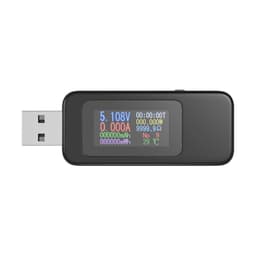
You bought a power bank with a large mAh number on the case, ran it through a USB meter, and the screen stopped far below that number. That gap is usual when you count two different things, not instant proof the bank is fake. This page is one job: charge the bank, discharge it once, and compare watt-hours. The meters are the five in our [USB multimeter comparison](/hub/measuring-equipment/usb-multimeter). The first ordinary reading is the [how to use a USB tester](/hub/measuring-equipment/usb-multimeter/sub/usb-multimeter-how-to-test) page. Peter F. used the extracts and GOV.UK battery guidance on 16 October 2026, with no bench discharge. A qualifying purchase can earn a commission at no extra cost to you.

You bought a power bank with a large mAh number on the case, ran it through a USB meter, and the screen stopped far below that number.

Our top picks

YEREADW YEREADW KWS-2303C

Best overall

YEREADW YEREADW KWS-2303C
9.2/10about £11.97
YEREADW YEREADW 066C

Preis-Tipp

YEREADW YEREADW 066C
9.0/10about £9.27
Aideepen Aideepen TM962

Alternative

Aideepen Aideepen TM962
8.8/10about £8.79
On this page

The label and the meter count different things

The mAh on the case is cell capacity, not the charge that leaves the USB socket. GOV.UK’s batteries guidance, reflecting retained Regulation (EU) No 1103/2010, requires that capacity in whole mAh. For lithium chemistries it points at IEC/EN 61960. A USB meter integrates current at the output voltage. At 5 V, 1,000 mAh is 5 Wh. At 3.7 V, 1,000 mAh is 3.7 Wh. When the converter raises the voltage, the meter’s mAh falls even if the watt-hours are honest. A lower mAh is expected. It is not, by itself, a failed bank. An IEEE Access paper measured two banks at 2.4 A. Output mAh was about 59 and 62 per cent of the label, while watt-hours were about 78 and 84 per cent. Anker’s UK page suggests about 60 to 75 per cent of rated mAh, as a rule of thumb.

Discharge once, then read watt-hours

Charge the bank until it stops. Clear mAh, Wh, and the timer first. On the 066C a hold clears capacity, energy, and the timer. On the Aideepen a button stores groups 1–9. Connect the bank, the meter, and a load that keeps drawing until the bank shuts down. Write down watt-hours first and mAh second, plus the voltage the screen mostly showed. A phone that is filling will taper, so it is a poor stand-in for a fixed 2.4 A load. A torch or a hobby board that stays on is closer, inside the meter’s current and inside 30 V or 32 V. Do not put a 30 V meter on a bank that may negotiate 36 V or 48 V.
YEREADW YEREADW KWS-2303C

Testsieger

YEREADW YEREADW KWS-2303C
9.2/10about £11.97

Do not use the seller’s multiplier as a standard

The YOJOCK bullets tell you to multiply the mAh reading by 1.35 at 5 V discharge and by 2.45 at 9 V. The YEREADW UT003 prints one example: 35 Wh divided by 3.7 V equals 9.46 Ah. Both are the seller’s arithmetic. Neither is IEC 61960. Do not treat a bank as failed because it misses the multiplied mAh, or as genuine because it hits it. Compare watt-hours with the energy the label implies, if the label states watt-hours. If it only states mAh, you can estimate cell energy as mAh times a nominal 3.7 V and divide by 1,000, and you should label that estimate as a rule of thumb. The meter’s watt-hours are the output you measured. A shortfall in output mAh, with watt-hours in a plausible band, is not a prosecution of the label.

Stop if the pack gets hot

One 066C review said a 10,000 mAh bank delivered about 2,000 mAh at the USB port, and a Samsung Fold charge showed about 2,168 mAh against a 4,000 mAh-class cell. Those are two anecdotes. Do not turn them into a percentage for every bank. If the case gets hot, or the meter blanks halfway, stop and record what you have. If the number will be used to sell the bank, or the pack has swollen, stop. These screens are not a trading-standards test. The ceiling and the plugs are on the buying guide.

Common questions

Why is the meter mAh lower than the label?
The label is cell capacity under IEC/EN 61960 conditions. The meter counts charge leaving the USB port, often at 5 V or 9 V, after a boost converter. Higher output voltage means fewer mAh for the same energy. A lower mAh reading does not, by itself, mean the bank is fake.
Should I compare mAh or watt-hours?
Compare watt-hours. Watt-hours include voltage, so a 9 V run and a 5 V run can be set side by side. Milliampere-hours cannot, unless you also write down the voltage and convert. The IEEE examples were closer on watt-hours than on mAh, and those two banks are not a universal score.
Do I charge the bank first?
Yes. Start from a full charge, clear the meter, then discharge once. A half-charged bank will stop early and look smaller than the label for a reason that has nothing to do with the cells. Let it finish charging before you zero the counter.
What load should I use?
Use a device that keeps drawing until the bank stops, and stay inside the meter’s stated current and inside 30 V or 32 V. A phone that is nearly full will taper. These listings do not include an electronic load, so you cannot claim a fixed 2.4 A test unless you add a load the meter does not provide.
What do the ×1.35 and ×2.45 figures mean?
They are the YOJOCK listing’s shortcut for turning meter mAh into a cell-style mAh at 5 V and at 9 V. The YEREADW example divides 35 Wh by 3.7 V. Both are seller arithmetic. They are not a British standard and not a result from your bank.
Is 60 per cent always normal?
No. Anker’s UK page offers about 60 to 75 per cent of rated mAh as a rough usable output. The IEEE paper saw about 59 and 62 per cent mAh on two banks, with higher watt-hour shares. A 066C review saw a much lower mAh on one bank. None of those figures is a pass mark for every pack.
Can I leave the meter in overnight?
Only if the bank, the cable, and the meter stay cool and the button does not stick. Capacity counters need a full discharge, and UK reviews include meters that die and packs that should be unplugged at the first sign of heat or swelling. If it smokes, stop. Do not sleep on a test that has already gone hot.

Related pages

Sources

Public UK sources named in the research digest: battery marking, retained capacity rules, the Northern Ireland common-charger instrument, the Great Britain common-charger response, and the USB-IF e-marker method. Shelf prices, stars and review counts are the amazon.co.uk lines in the five extracts dated 15 October 2026. Prices move.

  1. GOV.UK, batteries (retrieved 15 October 2026)
  2. Regulation (EU) No 1103/2010, capacity marking (retrieved 15 October 2026)
  3. Radio Equipment (Amendment) (Northern Ireland) Regulations 2024, SI 2024/1231 (retrieved 15 October 2026)
  4. GOV.UK, Northern Ireland radio equipment amendment guidance (retrieved 15 October 2026)
  5. GOV.UK, government response to the common charger call for evidence (retrieved 15 October 2026)
  6. USB-IF, e-marker testing method, revision 1.2 (retrieved 15 October 2026)
  7. Plugable, VAMETER3 range (retrieved 15 October 2026)
  8. Digital Toolbelt, USB-C power meter ceiling warning (retrieved 15 October 2026)