Independent comparisons. We may earn from shop links. Our editors compare products independently. Some links go to shops, and we may earn a commission. More info
Top pick: Jadeshay DIN-rail energy meter Best value: Awootsv PM04UK-1 power meter plug – About £11.99, 4.5 from 86 reviews, with a stated disconnect above 13 A and no backlight. Updated October 2026.
An energy meter on amazon.co.uk is usually a plug-in monitor in a BS 1363 socket. It shows watts, kilowatt-hours, and a cost after you type a unit rate in pence per kWh. The same shelf also lists clamps, a meter, and one hardwired whole-home monitor. A smaller group wants a circuit or a solar feed.
A useful plug is a UK 3-pin body, a readable display, and a load claim that respects 13 A. At 230 V a 13 A fuse is about 2,990 W. A listing that also prints 3,680 W is 16 A, which conflicts with the fuse. A clamp or the monitor needs a competent person.
The [energy meter buying guide](/hub/measuring-equipment/energy-meter/sub/energy-meter-buying-guide) separates a plug, a clamp and a rail.
Do not rank a plug against the on price alone.
An energy meter on amazon.co.uk is usually a plug-in monitor in a BS 1363 socket. It shows watts, kilowatt-hours, and a cost after you type a unit rate in pence per kWh.
An energy meter on amazon.co.uk is usually a plug-in monitor in a BS 1363 socket. It shows watts, kilowatt-hours, and a cost after you type a unit rate in pence per kWh. The same shelf also lists clamps, a meter, and one hardwired whole-home monitor. A smaller group wants a circuit or a solar feed.
A useful plug is a UK 3-pin body, a readable display, and a load claim that respects 13 A. At 230 V a 13 A fuse is about 2,990 W. A listing that also prints 3,680 W is 16 A, which conflicts with the fuse. A clamp or the monitor needs a competent person.
The [energy meter buying guide](/hub/measuring-equipment/energy-meter/sub/energy-meter-buying-guide) separates a plug, a clamp and a rail.
Do not rank a plug against the on price alone.
An energy meter on amazon.co.uk is usually a plug-in monitor in a BS 1363 socket. It shows watts, kilowatt-hours, and a cost after you type a unit rate in pence per kWh. The same shelf also lists clamps, a meter, and one hardwired whole-home monitor. A smaller group wants a circuit or a solar feed. A useful plug is a UK 3-pin body, a readable display, and a load claim that respects 13 A. At 230 V a 13 A fuse is about 2,990 W. A listing that also prints 3,680 W is 16 A, which conflicts with the fuse. A clamp or the monitor needs a competent person.
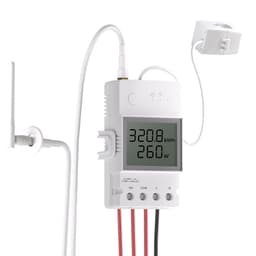
The Jadeshay DX-220V is a single-phase DIN-rail meter at £13.69, titled 5(32) A, with a backlit LCD of 6+1 digits and 4.8 from 5 reviews. You cannot plug it into a wall socket. A UK review says you need space in the consumer unit or a separate DIN box with a window, which is work for a competent person. The listing mentions PV use and does not show a test of it. Weight is 86 g and the model name is DX-220V. There is no tariff field in the comparison, so it reads as a kilowatt-hour counter rather than a cost calculator. Five reviews is a thin sample, which is why a 4.8 does not outrank the plug-in meters with 86 and 92 reviews. Skip it for a kettle, and use it only if you already have a plan for a DIN rail and someone competent to fit it.
Pros
DIN-rail kWh meter at £13.69, titled 5(32) A
Backlit LCD with 6+1 digits
86 g, model DX-220V
A UK review describes fitting it in a DIN box with a window
Cons
4.8 from only 5 reviews
Not a UK plug, and tariff entry is not stated
Consumer-unit or DIN-box fitting needs a competent person
PV use is mentioned and not tested; no accuracy percentage
Best for: A single-phase DIN rail you have already planned, with a competent person to fit the meter.
Less suitable: A kettle, a renter who cannot touch the board, or anyone treating five stars from five reviews as a track record.
The SONOFF POWCT is a clamp meter at £29.91 with 4.5 from 246 reviews, an LCD and an eWeLink app, and a stated maximum of 100 A and 24000 W. It is not a plug-in socket meter, and fitting it is electrical work. The bullets say solar-panel monitoring. A UK review used it on solar output and compared it with the inverter, which is not the same as the supplier meter. The bullet says a dry contact rated 2 A, used with a contactor to switch a load, so it is not a 100 A switch by itself. History of up to six months is claimed, weight is 247 g, and CE, UL and cULus are listing claims, not a trade-meter approval. Choose it when you need a circuit clamp with a larger stated current than the POFET's 10 mm opening, and skip it for a kettle.
Pros
4.5 from 246 reviews at £29.91
100 A and 24000 W stated, with an LCD and an app
Solar monitoring claimed, and a UK review compared it with an inverter
History of up to six months claimed
Cons
Not a plug; fitting is electrical work
The relay is 2 A for a contactor, not a 100 A switch
No accuracy percentage is stated
CE, UL and cULus claims are not a trade-meter approval
Best for: One circuit you can have fitted, when you want a clamp with a 100 A claim and an app history.
Less suitable: A kettle, a renter who cannot touch the board, or anyone who needs the clamp itself to switch 100 A.
The Tapsin JJ100851 sits in a BS 1363 socket and shows watts, kilowatt-hours and a cost once you enter a tariff, at £13.99 on amazon.co.uk with 4.5 from 92 reviews. The listing states a backlight of about five seconds after a button press, which matters if the socket is in a cupboard, and it does not light when the meter is unplugged. A backup battery is claimed, so the stored reading is meant to survive a short unplug. The bullets also state an overload alarm and cut-off at 3680 W. That figure is 16 A at 230 V, while a UK 13 A fuse on the same supply is about 2990 W, so you should not treat 3680 W as a safe continuous load. A UK review says the cost display reaches 99.99 and then rolls back to zero, while the kWh memory is a separate reading. No accuracy percentage is printed. It is the top pick among plug-in meters in this set because of that star line and the backlight, and you should skip it if you need the whole house or a reading you will charge someone for.
Pros
4.5 from 92 reviews at £13.99, with a stated backlight
Tariff button and a claimed backup battery
UK plug for one appliance
Cost and kWh are separate readings
Cons
3680 W alarm conflicts with a 13 A fuse, about 2990 W at 230 V
A UK review says the cost display rolls back to zero after 99.99
No accuracy percentage is stated
Backlight lasts about five seconds, and not when unplugged
Best for: One appliance in a BS 1363 socket where you want a backlit plug-in meter with a large review count.
Less suitable: A whole-house or solar reading, a dark socket you must read for minutes, or any figure you will use to bill someone.
The Awootsv PM04UK-1 is a plug-in meter at £11.99, with 4.5 from 86 reviews on amazon.co.uk. The listing says it alarms and disconnects when the load exceeds 13 A, which sits closer to a UK plug fuse than a 3680 W headline. There is no backlight, and UK reviews repeat that, so a socket behind a fridge is harder to read than on the Tapsin. A UK review says it keeps the price of the units, which is the setting that turns kilowatt-hours into a cost. A percentage accuracy is not stated. The table claims a 12-month warranty and GS and CE marks; those are listing claims, not a test we ran. At 150 g it is the lighter of the two 4.5-star plugs. It is the best value when you want the 13 A cut-off and can read the screen in ordinary light, and you should skip it if the socket is dark or you need a circuit rather than one appliance.
Pros
4.5 from 86 reviews at £11.99
Stated alarm and disconnect above 13 A
A UK review says it keeps the unit price
UK plug, 150 g
Cons
No backlight, which UK reviews repeat
No accuracy percentage is stated
Whether it keeps kWh after you unplug it is not stated
GS and CE are listing claims, not a trade-meter approval
Best for: One appliance in a lit room, when you want a cheap plug that states a 13 A cut-off.
Less suitable: A cupboard or a socket behind a fridge, or any load that is not a single plug.
The KETOTEK KTEM03 is a UK plug at £25.99 with the backlit LCD on a 2.9 m lead, so you can read a socket that sits behind an appliance. The Customer Reviews line is 4.4 from 6, which is a small sample next to the KTEM02UK's 113. A CR2032 is included and the bullet says data is saved during a power cut. Tariff entry is stated, with an alarm for power, kilowatt-hours or cost. A maximum watt figure is not in the technical details. Weight is 310 g, the heaviest plug here, and no accuracy percentage is printed. It is the plug to consider when the socket is blocked and you will pay more for the lead. Skip it if six reviews are too thin, or if the load is not a single appliance.
Pros
Backlit display on a 2.9 m lead
CR2032 included, and data-save in a power cut is claimed
Tariff entry and alarms for power, kWh or cost
4.4 from 6 reviews at £25.99
Cons
Only 6 reviews
£25.99, the dearest plug in the set
Maximum wattage is not stated
310 g, and no accuracy percentage
Best for: One appliance whose socket is hidden, when you need the screen on a lead and can accept a thin review file.
Less suitable: A visible socket where a cheaper plug will do, or any load that is not a single appliance.
The KETOTEK KTEM02UK is a UK plug at £18.99 with 4.3 from 113 reviews, the largest review count among the socket meters in this set. The title states 2900 W / 13 A overload protection, which sits next to a UK 13 A plug rather than a 3680 W line. There is no backlight. The tariff is stored, and the listing includes an alarm for power, kilowatt-hours or cost. A UK review says the timer paused when a heater thermostat opened and continued when it closed, so a run-time figure on a thermostatic load is not a clock of wall time. Weight is 190 g, and no accuracy percentage is stated. It is the plug to open if you want a stated 13 A limit and a larger review file than the Awootsv, at a higher price and without a light, and you should skip it behind a freezer where you cannot see the screen.
Pros
4.3 from 113 reviews, the largest plug-in count here
Title states 2900 W / 13 A
Tariff stored, with alarms for power, kWh or cost
UK plug, 190 g
Cons
No backlight
£18.99, dearer than the 4.5-star plugs
A UK review says the timer pauses when a heater thermostat opens
No accuracy percentage is stated
Best for: One appliance on a visible socket, when a stated 13 A limit and a larger review file matter more than a backlight.
Less suitable: A socket you cannot see, or a thermostatic heater if you need wall-clock run time.
The DEWIN KWS-AC301 is a panel meter at £16.39 for 50–300 V AC and 0–100 A, with 4.3 from 26 reviews. It is not a UK plug. The listing says pure AC at 50–63 Hz only, and that square-wave inverter output can damage it. A closed current transformer and a temperature sensor are in the box, and a competent person fits it. EN 61010-1 is claimed on the listing. A UK review says it works and is fairly accurate, and that the display is dim. Weight is 100 g, and dimensions are not stated. It measures one AC circuit on a panel, not the cost of a kettle, and you should not put it on a square-wave inverter output.
Pros
0–100 A and 50–300 V AC stated, at £16.39
4.3 from 26 reviews
Closed transformer and temperature sensor in the box
A UK review calls it fairly accurate
Cons
Not a plug, and a competent person has to fit it
Listing says square-wave inverter output can damage it
A UK review says the display is dim
No tariff entry and no stated dimensions
Best for: One pure AC circuit on a panel, 50–63 Hz, where a competent person can fit a closed transformer.
Less suitable: A socket appliance, a square-wave inverter output, or a cost in pence.
The KETOTEK KTEM01UK is a UK plug at £16.99 with an 11-mode LCD and 4.2 from 92 reviews, the same review count as the Tapsin and a lower star line. The style field says No Backlight UK Plug, and a UK review flags that. UK reviews say the tariff is the main setting, and the bullets include alarms for overload, kilowatt-hours and cost. The listing says it keeps data, and a review mentions a reset tool in the box with the plug and manual. A maximum watt figure is not in the raw technical details, so the load limit is n/a. Weight is 190 g. Eleven modes are more screen than a unit price and a display require. Choose it if you want those alarms and can read an unlit LCD, and skip it for a dark cupboard or if you wanted the cheaper 4.5-star plugs.
Pros
4.2 from 92 reviews, matching the Tapsin count
11 modes, with alarms for overload, kWh and cost
Tariff entry, and the listing says it keeps data
UK plug, 190 g
Cons
No backlight
Maximum wattage is not stated
£16.99, above the 4.5-star plugs
No accuracy percentage is stated
Best for: One appliance in a lit socket, if you want on-screen alarms and do not need a backlight.
Less suitable: A dark cupboard, or a buyer who needs a stated maximum wattage.
The Emporia Vue 3, model EMV3A-3P-WH, is the only hardwired whole-home monitor in this set, at £109.99 with 4.0 from 21 reviews. The power description says hardwire, and the title includes three-phase, solar and net metering. A competent person fits it in the panel. A UK review says the figures were in dollars, not pounds, and mentions spam email after registration. That is one of two UK reviews against a line of 21, so the currency complaint is one report, not a proof about every account. The UK reviews in the file do not confirm an export reading even though the title says solar. Weight is 1.03 kg, and a maximum load is not stated. It is the listing for a multi-circuit install you have already planned, and you should skip it if you only need the cost of one appliance.
Pros
Hardwired whole-home monitor, three-phase in the title
Title says solar and net metering
4.0 from 21 reviews
App dashboard rather than a socket screen
Cons
£109.99, far above the plugs
A UK review reports dollar figures and spam email after registration
Export is in the title and not confirmed by the UK reviews in the file
Hardwire fit by a competent person; maximum load is not stated
Best for: A planned panel install, by a competent person, when you want more than one circuit and have checked the app currency.
Less suitable: One kettle, a renter, or anyone who needs the screen in pounds without checking the account.
No. The power description says hardwire, and the style field says whole home monitor. A competent person fits it in the panel.
Are the app figures in pounds?
A UK review says the figures were in dollars, not pounds, and mentions spam email after registration. That is one of two UK reviews against a line of 21.
Does the title include solar?
Yes. The title says solar and net metering compatible. The UK reviews in the file do not confirm an export reading.
The Bearware A305823x31 is a backlit UK plug at £13.85, with 3.9 from 31 reviews, and the listing states 2 percent accuracy, CAT II, and a range of 2 W to 3680 W. Cost and Set are the tariff keys. A UK review says the instructions should tell you to enter pence per kWh, not pounds, which is how a cost figure becomes nonsense. Two LR44 cells are included and the listing says they keep settings when you unplug it, but a UK review says the kWh display cleared around midnight. The weight cell says 260 g and a bullet says 200 g. One UK review says a unit nearly caught fire and the house breaker opened, so you should stop using a meter that smells hot. The 3680 W ceiling conflicts with a 13 A fuse in the same way as the other plugs that print it. It is a three-line meter with a stated accuracy claim, and you should not treat it as the top pick while that safety review sits in the file.
Pros
Backlit three-line LCD and a tariff you can set
Listing states 2 percent and CAT II
Two LR44 cells included
Programmable overload limit is stated
Cons
3.9 from 31 reviews, below the 4.5-star plugs
A UK review says the kWh display cleared around midnight
One UK review describes a near fire and a tripped breaker
3680 W claim conflicts with a 13 A fuse; weight cells disagree
Best for: A short test of one appliance where you will watch for heat and write the kWh down the same day.
Less suitable: An unattended week on a heater, or anyone who needs the top-reviewed plug in this set.
The POFET CP025107 is a clamp-on Tuya monitor at £16.99 with 3.8 from 380 reviews, the largest count in the whole set and a lower star line than the plugs. The title says 80 A. A bullet says the opening is 10 mm and will not fit larger mains cables, and a UK review says it was too small for 25 mm tails. The bullet says one direction only, and not bidirectional solar or battery measurement unless otherwise specified. Wi-Fi is 2.4 GHz only, not 5 GHz, Zigbee or Bluetooth. Class 1.0 (±1 percent) is claimed, the listing still allows a difference from the main meter, and alarms may need a subscription. Fitting it is electrical work, and the box lists the CT clamp without extra flex. It is a circuit monitor with a clamp-size conflict, not a socket meter for a kettle.
Pros
3.8 from 380 reviews, the largest count in this set
Clamp for one cable, with an app
Class 1.0 (±1 percent) claimed
£16.99 for a non-plug monitor
Cons
Title says 80 A; bullet says a 10 mm opening
A UK review says it was too small for 25 mm tails
One direction only, so not an export meter
2.4 GHz only, and alarms may need a subscription
Best for: One insulated cable that the 10 mm clamp can actually close on, fitted by someone competent, on 2.4 GHz Wi-Fi.
Less suitable: Meter tails around 25 mm, solar export, a 5 GHz-only router, or a kettle.
The LOWENERGIE 1503 is the cheapest plug in this set at £11.79, titled as a 240 V 13 A monitor with a blue backlight and a tariff in pence per kWh. The raw amazon.co.uk file has UK review text but no Customer Reviews aggregate line, so the star rating is n/a and the score stays at 0. A UK review on a freezer says it reports consumption and does not cut the price, which is what a plug meter does. The title says 13 A, while a bullet says the OVERLOAD icon flashes above 16 A or 3680 W, so both sentences are on the listing and they do not agree. Package weight is 225 g. Whether it keeps data after you unplug it is not stated. You can use it as a backlit socket meter if you accept a missing star line. Skip it if you want a review count you can set beside the 4.5-star plugs.
Pros
£11.79, the lowest plug price in this set
Blue backlight and a tariff in pence per kWh
Title states 240 V and 13 A
A UK freezer review says it reports use rather than cutting the bill
Cons
No aggregate star line, so it cannot be ranked on stars
OVERLOAD icon is stated at 16 A or 3680 W, against a 13 A title
Data retention is not stated
No accuracy percentage is stated
Best for: A backlit check of one plugged-in appliance when a missing star line is acceptable.
Less suitable: Anyone who wants a comparable review count, or a load above a 13 A fuse.
The raw amazon.co.uk file has UK review text but no Customer Reviews aggregate line, so the rating is shown as n/a.
Does it reduce the bill on its own?
No. A UK review on a freezer says it reports consumption and does not cut the price.
What happens above 13 A?
The title says 13 A. A bullet says the OVERLOAD icon flashes above 16 A or 3680 W. Both sentences are on the listing.
How we compared
The score on each of the twelve amazon.co.uk listings is the star line times 20. A 4.5 becomes 90. A missing aggregate line scores 0. LOWENERGIE has UK review text and no Customer Reviews aggregate. Price is not inside the score. It is used only for the best-value badge. Thin samples, a near-fire review, a clamp-size clash and a currency complaint stay in the assessment. They are not subtracted. This is not a lab test and not a calibration against a supplier meter. The five weights below are the order of the buying checks. They sum to 100. They are not a second score.
1
Job shape
30%
One unpluggable appliance means a plug-in meter. A circuit, the board or a solar feed means a clamp or a hardwired meter, and a competent person fits it. Do not rank those forms against each other on price alone.
2
UK plug and stated current
25%
A normal socket is BS 1363, 13 A. At 230 V that is about 2,990 W. A printed 3,680 W is 16 A and conflicts with the plug fuse. Prefer a stated 13 A cut-off when the product is a plug.
3
Tariff entry and display
20%
Which? treats a built-in display and a unit-price input as the features that make a plug useful. Enter pence per kWh from your own bill. A backlight matters in a cupboard. Several cheap plugs state that they have none.
4
Star line and sample size
15%
The published score is the amazon.co.uk star line times 20. Jadeshay is 4.8 from 5 and scores 96, and that sample is too thin for the top-pick badge. SONOFF is also 4.5, from 246, and it is a clamp, so it is not the plug-in top pick.
5
Shelf price, badge only
10%
Price does not change the star score. The best-value badge is the Awootsv plug at £11.99, 4.5 from 86, with a stated 13 A disconnect. LOWENERGIE is cheaper at £11.79 and has no aggregate star line, so it does not take the badge.
Independent review
Last updated: October 2026
8 sources checked
Energy meter buying guide
Match the form to the job before the brand. A plug prices one appliance. A clamp, a DIN-rail meter or a hardwired monitor is electrical work, and the number on the screen is not the bill.
What is an energy meter?
An energy meter here shows watts and kilowatt-hours on one load, and a cost only after you type a unit rate. On amazon.co.uk the usual product is a plug-in monitor in a BS 1363 socket. The same twelve listings also include clamps, a DIN-rail meter, a panel instrument and one hardwired whole-home monitor. Those are different jobs. Do not rank a plug against the Emporia on price alone.
Choose a plug when the appliance unplugs.
Best for
Householders pricing one appliance, using their own pence-per-kWh figure
A planned circuit or solar feed, with a competent person to fit the meter
Not ideal for
Anyone who expects a plug to match the bill, including the standing charge
Anyone who will charge a third party, which these listings do not establish
Mistakes to avoid
1
Typing pounds instead of pence
A UK review of the Bearware says the instructions should tell you to enter pence per kWh, not pounds. The cost figure is that tariff times the kilowatt-hours the plug has seen. A pound figure in the unit-price field is not a unit rate.
2
Expecting the plug to equal the bill
Kilowatt-hours on one socket are not the supplier's meter. The standing charge on the England, Scotland and Wales Direct Debit cap is separate, and a plug cannot see it. A UK review of the LOWENERGIE on a freezer says it reports consumption and does not cut the price.
3
Trusting 3,680 W on a 13 A plug
At 230 V, 13 A is about 2,990 W and 3,680 W is 16 A. The fuse in a BS 1363 plug is the limit. A stated 13 A disconnect, as on the Awootsv, sits closer to that fuse than a 3,680 W headline.
What to weigh up
Job shape and stated current
High
Job shape comes first. One unpluggable appliance means a plug-in meter. A circuit, the consumer unit or a solar feed means a clamp or a hardwired meter, fitted by a competent person. Jadeshay is a DIN-rail meter and does not go in a wall socket. POFET and SONOFF are clamps. DEWIN is a panel meter. Emporia Vue 3 is hardwired.
On a plug, the current limit is the next check. A BS 1363 socket uses a 13 A fuse. At 230 V that is about 2,990 W.
Tariff, the bill and labelled accuracy
High
A plug is useful when you can enter a unit price and read the result. Which? treats a built-in display and that unit-price input as the features that matter. Type pence per kWh from your own bill. Pounds instead of pence make the cost figure nonsense. A backlight matters if the socket is in a cupboard. Tapsin, LOWENERGIE, Bearware and the KTEM03 state one. Awootsv and the other two KETOTEK socket plugs state that they have none.
Which option suits you?
Three typical situations, each with a recommendation from this comparison.
🔌
One appliance in a dark socket
You want watts and a cost for a single plug, and the socket is hard to see. The Tapsin is about £13.99, with 4.5 from 92 reviews. The listing states a backlight of about five seconds. The 3,680 W alarm still conflicts with a 13 A fuse.
You can read the screen in ordinary light and you want a disconnect stated above 13 A. The Awootsv PM04UK-1 is about £11.99, with 4.5 from 86 reviews, and it has no backlight. It is the best value on that basis.
You need a clamp on one circuit and a competent person to fit it. The SONOFF POWCT is about £29.91, with 4.5 from 246 reviews, and 100 A is stated. It is not a plug, and the relay is 2 A for a contactor, not a 100 A switch.
The top pick is the Tapsin plug at about £13.99, with 4.5 from 92 amazon.co.uk reviews. It is a BS 1363 plug with a stated backlight of about five seconds and a claimed backup battery. That is why it is the top pick among plug-in meters. A 3,680 W alarm is 16 A at 230 V, and a 13 A fuse is about 2,990 W. Do not treat 3,680 W as a continuous load. It is not the supplier's meter.
Which energy meter is the best value?
The best value is the Awootsv PM04UK-1 at about £11.99, with 4.5 from 86 reviews. The listing says it alarms and disconnects above 13 A, closer to a UK plug fuse than a 3,680 W headline. A UK review says it keeps the unit price. LOWENERGIE is cheaper at about £11.79 and has no aggregate star line, so it does not take the badge. Skip it if the socket is dark or the load is not one appliance.
How much does an energy meter cost on amazon.co.uk?
On these twelve amazon.co.uk listings, shelf prices run from about £11.79 to about £109.99. Entry plugs and the DIN-rail meter sit at about £11.79 to £13.99. Mid plugs, the clamps and the panel meter sit at about £16.39 to £29.91. The only hardwired whole-home monitor, the Emporia Vue 3, is about £109.99. These are the twelve shelf prices, not a census of every UK energy meter. Prices move.
Does a plug-in energy meter include the standing charge?
No. A plug sees one appliance, or one extension if that is what you plug in. It does not see the standing charge, and the cost figure is not your bill. Ofgem's Direct Debit average for England, Scotland and Wales from 1 October to 31 December 2026 is 26.32p per kWh and 54.83p a day. That cap is not a Northern Ireland rate. Enter pence per kWh from your own bill.
Is 3,680 W safe on a 13 A plug?
No. A UK 13 A plug is limited by its fuse. At 230 V that is about 2,990 W. Several listings also print 3,680 W, which is 16 A at 230 V, and that conflicts with the fuse. Awootsv and the KETOTEK KTEM02UK state a 13 A limit instead. Prefer that stated cut-off on a plug. Stop using a meter that smells hot. One Bearware UK review describes a near fire and a tripped breaker.
Can these meters be used to bill a tenant?
These listings do not establish a meter you can use to charge a tenant or any other third party. The Measuring Instruments Regulations 2016 cover active electrical energy meters used for trade, and OPSS enforces that in Great Britain. A consumer plug is not evidenced here as a trade meter. Bearware's 2 percent and POFET's class 1.0 are labelled claims, not a test run for this page. POFET still says it can differ from the main meter.
Is an energy meter the same as a multimeter?
No. These energy meters total watts and kilowatt-hours on a plug, a clamp or a panel, and some turn that into a cost after you enter a tariff. A multimeter is for voltage, current and continuity, which is a different job. A plug-in energy meter does not make a circuit safe to work on. If the job is inside the consumer unit, the tails or a burnt plug, stop and use a competent person.
Our verdict
The top pick is the Tapsin plug at about £13.99, with 4.5 from 92 reviews and a stated backlight, among plug-in meters. The 3,680 W alarm still conflicts with a 13 A fuse. The best value is the Awootsv PM04UK-1 at about £11.99, with 4.5 from 86 reviews and a stated disconnect above 13 A, and with no backlight. Jadeshay scores higher on a line of five reviews, and that sample is too thin for the top-pick badge. SONOFF is also 4.5, from 246, and it is a clamp, so it is not the plug-in top pick. None of these twelve listings is the supplier's meter.
Peter F. is the editor for DIY & tools at productscompared.co.uk. Comparisons in this category are checked against amazon.co.uk listings, review evidence and public UK sources.
Updated: October 2026
8 sources checked
Guides to energy meters
Guides on what to look for, how to use a product, and common mistakes.
Public UK sources on the price cap, trade meters, notifiable electrical work and competence. Shelf prices, stars and review counts are the amazon.co.uk lines in the twelve listings dated 16 October 2026. Prices move.
This page contains affiliate links to amazon.co.uk. A qualifying purchase can earn us a commission at no extra cost to you. Scores are the star line times 20. They are not a laboratory test and not a calibration against a supplier meter.