Plug in energy monitor or CT clamp
The kettle has a plug. The cooker does not. Both get called an energy meter, and buying the wrong one wastes the afternoon. A plug in energy monitor or CT clamp is a split on what the load is, not on which brand has more stars. If you can unplug it, use a socket meter. If you cannot, you need a clamp or a hardwired monitor and someone competent, not a braver hour with the consumer unit open. Our [energy meter comparison](/hub/measuring-equipment/energy-meter) lists both shapes. This page only decides between them. DIN rail, tariffs and trade billing sit in the [buying guide](/hub/measuring-equipment/energy-meter/sub/energy-meter-buying-guide).
The kettle has a plug. The cooker does not. Both get called an energy meter, and buying the wrong one wastes the afternoon.
The kettle has a plug. The cooker does not. Both get called an energy meter, and buying the wrong one wastes the afternoon. A plug in energy monitor or CT clamp is a split on what the load is, not on which brand has more stars. If you can unplug it, use a socket meter. If you cannot, you need a clamp or a hardwired monitor and someone competent, not a braver hour with the consumer unit open. Our energy meter comparison lists both shapes. This page only decides between them. DIN rail, tariffs and trade billing sit in the buying guide.
Our top picks
| Badge | Product | What it sees | What it misses | Who fits it | Note | Price | Offer |
|---|---|---|---|---|---|---|---|
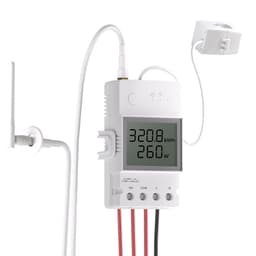
| Best overall |  SONOFF SONOFF POWCT clamp power meter | One circuit | A kettle you can unplug | Competent person | 9.0 | about £29.91 | View offer |
 Tapsin Tapsin energy monitor plug | One BS 1363 socket | Cooker and standing charge | You plug it in | 9.0 | about £13.99 | View offer | |
| Preis-Tipp |  Awootsv Awootsv PM04UK-1 power meter plug | One appliance | The rest of the bill | You plug it in | 9.0 | about £11.99 | View offer |


On this page
What a plug can see
What a clamp can see
Who fits it
Which listing sits on which side
Common questions
I want the whole bill. Is a plug enough?
The kettle has a plug. Do I still need a clamp?
Can I clip the clamp on without an electrician?
Will a one-direction clamp see solar export?
Why does the POFET title say 80 A if the clamp is 10 mm?
Is the SONOFF a switch or only a meter?
Does the in-home display already do this?
Related pages
Sources
Public UK sources on the price cap, trade meters, notifiable electrical work and competence. Shelf prices, stars and review counts are the amazon.co.uk lines in the twelve listings dated 16 October 2026. Prices move.
- Ofgem, energy price cap 1 October to 31 December 2026 (retrieved 16 October 2026)
- Ofgem, energy price cap unit rates and standing charges (retrieved 16 October 2026)
- GOV.UK, Measuring Instruments Regulations 2016, Great Britain (retrieved 16 October 2026)
- Measuring Instruments Regulations 2016, SI 2016/1153 (retrieved 16 October 2026)
- GOV.UK, building work, replacements and repairs (retrieved 16 October 2026)
- HSE, electrical safety introduction (retrieved 16 October 2026)
- Electricity at Work Regulations 1989, regulation 16 (retrieved 16 October 2026)
- Which?, energy monitors and measuring power use (retrieved 16 October 2026)