Independent comparisons. We may earn from shop links. More info

Electricity usage monitor buying guide

Updated: October 2026

You have a kettle, a tumble dryer or a whole consumer unit in mind, and the amazon.co.uk shelf uses one phrase for all three. An electricity usage monitor buying guide has to split those jobs before it talks about brands. A plug-in meter sees one BS 1363 socket, or one extension if everything you care about is plugged into that lead. A clamp or a DIN-rail meter sees a cable or a circuit, and fitting one is electrical work. None of the twelve listings in our [energy meter comparison](/hub/measuring-equipment/energy-meter) is your supplier's meter, and none of them includes the standing charge.

You have a kettle, a tumble dryer or a whole consumer unit in mind, and the amazon.co.uk shelf uses one phrase for all three.

Our top picks

On this page

What you are actually measuring

Which? says a plug-in monitor measures one appliance, or one extension, and it is not the smart-meter display. Ofgem's Direct Debit average for England, Scotland and Wales from 1 October to 31 December 2026 is 26.32p per kWh and 54.83p per day. That cap is not Northern Ireland. The plug or clamp page is the fork. Listings were checked on 16 October 2026. There was no lab test.

Plug, clamp, or DIN rail

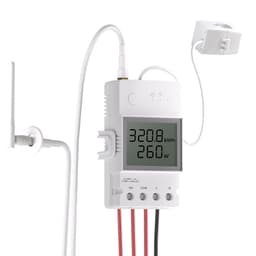
Plug-in monitors run from the LOWENERGIE at £11.79 to the KETOTEK KTEM03 at £25.99. Awootsv states a disconnect above 13 A and no backlight. Tapsin states a backlight of about five seconds. A clamp does not occupy the socket. The SONOFF POWCT is £29.91 with a stated 100 A. The Emporia Vue 3 is £109.99 and hardwired. The Jadeshay is a DIN-rail meter, not a plug. If you cannot unplug the load, do not buy a socket meter.

The 13 A limit and the tariff

A BS 1363 plug is fused at 13 A. At 230 V that is about 2,990 W. A printed 3,680 W is 16 A and conflicts with the fuse. Awootsv says it disconnects above 13 A. The KETOTEK KTEM02UK title states 2900 W / 13 A. The unit rate is pence per kWh from your bill. If you type pounds, the cost line looks absurd while the kilowatt-hours may still be right. The 26.32p figure is an example, not a Northern Ireland rate.

What you must not use it for

These listings do not establish a meter for charging a lodger. The Measuring Instruments Regulations 2016 cover meters used for trade. The Office for Product Safety and Standards enforces that in Great Britain. In England a new circuit or a replacement consumer unit is notifiable. That note is not the rule for Scotland or Northern Ireland. One Bearware review describes a near fire. Unplug anything that smells hot. The best plug-in energy monitor page names a top pick inside the plug group. A qualifying purchase can earn a commission at no extra cost to you.

Common questions

Is a plug-in meter the same as my smart meter display?
No. A plug-in meter sits in one BS 1363 socket and shows that load. The in-home display, where your supplier has fitted a smart meter, is the home's import as the supplier sees it. Which? treats them as different tools. A plug will not reproduce the bill, because the bill includes every circuit and the standing charge. Use the plug when you want one appliance, and leave the supplier display for the house total.
Can one plug meter see the cooker or the whole bill?
It can see the cooker only if the cooker is plugged into that socket, which a built-in oven is not. The whole bill includes lighting, the board and the standing charge. Ofgem's example standing charge for England, Scotland and Wales in this quarter is 54.83p a day on Direct Debit, and the plug never adds that line. A socket reading of the kettle is still useful. It is not a forecast of the monthly total.
What current is safe on a UK plug meter?
A BS 1363 plug is fused at 13 A. At 230 V that is about 2,990 W. A listing that also prints 3,680 W is stating 16 A, which conflicts with that fuse. Use the 13 A figure as the limit for a plug-in meter, and do not run a continuous load up to the higher headline. The Awootsv listing is the one in this set that states a disconnect above 13 A.
When do I need a clamp instead?
You need a clamp, or a hardwired monitor, when the load has no plug you can remove: a circuit, the meter tails, or a solar feed you are allowed to measure. The POFET and SONOFF listings are that shape. Fitting them is electrical work, and the POFET bullet limits the opening to 10 mm. A kettle does not need a clamp. A renter who cannot touch the board is stuck with plugs even if they wanted the whole house.
Can I fit a DIN-rail meter myself?
The Jadeshay listing is a DIN-rail meter, and a UK review says you need space in the consumer unit or a separate DIN box. That is work for a competent person. In England, a new circuit or a replacement consumer unit is notifiable. Do not treat a £13.69 price as permission to open the board. If you only need one plugged-in appliance, this meter is the wrong shape.
Will a cheap meter be accurate enough to bill a lodger?
No. Bearware states 2 percent and POFET states class 1.0, and those are claims, not a billing-grade approval. The Measuring Instruments Regulations 2016 are the trade-meter rules in Great Britain. These consumer listings do not establish that you may charge a third party from the screen. Keep the reading for your own curiosity, and use a lawful trade meter if money changes hands.

Related pages

Sources

Public UK sources on the price cap, trade meters, notifiable electrical work and competence. Shelf prices, stars and review counts are the amazon.co.uk lines in the twelve listings dated 16 October 2026. Prices move.

  1. Ofgem, energy price cap 1 October to 31 December 2026 (retrieved 16 October 2026)
  2. Ofgem, energy price cap unit rates and standing charges (retrieved 16 October 2026)
  3. GOV.UK, Measuring Instruments Regulations 2016, Great Britain (retrieved 16 October 2026)
  4. Measuring Instruments Regulations 2016, SI 2016/1153 (retrieved 16 October 2026)
  5. GOV.UK, building work, replacements and repairs (retrieved 16 October 2026)
  6. HSE, electrical safety introduction (retrieved 16 October 2026)
  7. Electricity at Work Regulations 1989, regulation 16 (retrieved 16 October 2026)
  8. Which?, energy monitors and measuring power use (retrieved 16 October 2026)