Independent comparisons. We may earn from shop links. More info

USB cable or charger fault

Updated: October 2026

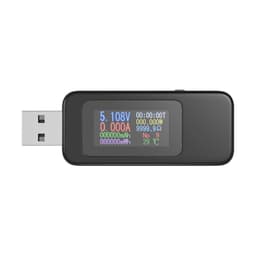
The phone charges on the kitchen charger and crawls on the one by the bed. Three parts can do that: the cable, the charger, and the phone. A USB meter only helps if you change one of them and write down volts, amps, and watts. This page is that comparison. The first reading is the [how to use a USB tester](/hub/measuring-equipment/usb-multimeter/sub/usb-multimeter-how-to-test) page. The five meters are in our [USB multimeter comparison](/hub/measuring-equipment/usb-multimeter). Peter F. used review themes on 16 October 2026 and did not test your lead. A qualifying purchase can earn a commission at no extra cost to you.

The phone charges on the kitchen charger and crawls on the one by the bed. Three parts can do that: the cable, the charger, and the phone.

Our top picks

YEREADW YEREADW KWS-2303C

Best overall

YEREADW YEREADW KWS-2303C
9.2/10about £11.97
YEREADW YEREADW 066C

Preis-Tipp

YEREADW YEREADW 066C
9.0/10about £9.27
Aideepen Aideepen TM962

Alternative

Aideepen Aideepen TM962
8.8/10about £8.79
On this page

Keep two things the same

Start with a charger and a phone you already trust, and a battery that is not full. A full phone drawing 12 W from a 30 W charger is a taper, not a failed brick. Let the phone ask for current before you condemn the lead. Then change only the cable. Same charger, same load, swap the cable, and a lower wattage points at the cable. Repeat the low cable once. If the second run matches, that lead is the weak part. Write volts, amps, and watts each time, plus which lead. A known short lead is the fairest comparison. Texas Instruments’ note illustrates 0.6 V at 2.1 A on a 1 m lead. That is a design example, not your cable’s limit. Fail the lead, for your own use, only if the same phone and charger deliver clearly fewer watts on it twice.

Then change the charger, not both

If every cable is weak on one charger and fine on another, with the same phone, the charger is the next suspect. Keep the cable that just passed, and swap only the charger. A voltage that never leaves 5 V on USB-C can mean the charger and the phone never agreed a higher profile. It can also mean the phone was full. Check the battery percentage before you bin the brick. If the same charger is fine on a second phone and weak on yours, the request is coming from the device. Car sockets add a switch you do not have at home. UK reviews of the YEREADW UT003 mention USB ports that switch off when the car locks. Try the lead in a wall charger you already measured before you replace the camera.
YEREADW YEREADW KWS-2303C

Testsieger

YEREADW YEREADW KWS-2303C
9.2/10about £11.97

When the meter is the part you changed

One 066C review says the meter interfered with Samsung super-fast charging. If the phone fast-charges and then drops the moment the meter is inserted, remove the meter. You have learned that this meter disturbs that handshake. You have not learned that the charger is faulty. A KWS-2303C review that stayed at 5 V and 0 A on a laptop is a reminder that no request means no current. Do not replace three cables because a full laptop sat at 5 V. If the phone charges and the laptop does not, on a cable you have already passed, stop blaming the drawer. Port replacement is a repair.

A wattmeter cannot certify the cable

An e-marker is a chip in a full-featured USB-C cable. Reading it needs a protocol tool. USB-IF’s method is a lab check. These meters can show whether this charger and this device delivered less power on this cable. They cannot print a pass for the chip, and none of the listings states e-marker reading. Do not short the power pins. Do not use the meter as a switch for a vacuum or a heater. One Aideepen review describes a power bank catching fire with a cordless vacuum attached. If a pack has swollen or smoked, unplug it and leave it. The household job is done when two readings, one change at a time, point at the cable, the charger, or the device. If you still need a meter that matches the plug, the buying guide is the order of checks.

Common questions

How do I test the cable without also changing the charger?
Use one charger and one phone, and swap only the cable. Note volts, amps, and watts on a lead you trust, then on the suspect lead, and repeat the low result once. If you change the charger at the same time, you cannot tell which part moved the number.
What counts as a voltage drop?
A drop is the difference between the voltage at the charger end and the voltage at the device, at a stated current. Texas Instruments’ note illustrates 0.6 V at 2.1 A on a 1 m lead. That figure is an example, not your cable’s limit. Compare two of your own leads on the same charger and the same phone.
Why did watts fall as the phone filled?
Phones ask for less current as the battery fills. A 30 W charger showing 12 W at 80 per cent can be normal. Empty the comparison by starting both cable tests at a similar battery level, or use a load that does not taper. The headline wattage needs a device that requests it.
The charger works on one phone and not another. Which part failed?
If the cable and the charger are the pair you already passed, the second phone is not making the same request, or its port is the fault. Try that phone on a second charger you have measured. If it is weak on both, stop swapping cables. The device is the part that changed.
Fast charging stopped only when the meter was inserted. What now?
Take the meter out. One 066C review reports interference with Samsung super-fast charging. The meter is then the changed part, and the charger’s behaviour without it is the fair test. Do not keep the meter in line and blame the brick.
Can the meter prove a cable’s e-marker rating?
No. These listings do not state e-marker reading. A lower wattage on one lead shows what this charger and this device did with that lead. Certifying the chip is a protocol tool and, in USB-IF’s method, a lab check. A protocol name on the listing is not that proof.
When do I stop and get the device looked at?
Stop if the pack smokes or swells, a plug is hot, or the laptop port has failed. Also stop if every fair cable and charger swap still leaves one device dead and another fine. A meter cannot repair a port, and it should not be used to keep testing a pack that has already failed.

Related pages

Sources

Public UK sources named in the research digest: battery marking, retained capacity rules, the Northern Ireland common-charger instrument, the Great Britain common-charger response, and the USB-IF e-marker method. Shelf prices, stars and review counts are the amazon.co.uk lines in the five extracts dated 15 October 2026. Prices move.

  1. GOV.UK, batteries (retrieved 15 October 2026)
  2. Regulation (EU) No 1103/2010, capacity marking (retrieved 15 October 2026)
  3. Radio Equipment (Amendment) (Northern Ireland) Regulations 2024, SI 2024/1231 (retrieved 15 October 2026)
  4. GOV.UK, Northern Ireland radio equipment amendment guidance (retrieved 15 October 2026)
  5. GOV.UK, government response to the common charger call for evidence (retrieved 15 October 2026)
  6. USB-IF, e-marker testing method, revision 1.2 (retrieved 15 October 2026)
  7. Plugable, VAMETER3 range (retrieved 15 October 2026)
  8. Digital Toolbelt, USB-C power meter ceiling warning (retrieved 15 October 2026)